
Designers' Sourcing Checklist: Avoid Iron Stains on Arabescato Corchia

Arabescato Corchia is an Italian brecciated marble quarried on Mount Corchia, prized for ivory backgrounds broken up by egg-shaped clasts and sweeping gray to green-gray veins. It works best as a feature material for countertops, accent walls, and bookmatched panels rather than heavy-traffic flooring. Order samples, request the technical product sheet, and inspect slabs for iron deposits before you commit to wet-area installations.
TL;DR:
- Iron deposits can cause rust stains and internal staining, so slabs should be inspected for iron oxidation before installation.
- The marble is highly sensitive to acids, making citrus, vinegar, and wine likely to etch its surface, especially in kitchen settings.
- Use slab instead of tile for countertops and shower walls to ensure continuous veining and avoid grout lines that disrupt the pattern.
- Properly check substrate flatness and moisture levels before installation to prevent marble failures and ensure long-term durability.
- Sourcing through direct importers can reduce costs and allow inspection of actual slabs, which vary significantly in veining and clast density.
Table of Contents
- What Is Arabescato Corchia Marble, Exactly?
- Slab Sizes, Tile Formats, and Finishes to Request
- Where Arabescato Corchia Works Best in a Design
- Getting the Installation and Care Right
- Sourcing Arabescato Corchia Through Surfaces Galore
- Sustainability and Sourcing Considerations Worth Asking About
- Common Defects to Catch Before You Fabricate
- Your Specification Checklist Before the Job Starts
- Explore Arabescato Corchia and Request Samples From Surfaces Galore
- Sources
- FAQ
What Is Arabescato Corchia Marble, Exactly?
Arabescato Corchia comes from Mount Corchia in Tuscany’s Apuan Alps, the same mountain range that produces Carrara’s most famous blocks. It’s classified as a brecciated marble, meaning the stone formed from fragmented rock pieces cemented back together by mineral deposits over geologic time. That process is exactly why it looks the way it does.
For spec sheets, request these figures from your supplier:
- Density: approximately 2,700 kg/m³
- Water absorption: generally low, within a narrow range suitable for indoor use
- Mohs hardness: 3 to 5, medium hardness with real acid sensitivity
- Acid sensitivity: high, meaning citrus, vinegar, and wine will etch the surface on contact
One more thing worth flagging early: the same iron-rich mineral pockets that create those dramatic clasts can also oxidize over time, producing internal rust staining that no topical cleaner will fix. Ask your supplier to confirm the slab has been checked for visible iron before it ships.
Slab Sizes, Tile Formats, and Finishes to Request
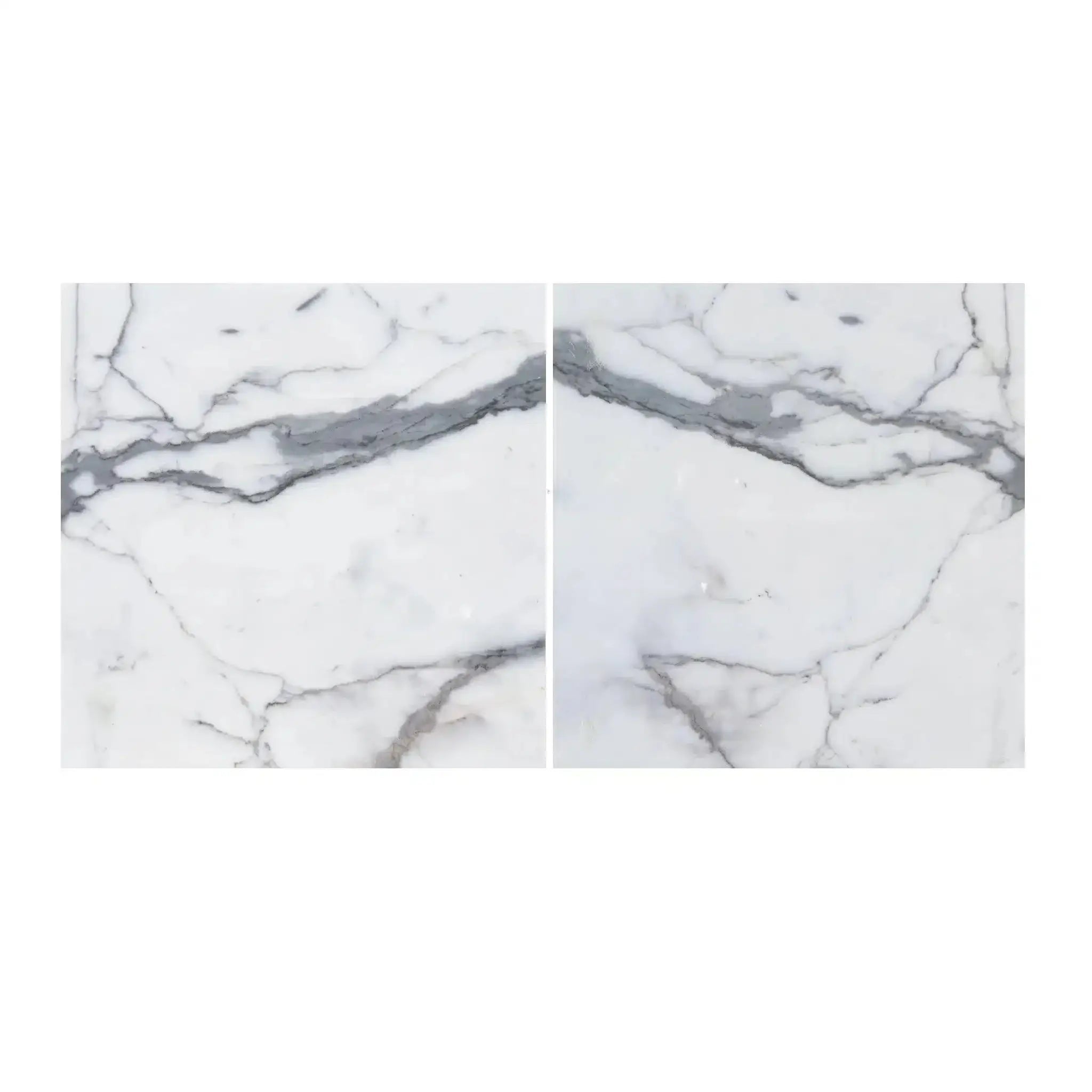
Arabescato Corchia ships in standard slab formats along with several tile sizes suited to different project scales. Larger formats favor visual continuity across countertops and feature walls, while smaller tiles simplify layout on floors and backsplashes.
The three most common tile SKUs designers and contractors ask for are:
- Arabescato Corchia 2X2 Polished or Honed, suited to mosaics, borders, and shower floors
- Arabescato Corchia 12X12 Marble Tile Polished or Honed, a workhorse size for bathroom and kitchen floors
- Arabescato Corchia 24X24 Marble Tile Polished or Honed, ideal for open floor plans and feature walls where fewer grout lines read cleaner
Before ordering, ask for the technical product sheet and actual slab photos, not stock catalog images. Vein scale and clast density vary enough between lots that a sample chip won’t tell the whole story on a large installation.
Where Arabescato Corchia Works Best in a Design
This stone earns its price when it’s the visual anchor, not a supporting player. Kitchen islands, waterfall-edge countertops, and bookmatched shower walls let the veining and clasts read as intentional artwork rather than busy noise.
Strong applications include:
- Kitchen countertops and waterfall edges where the pattern gets uninterrupted real estate
- Bathroom vanity tops and shower feature walls, especially bookmatched pairs
- Accent walls, fireplace surrounds, and reception desks in commercial interiors
- Floor medallions or borders where the eye is meant to land
Proceed cautiously in exterior applications and heavy wet-traffic floors, where etching risk and long-term iron exposure both work against the stone. Pair it with warm brass or matte black fixtures to let the gray veining pop, and lean toward a grout tone that matches the ivory background rather than the veins, so grout lines disappear instead of drawing a grid over the pattern. For countertops or a full shower wall, specify slab over tile whenever budget allows. The continuous vein movement across a single cut piece is the whole reason people choose this marble in the first place.
Getting the Installation and Care Right
Most marble failures trace back to two mistakes: the wrong adhesive and skipping the moisture check on the substrate. Neither is expensive to fix upfront, and both are expensive to fix after the fact.
- Check the substrate first. Confirm flatness and moisture levels meet the setting material manufacturer’s limits before any stone touches the floor or wall.
- Use white, non-discoloring thin-set adhesive. Dark adhesive can shadow through the translucent parts of a light marble like Arabescato Corchia, according to installation guidance from FutureStone Group. For large-format tile or slab work, back-butter the stone in addition to troweling the substrate.
- Seal before you grout. Sealing the surface first keeps grout haze from lodging in the stone’s natural pores, then follow with an unsanded or epoxy grout depending on joint width.
- Inspect for iron oxidation under raking light before installation, and again a few months after, particularly in showers and around sinks.
- Clean with pH-neutral stone cleaners only. Skip anything with citrus, vinegar, or ammonia, all of which will etch the polished surface.
Pro Tip: Hold a candidate slab at an angle under a work light before you approve it. Faint reddish flecks that don’t show under overhead lighting often show up immediately at an angle, and that’s your cue to reserve that slab for a dry vertical application instead of a kitchen counter.
For calcareous stone in heavy-use kitchens, some fabricators now offer certified anti-etch coating systems that reduce (not eliminate) etch risk. Ask your installer whether they offer one and get the maintenance implications in writing.
Sourcing Arabescato Corchia Through Surfaces Galore
Surfaces Galore carries Arabescato Corchia across three tile formats built for different project scales: the 2x2 polished or honed tile for mosaics and shower pans, the 12x12 marble tile for standard floor and wall work, and the 24x24 marble tile for larger feature installations.
A sound procurement path looks like this:
- Request a sample chip to confirm background tone and finish
- Ask for slab or lot photos and inspect for visible iron before ordering in volume
- Confirm finish and thickness match your fabricator’s requirements
- Place the order and coordinate a fabrication schedule with your installer
The material is available through direct importer channels, which can reduce markup layers compared to buying through multiple middlemen. For fabrication-specific slab checks, our Arabescato marble fabrication guide walks through what to look for on-site before cutting begins.
Sustainability and Sourcing Considerations Worth Asking About
Natural stone carries an environmental footprint that starts at the quarry and doesn’t end until installation. Quarrying marble from a mountain like Corchia involves real extraction impact, and responsible producers manage water runoff, dust control, and land reclamation as part of ongoing operations. If sustainability matters to your project or your client, ask your supplier directly whether their quarry partners follow documented environmental management practices and whether waste stone gets repurposed into aggregate, mosaics, or smaller-format products instead of discarded.
Natural stone also has a durability advantage that’s easy to overlook in sustainability conversations. A properly sealed and maintained marble surface can last for decades, often outlasting engineered alternatives that get replaced on shorter renovation cycles. That longevity offsets some of the upfront extraction footprint, especially compared to materials with a shorter functional lifespan.
Ethical sourcing also touches labor practices at the quarry level. Ask suppliers whether they can speak to working conditions and safety standards at the originating quarry, not just the finishing facility. A direct importer that deals with fewer intermediary layers is generally in a better position to answer those questions with confidence, since fewer parties stand between the quarry and your project.
Transportation is the other piece of the footprint that’s easy to ignore. Stone shipped by sea from Italy in consolidated container loads has a different carbon profile than smaller, fragmented shipments, so ask about how your supplier consolidates freight before it reaches a U.S. warehouse.
Common Defects to Catch Before You Fabricate
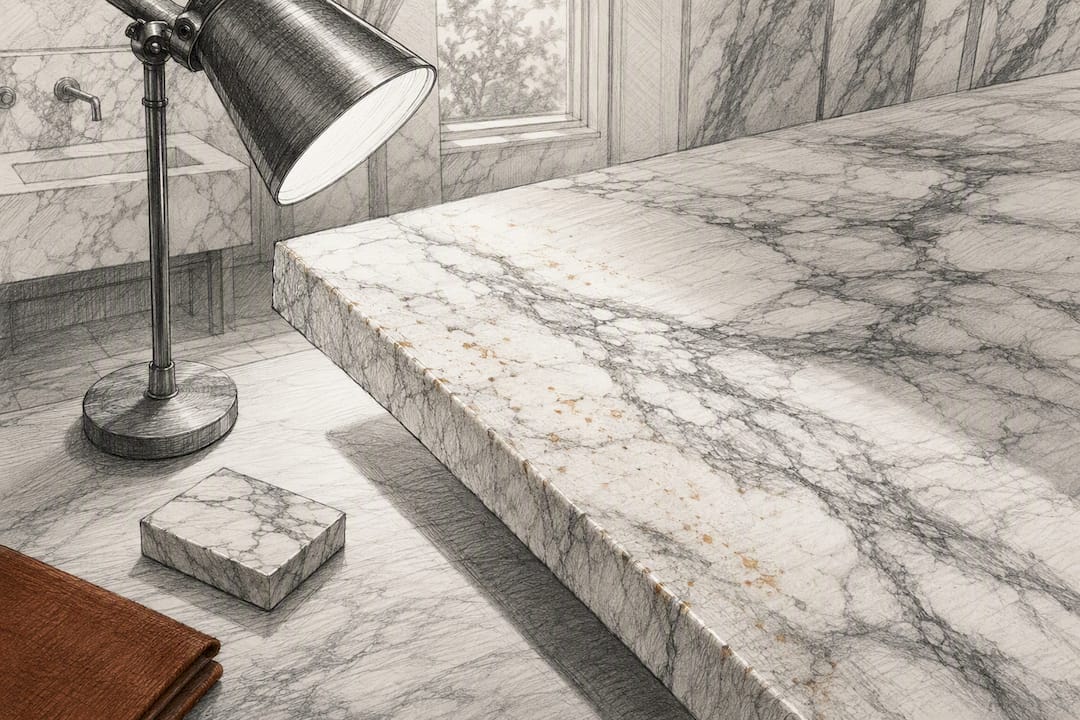
The single biggest defect risk with Arabescato Corchia is internal iron oxidation. Because the stone is a breccia formed from cemented rock fragments, iron-bearing minerals sometimes get trapped inside those clasts. Left unnoticed, they oxidize over time and produce rust-colored staining from the inside out, a problem no surface cleaner can reverse.
Watch for these issues during slab inspection:
- Reddish or orange flecks visible under raking or angled light, even faint ones
- Hairline fissures that run through clasts rather than around them, which can widen during fabrication or installation
- Excessive pitting on honed or leathered finishes, which can trap grime in high-touch areas like countertops
- Color mismatch between lots, since vein tone can shift from yellowish brown to dark gray between blocks, even within the same quarry run
Fissures and clast fractures are common in brecciated marbles because of how the stone formed. They don’t always compromise structural integrity, but they do affect how a fabricator should handle cutting and edge work. Flag them before the saw runs, not after.
Buyers should also confirm finish consistency across an order. Polished, honed, and leathered finishes interact differently with the same veining, and a mismatched sheen across tiles in one room reads as a fabrication error even when the stone itself is fine.
Your Specification Checklist Before the Job Starts
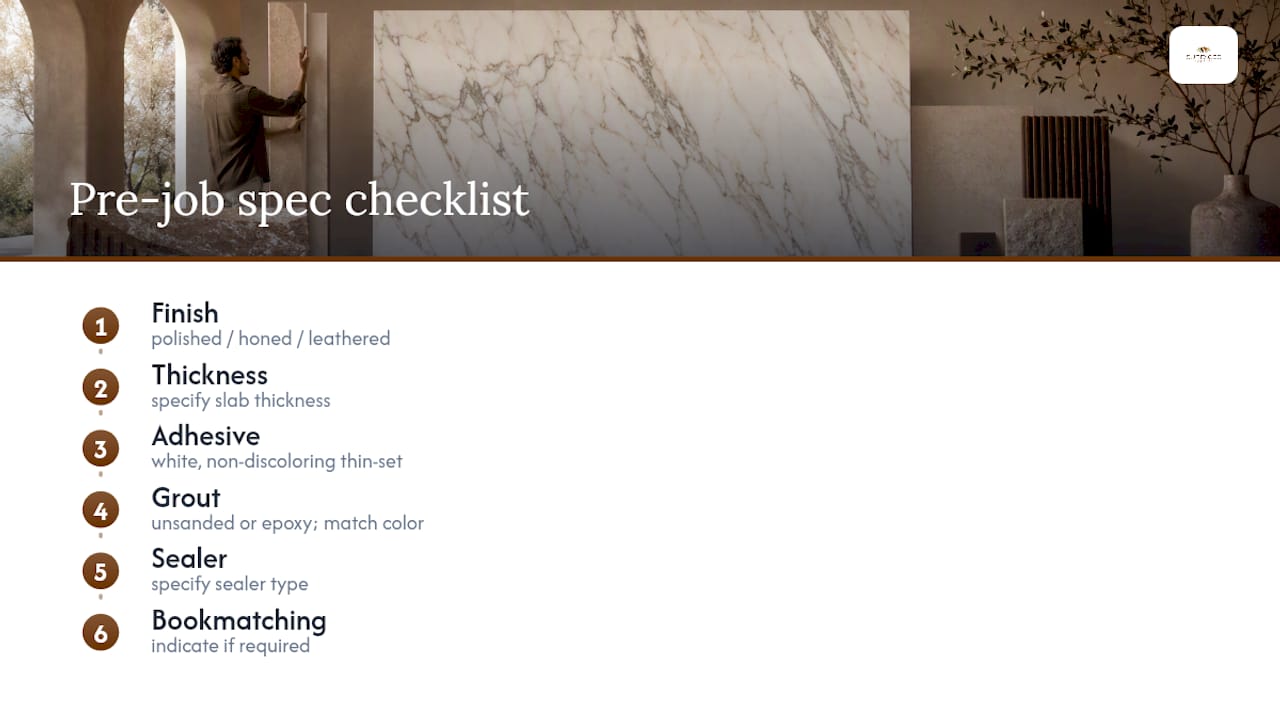
Getting Arabescato Corchia right on paper saves you from getting it wrong on site. Copy this into your spec sheet: finish (polished, honed, or leathered), thickness, adhesive type (white, non-discoloring thin-set), grout type (unsanded or epoxy, color matched to background), sealer type, and whether the installation requires bookmatching.
On-site, three checks catch most problems before they become expensive ones. Do a dry layout first so everyone sees the actual vein movement before adhesive goes down. Inspect slabs under angled light for iron before fabrication starts. Let the stone acclimate to room temperature and humidity for at least 24 hours before cutting or setting.
On timing, order samples at the design phase, confirm slab photos two to three weeks before fabrication, and keep a labeled sample chip on file for warranty and matching purposes for the life of the project.
Explore Arabescato Corchia and Request Samples From Surfaces Galore
The Arabescato Corchia featured here is typically sourced through direct importer supply chains that can reduce markup compared to multiple distributors. This approach is beneficial for feature-material purchases where slab-to-slab variation is significant, making it valuable to see the actual material before committing rather than relying on catalog photos.
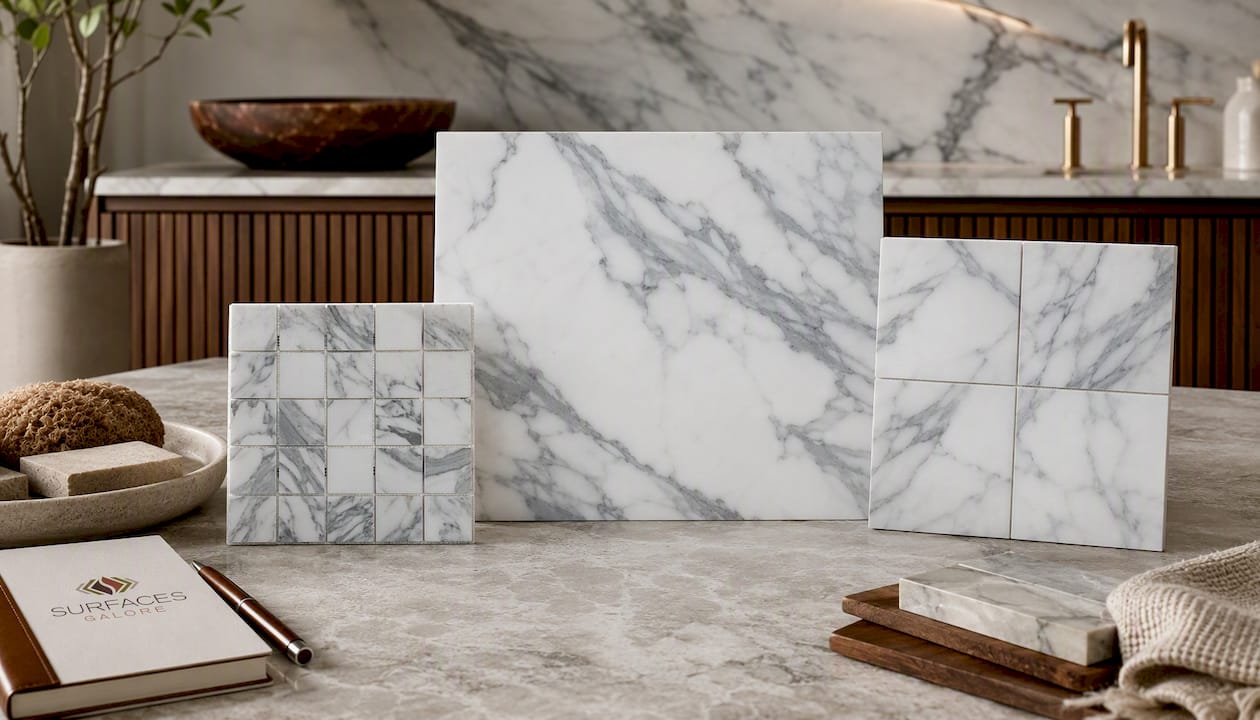
Browse the Arabescato Corchia 2x2, 12x12, and 24x24 tile pages to compare finish options for your project, or explore the full marble, travertine, and limestone collection if you’re still narrowing down materials. Every slab is unique, so request a sample and ask for current slab photos before you finalize quantities, especially on wet-area work where iron inspection matters most. For bulk orders or commercial specs, our trade team can put together a quote and coordinate sample shipping to your office or job site.
Sources
- Arabescato Corchia marble — StoneContact
- Arabescato Corchia — Stone Intelligence
- Marble installation best practices — FutureStone Group (2026)
FAQ
What Is Arabescato Corchia Marble?
Arabescato Corchia is a brecciated marble quarried from Mount Corchia in the Apuan Alps, known for its ivory background, egg-shaped clasts, and gray to green-gray veining. It’s used most often for countertops, accent walls, and bookmatched feature surfaces.
Is Arabescato a True Marble?
Yes, Arabescato is a genuine metamorphic marble, and Arabescato Corchia specifically is classified as a monogenic breccia, a marble formed from cemented rock fragments rather than a single uniform mineral bed. That formation process is what produces its distinctive clast pattern.
What Is the Price of Arabescato Corchia Marble?
Pricing varies by tile size, finish, and order volume, so current pricing for the 2x2, 12x12, and 24x24 tiles is listed on each Surfaces Galore product page. Requesting a trade quote is the fastest way to get an accurate number for larger orders.
Does Arabescato Corchia Scratch or Etch Easily?
It has medium Mohs hardness (3 to 5) and high acid sensitivity, so acidic foods and drinks can etch the polished surface on contact. A honed finish hides light etching better than a polished one in busy kitchens.
Where Should I Avoid Using Arabescato Corchia?
Avoid it in exterior applications and heavy-traffic wet floors, where acid exposure and iron oxidation risk both increase over time. It performs best as an accent material on countertops, walls, and lower-traffic vertical surfaces rather than as a full exterior installation.
Recommended
- Designers & Fabricators: 4 Fabrication Checks for Arabescato Marble
- Designers & Contractors: Bardiglio Marble Importer Specs, Mohs 3–4
- 4 Phase Marble Design Checklist for Homeowners and Design Pros
- Top Marble Selection Tips 2025 for Stylish Projects
This article is provided for general informational guidance only. Natural stone varies in color, veining, texture and performance. For installation, sealing, cleaning and maintenance, follow the product manufacturer’s instructions and consult a qualified installer or stone-care professional. Always test cleaning and sealing products in an inconspicuous area first. Surfaces Galore is not responsible for damage, discoloration, etching, staining, installation issues or other problems resulting from

Leave a comment