

How to choose travertine French pattern sets

TL;DR:
- Choosing a travertine French pattern set involves evaluating finishes, colors, and performance criteria like slip resistance and sealing needs to ensure long-lasting beauty and safety. Filled and honed finishes are ideal for kitchens and bathrooms due to their hygienic and slip-resistant properties, while polished options create dramatic visual impact but require more maintenance. Proper installation, sealing, and choosing the right pattern enhance durability, perception of space, and overall value in residential spaces.
Choosing the right tile for a kitchen or bathroom renovation is harder than most homeowners expect. You need something that holds up under daily traffic, resists moisture, stays safe underfoot, and still looks stunning years from now. Travertine French pattern sets check nearly every box, but only when you select the right finish, understand the upkeep, and install them properly. This guide walks you through every decision point, from evaluating finishes and colors to comparing options side by side, so you can move forward with confidence and avoid costly mistakes.
Table of Contents
- Key criteria for selecting a travertine French pattern set
- Popular travertine French pattern set options explained
- Comparison: Finish, performance, and maintenance at a glance
- How to install and protect your French pattern travertine set
- When and where to use the French pattern: Designer recommendations
- Our take: Why French pattern sets succeed in real homes
- Find your perfect travertine French pattern set with SurfacesGalore
- Frequently asked questions
Key Takeaways
| Point | Details |
|---|---|
| Choose finishes wisely | Select filled and honed travertine for best hygiene and safety in kitchens or bathrooms. |
| Prioritize regular sealing | Reseal travertine every 12 to 24 months to protect its beauty and prevent staining. |
| Plan the layout | French patterns visually expand spaces and suit both large and small rooms when well planned. |
| Focus on installation best practices | Professional installation and correct cleaning ensure your tiles stay elegant for years. |
Key criteria for selecting a travertine French pattern set
With those goals in mind, let’s start by outlining the criteria that matter most in your tile decision.
When you’re comparing travertine French pattern sets for a kitchen or bathroom, the most important thing to understand is that not every travertine product performs the same way. The stone itself is beautiful and durable, but travertine is a porous, sedimentary limestone that has naturally occurring voids and channels. How those voids are treated, and how the surface is finished, changes everything about how the tile performs in a real home.
Here are the key criteria you should use to evaluate any French pattern set:
- Slip resistance: Wet surfaces are a serious hazard in bathrooms and kitchens. Look for a finish that provides grip, especially for floors.
- Voids and bacteria: Filled and honed finishes are the industry-recommended choice for counters and floors to prevent voids from trapping bacteria and food debris.
- Sealing requirements: Natural stone needs a quality penetrating sealer at installation and consistent resealing to stay protected. Some finishes require more frequent care than others.
- Visual impact: The French pattern, also called the Roman or Versailles pattern, uses four interlocking tile sizes to create a mosaic-like, hand-laid look that has been used in architecture for centuries. It adds visual movement and elegance to any space.
- Budget: Honed and brushed finishes are often more affordable than polished. Premium walnut or noce colorways tend to cost more than classic ivory or cream tones.
- Finish options: Understanding your available travertine finish options helps narrow the right product for your room’s specific needs.
Pro Tip: Always request a sample before ordering your full set. Travertine is a natural stone, so even tiles in the same batch can vary in veining, tone, and texture. A sample lets you test how the finish behaves in your lighting and confirm the color coordinates with your cabinetry and fixtures.
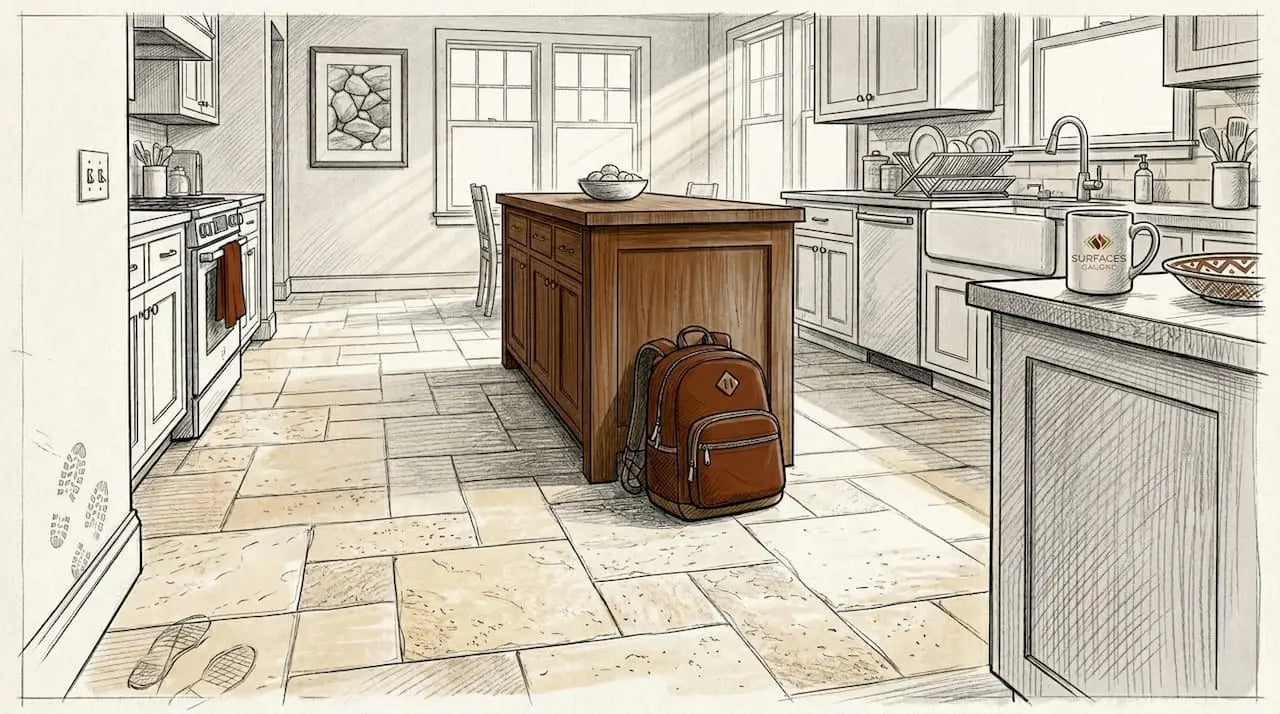
When it comes to kitchens specifically, honed travertine is a strong performer. It’s non-reflective, easy to wipe down, and resists showing everyday scuffs. For bathrooms, the same logic applies on floors, where moisture and foot traffic meet every single day.
Popular travertine French pattern set options explained
Now that you know what to look for, it’s time to explore the most popular travertine French pattern set options.
The good news is that travertine French pattern sets come in a wide variety of finishes and tones, and each serves a different purpose in a kitchen or bathroom. The challenge is knowing which combination actually fits your project. Let’s break down the most popular options and where each one belongs.
Filled and honed travertine This is the most practical and most popular choice for interior floors and countertops. The voids in the stone are filled with grout or matching compound, and the surface is ground smooth to a matte finish. The result is a flat, non-porous surface that’s easy to clean and hygienic. Because brushed and honed finishes provide slip resistance in wet areas, and polished should be avoided in showers, this option dominates professional installations in bathrooms.
Unfilled and brushed travertine This finish preserves some of the stone’s natural texture and depth. Brushed travertine has a rougher feel underfoot, which makes it ideal for shower floors or areas where grip is the top priority. The unfilled version should be avoided on kitchen counters or food-prep surfaces because the open voids collect bacteria and debris.
Polished travertine Polished travertine delivers the most dramatic visual impact. The stone is ground to a smooth, reflective finish that makes colors pop and veining look sharp. It works beautifully as a design statement on walls or fireplace surrounds. However, polished travertine is not a safe floor choice in wet areas, and it shows water spots and fingerprints more easily than matte finishes.
Color spectrum overview:
- Ivory and cream: Classic, bright tones that open up small bathrooms and pair well with white or light gray cabinetry
- Walnut and noce: Darker, warmer tones with bold veining; creates a grounded, luxurious aesthetic
- Silver and gray: Cool-toned travertine that bridges traditional and contemporary design styles
- Gold and honey: Warm mid-tones that work especially well in Mediterranean or Tuscan-inspired kitchens
| Finish | Best application | Slip resistance | Maintenance level |
|---|---|---|---|
| Filled and honed | Kitchen floor, bath floor | High | Low to medium |
| Brushed | Shower floor, outdoor | Very high | Low |
| Polished | Accent wall, fireplace | Low | High |
| Tumbled | Casual bath, outdoor | High | Low |
Pro Tip: If you’re torn between ivory and walnut, consider your natural light. Ivory travertine reflects light and works well in north-facing or smaller rooms. Walnut tones absorb light and feel cozier in larger, sun-drenched spaces. This simple trick helps many homeowners avoid expensive decisions they regret after installation.
For a deeper look at how stone choices reflect into your overall interior concept, it’s worth exploring timeless travertine design principles. And if your project leans toward upscale specifications, the approach used in travertine for luxury spaces can elevate both your planning process and your final result.
Comparison: Finish, performance, and maintenance at a glance
Having seen your options individually, compare them side by side to weigh their strengths.
The table below gives you a direct comparison of the four most common travertine finishes across the performance factors that matter most in kitchens and bathrooms.
| Feature | Honed | Brushed | Polished | Tumbled |
|---|---|---|---|---|
| Hygiene (filled voids) | Excellent | Good | Excellent | Good |
| Slip resistance (wet) | Good | Excellent | Poor | Good |
| Visual drama | Medium | Low | High | Medium |
| Sealing frequency | Every 12 to 24 months | Every 12 to 24 months | Every 12 months | Every 12 to 24 months |
| Maintenance effort | Low | Low | High | Low |
| Recommended for shower floors | Yes | Yes | No | Yes |
| Recommended for kitchen counters | Yes | Not ideal | No | No |
Sealing is non-negotiable. A penetrating impregnator sealer should be applied at installation and reapplied every 12 to 24 months depending on traffic and moisture exposure. A penetrating sealer soaks into the stone and blocks water and oils from entering the pores, without changing how the surface looks or feels. This single step is the most important thing you can do to protect your investment.
Understanding why seal natural stone goes beyond just waterproofing. Sealing also reduces the risk of staining from grease and cooking oils in kitchens, and from soap scum and hard water minerals in bathrooms. Both of those environments punish unsealed stone quickly.
A quick note on maintenance effort: Polished finishes require the most ongoing work. You’ll need to use specific pH-neutral cleaners, avoid any acidic products, and buff out water spots regularly to keep the reflective surface looking sharp. Honed and brushed finishes are much more forgiving and are better suited to homeowners who want a beautiful floor without a demanding maintenance routine.
How to install and protect your French pattern travertine set
Once your set is chosen, installation and care practices make all the difference for results that last.
The French pattern layout, sometimes called the Versailles pattern, includes four tile sizes: typically 16x16, 16x8, 8x8, and 8x4 inches. The tiles interlock in a repeating sequence that eliminates straight grout lines and creates an organic, hand-crafted appearance. Installing this pattern correctly requires planning, a level subfloor, and patience.
Follow these steps for a successful installation:
- Prepare your subfloor thoroughly. The subfloor must be flat, clean, and structurally solid. Any flex or unevenness will cause tiles to crack along the grout lines over time. For bathrooms, use a cement board substrate instead of plywood to prevent moisture damage beneath the tiles.
- Dry-lay your French pattern first. Before applying mortar, spread your tiles out dry on the floor and map the pattern. This lets you identify where cuts will fall, how the pattern flows across the space, and whether your starting point will create awkward partial tiles at the walls or doorways.
- Use a white polymer-modified thin-set mortar. Avoid gray mortar under lighter travertine because it can bleed through grout joints and subtly shift the color of your installation. White thin-set keeps the tone clean under ivory, cream, and silver tiles.
- Leave proper grout joint spacing. Most French pattern sets work best with a 1/8-inch to 3/16-inch grout joint. Too tight and the varying stone thicknesses cause lippage (uneven edges); too wide and the pattern loses its refined character.
- Seal before grouting. Apply your first coat of penetrating sealer to the tile surface before you grout. This prevents grout from staining the stone surface during the grouting process.
- Choose unsanded grout for tight joints. Sanded grout is fine for larger joints but can scratch the surface of honed or polished travertine if used in close joints.
- Apply a second coat of sealer after grouting. Once the grout has fully cured (typically 72 hours), apply your final sealer coat to lock everything in.
“Clean travertine only with pH-neutral cleaners. Acids will etch the surface and permanently damage the finish.” This applies to everything from common household cleaners to citrus-based products and vinegar, all of which are frequently used in kitchens and bathrooms. Always read labels before applying anything to natural stone.
You can find a detailed walkthrough in this step-by-step travertine tiling guide, which covers both DIY installs and what to expect when working with a professional tile setter.
Mistakes to avoid:
- Using acidic grout cleaners or vinegar-based solutions near or on the stone
- Skipping the pre-grouting sealer coat, which leads to grout staining
- Installing over an insufficiently cured or flexible subfloor
- Applying too much mortar under large tiles without back-buttering, which leads to hollow spots
- Failing to seal within the first 24 to 48 hours after installation is complete
When and where to use the French pattern: Designer recommendations
Selecting the right set is also about timing, placement, and overall design harmony.
The French pattern is not just a tile layout. It’s a design statement. The interlocking sizes create a visual rhythm that changes how a room feels, and experienced designers use this intentionally. Here’s where the pattern excels and where it may not be the best fit.
Where French pattern travertine works best:
- Large open-plan kitchens: The scale of the French pattern suits larger spaces where multiple tile sizes can repeat across the floor without interruption. The pattern gives the space an estate-like quality without adding visual clutter.
- Master bathrooms and spa-style retreats: The organic variation in the pattern creates a luxurious, layered feel that plain large-format tiles can’t replicate. Filled and honed ivory or silver travertine works especially well here.
- Entryways and foyers: A French pattern in a foyer makes an immediate impression and transitions naturally into adjacent kitchen or living spaces.
- Outdoor patios and pool surrounds: Brushed or tumbled finishes in a French pattern handle the transition from indoor to outdoor beautifully and provide the grip needed around wet surfaces.
Designer-recommended finish and color pairings:
- Ivory honed with light grout for bright, airy kitchens
- Walnut brushed with a slightly darker grout for dramatic, moody bathrooms
- Silver honed with white fixtures and matte black hardware for a contemporary bathroom
- Gold filled and honed for Mediterranean-inspired outdoor kitchens
It’s worth noting that filled and honed travertine remains the professional default for any floor or counter surface where hygiene is a concern, specifically to prevent food and bacteria from settling in unfilled voids.
Where the French pattern may not be the best choice:
- Very small bathrooms under 40 square feet, where the multi-size pattern can feel crowded and visually busy
- Narrow hallways where tile cuts would interrupt the pattern’s rhythm constantly
- Ultra-modern or minimalist designs where large-format single-size tiles deliver a cleaner, more restrained aesthetic
For broader ideas on how travertine fits into a variety of room types and design styles, the travertine application ideas resource covers a wide range of practical use cases and room scenarios.
Our take: Why French pattern sets succeed in real homes
Stepping back from the details, here’s what most buyers and renovators overlook about French pattern travertine sets.
We’ve seen hundreds of kitchen and bathroom renovations, and the projects that age the best almost always have one thing in common: the homeowner thought about function first and aesthetics second. That sounds counterintuitive when you’re selecting tile, but it holds true project after project.
The French pattern has survived for centuries in European architecture because it was designed to work. The interlocking sizes distribute weight and foot traffic more evenly than single-format tiles. The visual variation in the pattern naturally hides minor scratches, wear, and irregular grout joints that accumulate over years of real use. In a polished, uniform tile floor, every scuff is visible. In a French pattern honed travertine floor, the same wear simply becomes part of the character of the stone.
What most people don’t anticipate until they’re living with the tile is how much room size perception changes with this layout. Rooms we’ve seen tiled in French pattern travertine consistently feel larger, more open, and more interesting than rooms tiled in standard grid or offset brick patterns. The irregular joint lines prevent the eye from “locking onto” a single line and instead draw the gaze across the whole floor surface.
The single most common regret we hear from homeowners is skipping or delaying the sealing step. Travertine that hasn’t been sealed properly shows grease staining in kitchens within months and soap scum infiltration in bathrooms within a year. The good news is that this is entirely preventable. Understanding why use travertine tiles correctly begins with understanding that the stone rewards proper care generously and punishes neglect quickly.
There’s also the question of long-term value. Travertine French pattern floors consistently add perceived value to a home. They photograph well, they appeal to buyers across design preferences, and they carry a sense of quality that ceramic and porcelain imitation tiles simply can’t replicate. When you choose a premium natural stone over a printed ceramic, you’re investing in something that improves with time rather than aging out of style.
If we could leave you with one practical truth after working with thousands of homeowners and remodelers: the projects that look the best five years later are not the ones with the most expensive tiles. They’re the ones where someone thought carefully about finish, sealed on day one, and used the right cleaners from the start. That combination is worth more than any premium stone upgrade.
Find your perfect travertine French pattern set with SurfacesGalore
If you’re ready to create a standout kitchen or bathroom with travertine’s timeless appeal, here’s your next step.
At Surfaces Galore, we import premium travertine directly from the source, which means you get authentic stone at prices that don’t require a contractor’s trade account to afford. Our curated selection of French pattern travertine sets covers every finish and colorway covered in this guide, from filled and honed ivory to brushed walnut and silver, with options that work for kitchens, bathrooms, and outdoor spaces alike.
Our team based in Anaheim, California works directly with homeowners, remodelers, designers, and contractors nationwide to match the right product to the right project. Whether you need help comparing finishes, calculating square footage for your French pattern layout, or finding the right sealer for your specific installation, we’re here to help. Browse our travertine collections and explore detailed guides built for every stage of your renovation, from first sample order to final sealing.
Frequently asked questions
What is a travertine French pattern set?
A travertine French pattern set is a pre-mixed bundle of travertine tiles in various sizes designed to be laid out in a repeating, interlocking pattern for a classic European look. The four tile sizes create visual rhythm and eliminate the uniform grid lines of standard tile installations.
Which travertine finish is best for kitchens and bathrooms?
Filled and honed finishes are best for kitchens and baths to prevent bacteria from settling in open stone voids and to provide a smooth, easy-to-clean surface that holds up under daily use.
How often should I reseal my travertine French pattern tiles?
Apply a penetrating impregnator sealer at installation and reapply every 12 to 24 months, with the shorter interval in high-traffic or high-moisture areas like active kitchens or primary bathrooms.
Are polished travertine tiles suitable for shower floors?
Polished travertine is not recommended for shower floors because the smooth, reflective surface becomes dangerously slippery when wet. Brushed or honed finishes offer the traction and safety that shower floors require.
What’s the safest way to clean travertine French pattern floors?
Use only pH-neutral cleaners on travertine surfaces. Acidic products like vinegar, lemon juice, and many common household cleaners will etch and permanently damage the finish, dulling the stone’s appearance over time.
Recommended
- Designer Guide to Travertine for Luxury Spaces– SurfacesGalore
- Travertine Tiling Process for Stunning and Lasting Floors– SurfacesGalore
- Step-by-step travertine tiling: A DIY guide for homeowners– SurfacesGalore
- Design with Travertine for Timeless Home Elegance– SurfacesGalore
- Fliesenfarben Inspiration: Moderne Trends 2026
Leave a comment