

Popular Bathroom Floor Tile Looks Homeowners Love in 2026

Porcelain leads the pack as the most popular bathroom floor tile in the U.S. right now, with honed marble, travertine, and slate close behind for homeowners who want natural stone warmth. Mosaic and hexagon patterns are surging for shower floors and powder rooms, and luxury vinyl tile (LVT) holds steady as the go-to affordable bathroom floor material for budget-conscious renovators.
Quick picks by goal:
- Durability first: Large-format porcelain (24×24 or 12×24) with a matte or textured finish. Low maintenance, waterproof, and built to last decades.
- Budget-friendly: Ceramic or porcelain tile in a classic subway or grid layout, typically the most affordable bathroom floor materials available.
- Luxury look: Honed Carrara-style marble or filled travertine with warm-metal fixtures and a tonal grout.
Before you commit, order samples and verify DCOF (Dynamic Coefficient of Friction) test data from your supplier. That one step prevents most buyer’s remorse.
Key Takeaways
Porcelain and natural stone (travertine, honed marble, quartzite) are the most popular bathroom floor tile choices in 2026, and the right pick depends on your slip-rating requirements, maintenance tolerance, and room size.
| Point | Details |
|---|---|
| Porcelain leads for low maintenance | Large-format porcelain needs no sealing and handles wet areas without issue. |
| Natural stone requires performance specs | Always request DCOF test data and absorption rates, not just product labels. |
| Honed finishes outperform polished in wet areas | Honed marble and quartzite hide etching and offer better grip than polished surfaces. |
| Grout color shapes the whole floor | Tonal grout reads as seamless; dark grout hides staining but can feel heavy in small baths. |
| Surfacesgalore for authentic natural stone | Direct-import pricing on marble, travertine, and limestone with samples available nationwide. |
Table of Contents
- 1. The most popular bathroom floor tile styles right now
- 2. Material pros and cons: what actually matters in a bathroom
- 3. Color, finish, and pattern trends to know for 2026
- 4. How to choose the right bathroom floor tile for your project
- 5. Tile sizes, layout patterns, and grout recommendations
- 6. Installation complexity, timelines, and cost ranges
- 7. Care and maintenance by material
- 8. Where to buy tiles and how to use samples effectively
- 9. How grout color changes the look and maintenance of your floor
- 10. Environmental impact and sustainability of bathroom floor tiles
- 11. Choosing tile based on bathroom size and lighting
- A note on what actually lasts vs. what just looks good
- Natural stone tile collections, samples, and expert guidance at Surfacesgalore
- Sources
- FAQ
1. The most popular bathroom floor tile styles right now
The styles below represent what homeowners and designers are actually choosing in 2026, from the practical to the statement-making. Each entry covers the look, where it works best, and the key trade-off to know before you buy.
1. Large-format porcelain tile
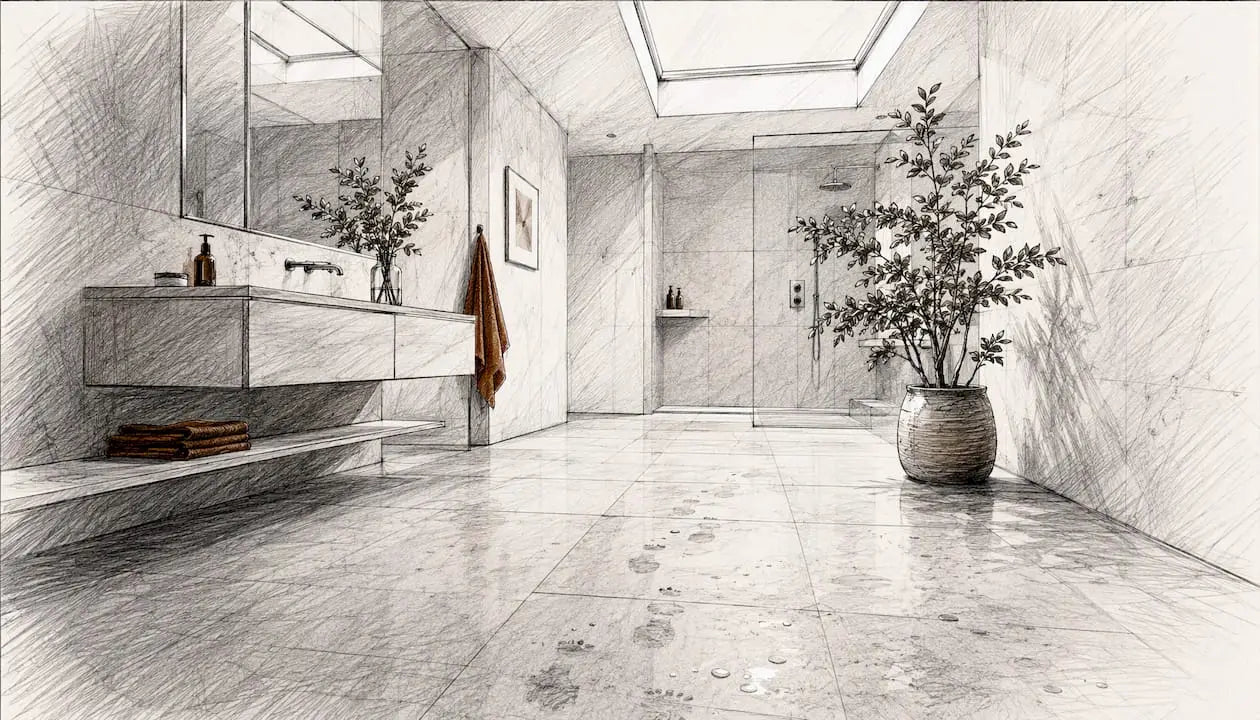
Think 24×24 or 12×24 slabs in a matte or lightly textured finish. Fewer grout lines mean a cleaner look and easier mopping. Works beautifully in master baths and open-plan wet rooms. Pros: waterproof, low maintenance, wide price range. Cons: heavy, requires a level substrate, and large formats need leveling clips during install.
2. Porcelain that mimics natural stone
Porcelain with inkjet-printed veining has gotten convincingly close to real marble or travertine at a fraction of the cost. The best versions have rectified edges and through-body color so chips are less visible. Great for high-traffic family baths. Pros: zero sealing, easy to clean. Cons: lacks the depth and variation of authentic stone.
3. Honed marble
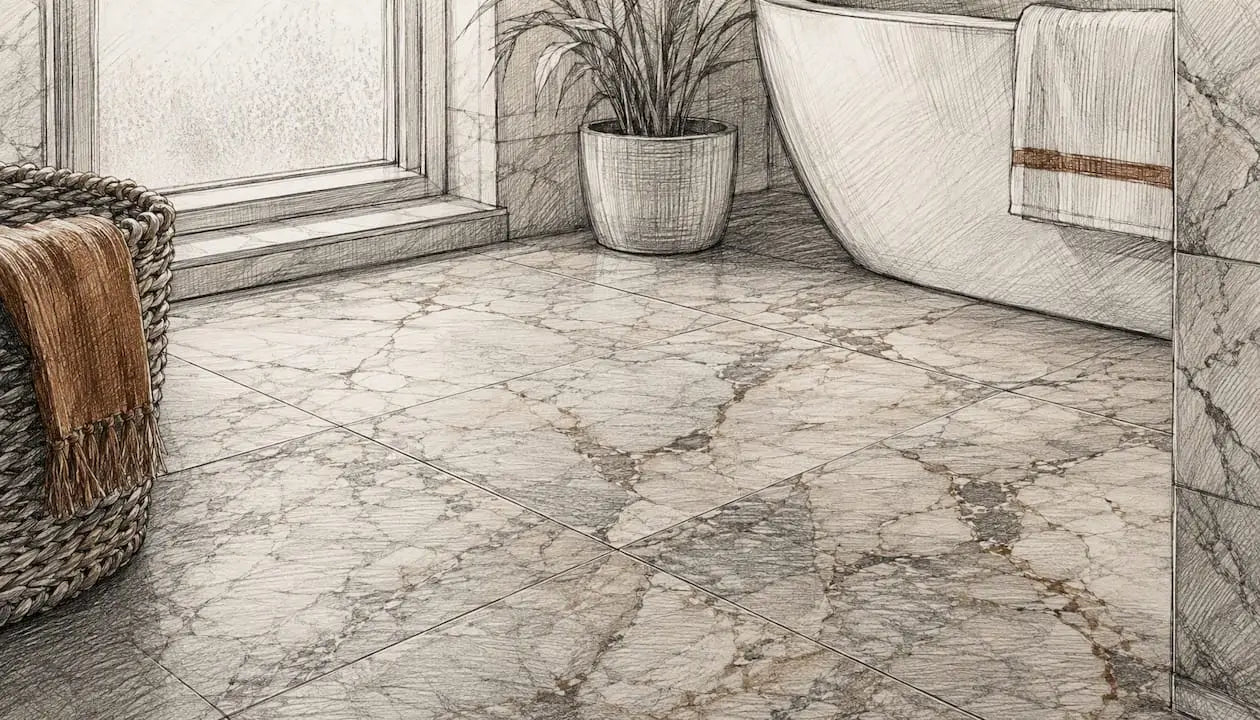
Soft gray or warm beige veining on a matte, non-reflective surface. Honed Carrara-style marble is the classic choice for master baths and spa-style showers. The matte finish hides minor etching better than polished marble and offers better slip resistance. Pros: timeless, adds resale value. Cons: requires sealing and is sensitive to acidic cleaners.
4. Travertine
Travertine’s warm, earthy tones and natural pitting give bathrooms an organic, resort-like feel. According to Duravit, travertine conducts heat well, making it a natural partner for underfloor heating systems. For wet areas, always specify filled travertine so the voids don’t trap moisture or soap. Pros: warm aesthetic, heat-conductive. Cons: higher porosity, needs filling and regular sealing.
5. Slate
Slate’s naturally cleft surface gives it built-in texture and grip, which is why it appears so often on shower floors and mudroom-adjacent baths. Colors range from charcoal and graphite to rusty red and green-gray. Pros: naturally slip-resistant, durable, earthy look. Cons: uneven surface can make mopping harder; some slates exfoliate over time.
6. Granite
Granite is dense, chemically stable, and absorbs very little water when sealed. It handles heavy foot traffic without complaint and resists scratching better than most stones. Pros: extremely durable, low absorption, low maintenance once sealed. Cons: heavy, cold underfoot without radiant heat, and the speckled pattern isn’t for everyone.
7. Quartzite
Quartzite is trending in 2026 because it delivers marble-like veining with higher hardness and lower etching risk. Most designers specify it in a honed finish for slip performance. A smart pick for homeowners who love the marble look but want a stone that handles a busy household.
8. Terrazzo and terrazzo-look porcelain
Classic terrazzo, a composite of marble chips set in cement or resin, is back in a big way. The porcelain version brings the same speckled aesthetic without the weight or sealing demands. Works well in powder rooms and as a statement floor in smaller baths. Pros: visually rich, unique. Cons: authentic terrazzo is expensive and labor-intensive; porcelain versions vary widely in quality.
9. Encaustic and cement-look patterned tiles
Geometric, Moroccan-inspired, and checkerboard floor tile patterns fall into this category. ELLE Decor’s roundup shows how bold encaustic patterns anchor a powder room or guest bath without overwhelming the space. Pros: high visual impact, personality-driven. Cons: busy patterns can date faster than neutrals; grout lines need attention.
10. Hexagon and mosaic tiles
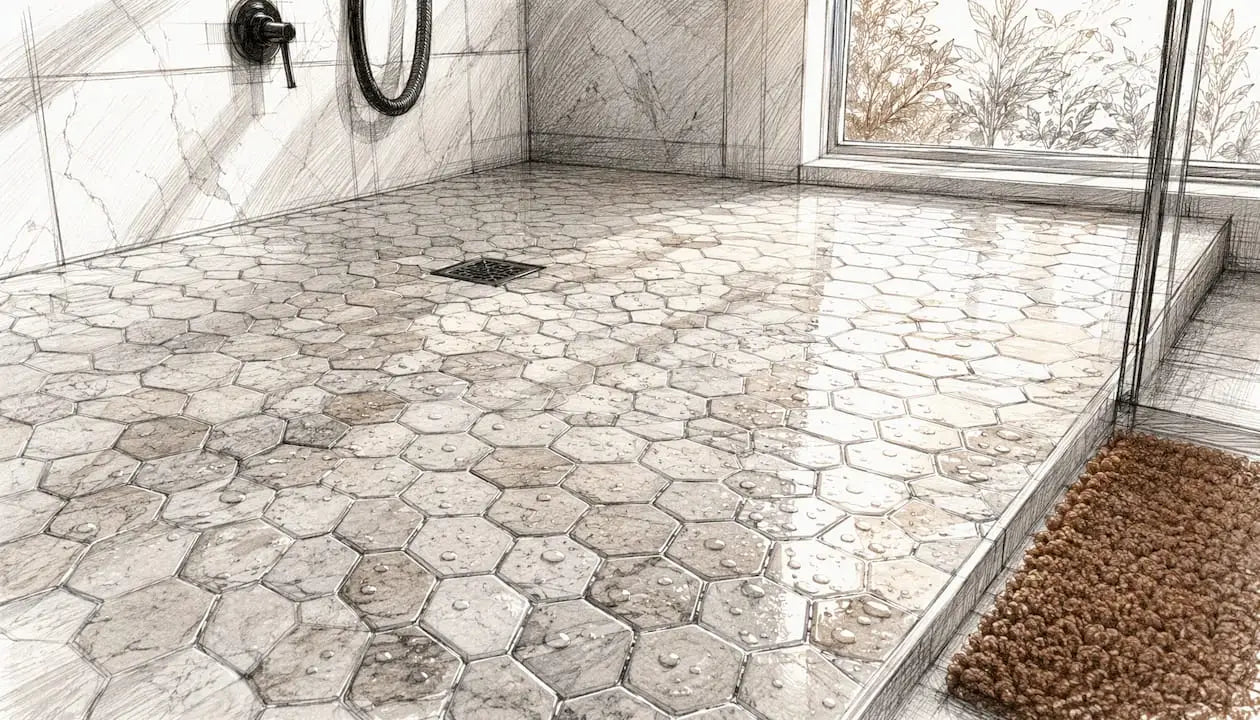
Small-format hexagons (2-inch or 4-inch) and stone mosaics are the go-to for shower floors because the extra grout lines improve traction on a sloped surface. They also work as a design accent in a sea of larger field tile. For creative applications, mosaic tile ideas from Surfacesgalore show how to use them beyond the obvious. Pros: excellent slip resistance, design flexibility. Cons: more grout to clean.
11. Luxury vinyl tile (LVT)
LVT is the most affordable bathroom floor material that still looks intentional. Pros: budget-friendly, DIY-friendly, warm underfoot. Cons: not as durable as stone or porcelain long-term, and it can’t be refinished.
2. Material pros and cons: what actually matters in a bathroom
ArchitectureLab notes that natural stones differ widely in water absorption, slip ratings, and durability, and recommends using test standards like ANSI A326.3 wet-DCOF values rather than product labels when specifying bathroom floors. That advice applies to every material below.
| Material | Water Resistance | Slip Resistance | Durability | Sealing Needed | Typical Cost (per sq ft, material only) |
|---|---|---|---|---|---|
| Porcelain | Excellent | Good (matte/textured) | Excellent | No | $2–$15 |
| Ceramic | Good | Moderate | Good | No | $1–$8 |
| Honed marble | Moderate | Good (honed) | Moderate | Yes, annually | $8 |
| Travertine (filled) | Moderate | Good | Moderate | Yes, 1–2x/year | $5–$20 |
| Slate | Good | Excellent (cleft) | Good–Excellent | Light sealing | $5–$15 |
| Granite | Excellent | Moderate (polished) | Excellent | Yes, every 2–3 yrs | $8–$30 |
| Quartzite | Good–Excellent | Good (honed) | Excellent | Yes, annually | $10–$30 |
| Terrazzo | Good | Moderate | Excellent | Periodic sealing | $15 |
| LVT | Excellent | Good | Moderate | No | $2–$7 |
Key takeaways from the table:
- Porcelain is the lowest-maintenance option across the board. No sealing, no etching risk, and it handles wet conditions without complaint.
- Natural stone adds warmth and luxury but requires a sealing schedule. Travertine and marble need the most attention; granite and quartzite are more forgiving.
- Ask your supplier for DCOF test data before buying any tile for a shower floor. A wet DCOF of 0.42 or higher is the standard threshold for wet areas per ANSI A326.3.
- Slate’s cleft surface gives it naturally high traction, but the uneven texture makes it harder to mop flat.
Pro Tip: Request the actual DCOF test certificate from your supplier, not just a “slip-resistant” label. The label is marketing; the certificate is performance data.
3. Color, finish, and pattern trends to know for 2026
Better Homes & Gardens identifies the dominant 2026 tile color and pattern directions as natural neutrals, softly veined warm marbles, muted zellige-inspired tiles, monochromatic palettes, deep greens, and burnt-yellow accents. Here’s how to apply each without overcommitting:
- Natural neutrals (warm whites, greiges, soft taupes): Pair with brushed brass or unlacquered brass fixtures and a tonal grout one shade darker than the tile. This combination reads current in 2026 and will still look right in 2036.
- Softly veined warm marble: Honed marble with gold or caramel veining pairs beautifully with warm wood vanities and matte black hardware. Use a sanded grout in warm gray to let the stone read as continuous.
- Muted zellige-inspired tiles: These handmade-look tiles with slight color variation and irregular edges work best as a floor-to-ceiling statement in a small powder room. Pair with simple white fixtures so the tile does the talking.
- Monochromatic palettes: Matching floor, wall, and grout in the same tonal family (all warm white, all slate gray) creates a spa-like calm. This approach also makes small baths feel larger.
- Deep greens: Forest green or hunter green tile floors anchor a bathroom with drama. Balance with natural wood tones and unlacquered brass. Works best in larger baths where the color doesn’t close in the space.
- Burnt-yellow accents: A single row of amber or ochre mosaic tile as a border or threshold adds warmth without committing the whole floor. Pair with terracotta grout for a cohesive earthy palette.
For resale, trending bathroom tile designs that lean toward natural neutrals and subtle veining tend to age better than bold pattern choices. If you love a statement floor, anchor it with neutral walls and simple fixtures so future buyers can see past the tile.
4. How to choose the right bathroom floor tile for your project
The right tile depends on your specific room, not just what looks good in a showroom. Work through this checklist before you buy.
Step-by-step selection checklist:
- Room function and traffic: A master bath with two adults differs from a kids’ bath with wet feet and dropped shampoo bottles. High-traffic rooms need harder, lower-maintenance materials.
- Slip rating (DCOF): Wet areas need a DCOF of 0.42 or higher. Ask for the test certificate, not just a product description.
- Finish: Honed and matte finishes offer better grip and hide minor scratches. Polished finishes look stunning but require more care and can be slippery when wet.
- Grout width and color: Wider grout joints collect more grime. Darker grout hides staining but can feel heavy. Match grout width to tile rectification (rectified tiles can go as narrow as 1/16 inch).
- Underfloor heating compatibility: Most porcelain and stone tiles work with radiant heat systems. Confirm with your installer that the adhesive and membrane are rated for thermal cycling.
- Tile size vs. room size: Large-format tiles in a small bath can look awkward and create difficult cuts. More on this in the sizing section below.
- Sample testing in real light: Place samples on your actual floor for 48 hours. Check them in morning light, evening light, and under your bathroom’s artificial lighting before deciding.
- Budget and installation complexity: Mosaics and large-format stone cost more to install than standard porcelain. Factor labor into your total budget, not just material cost.
Questions to ask your supplier or contractor:
- What is the DCOF value, and can you provide the test certificate?
- Is this tile frost-rated (relevant if the bathroom connects to an exterior space)?
- What substrate and membrane system do you recommend for this stone in a wet area?
- What is the recommended grout joint width for this tile format?
- What batch is this tile from, and can I get samples from the same batch?
DIY vs. pro: Straight-lay porcelain in a simple grid is a realistic DIY project for a confident renovator. Natural stone, large-format tiles, herringbone layouts, and any shower floor with a slope require professional installation. The cost of fixing a failed substrate or a cracked stone floor far exceeds the savings from a DIY attempt on a complex job. For a full planning framework, Surfacesgalore’s bathroom tile design workflow walks through the process step by step.
5. Tile sizes, layout patterns, and grout recommendations
Size and layout affect how a bathroom feels as much as the tile itself. A few principles that hold across styles:
- Small tiles in small baths: 2-inch hexagons or 4×4 subway tiles keep the scale proportional in powder rooms and compact baths. Too large a tile in a small room creates awkward cuts at every edge.
- Large-format in larger rooms: 24×24 or 12×24 tiles in a master bath reduce grout lines and make the floor read as a continuous surface. Fewer joints also mean less grout to clean.
- Diagonal layout: A 12×12 tile laid at 45 degrees visually widens a narrow bathroom. The trade-off is more cuts and slightly more waste (budget an extra 10–15% for material).
- Herringbone: Works beautifully with rectangular tiles (3×6 or 4×12). Adds movement and direction to a floor. More complex to install than straight lay.
- Stacked/linear: A modern, graphic look that suits large-format rectified tiles. Requires very precise grout lines, so it’s less forgiving of substrate imperfections.
Grout width: Rectified tiles (machine-cut to exact dimensions) can go as narrow as 1/16 inch. Non-rectified tiles need at least 1/8 inch to accommodate size variation. Wider joints (3/16 inch or more) suit handmade or textured tiles.
Grout type: Epoxy grout is stain-resistant, doesn’t need sealing, and holds up in wet areas, but it’s harder to work with and more expensive. Cementitious grout is easier to apply and widely available; seal it with a penetrating grout sealer after installation and reseal annually in wet areas.
6. Installation complexity, timelines, and cost ranges
Realistic budgeting means accounting for both material and labor. Here’s how the numbers typically break down for a standard U.S. residential bathroom remodel.
| Material | Material Cost (per sq ft) | Installed Cost Estimate (per sq ft) | Notes |
|---|---|---|---|
| Ceramic tile | $1–$8 | $5 | Most affordable; straightforward install |
| Porcelain tile | $2–$15 | $7–$20 | Heavier; large format needs leveling clips |
| Honed marble | $8 | $15 | Requires membrane, sealing, careful handling |
| Travertine (filled) | $5–$20 | $12 | Filling and sealing add time and cost |
| Slate | $5–$15 | $10 | Uneven surface needs skilled setting |
| Granite | $8–$30 | $15–$45 | Dense and heavy; professional install recommended |
| Quartzite | $10–$30 | $50 | Premium stone; treat like marble for install |
| Terrazzo (authentic) | $15 | $50 | Labor-intensive; long cure time |
| LVT | $2–$7 | $4–$12 | DIY-friendly; fastest install |
Typical timeline for a standard bathroom tile remodel:
- Demolition and substrate prep: 1–2 days. This phase often reveals surprises (damaged subfloor, old adhesive) that add time.
- Waterproofing membrane: 1 day application, 24–48 hours cure. Non-negotiable for any wet area with natural stone.
- Tile installation: 1–3 days depending on layout complexity and room size.
- Grout curing: 24–72 hours before light use; 7 days before heavy use or sealing.
- Stone sealing: 1–2 hours; must be done before the bathroom goes back into service.
What drives costs up: Complex layouts (herringbone, diagonal, mosaic) add 20–30% to labor. Large-format tiles require leveling systems and more precise substrate prep. Natural stone needs a waterproofing membrane in wet areas. Dynamic Stone Tools recommends smaller-format tiles or mosaics for shower floors specifically because they conform better to the sloped pan and improve slip performance.
7. Care and maintenance by material
Maintenance is where many homeowners underestimate natural stone. The cleaning chemistry matters as much as the sealing schedule.
Sealing guidance: Use a penetrating (impregnating) sealer for all natural stone, not a topical coating. Topical sealers peel and trap moisture underneath. For travertine and marble, annual re-sealing is the standard cadence in a bathroom. Granite and slate can go two to three years between applications.
Pro Tip: Before committing to a natural stone tile, test your regular bathroom cleaner on a sample piece. Leave it for 10 minutes, then rinse. If the surface etches or discolors, switch to a pH-neutral stone cleaner before the tile goes in, not after.
For detailed guidance on marble shower floor slip resistance and safe finish choices, Surfacesgalore covers the specifics by finish type.
8. Where to buy tiles and how to use samples effectively
Buying tile online or from a big-box store is fine for porcelain and ceramic. For natural stone, the sourcing process deserves more care.
Shopping checklist:
- Request the full specification sheet: DCOF value, water absorption rate, country of origin, and recommended installation details.
- Ask for samples from the same batch you’ll receive. Natural stone varies between quarries and even between cuts from the same block.
- Confirm the return and sample policy before ordering. Some suppliers charge restocking fees on natural stone.
- For large orders, request a pre-installation mockup or sample panel so you can see how multiple tiles read together before committing.
How to use samples at home:
- Place the sample flat on your bathroom floor, not propped against a wall.
- Leave it for 48 hours and check it in morning light, midday light, and under your bathroom’s artificial fixtures.
- Bring grout and fixture samples into the same space at the same time. A tile that looks warm alone can read cold next to the wrong grout color.
- Test a small amount of your regular cleaning product on the back of the sample. If it reacts, you’ll know before installation.
When the layout is complex (a mosaic border, a custom threshold, or a patterned field), ask your contractor or supplier about an onsite sample panel. A few square feet of installed tile tells you more than any showroom display. For custom mosaic projects, Surfacesgalore’s custom mosaic workflow outlines how to plan and proof a design before full production.
9. How grout color changes the look and maintenance of your floor
Grout is the detail most homeowners decide last and regret most. The color and width of your grout lines affect the entire visual character of a floor, and the maintenance burden shifts significantly depending on what you choose.
Light grout makes tile patterns read as a continuous surface and suits large-format porcelain or marble where you want the stone to dominate. The drawback is visible staining in high-traffic or wet areas. Sealing light cementitious grout at installation and resealing annually keeps it manageable, but it will never be zero-effort.
Dark grout (charcoal, slate, or near-black) hides dirt and soap residue far better than white or cream. It also creates a graphic contrast with light tile, which suits checkerboard floor tile patterns and classic black-and-white baths. The trade-off: dark grout can feel heavy in a small bathroom and tends to show efflorescence (white mineral deposits) over time in wet areas.
Tonal grout (matching or closely matching the tile color) is the most popular choice in 2026 for natural stone floors. A warm beige grout on travertine or a soft gray on honed marble reads as nearly seamless and lets the stone’s natural variation carry the design.
Epoxy vs. cementitious grout: Epoxy grout resists staining and doesn’t need sealing, which makes it the practical choice for shower floors and around toilets. It’s harder to apply and costs more upfront, but it eliminates the annual resealing step. Cementitious grout is easier to work with and widely available; seal it with a penetrating grout sealer and plan to reseal wet areas every year.
10. Environmental impact and sustainability of bathroom floor tiles
Sustainability in tile manufacturing has moved from a niche concern to a mainstream specification question. Here’s where the major materials stand.
Porcelain and ceramic are made from natural clay and minerals, fired at high temperatures. The firing process is energy-intensive, but many manufacturers now use recycled content in their body mix and reclaim water in production. Look for tiles certified under LEED or with Environmental Product Declarations (EPDs) if sustainability is a priority.
Natural stone has a compelling environmental argument: it’s a single-ingredient material extracted from the earth, requires no synthetic binders, and lasts for decades or longer when maintained. The carbon footprint concentrates in quarrying and transportation. Choosing stone sourced closer to your project or from suppliers who consolidate shipments reduces that impact. Stone also doesn’t off-gas volatile organic compounds (VOCs) the way some adhesives and synthetic flooring products do.
LVT is the least sustainable option in this category. Most LVT is PVC-based, which is petroleum-derived and difficult to recycle at end of life. Some manufacturers offer phthalate-free or recycled-content LVT, but the category as a whole lags behind ceramic and stone on environmental metrics.
Terrazzo made with recycled marble chips or post-industrial aggregate is one of the more sustainable luxury options. The material itself can incorporate significant recycled content, and its longevity (terrazzo floors in public buildings routinely last 50+ years) offsets the energy cost of production.
When evaluating sustainability, ask suppliers for EPDs, recycled content percentages, and whether the tile carries a Declare label or Cradle to Cradle certification. These documents are the equivalent of DCOF certificates for environmental performance: actual data, not marketing language.
11. Choosing tile based on bathroom size and lighting
Room dimensions and light sources interact with tile in ways that showroom displays rarely reveal. Getting this right before you buy saves a costly reinstall.
Small bathrooms (under 50 sq ft): Smaller tiles (4×4, 2-inch hex, 3×6 subway) keep the scale proportional. Large-format tiles create awkward cuts at every edge and can make the room feel cluttered rather than expansive. Light-colored tiles with a tonal grout reflect more light and push the walls out visually. Avoid busy patterns that compete with the limited square footage.
Medium bathrooms (50–100 sq ft): This is the most flexible range. A 12×24 tile laid in a straight or diagonal pattern works well. You can introduce a patterned border or a contrasting threshold without the room feeling overwhelmed.
Large master baths (100+ sq ft): Large-format tiles (24×24 or larger) read best here. The fewer grout lines create a clean, hotel-like floor that suits the scale. Natural stone in large format, such as honed marble or quartzite slabs, makes the biggest visual impact in rooms with the square footage to support it.
Lighting considerations:
- Natural light: Matte and honed finishes absorb light and look warm. Polished surfaces reflect natural light beautifully but show water spots and footprints more readily.
- Artificial light (warm bulbs, 2700–3000K): Warm-toned tiles (cream travertine, beige marble, sandy porcelain) look richer. Cool-gray tiles can read slightly greenish under warm artificial light.
- Low-light bathrooms: Avoid very dark tiles on the floor. Deep greens and charcoal slate can make a windowless bath feel like a cave. If you want drama, use the dark tile on one wall and keep the floor lighter.
Pro Tip: Take your tile sample to the bathroom at night and check it under your existing light fixture. Showroom lighting is almost always brighter and more neutral than what you have at home.
A note on what actually lasts vs. what just looks good
The most common mistake I see homeowners make is choosing a tile based on a single showroom visit under perfect lighting, then discovering the reality six months into living with it. A polished marble floor looks extraordinary in a staged photo. In a real bathroom with kids, pets, and hard water, it shows every footprint, etches from toothpaste splatter, and demands more upkeep than most households are prepared for.
That’s not an argument against marble. It’s an argument for specifying it correctly: honed finish, penetrating sealer applied before first use, pH-neutral cleaner only, and a realistic re-sealing schedule. The stone itself is extraordinary and will outlast the house if maintained. The problem is almost never the material; it’s the mismatch between what the material needs and what the homeowner expected.
The same logic applies to DCOF ratings. A tile that looks slip-resistant because it has a matte finish may still fall below the 0.42 wet-DCOF threshold that ANSI A326.3 sets for wet areas. The only way to know is to ask for the test data. Surfacesgalore’s approach to natural stone specification starts with performance data, not aesthetics, and that order of priority is exactly right.
Bold pattern choices, deep colors, and statement floors are all worth considering. Just anchor them with neutral walls, simple fixtures, and a maintenance plan you’ll actually follow.
Natural stone tile collections, samples, and expert guidance at Surfacesgalore
If you’ve worked through this guide and you’re ready to source authentic marble, travertine, or limestone for your bathroom floor, Surfacesgalore is a direct importer of premium natural stone, shipping nationwide from Anaheim, California.
What sets Surfacesgalore apart from a big-box tile aisle is the depth of the natural stone selection and the ability to request samples before committing to a full order. Authentic travertine, honed marble, and limestone tiles are available alongside mosaics and custom cuts, all at direct-import pricing. Every product comes with the specification data you need to make a confident decision: absorption rates, finish details, and installation recommendations.
Visit Surfacesgalore to browse marble and travertine collections, request samples, or get guidance on which stone suits your specific bathroom project.
Sources
- 12 Types Of Natural Stone For Bathrooms – Properties, Slip Ratings & Costs - ArchitectureLab
- Bathroom color trends for 2026 | Better Homes & Gardens
- Natural stone in the bathroom – natural, attractive, durable | Duravit
- Natural Stone Flooring For Bathroom: 2026 Cost & Design Guide
- 50 Bathroom Floor Ideas to Step Up Your Style - ELLE Decor
FAQ
What is the most popular floor tile for a bathroom?
Porcelain is the most popular bathroom floor tile in the U.S. because it’s waterproof, durable, and requires no sealing. Among natural stones, honed marble and filled travertine are the top choices for homeowners who want warmth and luxury.
What is the current trend in bathroom tile for 2026?
Deep greens and selective burnt-yellow accents are the bolder choices gaining traction this year.
What bathroom tile never goes out of style?
Classic subway ceramic tile, large-format porcelain, honed marble, and terrazzo are consistently cited as timeless choices that hold their appeal and resale value across decades.
Do I need to seal natural stone bathroom floor tile?
Yes. Marble, travertine, quartzite, and granite all require a penetrating sealer before first use and periodic resealing (annually for marble and travertine; every two to three years for granite). Porcelain and ceramic do not need sealing.
What DCOF rating do I need for a bathroom floor?
A wet DCOF of 0.42 or higher is the standard threshold for wet areas per ANSI A326.3. Always ask your supplier for the actual test certificate rather than relying on a “slip-resistant” product label.
Leave a comment