
Stop Costly Layout Mistakes with Arabesque Marble Mosaic for Designers

Arabesque marble mosaic is a mesh-backed sheet of small, interlocking marble tesserae arranged in a flowing, curved motif borrowed from centuries-old Islamic and Mediterranean design. It works best on backsplashes, shower surrounds, accent walls, and select floors where you want a high-impact stone pattern. The tradeoff: this is real marble, so it’s porous and needs sealing and periodic care to hold up over time.
TL;DR:
- Mixing sheets from multiple cartons before installation prevents color pooling and ensures even veining across the surface.
- Resealing marble every one to three years keeps it protected from staining and surface damage.
- Polished finishes suit walls and low-traffic areas, while honed finishes provide better grip for floors and shower applications.
- Natural marble’s environmental impact is mitigated by its durability, lifespan, and recyclability, despite energy-intensive quarrying.
- Proper dry layout, careful cutting, and avoiding sanded grout are crucial to prevent visual flaws and surface damage during installation.
Table of Contents
- What Are the Options for Arabesque Marble Tiles?
- Where Does Arabesque Marble Mosaic Work Best?
- How Do You Install and Order Marble Mosaic Correctly?
- How Do You Clean and Reseal Marble Mosaic?
- How Do You Choose the Right Arabesque Mosaic for Your Project?
- Where Does the Arabesque Pattern Come From?
- How Does It Differ From Other Mosaic Patterns?
- How Can You Tell Quality Arabesque Marble Mosaic?
- What Should You Know About Marble Sourcing and Sustainability?
- What Contractors Get Wrong About Specifying This Pattern
- Order Samples of Our Arabescato Corchia Collection
- Sources
- FAQ
What Are the Options for Arabesque Marble Tiles?
Not all arabesque marble mosaic is cut from the same stone, and the differences show up fast once you’re comparing samples side by side. Carrara reads gray and understated with soft linear veining. Calacatta brings bolder, wider gold or gray veining against a brighter white field. Statuario sits between the two, prized for dramatic contrast that reads almost like abstract art on a wall. Arabescato marble, the namesake stone for this pattern, typically shows heavier, more chaotic veining that suits the swirling arabesque cut.
Finish matters just as much as the marble species. A comprehensive care guide from Stone Styling notes that finish choice directly affects both slip resistance and cost, and it should drive where the tile goes.
- Polished finish delivers maximum shine and depth of veining. Best for walls, backsplashes, and low-traffic floors.
- Honed finish gives a matte surface with better grip. Better suited to shower floors and high-traffic areas.
- Tumbled finish adds a softened, aged edge for a more rustic or Old World look.
Sheet formats typically run 12x12 inches on mesh backing, which speeds up installation compared to setting individual tesserae by hand. Tesserae size (commonly ranging from 5/8 inch up to 1 inch pieces within the sheet) also changes how the pattern reads. Smaller pieces with tighter grout lines create a more delicate, jewelry-like effect; larger pieces read bolder from across a room.
Where Does Arabesque Marble Mosaic Work Best?
The pattern’s curved, interlocking geometry makes it a natural fit for vertical surfaces and accent applications rather than wall-to-wall flooring. Kitchen backsplashes are the most requested use, especially behind a range where the mosaic becomes a focal point. Shower walls and niches are close behind, along with powder room accent walls and framed inlays at entryways.
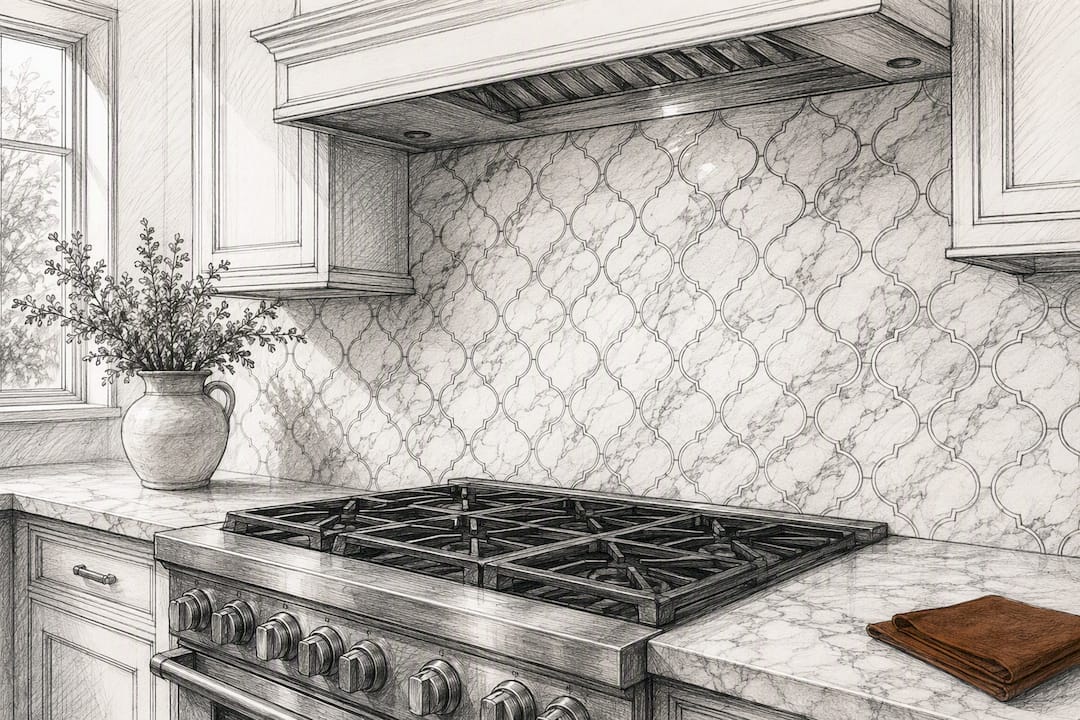
Finish and grout pairing depends on location. Polished tile on a backsplash pairs well with a light, close-in-color grout that lets the veining lead. In a shower, a honed finish on the floor paired with polished on the walls balances traction and shine. According to Stone Styling’s design guidance, finish selection should track the room’s function first, then aesthetics second.
A few coordination rules keep the pattern from overwhelming a space:
- Keep surrounding cabinetry, countertops, and fixtures simple when the mosaic carries the visual interest.
- Use warm, directional lighting to bring out veining depth rather than flat overhead light that washes it out.
- Limit arabesque mosaic to one focal wall or surface per room instead of repeating it everywhere.
- Choose grout color close to the dominant marble tone unless you want the pattern’s linework emphasized.
Pro Tip: Never install straight from one box. Mixing sheets from at least three or four cartons before you start setting tile prevents color pooling, where all the darker or lighter pieces cluster in one area instead of blending evenly across the wall.
How Do You Install and Order Marble Mosaic Correctly?
Getting arabesque marble mosaic to look right on the wall comes down to sequence, not speed. Skip a step and you’ll see it in the grout lines or, worse, in staining that shows up months later.
- Prep the substrate so it’s flat, clean, and structurally sound.
- Do a dry layout first, mixing sheets from multiple boxes to balance veining and tone.
- Set sheets with a non-staining thin-set adhesive, since standard gray thin-set can discolor light marble.
- Cut pieces to fit edges and outlets with a diamond wet saw.
- Grout with unsanded grout on polished marble, since sanded grout can scratch the polished surface.
- Apply a penetrating sealer once the grout cures.
That sequence follows the professional installation workflow documented by Tilechoices, and the dry layout step is worth slowing down for. Photograph the dry layout before setting anything permanently. It makes the pattern repeat predictable and gives you a reference if a sheet needs replacing later, a detail our stone mosaic installation guide covers in more depth.
Before you commit to an order:
- Request a physical sample and view it under your actual room lighting, not a showroom light.
- Run a bead test on the sample to confirm sealer compatibility before full installation.
- Order 5 to 10 percent extra material to cover cuts, breakage, and future repairs.
- Confirm lead times up front, and ask about trade pricing or commercial quoting if you’re ordering for a multi-unit or commercial project.
How Do You Clean and Reseal Marble Mosaic?
Marble rewards routine care and punishes neglect, and there’s no middle ground with a porous stone like this. Dust and vacuum on a soft setting weekly, then damp mop with a pH-neutral, stone-safe cleaner or mild dish soap diluted in water.
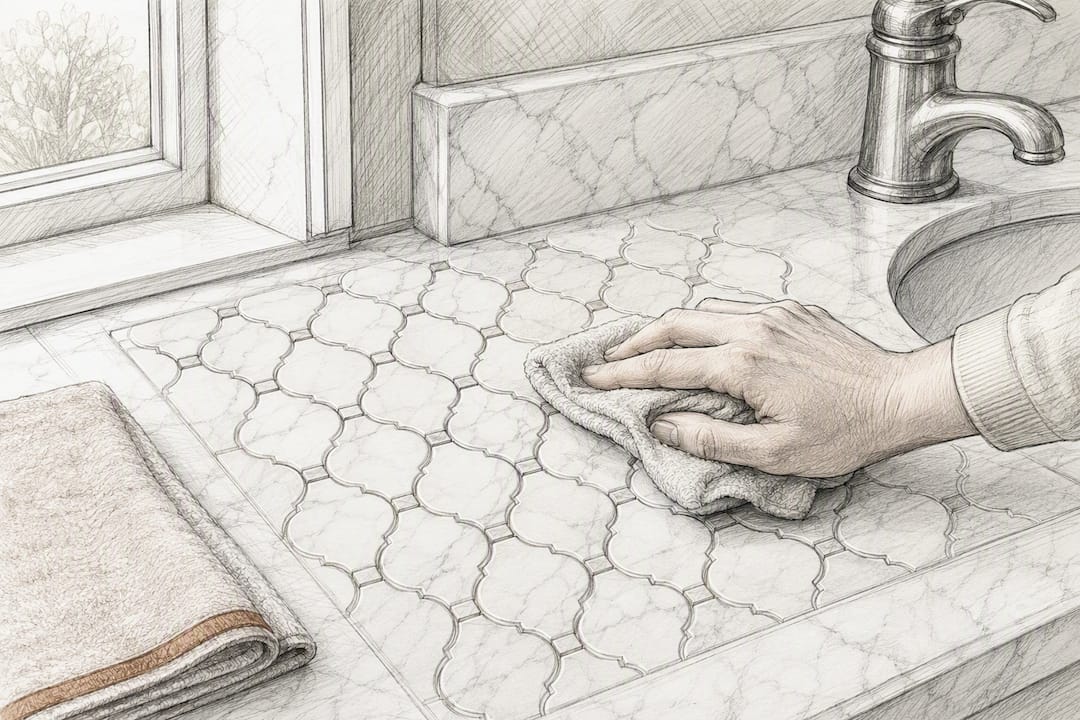
What to avoid matters more than what to use. Skip vinegar, lemon-based cleaners, and bleach entirely. Prosoco’s sealing guidance is direct on this point: acidic products etch marble’s calcium carbonate surface almost immediately, leaving a dull spot that polishing alone won’t fully fix. Abrasive pads and scouring powders scratch polished finishes the same way sandpaper would.
On sealing, the simplest quality check is the bead or spring test: drip a small amount of water on the surface. If it beads up, the sealer is doing its job. If it darkens the stone within a minute or two, it’s time to reseal. Depending on foot traffic and how often the surface gets wet, reseal every 1 to 3 years to maintain that protective barrier.
Grout lines need attention too. Sealing grout separately reduces staining, and a weekly pass with a soft grout brush and pH-neutral grout cleaner keeps lines from darkening over time, a routine OPICIS outlines in detail for marble mosaic floors specifically.
- Damp mop weekly with pH-neutral cleaner.
- Blot spills immediately, especially wine, coffee, and oil.
- Reseal every 1 to 3 years based on traffic.
- Call a professional for etching repair, deep grout restoration, or full re-polishing.
Call in a pro once etching has set in or grout haze won’t lift with normal cleaning. Our guide on restoring marble shine covers what’s a DIY fix and what needs professional equipment.
How Do You Choose the Right Arabesque Mosaic for Your Project?
Start with function, not just looks. A shower floor and a kitchen backsplash have completely different demands even though both might use the same arabesque pattern.
- Finish: polished for visual drama on walls, honed for slip resistance on floors.
- Marble species: Carrara for subtle veining, Calacatta or Statuario for bold contrast.
- Sheet size and grout width: smaller tesserae and tighter grout lines for a refined look; larger pieces for bolder scale.
- Maintenance tolerance: be honest about whether you’ll actually reseal every year or two.
Cost tracks marble grade, finish complexity, and installation difficulty; intricate curved cuts around fixtures take longer than a straight backsplash run, and that labor adds up. Before ordering, ask your supplier about stone origin, grading consistency between batches, available finish options, and their return or warranty policy on defective sheets. Always request a spec sheet alongside your sample, and buy 5 to 10 percent more material than your measured square footage to cover cuts and future repairs.
Where Does the Arabesque Pattern Come From?
The arabesque motif traces back over a thousand years to Islamic art and architecture, where geometric prohibition on figurative imagery in sacred spaces pushed artisans toward intricate, repeating floral and vine-like patterns instead. Palaces, mosques, and courtyards across the Middle East, North Africa, and Moorish Spain used carved stone and tile in these interlocking curves to suggest infinite growth without depicting any living form directly.
The pattern traveled through trade routes into Mediterranean design, picking up influence from Byzantine and later Venetian craftsmen who adapted it into marble inlay work for European palazzos and cathedrals. By the time it reached American residential design, the arabesque had shed most of its religious symbolism and become simply a design vocabulary, prized for the way it makes a static stone surface feel like it’s moving.
What makes it durable as a design choice is the balance it strikes: intricate enough to hold visual interest, but symmetrical enough to feel calm rather than busy. That’s part of why it keeps reappearing in kitchen and bath design decades after decades of trend cycles. A backsplash or shower wall in this pattern references design history, whether or not the homeowner is thinking about medieval Andalusia while they’re brushing their teeth. It’s one of the few tile patterns where the historical weight actually reads as sophistication rather than costume.
How Does It Differ From Other Mosaic Patterns?
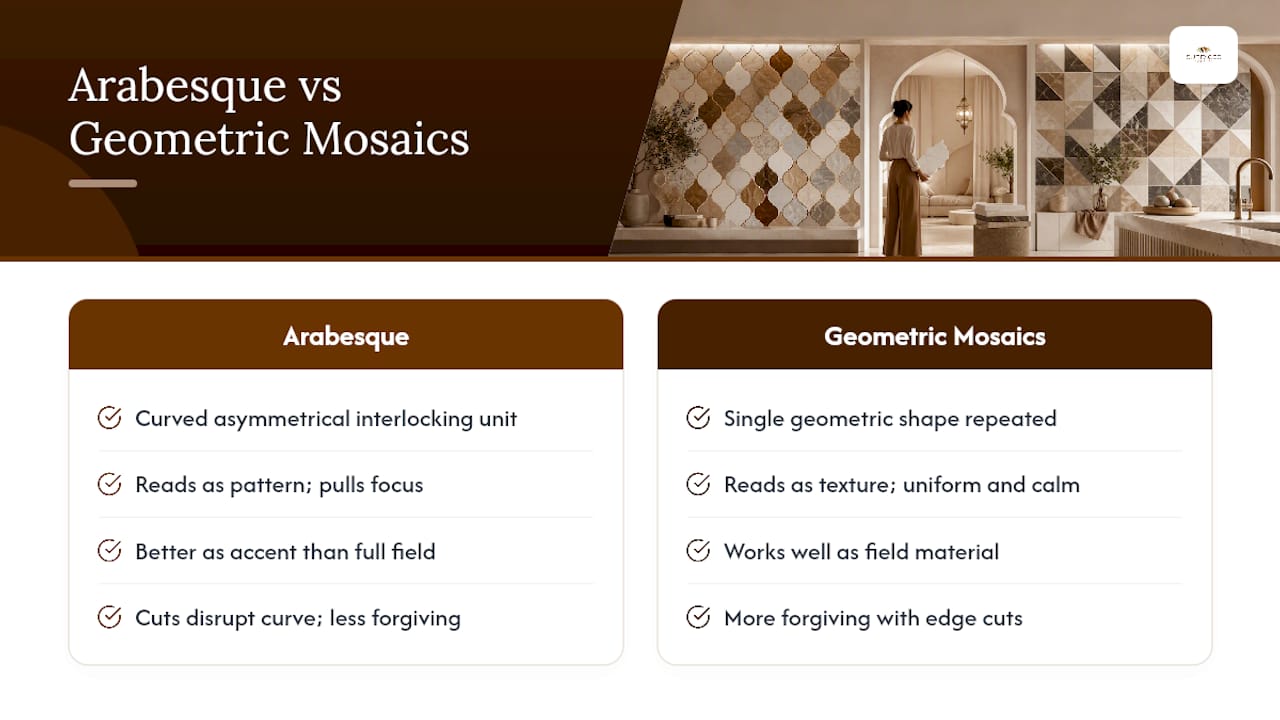
Basketweave, herringbone, hexagon, and penny-round mosaics all rely on repeating a single geometric shape across a surface. Arabesque mosaic is fundamentally different because its base unit is a curved, asymmetrical shape designed to interlock with its mirror image, creating a continuous flowing line rather than a grid.
That distinction changes how the eye reads the surface. A hexagon or herringbone floor reads as texture. It’s uniform, calm, and recedes into the background. Arabesque mosaic reads as pattern. It pulls focus and works better as an accent than as a field material covering an entire room.
Installation also differs. Geometric mosaics like basketweave or herringbone are more forgiving with cuts at edges since the repeating shape is simple to trim. Arabesque sheets require more careful planning at transitions and corners because cutting through the curve disrupts the flow of the design, which is why the dry layout step matters more here than with a straight grid pattern.
Traditional marble patterns like basketweave also tend to use a single marble tone or two-tone contrast (often marble paired with a dark accent stone). Arabesque mosaic frequently leans on veining variation within a single marble species to add depth, which means no two installations look exactly alike even when the sheets come from the same production run.
How Can You Tell Quality Arabesque Marble Mosaic?
Sheet-to-sheet consistency is the first thing to check. Lay two or three sample sheets side by side and look at tesserae thickness, cut precision at the curved edges, and how tightly each piece sits against its mesh backing. Sloppy backing work shows up later as loose or popping tesserae.
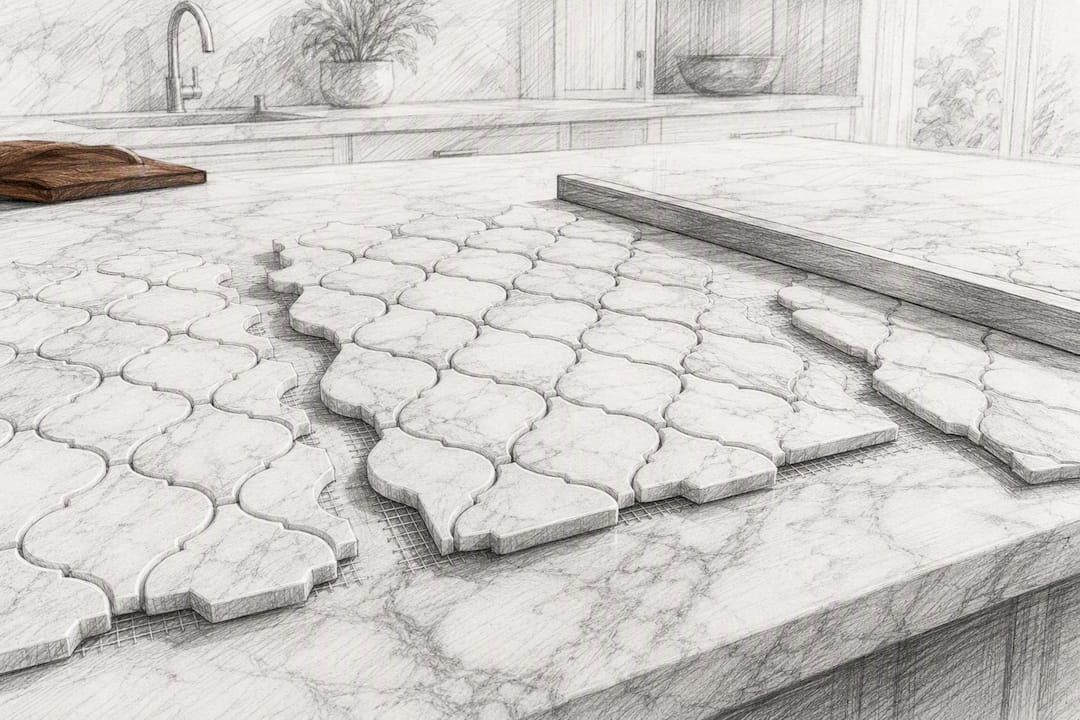
Check the marble itself under raking light, not just straight-on. Authentic marble shows natural mineral veining with some irregularity. Overly uniform, repeating vein patterns across every single piece can signal a lower-grade stone or, in some cheaper products, a resin composite marketed as marble. Ask directly whether the product is natural stone or an engineered composite, since the two perform very differently over time.
Edge finishing matters too. Run a finger along the cut edges of the tesserae. Rough or chipped edges suggest lower-quality cutting equipment or rushed production, and those edges are more likely to chip further during grouting or cleaning.
Finally, ask about country of origin and whether the supplier can speak to consistent grading between production batches. A supplier that can answer specifics about quarry source and finish process is generally a more reliable bet than one that can only point to a photo on a website.
What Should You Know About Marble Sourcing and Sustainability?
Marble is a quarried natural material, and that origin carries real environmental tradeoffs worth understanding before you specify it. Quarrying is energy-intensive, and transportation from source regions (often Italy, Turkey, or other Mediterranean quarries) to the U.S. adds to the material’s carbon footprint compared to locally manufactured products like porcelain.
That said, marble’s durability cuts the other direction on lifecycle impact. A properly sealed and maintained marble mosaic installation can last decades, sometimes generations, which spreads its environmental cost over a much longer service life than materials that need replacement every 10 to 15 years. Marble is also fully recyclable as aggregate or crushed stone at end of life, unlike many composite or resin-based tile products.
Buyers who care about sourcing transparency should ask suppliers directly about quarry origin and whether the stone is a natural, unaltered product rather than a resin-filled or dyed composite. Direct-import suppliers who work closely with quarry partners are generally better positioned to answer these questions with specifics rather than vague assurances.
What Contractors Get Wrong About Specifying This Pattern
The most common mistake I see on job sites isn’t a design choice. It’s sequencing. Contractors skip the dry layout because it feels like an extra step, then wonder why the finished wall has an obvious dark patch where three boxes’ worth of heavier veining ended up clustered together. Mixing sheets from multiple cartons before setting anything takes twenty extra minutes and saves a callback.
The second mistake is grout selection. Sanded grout on polished marble looks fine in the bucket and terrible six months later, once fine scratches from the sand start catching light across every tesserae edge. As a direct importer, Surfaces Galore works with contractors and designers on sample requests and trade quotes specifically so these details get caught before installation day, not after.
— John | Surfaces Galore
Order Samples of Our Arabescato Corchia Collection
If the veining and movement of arabesque patterns caught your eye, Arabescato marble is where that dramatic look originates, and Surfaces Galore stocks it as a direct imported in the sizes contractors and designers actually spec most often.
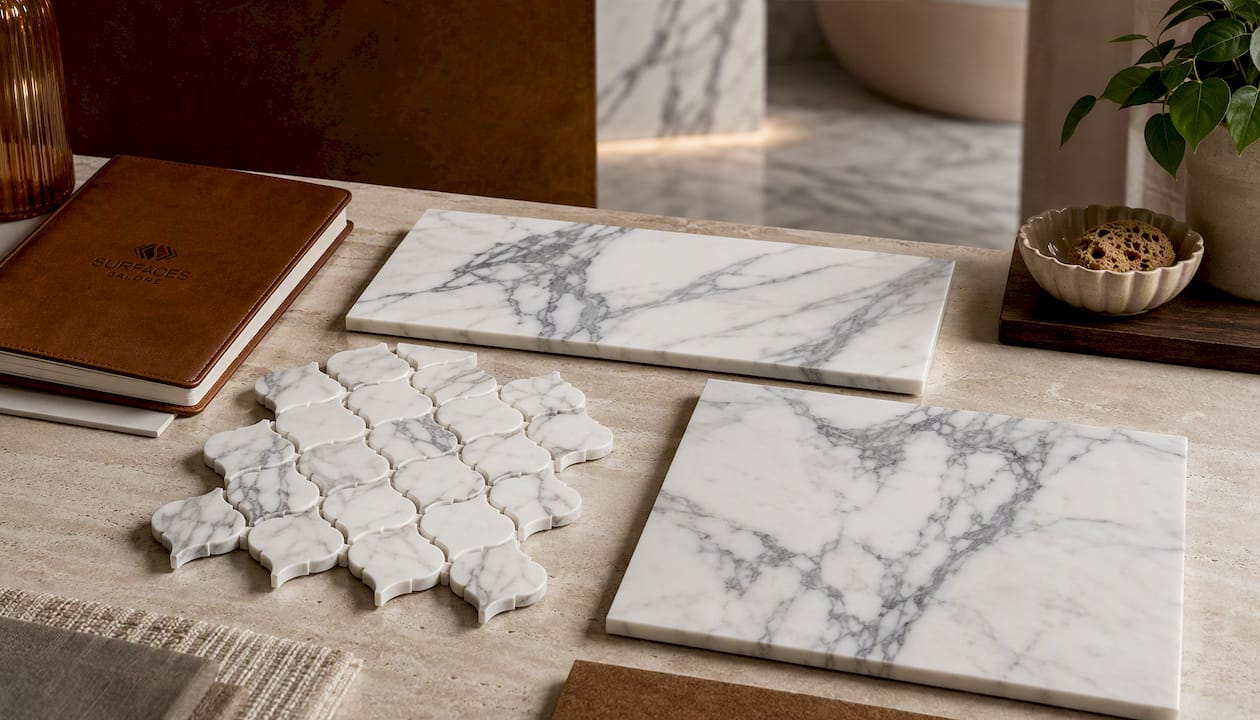
The Arabescato Corchia 12x12 polished or honed tile works well for smaller accent areas and niches, while the 12x24 format suits larger backsplash runs and shower walls where fewer grout lines mean a cleaner read. For statement floors or oversized shower panels, the 18x18 polished or honed option gives you fewer seams across a bigger surface. All three come in polished or honed finish depending on whether the application calls for shine or slip resistance.
Trade pricing for contractors and designers along with sample ordering allows you to check veining and color against your actual project lighting before committing. Order a sample, request a trade quote, or ask for a spec sheet before your next bid.
Sources
- Marble sealing guidance — Prosoco
- Arabesque marble mosaic tile: design ideas, pros and care — Stone Styling
- How to care for a marble mosaic floor — OPICIS
FAQ
Is arabesque tile outdated?
No. The pattern has held steady in kitchen and bath design for decades because its curved, symmetrical geometry reads as classic rather than trend-driven, and it continues to appear in current designer projects and product lines.
What does the term “arabesque tile” mean?
Arabesque tile refers to a mosaic pattern of interlocking, curved tesserae arranged in a flowing motif derived from historic Islamic and Mediterranean decorative art, typically sold as mesh-backed marble sheets.
Are arabesque tiles in style?
Yes. Designers continue to specify arabesque marble mosaic for backsplashes, shower walls, and accent applications because the pattern pairs well with both traditional and modern cabinetry and fixtures.
Does arabesque tile add value to a home?
A well-installed, properly maintained natural marble mosaic reads as a higher-end finish than standard ceramic tile, and buyers often view it as a signal of overall renovation quality, though it functions as one detail within a broader remodel rather than a standalone value driver.
Recommended
- Custom Tile Mosaic Creation Workflow for Stunning Results
- Master Stone Mosaic Installation for Luxury Projects
- How to Match Tile Patterns for Flawless Design Results
- Custom Mosaic Design Guide for Stunning Stone Projects
This article is provided for general informational guidance only. Natural stone varies in color, veining, texture and performance. For installation, sealing, cleaning and maintenance, follow the product manufacturer’s instructions and consult a qualified installer or stone-care professional. Always test cleaning and sealing products in an inconspicuous area first. Surfaces Galore is not responsible for damage, discoloration, etching, staining, installation issues or other problems resulting from

Leave a comment