
Tile Freight Damage Claims: How to File and Win

If your tile or stone shipment arrives damaged, the claim is won or lost in the first hour. Note the damage on the delivery receipt, photograph everything before you move it, keep the packaging, and then file a separate written claim with the carrier that includes a specific dollar amount. A note on the delivery receipt alone does not count as a claim. This guide walks through each step for natural stone tile, mosaics and pavers shipped on pallets, including the deadlines, the paperwork and what to do when a carrier says no.
TL;DR
- Inspect before you sign. Write the specific damage on every copy of the delivery receipt, or refuse the load if it is badly damaged.
- A receipt notation is not a claim. Federal rules require a separate written claim that identifies the shipment, asserts carrier liability and states a specified or determinable dollar amount.
- Carriers must acknowledge a proper claim within 30 days and pay, decline or make a written compromise offer within 120 days.
- Concealed damage (found after you unpack) is harder to win. Stop, keep the packaging and report it right away.
- The carrier’s liability can be limited by the bill of lading, so check the declared value before the shipment ships, not after it breaks.
Table of Contents
- Why stone tile is a freight claim waiting to happen
- Who files the claim, and with whom
- Step 1: Inspect before the driver leaves
- Step 2: Handle concealed damage the right way
- Step 3: Build the claim package
- Step 4: File in writing and keep proof
- Deadlines that apply
- How much can you recover?
- When the carrier denies or stalls
- A perspective from our warehouse
- Order smarter so you file fewer claims
- FAQ
- Sources
Why stone tile is a freight claim waiting to happen
Natural stone is heavy, dense and brittle at the edges. A crate of 12x12 limestone can weigh hundreds of pounds, and a pallet of marble mosaic sheets carries a lot of value in a small footprint. Large shipments like this usually travel by less-than-truckload (LTL) freight, which means your pallets are loaded and unloaded several times, often at terminals, before they reach you.
The usual damage patterns are predictable:
- Chipped or cracked corners on tile boxes at the bottom or outer edge of a pallet.
- Crushed cartons where another shipment was stacked on top or a forklift tine punctured the side.
- Shifted loads where shrink wrap and banding failed and boxes slid or tipped.
- Wet cartons from rain exposure or a leaking trailer, which weaken the boxes and can stain porous stone such as travertine and some limestone.
- Concealed breakage, where the outer carton looks fine but tiles inside are broken.
We cover how stone moves from our warehouse to your door in more detail in our guide to natural stone tile freight delivery. Here the focus is what happens when it goes wrong.
Who files the claim, and with whom
The claimant is ordinarily whoever bears the risk of loss in transit, typically the shipper or the consignee, and a beneficial owner or assignee may also qualify, according to the federal rules in 49 CFR Part 370. The claim goes in writing to the receiving carrier, the delivering carrier, or the carrier that had the goods when the loss occurred.
In practice, that means:
- Check who owns the freight risk. Your order confirmation and the terms of sale say whether the seller or the buyer is responsible once the freight leaves the dock. If you are not sure, ask the seller before you do anything else, because the party with the risk is the one with standing to claim.
- Identify the delivering carrier. The name and phone number are on the delivery receipt and the bill of lading (BOL).
- Do not file with a broker alone. The FMCSA states that a broker does not assume responsibility for the shipment. The claim should be filed with the appropriate motor carrier, usually the delivering carrier or the one that caused the loss, although a broker may help you through the process.
If you bought from us and the shipment arrives damaged, contact us the same day with your photos. We can coordinate with the carrier on our side, and that is far easier when the evidence is fresh.
Step 1: Inspect before the driver leaves
This is where most claims are decided. You are allowed to take a few minutes. Do not let a driver rush you into signing a clean receipt.
Check the outside first
Look at the pallet and the wrap before anything comes off the truck. Walk around it. Look for:
- Torn, crushed or wet cartons
- Missing or loose banding
- Tilted or shifted stacks
- Punctures, forklift marks or scuffed corners
- A missing seal or signs the load was opened
Count the pieces and compare to the BOL. A short count is also a claim.
Photograph before you touch anything
Take wide shots of the pallet as it sits on the truck or liftgate, then close-ups of every damaged area, the carton labels, the BOL number and the truck or trailer number. Photograph the delivery receipt after you have written on it. Phone photos carry a timestamp, which helps.
Write specific exceptions on the delivery receipt
Do not write only “damaged.” Write what you see: “2 of 6 cartons crushed at corner, tile visible and broken” or “pallet 2 of 3 shifted, 4 cartons collapsed.” Put the notation on the driver’s copy and every other copy, and get the driver to sign or initial it. If you cannot assess the damage on the spot, a note such as “pallet damaged, contents not inspected” is far better than a clean signature.
Decide whether to accept or refuse
If the damage is severe, most of the load is obviously ruined, or the freight is wet, you can refuse delivery. The goods then go back to the carrier’s terminal and the carrier remains responsible. For partial damage, most buyers accept the freight with exceptions noted, then sort undamaged boxes from damaged ones and keep both. Ask the seller before refusing, since a refusal can add return costs and delay a replacement.
The receipt note is only the first step, though. The federal rule on filing of claims is clear that a damage notation on a delivery receipt alone is not sufficient to count as a claim.
Step 2: Handle concealed damage the right way
Concealed damage is what you find after the driver is gone: boxes look fine, but the tiles inside are cracked or chipped. With stone it is common when a pallet took a hit or a drop that did not mark the carton.
What to do:
- Stop unpacking as soon as you find it. Do not keep working through the pallet.
- Keep everything: the damaged tile, the cartons, the dividers and the pallet wrap. Carriers often want to inspect the packaging, and discarding it weakens your claim.
- Report it to the carrier immediately, in writing if possible, and tell them you are holding the freight for inspection. Carrier tariffs often set a short window for concealed damage reports, so look at the terms in your BOL or the carrier’s published rules and move quickly. Waiting weeks leaves room for the carrier to argue the damage happened at your site.
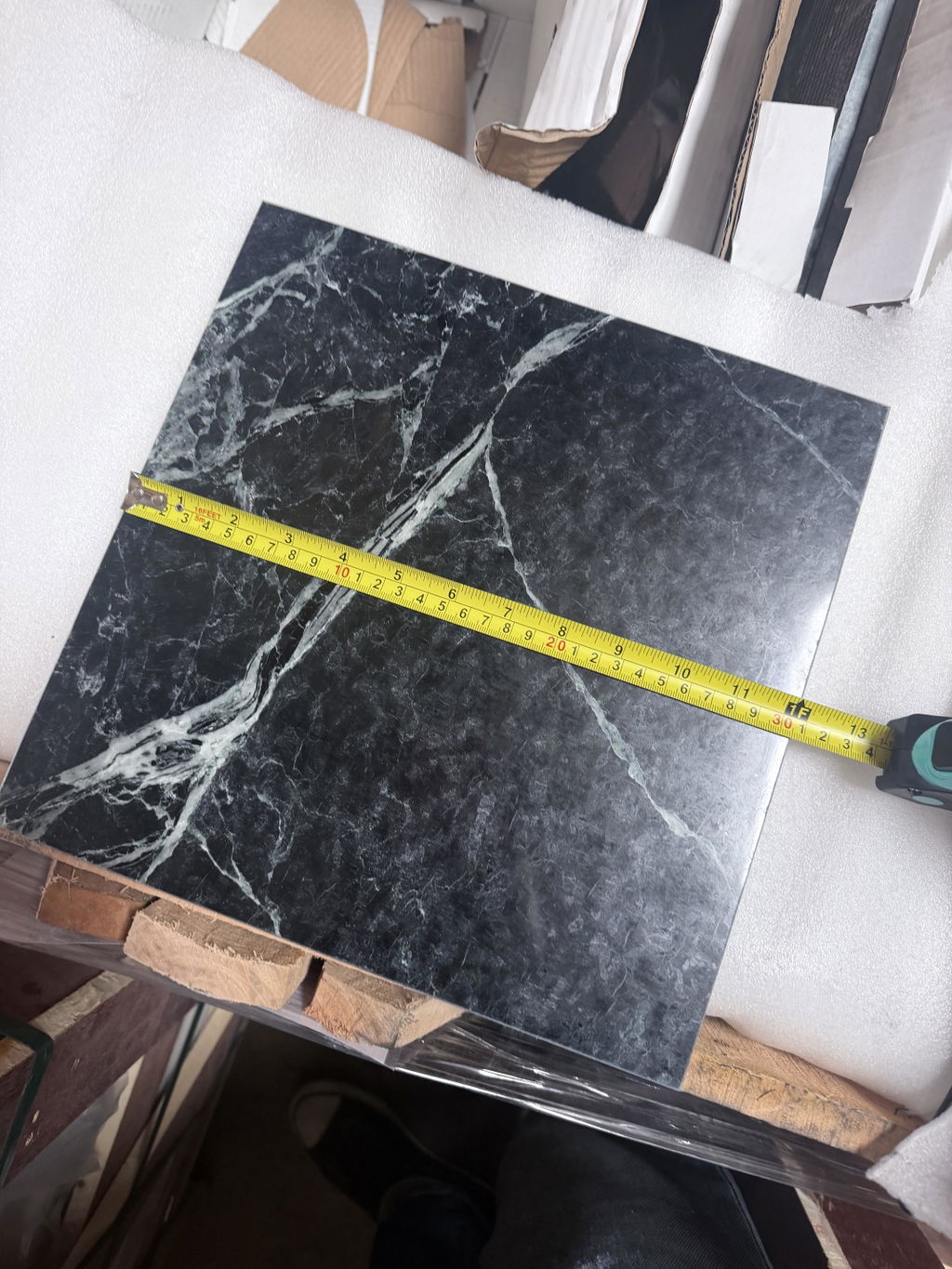
- Photograph the tiles in place in the carton before you pull them out, then lay out the broken pieces with a tape measure for scale.
The carrier will often send an inspector. While you wait, hold the container and its contents as they were when you found the damage, as far as you can. Do not install a damaged tile “to see if it works.” Once it is set in mortar, the evidence is gone.
Some breakage is not freight damage at all. Natural stone has veining, fissures and natural variation that are part of the material. Tiles with edge chips from manufacturing or from a previous handling stage in the supply chain are a seller issue, not a carrier issue. If you are not sure which you have, send photos to the seller before filing. Our guide to natural stone batch matching explains what normal variation looks like.
Step 3: Build the claim package
A claim is a written demand, and it is only as strong as its attachments. A professional guide to how to file a freight claim says a written claim should identify the shipment, state the type of loss, state an estimated or exact amount, and demand payment. Supporting documents usually include the bill of lading, the paid freight bill, the invoice, inspection reports and photographs.
The federal rule on investigation of claims also lists the bill of lading, evidence of the freight charges, and an invoice or certified evidence of the property’s price or value among supporting materials.
A practical checklist for a tile claim:
| Document | What it proves | Where to get it |
|---|---|---|
| Claim letter | Identifies the shipment, asserts carrier liability, demands a dollar amount | You write it |
| Bill of lading | The contract of carriage, piece count, declared value | Seller or carrier |
| Delivery receipt with exceptions | What you noted at delivery | Your copy from the driver |
| Paid freight bill | That freight charges were paid | Seller or carrier |
| Commercial invoice | The value of the stone | Seller |
| Photos and video | Condition of freight, packaging and tile | Your phone |
| Inspection report | The carrier’s or a third party’s findings | Carrier inspector |
| Repair or replacement quote | Support for the dollar amount | Seller or installer |
Put a number on it
The claim must ask for a specified or determinable dollar amount. “Please compensate for damage” is not enough. Count damaged boxes, multiply by the invoice price per box, and add any freight charges tied to the damaged goods if your paperwork supports it. If you are not sure of the final figure, state an estimate and say that it is an estimate.
Buyers often forget how much waste allowances matter here. If you ordered 10 percent extra for cuts and the damage eats into it, the project may now be short. Our guides on how much extra tile to order and calculating waste accurately for stone help you work out how many replacement boxes you truly need. That figure is what you put in the claim.
Step 4: File in writing and keep proof
Under 49 CFR § 370.3, a freight claim requires a written communication, filed within the time limit in the bill of lading or transportation contract, that identifies the shipment, asserts carrier liability and claims a specified or determinable amount.
A workable approach:
- Send the claim by email and by a trackable method such as certified mail or the carrier’s online claims portal, if it has one.
- Include the BOL or PRO number in the subject line and the first sentence.
- Attach the full package as a single PDF plus the original photo files.
- Keep a copy of everything and a log of every call, with the date, the name of the person and what they said.
A short claim letter can follow this shape: shipment identification (BOL, PRO number, ship date, delivery date, origin and destination), a plain statement of what you found, a statement that the carrier is liable for the loss, the dollar amount, a list of enclosures, and your contact details.
Deadlines that apply
There are three clocks to watch.
Your filing window. Federal law sets a floor. Under 49 U.S.C. § 14706, carriers are liable for actual loss or injury to property, and a carrier cannot set a claim filing period shorter than nine months or a suit period shorter than two years from the date it denies the claim. Many carriers allow exactly that minimum in their bills of lading, so the contract is where you confirm your window. Do not plan around the longest possible deadline. File within days.
The carrier’s acknowledgment. A carrier must acknowledge a proper written claim within 30 days, unless it pays or declines it in writing within that period, according to 49 CFR Part 370.
The carrier’s decision. The carrier must pay, decline, or make a firm written compromise offer within 120 days of receiving a written claim. If the claim is still pending, it must give you a written status and the reasons for the delay at 120 days and every 60 days after that, as set out in 49 CFR § 370.9.

In plain terms, expect the process to take months, not weeks. Calendar every date.
How much can you recover?
The baseline is actual loss. Under 49 U.S.C. § 14706, for property other than household goods, a motor carrier may set rates that limit its liability to a reasonable value established by the shipper’s declaration or written agreement. That is the catch for tile.
If the BOL declares a low value, or the freight class and limit are set low, the carrier may argue it owes only that limit even when your invoice is much higher. A pallet of premium marble mosaic is worth far more per pound than the default limits some carriers publish.
Three ways to protect yourself before the freight ships:
- Declare the real value on the BOL, especially for high-value mosaics, large-format slabs or multi-pallet orders.
- Ask about added coverage. Carrier liability and cargo insurance are different things. Cargo insurance can cover gaps the carrier’s limit leaves. Our explainer on insured tile shipping nationwide covers how that works for stone orders.
- Pack for the trip. Pallets that are properly banded, corner-protected and shrink-wrapped are harder for a carrier to blame on your side.
What you can usually include: the invoice value of the damaged tile, and the freight charges attributable to it. What is much harder to recover: installer downtime, delayed-project costs and other consequential losses, unless your contract specifically allows them. Read the BOL terms or ask the seller.
When the carrier denies or stalls
If a carrier declines your claim or says nothing, you still have options.
- Check the reason in writing. Carriers must state reasons when they decline. Common ones are “clear delivery receipt,” “no visible damage at delivery,” “insufficient packaging” and “late notice.”
- Answer each reason with evidence. If they say packaging was inadequate, send the seller’s packing photos. If they say you signed clean, send your timestamped photos of the freight on the truck.
- Request the status in writing if the 120-day period is running. The rules require status updates every 60 days after that point.
- Escalate inside the company. Claims departments often have a supervisor level that reviews denials.
- Consult a transportation attorney if the amount is large. Under the same federal law, a shipper or consignee who sues generally must show that the goods were delivered to the carrier in good condition, arrived damaged, and the amount of the damages. Your documents are the proof of each.
For smaller claims, many buyers also check whether the seller or their cargo insurer will pay first and pursue the carrier themselves. This is a common route when the order was shipped insured.
A perspective from our warehouse
We import and ship natural stone every week, and the pattern we see is consistent: claims that succeed almost always have three things in common. The receiver inspected before signing, photographed the pallet before moving it, and contacted us the same day. Claims that fail almost always have a clean signature and photos taken two days later.
Our advice to contractors and designers who order from us:
- Build the inspection into your receiving plan. Put a person on site who is allowed to refuse or note damage, not just whoever is around when the truck pulls in.
- Order with waste in mind. Stone is natural, and a few broken pieces in a large order are a reality even with careful packing. A sensible overage keeps a small freight problem from becoming a project delay.
- Tell us your site conditions before shipping. Liftgate, residential delivery and limited access all change how freight is handled and where it gets damaged.
- Do not install questionable pieces. Once set, a tile is a repair problem, not a claim.
We also use free sample shipping so you can see a stone’s color and finish before committing to a large order, which removes one major source of returns that have nothing to do with freight.
— John | Surfaces Galore
Order smarter so you file fewer claims
Most freight claims are preventable. Planning the order well, confirming delivery details and having a receiving routine cuts the risk. If you are sourcing marble, travertine or limestone for a kitchen, bathroom, floor or outdoor project, you can browse our marble tiles, marble mosaics and travertine tiles or look at specific favorites such as the Obsidian Ash 16x24 limestone. As a direct importer, we ship nationwide and support bulk and trade orders.

For larger jobs, our bulk tile ordering guide explains how to plan quantities and delivery, and our article on what tile coverage means helps you convert square footage into boxes correctly.
FAQ
Can I file a claim if I signed for the delivery without noting damage?
Yes, but it is much harder. A clean signature suggests the freight arrived in good condition, so you will need strong evidence that the damage was concealed and happened in transit. Report it to the carrier as soon as you find it, keep the packaging and photograph everything before touching it.
Is a note on the delivery receipt the same as filing a claim?
No. Federal rules require a separate written claim that identifies the shipment, asserts carrier liability and states a specified or determinable amount. The receipt notation is evidence supporting that claim, not the claim itself.
How long does a tile freight damage claim take?
A carrier must acknowledge a proper claim within 30 days and must pay, decline or make a firm written offer within 120 days. Complex or disputed claims can run past that, in which case the carrier owes you written status updates every 60 days.
Who pays for damaged tile, the seller or the carrier?
It depends on the terms of sale and who held the risk during transit. The claim itself goes to the carrier, and the party bearing the transit risk is ordinarily the one who files. If you bought from a seller, contact them the same day so you both know who will file.
Can I claim for broken tile if the box looked fine?
Yes, this is a concealed damage claim. Stop unpacking, hold the cartons and tiles as you found them, notify the carrier promptly and check the notice period in your bill of lading. Expect the carrier to want to inspect before paying.
Sources
- 49 CFR Part 370, Principles and Practices for the Investigation and Voluntary Disposition of Loss and Damage Claims (eCFR)
- 49 CFR § 370.3, Filing of claims (Cornell LII)
- 49 CFR § 370.7, Investigation of claims (Cornell LII)
- 49 CFR § 370.9, Disposition of claims (eCFR)
- 49 U.S.C. § 14706, Liability of carriers under receipts and bills of lading
- FMCSA: Does a broker process loss and damage claims?
- How to File a Freight Claim for Loss or Damage (Transportation Loss Prevention and Security Council)
Recommended
This article is provided for general informational guidance only. Natural stone varies in color, veining, texture and performance. For installation, sealing, cleaning and maintenance, follow the product manufacturer’s instructions and consult a qualified installer or stone-care professional. Always test cleaning and sealing products in an inconspicuous area first. Surfaces Galore is not responsible for damage, discoloration, etching, staining, installation issues or other problems resulting from

Leave a comment