
Backsplash Design Ideas: 2026 Trends and Smart Material Picks

If you want a clean, low-maintenance look, pick a slab. If you want warmth and texture, pick zellige or handmade tile. If you want budget flexibility with color options, porcelain or ceramic tile still wins. If you want a statement that reads as an investment, natural stone belongs at the top of your list.
- Slab backsplash — best for buyers who hate cleaning grout and want counters and walls to flow together.
- Zellige or artisanal tile — best for anyone chasing handmade texture and a lived-in, layered kitchen.
- Classic patterned tile (subway, herringbone, hex) — best for budget-conscious renovators who still want personality.
- Bold color tile — best for a cook who wants the backsplash to be the room’s focal point, not the cabinets.
Surfaces Galore stocks marble, travertine, and limestone slabs and tiles for anyone weighing the stone option, with samples available before you commit to a full order.
Table of Contents
- Backsplash Design Ideas Shaping Kitchens in 2026
- Which Backsplash Material Fits Your Budget and Upkeep?
- Layout and Pattern Ideas That Change the Whole Mood
- How Do You Choose the Right Backsplash for Your Kitchen?
- What Should You Budget for Installation and Timeline?
- Why Natural Stone Still Wins on a Small Wall
- Matching Backsplash Style to Your Kitchen’s Overall Look
- Turning Your Backsplash Into a Focal Point
- Making the Backsplash, Countertop, and Cabinets Work Together
- Beyond Tile: Metal, Wood, and Peel-and-Stick Alternatives
- Heat, Moisture, and Durability: What Placement Requires
- Is Natural Stone a Sustainable Backsplash Choice?
- Ready to Browse Real Stone for Your Backsplash?
- Sources
- FAQ
Backsplash Design Ideas Shaping Kitchens in 2026
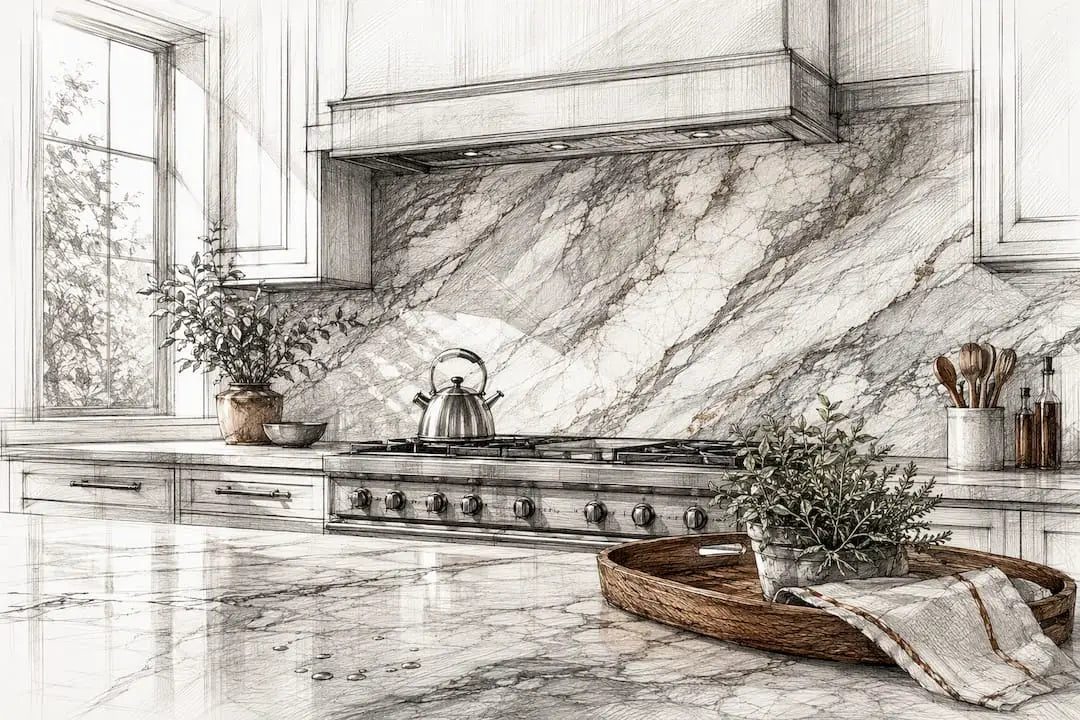
Slab backsplashes are no longer a niche upgrade. According to reporting on the 2026 Houzz Kitchen Trends Study, slab backsplashes have grown significantly in popularity and now make up a considerable portion of renovated kitchens. The appeal is practical as much as visual: a single stone slab eliminates grout lines, which means fewer places for grease and steam to collect near the range.
Texture is the counterpoint to all that smoothness. Handmade zellige tile has become one of the most requested looks for 2026, prized for its irregular glaze and warm, imperfect surface, the opposite of mass-produced subway tile.

Veining choice matters more than most homeowners expect. Designers recommend lighter, creamy slabs for kitchens meant to last, reserving dramatic dark veining for kitchens with neutral, unchanging cabinetry.
A few things to weigh before you commit to any trend:
- Full-height slabs and curve-cut edges are showing up in designer-favored 2026 kitchens as an elevated alternative to tile.
- Bold veining photographs beautifully but can date a kitchen faster than a quieter, more consistent pattern.
- If resale is on your mind in the next five years, lean toward the safer, lighter direction. If this is your forever kitchen, dramatic veining or saturated tile color is fair game.
Which Backsplash Material Fits Your Budget and Upkeep?
Every material trades something for something else. Ceramic tile is the cheapest entry point and easiest for a first-time DIYer to install, but it chips more readily than denser options. Porcelain costs more but resists moisture and wear better, which is why Consumer Reports flags it as denser and less porous than standard ceramic, a quality that also means it needs the right setting material.
Pro Tip: Porcelain often requires a specific thinset adhesive rather than standard mastic. Check the manufacturer’s instructions before you buy tile, because the wrong adhesive is one of the most common DIY mistakes with porcelain.
Glass tile brings light-catching shine and reads modern in almost any kitchen, but it shows trowel lines through translucent tiles and scratches if you’re not careful with abrasive cleaners. Cement and encaustic tile deliver bold graphic pattern, yet they’re porous and need sealing on install and periodically after, or stains from oil splatter will set in permanently.
Natural stone, whether marble, travertine, or limestone, offers a look no manufactured material fully replicates: the soft translucency of real veining and color variation from tile to tile. The tradeoff is maintenance. Marble in particular needs sealing and careful upkeep, and many homeowners accept that tradeoff because nothing else matches the finish.
A quick material rundown:
- Ceramic — cheapest, DIY-friendly, more prone to chipping.
- Porcelain — denser and more moisture-resistant; needs the correct adhesive.
- Glass — bright and modern; shows installation flaws, scratches with abrasive cleaning.
- Cement/encaustic — bold pattern; porous, needs sealing.
- Natural stone — unmatched depth of color; requires sealing and gentle, non-acidic cleaning.
The water-drop test tells you when stone needs resealing: if a drop of water darkens the surface within a few minutes, the stone is absorbing moisture and it’s time to reseal.
Layout and Pattern Ideas That Change the Whole Mood
The same tile laid two different ways can read completely differently. Herringbone adds visible motion and works well behind a range as a focal point. Stacked tile, laid in clean horizontal rows, reads modern and calm, especially in a kitchen with minimal upper cabinets. Large-format tile or slab reads seamless and quiet, letting your countertop or cabinet color take the lead.
Grout color is a bigger design lever than most people realize. Matching grout to the tile creates one continuous field, which is why slab and large-format installs favor it. Contrasting grout, on the other hand, pulls the pattern forward and makes even a plain subway layout feel intentional and graphic.
Mosaics and penny tile carry a lot of visual weight, so save them for a feature area rather than the whole wall, a niche behind the range, a small accent strip, a powder room vanity backsplash.
- Small kitchens: favor larger-format tile or slab to reduce visual clutter and grout lines.
- Large kitchens: herringbone or mosaic accents can anchor a specific zone without overwhelming the room.
How Do You Choose the Right Backsplash for Your Kitchen?
Before you fall for a photo online, run through this short checklist.
- Check your light first. A north-facing kitchen with little natural light usually needs a lighter backsplash to avoid feeling closed in; a sun-drenched kitchen can handle deeper tones or dramatic veining without going dark.
- Decide: match or contrast. Matching your backsplash to the countertop creates that seamless, slab-style look; contrasting materials or colors make the backsplash its own design statement.
- Match material to how you cook. A household that sears meat weekly needs something more heat- and stain-resistant behind the range than a household that mostly reheats leftovers.
- Order a real sample and look at it under your own lighting, morning, midday, and with your kitchen lights on at night, because tile and stone shift color dramatically between showroom light and home light.
- Hold the sample against your cabinet door, not just the countertop, since the cabinet color usually dominates more of the visual field than the counter does.
What Should You Budget for Installation and Timeline?
Cost climbs with material density and installation complexity, not just square footage. Ceramic and porcelain tile sit at the accessible end and are realistic DIY projects for a confident weekend renovator. Glass and mosaic tile take longer to set and grout, which raises labor cost even when material cost stays moderate.
Slab backsplashes carry the highest price tag, largely because you’re paying for a single cut piece rather than dozens of small tiles, and fabrication and templating take real time. If you’re ordering slab or large-format stone, order enough material from the same quarried lot to avoid visible veining mismatches at the seams. Lot-matching can extend your lead time, so order early if you’re working around a renovation deadline.
- Ceramic and porcelain: most DIY-friendly, shortest lead time.
- Glass and mosaic: moderate cost, longer install time.
- Slab stone: highest cost, longest lead time, but zero grout maintenance.
- A stone-look porcelain slab or a stone feature wall behind the range only can deliver a similar look at a lower total cost.
Why Natural Stone Still Wins on a Small Wall
A backsplash covers less square footage than a floor or a full wall, which is exactly why natural stone makes sense there even for buyers who’d never floor an entire kitchen in marble. You get maximum visual impact, veining, depth, subtle color shift, for a material budget that stays manageable because you’re only covering a few dozen square feet.
Sourcing matters more with stone than with manufactured tile. Order enough slab or tile from the same quarried batch to keep veining and tone consistent across your run, and bring an actual cabinet door or countertop sample with you when you’re choosing stone, since screen colors and even different lighting change how a slab reads.
Pro Tip: Reseal by usage, not by the calendar. A backsplash near a busy sink or range may need resealing more often than one in a lightly used butler’s pantry. Run the water-drop test every few months, if a drop darkens the stone within a couple minutes, it’s time to reseal.
- Marble delivers the boldest, most classic veining but needs the most attentive care.
- Travertine offers a softer, more matte, rustic texture that hides minor etching well.
- Limestone reads quiet and monochromatic, a good fit behind busy pattern elsewhere in the kitchen.
Surfaces Galore’s marble backsplash ideas page and natural stone guide are useful starting points if you’re deciding between the three.
Matching Backsplash Style to Your Kitchen’s Overall Look
A backsplash that fights your kitchen’s style always looks like an afterthought, even when the material itself is beautiful. Modern kitchens generally want minimal visual noise: a slab or large-format tile in a matching or near-matching grout, paired with flat-panel cabinets, keeps sightlines clean.
Rustic and farmhouse kitchens lean into texture and imperfection. Zellige, handmade subway tile with slightly uneven edges, or a warm travertine with visible fill holes all read as authentic rather than manufactured, which is the whole point of the style. A farmhouse kitchen with a bright white apron sink and shaker cabinets often looks best with a backsplash that has some tonal variation rather than a flat, uniform color.
Industrial kitchens respond well to darker, moodier materials, think cement tile, dark stacked stone, or even the metal options covered below, paired with exposed hardware and open shelving. The backsplash doesn’t need to be shiny in this style; a bit of texture or a matte finish actually reads more authentic.
Transitional kitchens, the ones splitting the difference between traditional and contemporary, tend to do best with classic patterns in a slightly updated material: a subway layout in stone instead of ceramic, or a herringbone pattern in a neutral marble. The layout stays familiar while the material upgrades the whole room.
The through-line across every style: pick one dominant texture story, wood grain, stone veining, tile pattern, and let the backsplash either echo it or intentionally contrast it. Trying to include three competing textures in one small wall almost always looks busy rather than curated.
Turning Your Backsplash Into a Focal Point
Not every backsplash needs to be a quiet backdrop. If your cabinets and countertop are both neutral, the backsplash is often the one place in the kitchen where you can take a real risk without redoing the whole room.
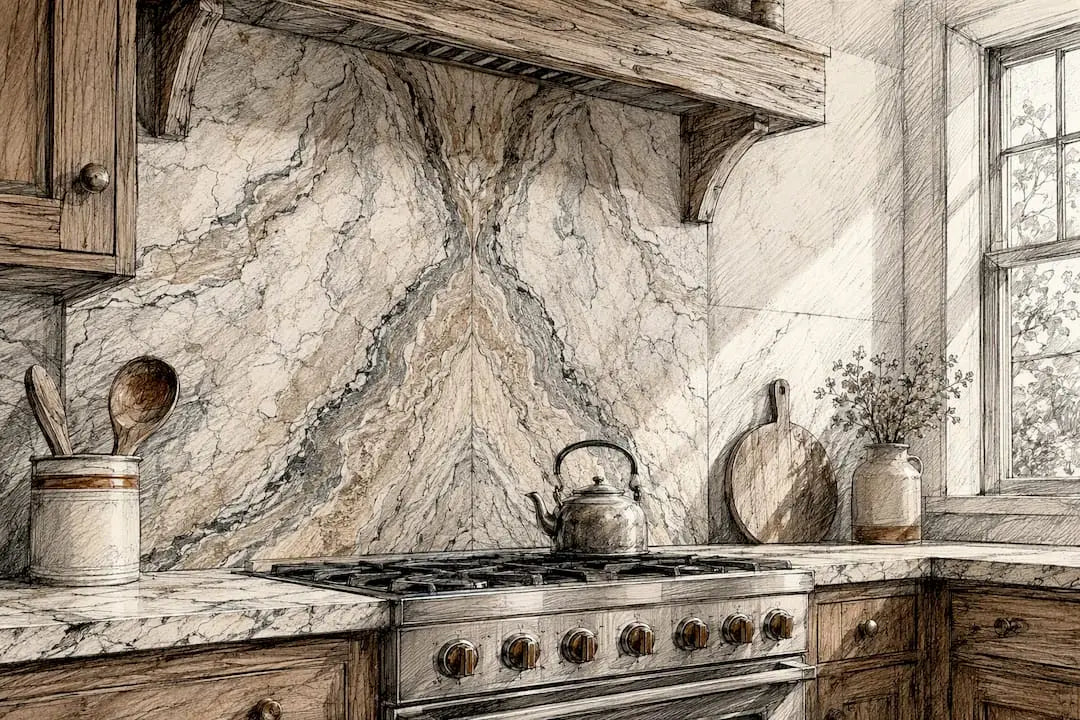
The most reliable way to create a focal point is contrast, in color, texture, or scale. A bold-color tile behind an otherwise all-white kitchen turns a functional wall into the room’s centerpiece. A textured zellige or handmade tile against smooth quartz counters creates tactile contrast that photographs well and feels good under your hand. Even within a single material family, contrast works: a honed stone finish against a polished countertop, or a dramatic bookmatched veining pattern set against plain cabinetry.
Scale is the other lever. Extending a patterned tile or a slab from counter to ceiling, rather than stopping at the standard 18 inches above the counter, turns the backsplash from a strip into an architectural feature. This full-height approach is one of the moves showing up repeatedly in 2026 designer kitchens, and it works because it commits fully to the material instead of treating it as trim.
If you want a focal point without redoing the entire wall, concentrate the drama behind the range only. A mosaic, a hand-painted tile mural, or a bookmatched stone panel behind the cooktop gives you a bold moment while keeping the rest of the kitchen calm and budget-friendly.
Making the Backsplash, Countertop, and Cabinets Work Together
The backsplash sits between two of the most expensive surfaces in your kitchen, so it has to negotiate with both. The safest approach for a first renovation is to pick your countertop first, since stone slabs have more limited color and veining options than tile, then choose a backsplash that either matches it for a seamless look or intentionally contrasts it for definition.
Cabinet color matters just as much as counter color, arguably more, since cabinets usually take up more visual real estate than the counter does. Dark cabinets with a light backsplash create clear definition and make a small kitchen feel less boxed in. Light or white cabinets give you more freedom: they’ll work with almost any backsplash color or material without a clash.
One detail DIYers often miss: the transition where backsplash meets countertop needs to be planned before installation, not improvised on install day. A stone backsplash paired with a stone counter can be cut to create a nearly invisible seam, while a tile backsplash against a stone counter needs a clean caulk line, not grout, at that joint to handle expansion and moisture.
If you’re mixing materials, natural stone counters with tile backsplash, or the reverse, try to repeat at least one element between them: a similar tone, a shared vein color, or a matching finish sheen. That repetition is what makes two different materials look chosen together instead of coincidentally installed in the same room.
Beyond Tile: Metal, Wood, and Peel-and-Stick Alternatives
Tile and stone dominate for good reason, but a handful of alternative backsplash ideas solve specific problems that standard materials don’t. Stainless steel or brushed metal backsplashes are a mainstay behind commercial ranges for a reason: they shrug off heat and grease and wipe clean in seconds, which makes them a smart pick for anyone who cooks hard and often. The tradeoff is fingerprints and water spots showing more visibly than they would on tile.
Reclaimed wood shows up occasionally as an accent backsplash, usually away from the range, since wood and open flame or sustained heat don’t mix well. It adds warmth fast in a farmhouse or industrial kitchen, but it needs a food-safe sealant and isn’t the right call directly behind a cooktop.
Peel-and-stick tile has improved enough that it’s a legitimate option for renters or anyone testing a look before committing to a permanent install. It’s genuinely useful for a quick refresh, but it’s not built for direct heat exposure and tends to look less convincing up close than real tile or stone. Treat it as a temporary or low-stakes solution rather than a long-term backsplash.
Tin backsplash panels, whether vintage-style pressed tin or a modern equivalent, deliver a distinct textured, reflective look that reads differently from flat metal sheeting. They suit a kitchen going for character over minimalism, and they hold up well to heat, though seams and edges need careful finishing to avoid a dated look.
None of these alternatives outperform tile or natural stone on durability in the zones that see the most heat and moisture. They’re best used as accents or in lower-intensity areas of the kitchen.
Heat, Moisture, and Durability: What Placement Requires
Where a backsplash sits changes what it needs to survive. The zone directly behind the range faces the most heat and grease of any spot in the kitchen, and that’s exactly where material choice matters most. Natural stone, porcelain, and ceramic all handle direct heat well. Cement tile can discolor with sustained heat exposure if it’s placed too close to a cooktop without a heat-resistant grout and sealant.
The area around the sink deals with a different threat: near-constant moisture and splashing. Any porous material there, unsealed cement tile, unsealed natural stone, needs a quality sealer to resist water absorption and staining. Marble in particular is porous enough that skipping sealer around a sink invites staining within months rather than years.
Grout choice affects durability as much as tile choice does. A moisture-resistant, mildew-inhibiting grout matters more directly behind a sink than it does on a decorative accent wall across the kitchen. If you’re using natural stone in a high-splash zone, a penetrating sealer applied at install, and reapplied based on the water-drop test rather than a fixed calendar, is the difference between a backsplash that lasts decades and one that stains within a year.
One safety note that’s easy to overlook: always confirm clearance requirements between your range and any combustible material, including reclaimed wood accents, before installation. Local building codes typically set minimum clearances for cooktops, and that applies to backsplash material choice as much as to cabinetry.
Is Natural Stone a Sustainable Backsplash Choice?
Sustainability in backsplash material comes down to two questions: how the material is sourced, and how long it lasts once installed. Natural stone answers both reasonably well. Marble, travertine, and limestone are quarried, not manufactured, which means no synthetic resins or plastics go into the base material, and a well-sealed stone backsplash can last decades with basic upkeep rather than needing replacement every renovation cycle.
Longevity is itself a sustainability argument. A cheap peel-and-stick or low-grade laminate backsplash that gets torn out and replaced in five years generates more landfill waste over twenty years than a single stone or quality tile installation that lasts the life of the kitchen. Durability and environmental impact aren’t separate conversations; they’re the same one.
For homeowners who want to push further, reclaimed materials, salvaged tile, reclaimed wood accents used away from heat sources, offer a genuinely lower-impact option, though they come with less consistency and more hunting to find enough matching material for a full wall. Recycled glass tile is another route: it delivers the same shine and light-catching quality as standard glass tile while diverting waste glass from landfills.
Porcelain and ceramic sit in the middle. They’re durable and long-lasting, but manufacturing is more energy-intensive than quarrying, and neither breaks down or gets reused the way natural stone can be repurposed or even reinstalled elsewhere. If sustainability is a real priority in your material decision, weigh total lifespan against manufacturing footprint rather than judging by raw material alone.
The most sustainable backsplash decision, regardless of material, is buying the right amount the first time. That’s another reason ordering from a single quarried lot matters: it avoids the wasted material and second shipment that come with a mismatched reorder.
Key Takeaways
The right backsplash direction depends on maintenance tolerance and style goals more than on chasing a single 2026 trend.
| Point | Details |
|---|---|
| Slab is the low-maintenance leader | Slab backsplashes gained significant market share in 2026 thanks to seamless, grout-free cleaning. |
| Zellige adds texture and character | Handmade, irregular-glaze tile suits rustic and farmhouse kitchens looking for warmth over uniformity. |
| Match material to the zone | Use sealed stone, porcelain, or ceramic near the range and sink; save wood and peel-and-stick for low-heat accents. |
| Sample before you order | Test tile and stone under your own kitchen lighting and against your actual cabinet door, not a screen photo. |
| Natural stone rewards small-wall use | Surfaces Galore’s marble, travertine, and limestone options deliver high visual impact on the limited square footage a backsplash covers. |
Ready to Browse Real Stone for Your Backsplash?
Surfaces Galore ships marble, travertine, and limestone tiles and slabs directly to homeowners and trade buyers nationwide, which means you’re buying from the importer instead of paying markup through multiple middlemen. That matters most on a backsplash project, where you need enough matched material from one quarried lot to avoid seams that don’t line up in veining or tone.
If a local showroom fits your project better, Tampa Kitchen & Bath’s guide to refreshing a backsplash is a solid resource for in-person consultation. For homeowners ready to work directly with stone, Surfaces Galore offers samples and custom bulk quotes, so you can hold the actual material against your cabinets before committing to a full order. Explore the marble collections or request a sample through the Surfaces Galore site to start planning your backsplash with real stone in hand.
A Quick Note From the Author
. If you’re weighing stone against tile for your own kitchen, browse Surfaces Galore’s collections or reach out directly. I’m happy to point you toward the right material for your space.
Sources
- The Biggest Kitchen Backsplash Trends for 2026, According to Pros - Good Housekeeping
- The best tile for floors, counters, and backsplashes - Consumer Reports
- 15 Pros & Cons of Marble Backsplashes (Are They Worth It?) - Prudent Reviews
FAQ
What Is the Rule for a Kitchen Backsplash?
There’s no strict rule, but the common guideline is to extend the backsplash at least 18 inches above the counter, more behind the range, and to choose a material that resists heat and moisture in high-splash zones like the sink and cooktop.
Should the Backsplash Be Lighter or Darker Than the Countertop?
Either works, but designers generally recommend lighter, creamy stone for a timeless look that won’t date the kitchen, saving dramatic dark veining for kitchens with neutral cabinetry that can handle the contrast.
What Is the Backsplash Trend for 2026?
Slab backsplashes and handmade zellige tile are the two dominant directions for 2026, one prized for its seamless, grout-free surface and the other for its warm, artisanal texture.
Is Natural Stone a Good Choice for a Small Kitchen Backsplash?
Yes. Because a backsplash covers limited square footage, natural stone like marble, travertine, or limestone delivers high visual impact without the material cost of flooring an entire kitchen in stone.
How Often Should You Reseal a Stone Backsplash?
Reseal based on use rather than a fixed schedule. Run the water-drop test periodically. If a drop of water darkens the stone within a couple of minutes, it’s time to reseal.

Leave a comment