

Order Samples & Quotes for Black Marquina Marble: 3 In Stock Formats for Designers

Black Marquina marble is a fine-grained black stone from Spain’s Basque Country, prized for the white calcite veins that streak across its surface like lightning on a dark sky. It works beautifully on backsplashes, bathroom walls, and accent floors, though its softer, acid-sensitive nature means it needs more care than granite. It is commonly available in 3x6 tumbled tile, as well as 18x18 and 24x24 tiles in polished or honed finishes.
TL;DR:
- Black Marquina marble’s softer density (Mohs 3 to 5) means it requires sealing and careful cleaning to prevent acid damage and staining.
- It is best used in low-exposure areas like fireplaces, bathroom vanities, and backsplashes, especially in polished or honed finishes for aesthetic contrast and practicality.
- Tile costs are generally lower than slabs, but prices vary based on grade, finish, and import logistics, with a typical mid-premium range compared to other natural stones.
- Always verify slab lot consistency, request full-slab photos and samples, and confirm sealing and installation details before purchasing to avoid matching issues or damage.
- Surfaces Galore offers in-stock formats including 3x6 tumbled tiles, 18x18, and 24x24 inch tiles, with options for both polished and honed finishes, accessible for quick sourcing.
Table of Contents
- What Is Black Marquina Marble?
- Where Does Black Marquina Marble Work Best?
- What Sizes and Finishes Are Available?
- How Much Does Black Marquina Marble Cost?
- How Do You Seal and Care for Black Marquina Marble?
- What Should You Check Before Buying Black Marquina Marble?
- Surfaces Galore’s Nero Marquina Product Line
- Is Black Marquina Marble Worth the Extra Care?
- Ready to Order Samples or Get a Quote?
- Sources
- FAQ
What Is Black Marquina Marble?
Marquina marble, also called Nero Marquina, is a calcitic marble quarried near Markina-Xemein in Spain’s Basque Country, on the Bay of Biscay coast. Its jet black base comes from bituminous material trapped in the limestone during formation, while the signature white veins are calcite that filled in cracks over millions of years, according to the material’s documented origin and composition.
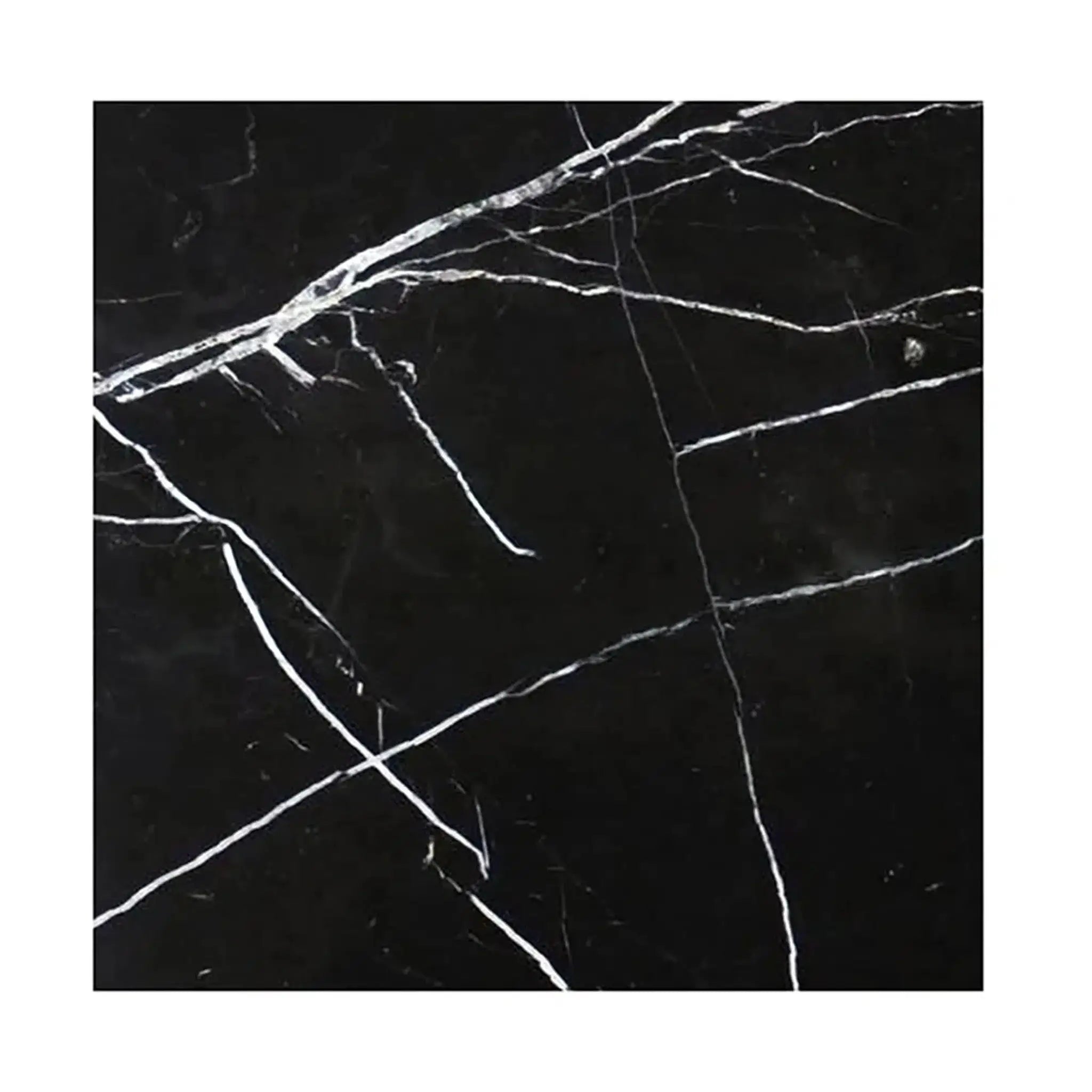
No two slabs read the same way. Some lots show tight, thread-like veining; others carry bold, almost geometric white streaks. That variation is part of the appeal, but it also means slab-to-slab matching matters more here than with a uniform stone.
On the durability side, Marquina sits on the softer end of the marble spectrum, with a Mohs hardness around 3 to 5. That’s notably softer than granite, and the stone is porous and reactive to acids. It’s a beautiful material, not an indestructible one.
- Quarried near Markina-Xemein, Basque Country, Spain
- Deep black base with white calcite veining, unique per slab
- Mohs hardness roughly 3 to 5, softer than granite
- Porous surface that requires sealing and acid-aware cleaning
Where Does Black Marquina Marble Work Best?
Marquina earns its reputation in spaces where drama matters more than heavy daily abuse. Bathroom vanities, powder room floors, fireplace surrounds, and kitchen backsplashes all showcase the veining without exposing the stone to constant acidic spills or grinding foot traffic.
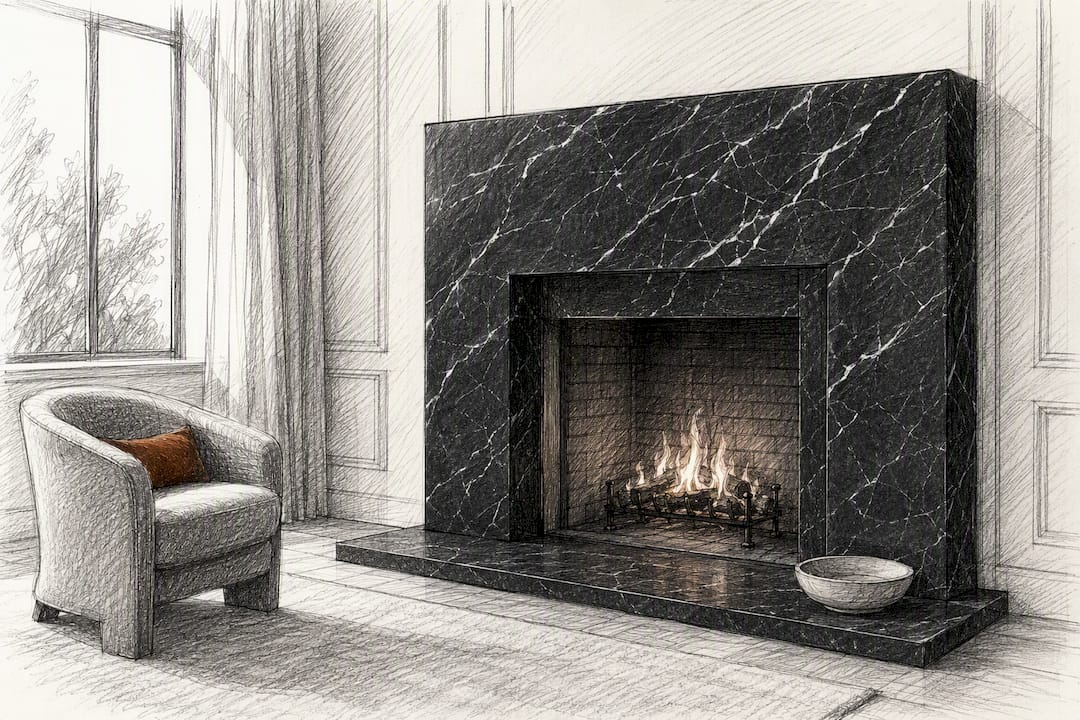
Designers increasingly reach for it in modern and mid-century schemes, where a single black surface anchors a room full of lighter tones, a trend that tracks with how marble’s natural variation reads as a design asset rather than a flaw.
Finish choice should follow how hard the surface works. Polished Marquina throws off the deepest black and the sharpest contrast with its veins, which makes it ideal for accent walls, fireplace surrounds, and low-moisture vertical surfaces. Honed Marquina, with its matte finish, hides etching and water spots better, so it’s the smarter call for shower floors, kitchen counters, and any area that sees regular contact with acidic foods or cleaning products.
- Bathroom vanities and powder room floors
- Backsplashes and accent walls
- Fireplace surrounds and mantels
- Selected countertops for lower-acid-exposure kitchens
Pro Tip: Pair Marquina with a warm-toned grout, like a soft gray or greige, rather than stark white. It keeps the veining as the visual star instead of competing with the grout lines.
What Sizes and Finishes Are Available?
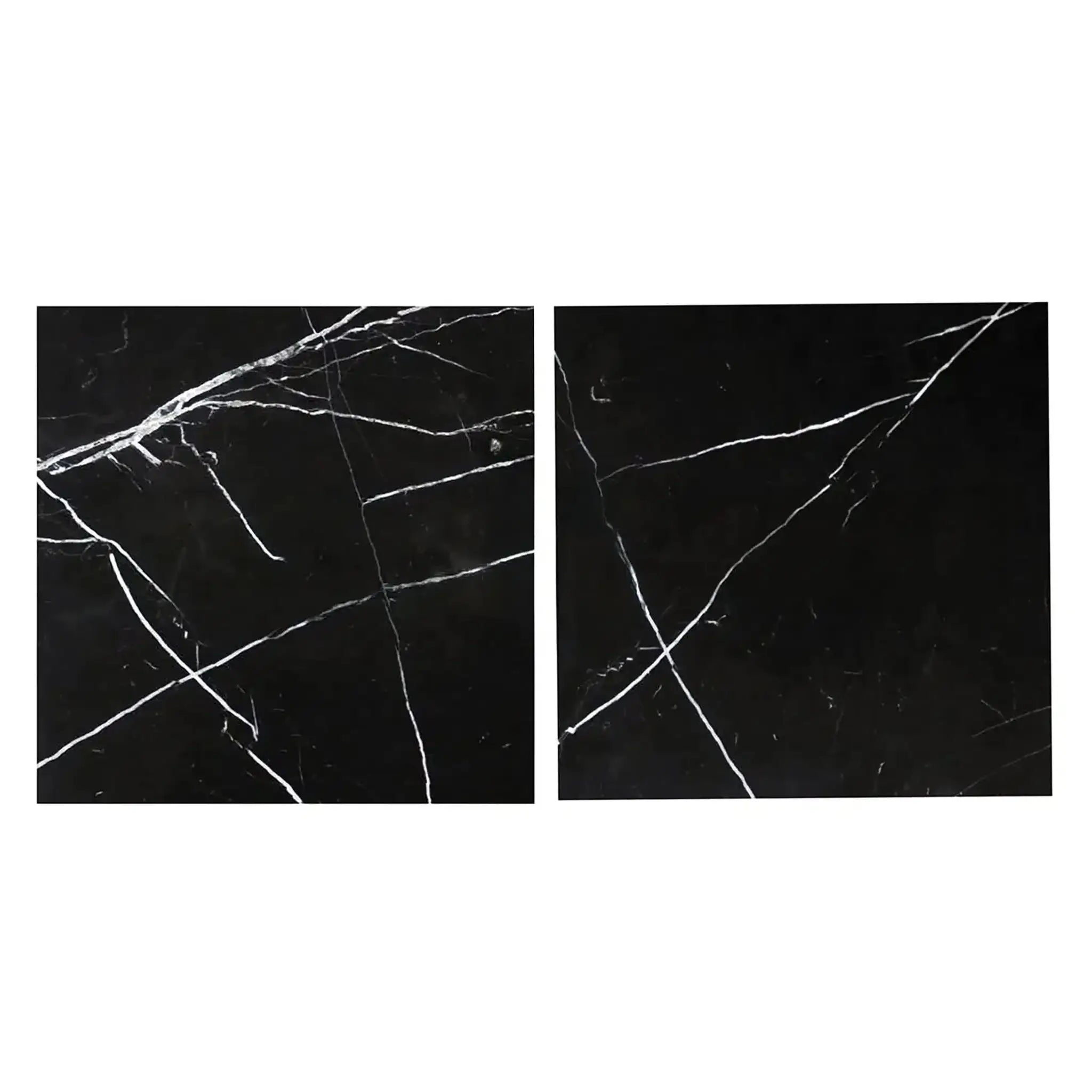
Buyers typically choose between tile and slab depending on the application, and each format comes with its own set of size and thickness options.
For floors, backsplashes, and accent walls, common tile formats include 3x6 inch pieces (often tumbled for a softer, aged look), and 18x18 or 24x24 inch tiles in polished or honed finishes for larger, more continuous surfaces. Slabs for countertops or feature walls generally run in 2cm or 3cm thicknesses, with the thicker option preferred for countertop edges that need to look substantial without extra buildup.
- 3x6 tumbled tile for mosaics, borders, and textured backsplashes
- 18x18 and 24x24 tile in polished or honed finish for floors and walls
- 2cm and 3cm slab thickness for countertops and feature panels
- Mosaic and molding pieces available for trim and decorative detailing
Stock tile is generally easier to source quickly and match across a project, since it comes from controlled production runs. Slabs are more particular. Because veining varies so much block to block, ask your supplier whether slabs come from the same lot before ordering for a large continuous run, and confirm ahead of time whether you’re buying stock inventory or placing a custom order.
How Much Does Black Marquina Marble Cost?
Price on Marquina marble is influenced by factors like grade, format, and shipping distance rather than color alone. Tile usually costs less than slab, honed finishes often cost less than polished, and imported lots with consistent veining can be more expensive than standard-grade material.
There’s a common assumption that black marble automatically costs more than white marble, but that’s not really how pricing works. Rarity, quarry output, and distribution chain matter more than color, according to pricing analysis on the stone. A well-supplied black stone can cost less than a rare white one, and vice versa.
Cost Snapshot: Marquina tends to price in the mid-to-premium range among natural marbles, largely because of import logistics and the labor-intensive fabrication its veining pattern demands. Ranges vary by supplier and lot, so treat any figure you see online as a starting point, not a quote. For a fuller breakdown of what drives marble pricing across the board, see this marble price per square foot guide, and for a side-by-side look at marble versus other stone categories, this marble versus granite cost comparison is worth a read.
Beyond the material itself, budget for:
- Fabrication and edge profiling
- Seam work on large countertop runs
- Installation labor, which varies by region and installer
- A waste allowance of 10 to 15% for cutting and matching
Always request a current quote rather than relying on a published range. Lot availability and import costs shift often enough that last year’s number rarely holds.
How Do You Seal and Care for Black Marquina Marble?
Because Marquina is porous and reacts to acid, sealing and daily habits do more to protect it than any single product purchase.
- Test before you seal. Drop a few tablespoons of water on the surface. If it darkens within a few minutes, the stone is absorbent and needs sealing.
- Choose a penetrating sealer over a topical coating for most installations. Penetrating sealers soak into the pores without changing the surface sheen, and sealing guidance from the Natural Stone Institute notes that sealer life expectancy varies widely by product, so check the manufacturer’s stated interval rather than assuming a fixed number of years.
- Clean daily with a pH-neutral stone cleaner and a microfiber cloth. Skip vinegar, lemon juice, bleach, and abrasive powders entirely. All of them etch or dull the surface.
- Wipe spills immediately, especially anything acidic like wine, coffee, or citrus.
- Treat dark stains with a poultice made for stone, left to sit and draw out the discoloration.
- Call a stone restoration professional for etching. Etches are surface corrosion, not stains, and refinishing typically requires professional honing or repolishing to fully remove.
Pro Tip: Keep a small sealed sample tile from your order. Test any new cleaning product on it first instead of risking the installed surface.
What Should You Check Before Buying Black Marquina Marble?
A little diligence before you order saves a lot of frustration during installation.
- Request full-slab photos, not just a corner swatch, so you can see the actual veining pattern
- Ask whether slabs for your project come from the same quarry lot
- Order a physical sample before committing to a large quantity
- Confirm polished versus honed finish in writing
- Verify delivery lead time and the supplier’s sample or return policy
Before finalizing, ask your fabricator these questions:
- Does the stone come pre-sealed, or will sealing happen after installation?
- Are any resin treatments applied to stabilize fissures?
- What sealer do you recommend for this specific finish?
- Can you recommend an installer experienced with natural stone, specifically marble?
For installation itself, a cementitious backer board or properly cured mortar bed gives Marquina the stable substrate it needs. Budget a waste allowance of at least 10% for cutting, and ask about beveled or bullnose edge profiles if you’re using it on a countertop. This installation guide for marble countertops walks through fabrication details worth reviewing before your installer starts cutting.
Surfaces Galore’s Nero Marquina Product Line
Surfaces Galore imports natural stone directly and ships it nationwide, which keeps Marquina marble tiles and other varieties available without the extra markup that comes from multiple middlemen, according to the company’s stated sourcing model.
Three Nero Marquina formats are currently in stock: 3x6 tumbled tile for mosaics and borders, 18x18 tile in polished or honed finish, and 24x24 tile for larger floor and wall runs. Samples and trade quotes are available directly through the site.
Is Black Marquina Marble Worth the Extra Care?
Choose Marquina when the project calls for real visual weight, a fireplace wall, a dramatic vanity, a backsplash that anchors the whole kitchen. It’s not the stone for a family bathroom floor that sees muddy boots and dropped toothpaste tubes daily.
If you love the look but want less risk, go honed and keep it off high-acid, high-traffic surfaces. Polished belongs on the walls and accents where it’s admired, not abused.
— John | Surfaces Galore
Ready to Order Samples or Get a Quote?
Some suppliers reduce distributor layers which can make them a preferred source for designers and contractors seeking hard-to-source stone like Marquina instead of searching multiple regional suppliers.
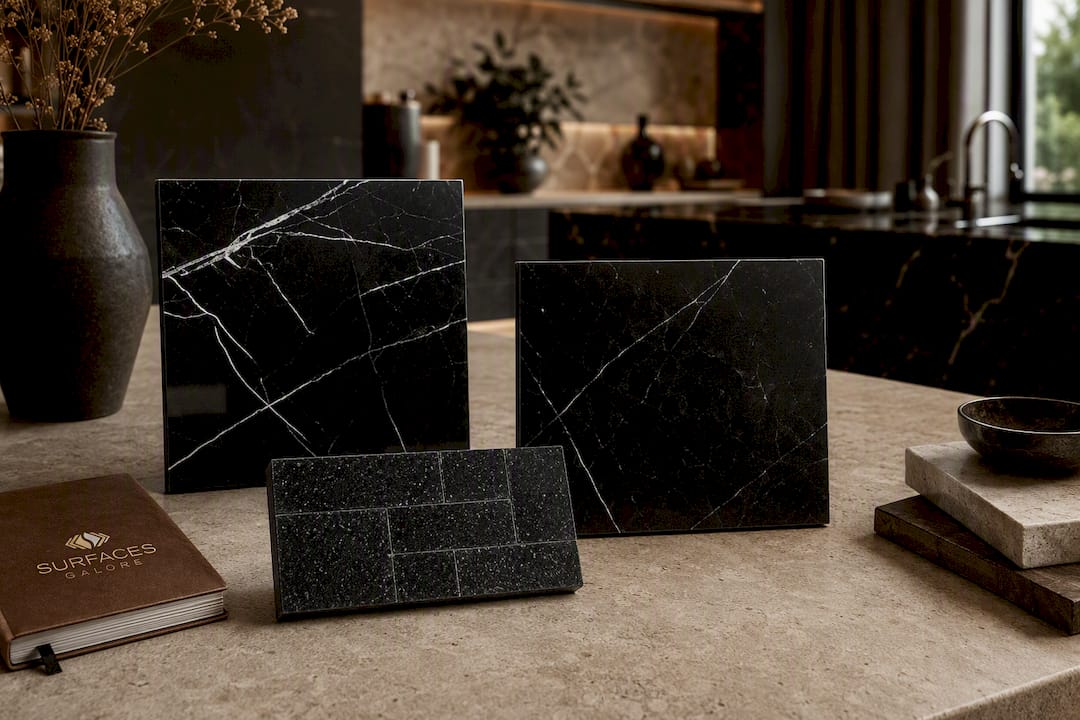
Each in-stock format has its own product page: the 3x6 tumbled tile for mosaic and border work, the 18x18 polished or honed tile for mid-size floor and wall runs, and the 24x24 polished or honed tile for larger, more continuous surfaces. Every listing supports sample ordering, so you can hold the actual veining pattern and finish against your cabinetry or fixtures before committing to a full order. Contractors and designers working on bulk or commercial projects can request a trade quote directly through the site.
Browse the full marble, travertine, and limestone selection or head straight to the tile and mosaic collection to compare Marquina against other natural stone options, then request your samples to start planning the install.
Sources
- Nero Marquina marble — Wikipedia
- Nero Marquina — Stone Intelligence
- Sealing natural stone — Natural Stone Institute
FAQ
What Is Black Marquina Marble?
Black Marquina marble, also known as Nero Marquina, is a black calcitic marble with white calcite veining, quarried near Markina-Xemein in Spain’s Basque Country. It’s used for backsplashes, accent walls, bathroom surfaces, and selected countertops.
What Is the Price of Black Marquina Marble?
Price depends on grade, format, and finish rather than a fixed rate, since import logistics and quarry supply drive cost more than color. Check current listings on Surfaces Galore’s product pages or request a quote for exact pricing on your project size.
Is Nero Marquina Marble Expensive?
It typically falls in the mid-to-premium range among natural marbles, mainly due to import costs and the fabrication work its veining requires. It’s not the most expensive marble available, but it costs more than basic domestic stone options.
Is Black Marble More Expensive Than White Marble?
Not inherently. Pricing comes down to rarity, quarry supply, and distribution rather than color itself, so a common black marble can cost less than a rare white one, and the reverse holds too. Always compare specific grades and lots rather than assuming color dictates price.
Recommended
- Nero Marquina Marble Guide For Interior Designers– SurfacesGalore
- Spec Ready Crema Marfil Marble for Designers & Contractors, 3 Grades– SurfacesGalore
- 4 Phase Marble Design Checklist for Homeowners and Design Pros– SurfacesGalore
- How Marble Forms, Why It Etches: For Designers & Homeowners– SurfacesGalore
This article is provided for general informational guidance only. Natural stone varies in color, veining, texture and performance. For installation, sealing, cleaning and maintenance, follow the product manufacturer’s instructions and consult a qualified installer or stone-care professional. Always test cleaning and sealing products in an inconspicuous area first. Surfaces Galore is not responsible for damage, discoloration, etching, staining, installation issues or other problems resulting from
Leave a comment