

Is Marble More Expensive Than Granite? 2026 Guide

Marble is generally more expensive than granite. Installed prices for granite typically run $40–$175 per square foot, while marble usually falls in the $65–$250 per square foot range for the same scope of work. At the planning stage, RealSimple puts the practical averages at roughly $75/ft² for granite and $100/ft² and up for marble; premium varieties push past $200/ft².
Three factors account for most of that gap:
- Slab rarity and grade. Some premium marble varieties are sourced in more limited quantities, making their material costs higher than many common granite types.
- Fabrication and edge work. Marble’s softness means it requires more careful handling during cutting and finishing; complex edge profiles add similar labor costs across materials but represent a larger share of cost on pricier slabs.
- Maintenance expectations. Marble typically requires more frequent sealing and occasional professional re-polishing, increasing lifetime maintenance costs relative to granite.
That said, the gap is not fixed. Entry-level Carrara marble can land at a similar price to mid-range granite, and remnant slabs or smaller projects can flip the math entirely.
Key Takeaways
Marble is generally more expensive than granite, but fabrication complexity and slab grade matter as much as the material itself when comparing final installed costs.
| Point | Details |
|---|---|
| Installed price ranges | Granite runs $40–$175/ft² installed; marble typically runs $65–$250/ft² installed. |
| Fabrication often dominates cost | On complex jobs, fabrication and installation can exceed the material cost share of the total quote. |
| Marble variety determines tier | Carrara can match mid-range granite pricing; Calacatta sits firmly in the premium tier. |
| Lifetime maintenance adds up | Marble sealing every 6–12 months and re-polishing every 3–7 years add $600–$2,000+ over 10 years. |
| Surfacesgalore direct import | Surfacesgalore sources marble directly, reducing supply-chain markup for homeowners and contractors nationwide. |
Table of Contents
- How installed prices compare: granite vs. marble at every budget level
- What actually drives countertop cost: material, rarity, and fabrication
- Why fabrication and installation often cost more than the slab itself
- Durability, maintenance, and what marble really costs over time
- When marble can actually cost the same as or less than granite
- How to get quotes that are actually comparable
- A sourcing perspective that changes the math
- When marble makes sense and when granite is the smarter call
- Natural stone, direct from the source
- Sources
- FAQ
How installed prices compare: granite vs. marble at every budget level
The table below maps typical installed price ranges to budget tiers for both materials, with specific marble varieties placed where they realistically land in 2026.
| Tier | Granite (installed/ft²) | Marble (installed/ft²) | Marble examples |
|---|---|---|---|
| Budget | $40–$75 | $65–$100 | Carrara (standard grade) |
| Mid-range | $75–$100 | $100–$150 | Vermont Danby, mid-grade Carrara |
| Premium | $120–$175 | $160–$250 | Calacatta, Statuario |
Carrara is the most widely available Italian marble in the U.S. and sits at the lower end of the marble price spectrum. It’s the variety most likely to overlap with mid-range granite on a per-square-foot basis. Vermont Danby, quarried domestically in Vermont, offers a bright white background with subtle gray veining and typically prices in the mid-range tier, with the added advantage of shorter shipping distances for East Coast projects. Calacatta, with its bold, dramatic veining and relative scarcity, sits firmly at the premium end. A full breakdown of Calacatta characteristics and pricing is worth reviewing before you budget for that tier.
Regional labor rates and slab availability create wide local variance. A quote in rural Texas will look very different from one in Manhattan for the same material and edge profile.
What actually drives countertop cost: material, rarity, and fabrication
Most homeowners focus on the material price per square foot, but that number is often the smaller part of the final invoice on a complex job.
Material cost vs. the rest of the quote
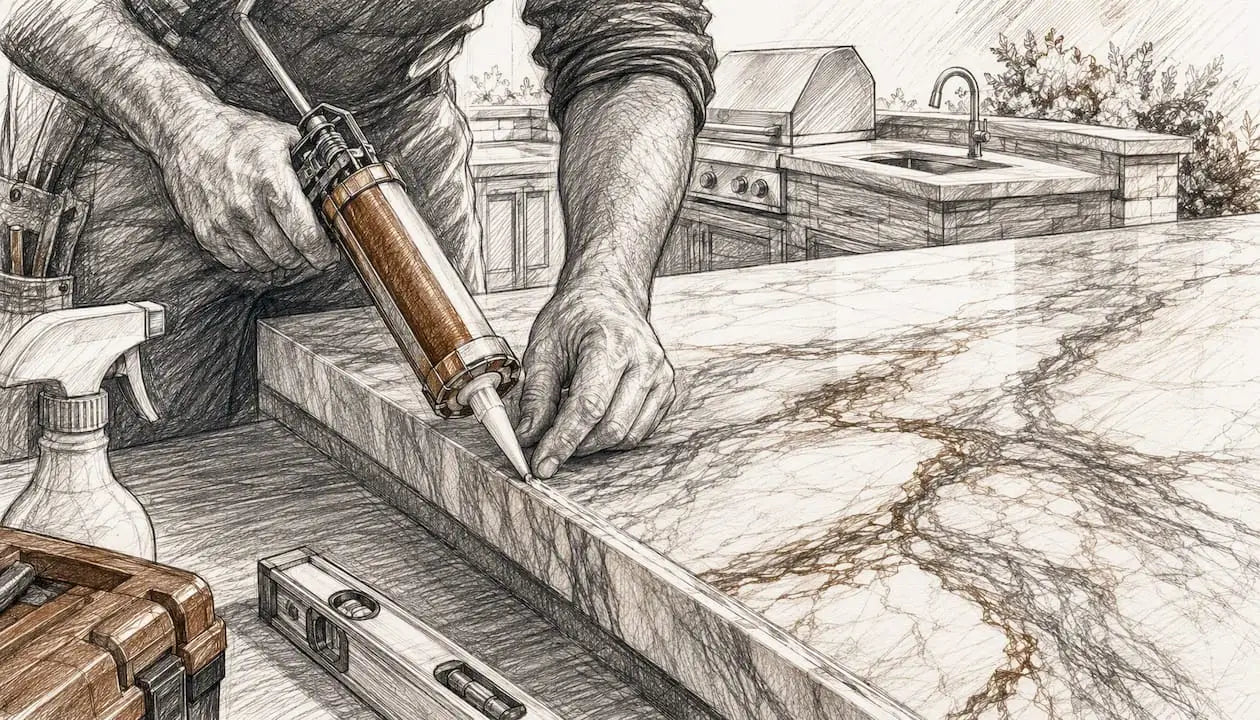
On straightforward installs, material can represent roughly one-third of the total installed cost, with fabrication and installation making up the remaining share. On jobs with complicated seams, waterfall edges, or multiple sink cutouts, fabrication and installation can exceed material costs entirely. That dynamic matters because it means two quotes with similar material prices can still differ by hundreds of dollars based on shop rates and job complexity alone.
How slab rarity and veining affect price
Calacatta slabs are more expensive than Carrara not just because of aesthetics but because of supply. Fewer quarries produce it, yield rates per block are lower, and demand from luxury residential and hospitality projects keeps prices elevated. Thickness also matters: 3 cm slabs cost more than 2 cm slabs and require less reinforcement, which can offset some of the price difference on large kitchen islands.
Edge profiles, cutouts, and backsplashes
A straight eased edge adds minimal cost. An ogee or waterfall edge on a kitchen island can add $15–$30 per linear foot in fabrication time alone. Sink cutouts, cooktop openings, and mitered backsplash pieces each add labor hours that show up as line items.
Pro Tip: Ask your fabricator for a line-item quote that separates material, templating, edge work, cutouts, and installation travel. Many remodelers are surprised to find that a $200 “template fee” and a $150 “travel charge” were never mentioned in the initial estimate.
Why fabrication and installation often cost more than the slab itself
Two kitchens with identical square footage and the same material can produce quotes that differ by $1,500 or more. The reason is almost always in the fabrication and installation details.
Fabrication steps that add real cost
- Templating: A fabricator visits your home to create a precise template of your cabinets. This step is billed separately by many shops ($100–$250 is common).
- CNC cutting and hand polishing: Marble’s softness means edges chip more easily during cutting, requiring slower machine speeds and more hand finishing time.
- Sink cutouts: An undermount sink cutout typically adds $100–$200 per opening.
- Reinforcement: Thinner marble slabs (2 cm) over large spans often need fiberglass mesh or rod reinforcement, which adds material and labor cost.
- Seam placement and polishing: Visible seams in dramatic-veined marble like Calacatta require careful bookmatching and hand blending, which is time-intensive.
Installation variables that move the final number
Understanding these line items before you call a fabricator puts you in a much stronger position to compare quotes on equal terms. For a closer look at how installation complexity affects marble projects, the specifics are worth reviewing before your first site visit.
Durability, maintenance, and what marble really costs over time
Upfront price is only part of the story. Marble and granite behave very differently over years of daily use, and those differences translate directly into recurring costs.
Hardness and scratch resistance
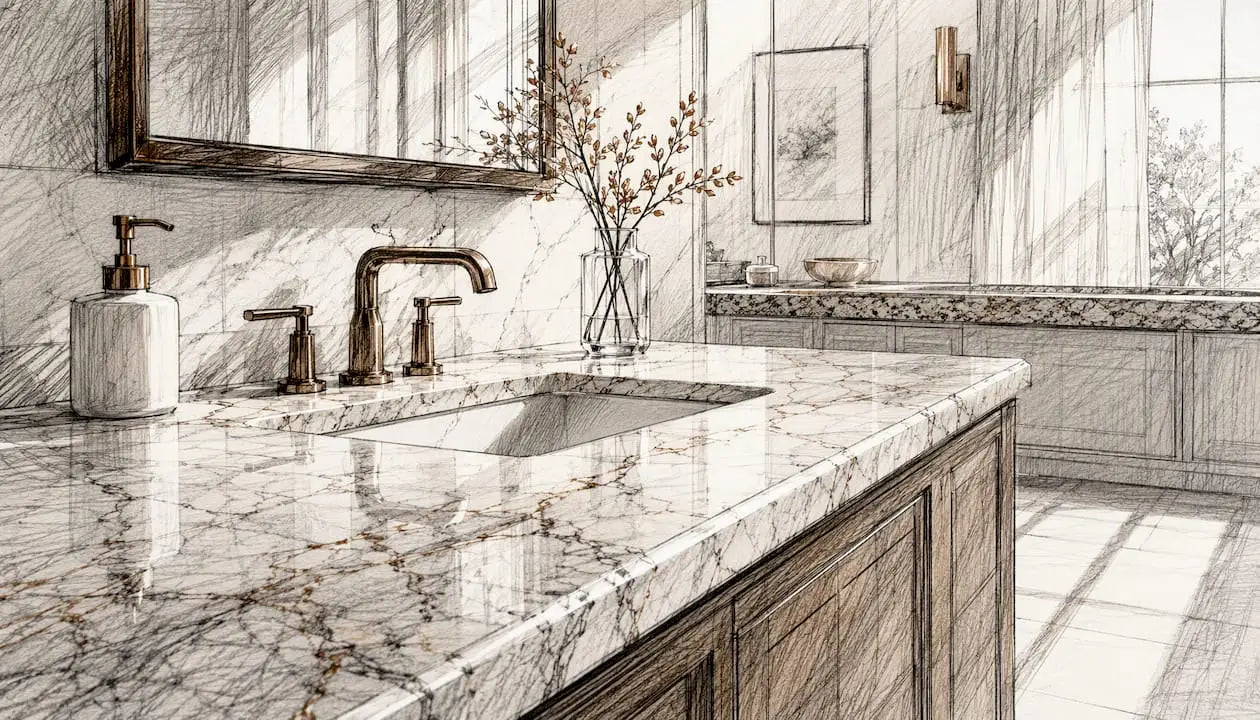
Marble sits at roughly 3–5 on the Mohs hardness scale, while granite typically measures 6–7. That two-point gap is meaningful in a kitchen: granite resists scratching from knives and pots far better than marble does. For a bathroom vanity or a dedicated baking counter, the lower hardness is less of a daily concern.
Staining vs. etching: a critical distinction
Sealing protects marble from liquid absorption, but it does not prevent etching. Etching is a chemical reaction between acidic substances (lemon juice, vinegar, wine) and marble’s calcium carbonate surface. The result is a dull, slightly rough patch that sealer cannot stop and that typically requires professional re-polishing to remove. Granite does not etch.
Maintenance schedules and recurring costs
- Marble sealing: every 6–12 months, depending on use and finish
- Professional marble re-polishing: every 3–7 years, typically $200–$600 per visit
- Granite sealing: every 1–3 years for most varieties; many granites need minimal sealing
- Granite re-polishing: rarely needed under normal use
Over a 10-year period, marble maintenance costs can add $600–$2,000+ to the total cost of ownership depending on kitchen traffic and the finish chosen. That figure shifts the marble vs. granite cost analysis meaningfully for high-use kitchens.
Pro Tip: A honed (matte) marble finish hides etch marks far better than a polished surface. If you love marble but cook frequently with acidic ingredients, honed is the practical choice. You’ll still need to seal and re-polish, but the visual impact of daily etching is dramatically reduced. Learn more about marble countertop finishes and benefits before committing to a surface.
Marble does carry a resale advantage in many markets. Natural-stone kitchens, particularly those with marble, tend to sell faster and at higher prices in many U.S. markets, which can offset some of the upfront and maintenance premium for homeowners planning to sell within 5–10 years.
When marble can actually cost the same as or less than granite
The assumption that marble always costs more than granite is not always accurate. There are real situations where the math flips.
- Entry-level Carrara vs. premium granite. Carrara marble can price comparably to mid-range granite, while exotic granites with rare patterning (Blue Bahia, Volga Blue) routinely exceed $150/ft² installed. If you’re comparing a standard Carrara slab to a rare granite, marble may actually be the more affordable choice.
- Remnant slabs. Fabricators often sell remnant pieces (leftover cuts from larger jobs) at steep discounts. A bathroom vanity or small baking island, typically 10–20 square feet, can often be completed with a remnant marble slab for less than a full granite slab would cost. For affordable marble slab options, remnants are worth asking about specifically.
- Thin-thickness installations. For wall cladding, backsplashes, or decorative applications, thinner marble tiles cost considerably less per square foot than full countertop slabs of either material.
- Small, localized projects. A powder room vanity or a pastry section of a kitchen island uses so little material that the per-square-foot price difference between Carrara and standard granite may amount to less than $100 total, making marble the more appealing choice for the aesthetic gain.
How to get quotes that are actually comparable
Getting three quotes and picking the lowest number is a reliable way to end up with a bad outcome. Here’s how to make quotes comparable before you choose.
Before you call a fabricator
- Measure your countertop area in square feet (length × width for each section, then add them up).
- Decide on slab grade and type: specify Carrara, Calacatta, Vermont Danby, or a granite variety by name.
- Choose your finish: polished, honed, or leathered.
- Pick your edge profile: eased, beveled, bullnose, ogee, or waterfall.
- List every cutout: undermount sink, cooktop, faucet holes.
- Request a fully itemized quote that separates material, templating, edge work, cutouts, travel, and installation.
Questions to ask every fabricator
- Where does your slab inventory come from, and can I see the actual slab before fabrication?
- What is your warranty on fabrication and installation?
- Is templating included in the quote or billed separately?
- Where will the seams fall, and can you show me on a drawing?
- Are travel and disposal fees included?
- Can you provide photos of completed jobs using this material?
Pro Tip: Always ask to see the actual slab, not just a sample tile. Marble and granite vary significantly from slab to slab within the same variety. A Carrara slab with heavy gray veining looks completely different from one with minimal veining, and both carry the same name on the invoice.
A sourcing perspective that changes the math
Direct importers source slabs earlier in the supply chain than most local stone yards, which can translate into lower material costs for the same grade of stone. When a fabricator sources through a distributor who sources through an importer, each step adds margin. Buying from a direct importer like Surfacesgalore, which brings marble, limestone, and travertine directly from quarry regions, removes at least one of those margin layers.
Choosing a slightly different marble variety can shift material cost by $20–$40 per square foot while delivering comparable or better visual impact at resale. A Vermont Danby slab, for example, offers a clean white background with subtle movement that photographs beautifully and often costs less than imported Calacatta, yet reads as premium to most buyers. The perceived value gap between the two is smaller than the price gap.
Pro Tip: When negotiating fabrication charges, ask whether the shop charges by the linear foot for edges or by the hour. Linear-foot pricing is predictable and easier to compare across shops. Hourly pricing on edge work can balloon if the fabricator encounters a difficult seam or a harder-than-expected section of stone.
When marble makes sense and when granite is the smarter call
Marble earns its premium in specific situations. A dedicated baking counter benefits from marble’s naturally cool surface, which keeps pastry dough from warming too quickly. A master bathroom vanity sees far less acid exposure than a kitchen, so etching is rarely a practical concern. And in a home where resale value is a priority, a marble kitchen island is a visual statement that photographs well and resonates with buyers.
Granite is the more practical choice for a family kitchen with young children, a high-traffic cooking surface where knives and pots are used daily, or any project where the maintenance schedule feels like a burden rather than a routine. Its hardness and resistance to etching make it genuinely lower-maintenance over a decade of real use.
The budget tier matters too. If your total countertop budget is under $5,000 installed, granite gives you more surface area and fewer maintenance concerns for the money. Above $8,000, the gap between a beautiful Carrara installation and a comparable granite narrows enough that the aesthetic and resale case for marble becomes worth the conversation.
Surfacesgalore carries a range of marble and granite options worth reviewing before you finalize your material choice.
Natural stone, direct from the source
Surfacesgalore imports premium marble, limestone, and travertine directly, shipping nationwide to homeowners, designers, and contractors from its Anaheim, California base. For a project where material cost matters, that direct-import model means you’re not paying distributor markup on top of importer markup on top of quarry price.
Whether you’re pricing a kitchen island in Carrara, evaluating Calacatta for a master bath, or looking for a remnant slab to keep a small project on budget, the Surfacesgalore team can help you match the right stone to your project scope and price target. National shipping means your local fabricator can work with stone sourced at a better price point than the regional yard may offer. Browse the marble collections at Surfacesgalore or request samples to evaluate slab quality before committing to a fabricator quote.
Sources
Price ranges, fabrication cost data, and maintenance guidance in this article draw from the following sources. Regional slab availability and local labor rates vary significantly, so treat all figures as planning benchmarks and verify current pricing with local fabricators and stone suppliers.
- Granite vs Marble Countertops 2026 | SlabWise
- Stone Countertops Cost Guide | HomeGuide
- Marble countertop pros and cons | RealSimple
- Marble Countertops in the Kitchen: Is It Worth It? – Dynamic Stone Tools
- Marble countertops pros, cons and costs | Harvey Jones
FAQ
Which is more expensive, marble or granite?
Marble is generally more expensive than granite. Installed granite typically runs $40–$175/ft², while marble runs $65–$250/ft², though entry-level Carrara marble can overlap with mid-range granite pricing.
What is the main disadvantage of marble countertops?
Marble etches when it contacts acidic substances like lemon juice or vinegar. Etching is a chemical reaction that sealer cannot prevent, and removing etch marks typically requires professional re-polishing at $200–$600 per visit.
Is Carrara marble cheaper than most granite?
Carrara is the most affordable widely available marble and can price similarly to mid-range granite. Premium granites with rare patterning often cost more than standard Carrara installed.
How much does marble countertop installation add to the material cost?
Fabrication and installation can represent the larger share of the total installed cost on complex jobs, sometimes exceeding the material cost itself. Templating, edge work, sink cutouts, and travel fees are the most common line items that push quotes higher.
Does marble add resale value compared to granite?
Both materials add perceived value, but marble tends to carry a stronger visual premium in many U.S. markets. Natural-stone kitchens with marble can sell faster and at higher prices, which can offset some of the upfront cost for homeowners planning to sell within 5–10 years.
Leave a comment