
Natural Stone Tile Freight Delivery: What Buyers Must Know

For most U.S. orders of natural stone tile, palletized LTL (less-than-truckload) freight with a liftgate and documented inspection at delivery is the best balance of cost and damage protection. Full truckload (FTL) makes sense for large project orders, and parcel carriers should handle samples only.
Before your first pallet ships, plan for these three things:
- Accessorials: Book liftgate service if you have no loading dock. Residential addresses almost always need it.
- Documented inspection: Inspect every pallet before signing the Bill of Lading (BOL). Note any damage in writing on the BOL itself.
- Declared value / insurance: Confirm coverage with your seller before the shipment leaves the warehouse.
Every buyer’s pre-delivery checklist: Confirm palletized LTL or FTL method with your seller. Verify liftgate is booked if you have no dock. Request a copy of the BOL and packing list before the truck arrives. Have a camera ready at delivery. Note all damage on the BOL before the driver leaves. Keep all original packaging until any claim is resolved.
Pro Tip: Ask your seller for pre-shipment photos of the crated pallets before they leave the warehouse. If damage appears at delivery, those photos prove the goods left in good condition, which dramatically strengthens a concealed-damage claim.
Table of Contents
- What shipping methods work best for natural stone tile freight delivery?
- How are freight costs calculated, and what should you ask for in a quote?
- How should natural stone tile be packaged to survive freight transit?
- What transit times should you expect, and how do you track your shipment?
- How do you inspect freight at delivery and file a damage claim?
- When does expedited or bulk-order shipping make sense?
- How do you prepare your job site to accept a heavy stone delivery?
- How Surfacesgalore handles shipping to protect your stone order
- Key Takeaways
- Why proper freight handling is worth every extra dollar
- Surfacesgalore makes nationwide stone shipping straightforward
- Useful sources
- FAQ
What shipping methods work best for natural stone tile freight delivery?
Natural stone tile is dense, brittle, and unforgiving of rough handling. The right shipping method depends on order size, delivery access, and how many times the freight changes hands.

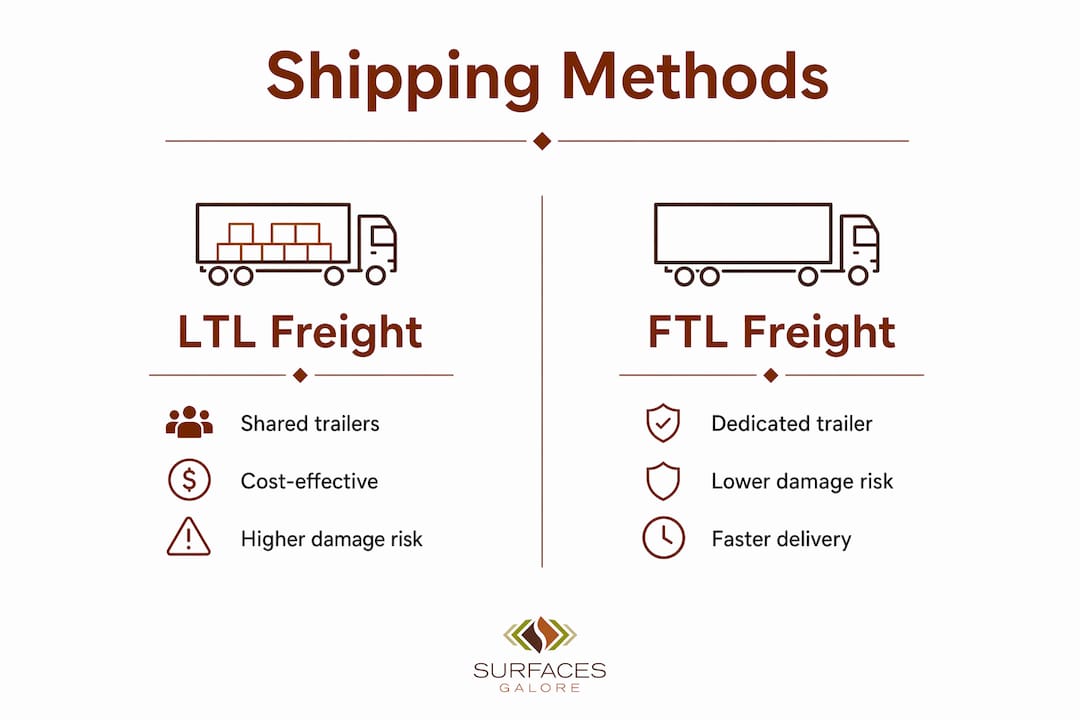
LTL pallet freight
LTL is the standard for most full orders. Your pallets share trailer space with other shippers’ freight, which keeps costs reasonable for mid-size orders. The tradeoff is that LTL shipments pass through one or more carrier terminals before reaching the final destination. Proper palletization with reinforced cartons, corner guards, and shrink-wrap is what keeps stone intact through those terminal handoffs. Without it, LTL is a breakage risk, not a cost saver.
Full truckload (FTL)
FTL dedicates an entire trailer to your order. No terminal stops, no co-mingling with other freight. For large project orders, the math often favors FTL because the per-pallet cost drops and damage risk falls sharply. If your order includes oversized slabs or requires a flatbed or tarped trailer, FTL is usually the only practical option. Oversize loads may also require state permits and route planning, which adds lead time.
Parcel carriers
Parcel networks use automated sortation systems with multiple high-impact handoffs. For a marble tile sample or a small mosaic accessory, that is fine. For a full order of stone tile, it is a reliable way to receive broken product. Reserve parcel for samples and decorative pieces under a few pounds.
Service levels explained
| Shipping Method | Cost Drivers | Service Level | Damage Risk | Typical Lead Time |
|---|---|---|---|---|
| LTL pallet freight | Weight, freight class, distance, accessorials | Curbside or liftgate | Moderate (terminal handling) | 3 to several business days |
| FTL (full truckload) | Mileage, trailer type, fuel surcharge | Curbside, inside, or white-glove | Low (no terminal stops) | 2–5 business days |
| Parcel carrier | DIM weight, zone, surcharges | Door-to-door | High (automated sortation) | 1–5 business days |
Curbside delivery means the driver drops the pallet at the curb or end of the driveway. You handle everything from there. Liftgate service uses a hydraulic platform on the truck to lower the pallet to ground level. Residential deliveries almost always need liftgate because a 53-foot trailer cannot back into a driveway. Inside delivery moves freight past the threshold, typically to a ground-floor room. It costs more and must be booked in advance.
How are freight costs calculated, and what should you ask for in a quote?
Stone tile freight rates are not simple. Several variables stack on top of each other, and missing one in your quote request can mean a surprise invoice at delivery.
Primary cost drivers
- Actual weight vs. dimensional (DIM) weight: Carriers charge whichever is higher. Stone typically weighs out before it cubes out, so actual weight usually governs. Tight packing and standardized panel formats reduce dimensional volume and keep costs in check.
- Freight class: LTL pricing uses the National Motor Freight Classification (NMFC) system. Stone tile generally falls into a lower freight class (denser = cheaper per pound), but misclassification adds cost.
- Distance and lane: Cross-country shipments cost more than regional ones. Carrier lane density also affects pricing.
- Fuel surcharges: These fluctuate weekly and are added on top of the base rate.
- Accessorials: Liftgate, residential delivery, limited-access delivery (job sites, gated communities), delivery appointment fees, and re-delivery charges are all billed separately.
Why the cheapest quote can cost the most
Carriers with stone-handling experience typically quote higher line rates but produce fewer damaged shipments. A carrier that saves you $80 on the base rate but delivers a cracked pallet costs you the replacement tile, the re-delivery fee, and the project delay. The lowest sticker price rarely yields the lowest total cost for stone shipments.
For import shipments, add customs documentation to your checklist. The Natural Stone Institute’s supplier-to-buyer manual recommends confirming U.S. Harmonized Codes, routing instructions, and shipping documents before the container departs to avoid port delays and penalties.
Quote checklist
- Full freight terms (prepaid, collect, or third-party billing)
- Complete accessorial list with per-item rates
- Estimated transit days (not just “3–5 days” — ask for origin-to-destination specifics)
- Carrier liability limits (standard LTL liability is often $0.10–$0.25 per pound, which rarely covers stone value)
- Declared-value or cargo insurance options and cost
- Fuel surcharge percentage at time of quote
How should natural stone tile be packaged to survive freight transit?
Stone is heavy but brittle. A pallet that shifts two inches in a turn can crack a dozen tiles. Packaging is the first line of defense, and buyers should know what proper packaging looks like before accepting a shipment.
Recommended materials and configurations
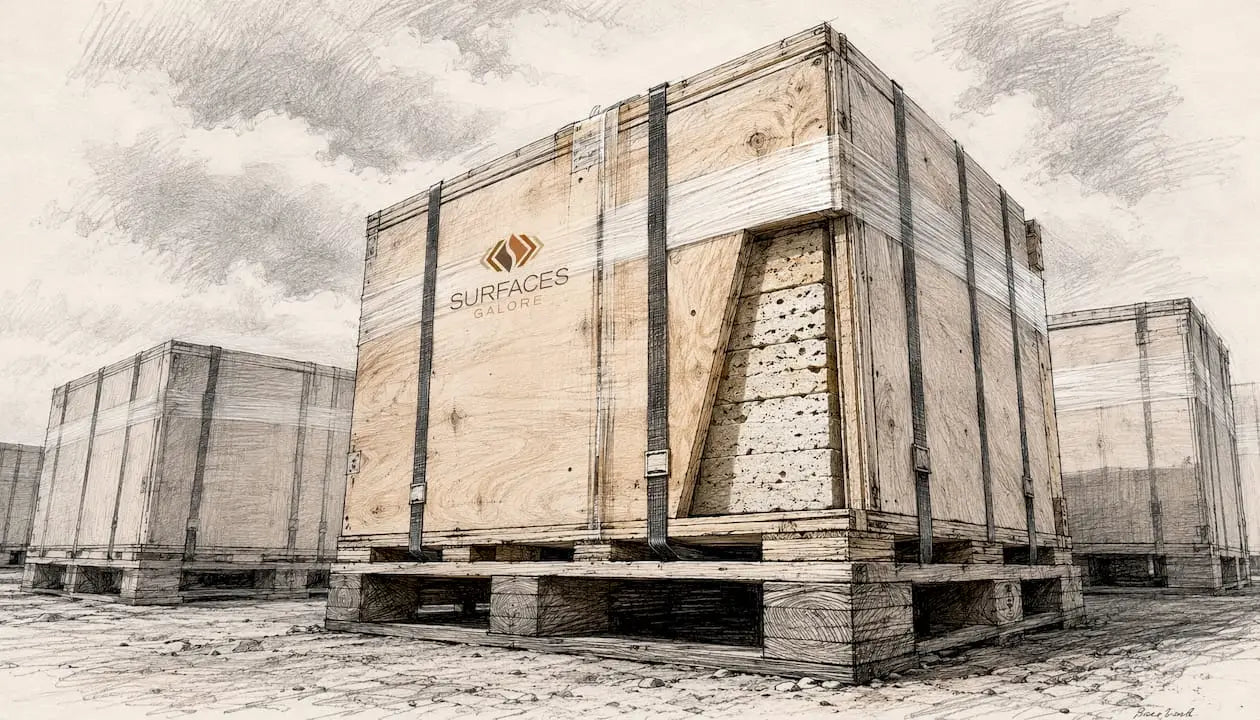
Export-grade plywood crates and reinforced 5-ply cartons are the industry standard for natural stone. Tiles and smaller panels go into reinforced boxes with foam or corrugated dividers between layers. Heavy slabs and large-format panels require plywood crating. A-frames are used for upright transport of slabs to distribute weight and prevent face-to-face contact. Industrial airbags or foam fill the void space inside crates to stop shifting during transit.
Palletization best practices
Proper weight distribution and protective packaging are essential. Heavier tiles should be placed near the bottom of the pallet, with lighter pieces on top. Use edge protectors, secure strapping, full shrink-wrap, and clear labeling to protect the shipment.
Packaging spec reference
| Element | Recommended Spec |
|---|---|
| Carton type | Reinforced 5-ply corrugated or plywood crate |
| Dividers | Foam sheet or corrugated layer between tile rows |
| Pallet size | 48 × 40 standard GMA pallet |
| Pallet weight range | Typically 1,500–2,500 lbs for tile orders |
| Strapping | Minimum 2-way steel or poly strapping |
| Outer wrap | Full shrink-wrap over strapped load |
| Labeling | BOL number, weight, “FRAGILE — HEAVY STONE” on 2+ sides |
Pro Tip: Request pre-shipment packing photos from your seller. A photo of a properly strapped, shrink-wrapped pallet before it leaves the warehouse is your baseline evidence if damage occurs at delivery.
What transit times should you expect, and how do you track your shipment?
Transit windows for LTL freight within the U.S. generally range from a few to several business days depending on distance for regional and cross-country shipments. FTL moves faster because it skips terminal stops, often resulting in shorter transit times for coast to coast shipments. Import shipments add ocean transit time plus customs clearance, which can add substantial additional time depending on origin port and U.S. customs workload.
Scheduling your delivery
Book liftgate and any inside-delivery services at the time you place the order, not the day before delivery. Carriers often cannot accommodate last-minute accessorial requests, and a truck that arrives without a liftgate at a residential address may leave and charge a re-delivery fee. Confirm a delivery appointment window with the carrier 24–48 hours before the scheduled date. For large project deliveries, coordinate with your general contractor or site manager so someone with authority to sign the BOL is present.
Tracking your shipment
Once your order ships, you should receive:
- BOL number: The master document for the shipment
- PRO number (or waybill number): The carrier’s internal tracking number, used to check status online
- Estimated delivery date: Confirm this directly with the carrier, not just the seller’s portal
- Carrier contact information: A direct number for the terminal handling your freight
Tracking escalation checklist:
- No PRO number within 24 hours of ship date? Contact your seller immediately.
- No ETA update within 48 hours of expected delivery? Call the carrier terminal directly using the PRO number.
- Shipment shows “out for delivery” but no one is on site? Call the carrier to reschedule before the truck attempts delivery, or you may face a re-delivery charge.
- Delivery is more than 2 days past the estimated date? Request a tracer from the carrier and notify your seller.
How do you inspect freight at delivery and file a damage claim?
Concealed damage is the biggest risk in stone tile freight. Carriers routinely deny claims for damage discovered after the driver has left, because they have no way to verify when or how it occurred. Your protection is the BOL, and you have a narrow window to use it.
Step-by-step inspection procedure
- Before the driver leaves: Walk the entire delivery. Photograph the crate seals, shrink-wrap, and pallet from all four sides before anything is touched.
- Check for external damage: Dents, crushed corners, broken strapping, and wet spots all indicate potential internal damage. Photograph everything.
- Open at least one carton per pallet while the driver is present. If you see cracked or chipped tiles, note it immediately.
- Write exceptions on the BOL. Use clear, specific language: “2 cartons crushed, possible tile damage” or “pallet corner damaged, tiles not yet inspected.” Vague notes like “subject to inspection” are sometimes rejected by carriers.
- Get the driver’s name and note it on your copy of the BOL.
- Keep all packaging. Do not discard boxes, crating, or strapping until the claim is fully resolved.
What to write on the BOL
Carriers accept short, factual exception notes. Examples:
- “1 carton wet, possible moisture damage”
- “Pallet wrap torn, 3 cartons show corner crush”
- “Crate side broken, tiles not yet fully inspected”
Claims documentation
Gather: signed BOL with exceptions noted, delivery receipt, photographs of damage, original packing list, and any pre-shipment photos from your seller. File the claim with the carrier as soon as possible. Most LTL carriers require claims to be filed within 9 months of delivery, but the sooner you file, the stronger your position.
When does expedited or bulk-order shipping make sense?
Speed costs money in freight, and the math is not always obvious. An expedited LTL shipment can be significantly more expensive than standard transit. A dedicated FTL load costs more upfront but often delivers faster and with less damage than expedited LTL through multiple terminals.
For large project orders, splitting into multiple trucks is sometimes smarter than one massive load. It reduces the risk of a single catastrophic delivery failure delaying an entire project. Schedule bulk deliveries during off-peak hours (early morning, mid-week) to avoid detention fees from congested job sites. Most truckload carriers charge detention after 2 hours of waiting, so having your crew and equipment ready before the truck arrives is not optional.
White-glove and inside-delivery services are worth the premium for high-value marble or custom-cut pieces. Fewer handling steps mean fewer opportunities for damage. For odd-shaped loads or very large slabs, tarped flatbeds and crane services are available through specialized carriers. Over-dimensional loads require state permits and route surveys, which add additional lead time to the shipping schedule. Plan accordingly.
For buyers ordering large quantities, the bulk ordering guide from Surfacesgalore covers quantity planning, documentation, and pre-shipment coordination in detail.
How do you prepare your job site to accept a heavy stone delivery?
A truck arriving at an unprepared site is an expensive problem. Re-delivery fees, detention charges, and damaged product from improvised unloading all add up fast.
Two days before delivery:
- Confirm the street can accommodate a 53-foot trailer (turning radius, overhead wires, low-hanging branches)
- Verify a forklift or pallet jack is on site with sufficient capacity for 1,500–2,500 lb pallets
- Identify a hard-packed, level staging area large enough for all pallets
- Confirm who will be present to sign the BOL and conduct the inspection
- Check whether parking permits are needed for the delivery vehicle
On delivery day:
- Have the BOL and packing list printed and ready
- Position the forklift or pallet jack before the truck arrives
- Clear the staging area of obstructions
- Assign one person to photograph the delivery and one to manage the driver
- Do not sign the BOL until the full inspection is complete
Residential deliveries require liftgate service when no dock is available. If you are at a residential address, confirm liftgate is on the order confirmation before the truck ships. A driver operating a large trailer cannot provide unloading labor and will not wait while you improvise a solution.
How Surfacesgalore handles shipping to protect your stone order
Surfacesgalore is a direct importer of marble, limestone, travertine, mosaics, and decorative stone, shipping nationwide from Anaheim, California. That direct-import model means tighter control over how orders are packed before they ever reach a carrier.
Orders ship on reinforced pallets with edge protection, strapping, and shrink-wrap as standard. Heavy slabs and large-format pieces are crated in plywood before palletizing. Liftgate service, delivery appointments, and inside delivery are available and can be coordinated at the time of order. For buyers who want visibility before the truck leaves, pre-shipment packing photos are available on request.
For import orders, Surfacesgalore coordinates shipping documentation including packing lists and declared-value coverage, so buyers are not scrambling for paperwork at the port or at delivery. Designers and contractors managing large projects can request a shipping quote or discuss special handling directly through the Surfacesgalore ordering team.
The step-by-step ordering guide for designers walks through pre-shipment documentation, quantity confirmation, and delivery coordination from start to finish.
Key Takeaways
Palletized LTL freight with liftgate and a documented BOL inspection is the most reliable approach for natural stone tile freight delivery across the U.S., and skipping any one of those three steps is where most claims and delays originate.
| Point | Details |
|---|---|
| Choose the right freight method | Use palletized LTL for most orders; FTL for large project loads; parcel for samples only. |
| Book accessorials in advance | Liftgate and inside delivery must be confirmed at order time, not on delivery day. |
| Inspect and document at delivery | Photograph damage and note BOL exceptions before the driver leaves to preserve claim rights. |
| Require proper packaging | Reinforced 5-ply cartons, plywood crates, edge protectors, strapping, and shrink-wrap are the standard. |
| Surfacesgalore ships nationwide | Direct-import control, pre-shipment packing photos, and liftgate coordination available on request. |
Why proper freight handling is worth every extra dollar
The buyers who get burned on stone freight are almost always the ones who optimized for the lowest line rate. A $120 savings on freight means nothing when a cracked pallet of travertine delays a bathroom renovation by three weeks and requires a re-order.
The real math is straightforward: fewer handling steps equal fewer damage events. Carriers with building-materials experience know how to load stone, how to block and brace pallets at terminals, and how to flag fragile freight for careful handling. That knowledge does not show up in a rate quote, but it shows up in your delivery condition. Paying a modest premium for a carrier with stone experience, booking the liftgate and requiring proper crating from your seller are the three decisions that separate a smooth delivery from a claims nightmare.
One more thing buyers consistently underestimate: the cost of project delay. A contractor waiting on replacement tile loses labor time, subcontractor scheduling, and sometimes the client’s confidence. The freight bill is a small line item in that context. Treat it accordingly.
Surfacesgalore makes nationwide stone shipping straightforward

Surfacesgalore ships premium marble, limestone, and travertine tiles nationwide from Anaheim, California, with the kind of packing and carrier coordination that most buyers have to figure out on their own. Every order ships on reinforced, strapped pallets. Liftgate service, delivery appointments, and inside delivery are available at booking. Pre-shipment packing photos are available on request, so you have documentation before the truck leaves.
For large project orders, the team can discuss freight options, help you plan delivery scheduling, and coordinate declared-value coverage. Browse the full collection or request a shipping quote at Surfacesgalore and get your project moving with stone you can count on.
Useful sources
- Natural Stone Institute: Supplier-to-Buyer Manual — import documentation requirements, BOL coordination, and customs preparation
- PartnerShip: 5 Key Things to Know About Shipping Stone — practical freight tips for stone shippers, including palletization and detention
- Natural Stone Institute / PartnerShip: BOL and Claims FAQ — BOL exception language, concealed damage procedures, and claims timelines
- Top Source Stone: Natural Stone Shipping and Breakage Control — packaging engineering, DIM weight, and LTL vs. parcel analysis
- Freight Specialist: Shipping Marble and Stone Safely — carrier selection, handling steps, and total-cost analysis
- LTL.delivery: Residential Freight Shipping — liftgate requirements, residential accessorials, and re-delivery fee avoidance
- Trinity Logistics: A Shipper’s Guide to Stone Transport — equipment selection, crating, and 3PL considerations for stone freight
- Surfacesgalore: How to Order Tile in Bulk Online — quantity planning, pre-shipment documentation, and bulk-order coordination
FAQ
What is the best way to ship large natural stone tiles?
Palletized LTL freight is the standard for most full orders of natural stone tile, with liftgate service booked in advance for residential or dock-free sites. For very large or project-scale orders, full truckload (FTL) reduces handling steps and damage risk.
Why is tile freight shipping so expensive?
Stone tile is heavy and dense, which drives up actual weight charges, and it requires accessorials like liftgate and residential delivery that are billed separately on top of the base rate. Specialized handling and proper packaging also add cost, but they reduce the far more expensive risk of breakage and re-orders.
Is natural stone considered a specialty freight item?
Yes. Natural stone tile is classified as specialty freight because it is simultaneously heavy and brittle, requiring reinforced packaging, careful palletization, and carriers with building-materials handling experience to minimize breakage.
How do you handle concealed damage on a stone tile delivery?
Photograph the crate, pallet, and any visible damage before signing, then note specific exceptions on the Bill of Lading while the driver is still present. Keep all original packaging and file a claim with the carrier as soon as possible, supported by photos, the signed BOL, and the packing list.
Can Surfacesgalore ship natural stone tile to residential addresses?
Yes. Surfacesgalore ships nationwide, including residential addresses, and can coordinate liftgate service and delivery appointments so your order arrives safely without requiring a loading dock.

Leave a comment