
Importer Tips for Oriental White Marble Buyers, Order 5–15% Overage

Oriental White marble, also sold as Asian Statuary or Eastern White, is a Chinese quarried stone with a milky white background and soft gray veining. It works well for homeowners and contractors who want a Carrara-like look without the Italian price tag, whether the project is a residential kitchen or a multi-floor commercial build. It suits budget-conscious luxury renovations and large-scale runs where matched slabs across many units matter more than a single showpiece vein.
TL;DR:
- Oriental White marble is a Chinese stone with variable quality, so verifying quarry origin and lot details before purchase is essential for large projects.
- The marble’s appearance ranges from bright white to ivory, with veining patterns that affect design choices, and finishes should match the application, such as polished for walls and honed for floors.
- Its density and strength are comparable to some grade white marbles, but higher porosity requires regular sealing and careful cleaning, especially around wet or oil-prone areas.
- To prevent mismatched batches, request physical samples, share lot photos, specify tolerance levels, and order extra slabs for future repairs.
- Proper long-term maintenance involves sealing every 9 to 18 months, using pH-neutral cleaners, and blotting spills promptly to preserve its appearance.
Table of Contents
- What Is Oriental White Marble and Where Does It Come From?
- What Does It Look Like, and Where Should You Use It?
- Is Oriental White Marble Durable Enough for Floors and Wet Areas?
- How Do You Buy Oriental White Marble Without Getting a Mismatched Batch?
- How Do You Clean and Maintain Oriental White Marble Long Term?
- Why Surfaces Galore Specifies Oriental White Marble
- Order Samples or Request a Project Quote from Surfaces Galore
- Sources
- FAQ
What Is Oriental White Marble and Where Does It Come From?
The primary source is Baoxing County in China’s Sichuan Province, with additional commercial supply tied to Guangxi quarries. Suppliers market the same stone under several names, which is why buyers get confused when comparing quotes.
Trade catalogs list it as Oriental White, Asian Statuary, or Eastern White, and all three terms typically point to the same quarry family. The naming varies because exporters position the stone against different reference points: some lean on the “Statuary” name to invite comparison with Italian Statuario, while others use “Eastern White” simply as a geographic descriptor. Neither name guarantees consistent lot quality, so verifying origin still matters before you commit to a large order.
Before finalizing a supplier, ask for:
- Written confirmation of quarry origin (Baoxing or another named source)
- Current lot number and slab photos matched to that lot
- Samples from the actual batch being shipped, not a stock catalog image
- Documentation on finish and any resin or fill treatment applied
What Does It Look Like, and Where Should You Use It?
Oriental White ranges from a bright, almost paper white to a softer ivory tone, and the veining falls into two general patterns. Some blocks show misty, feathered gray veining that spreads gently across the surface. Others show a more linear, directional vein that reads closer to classic Carrara. Neither pattern is better; the choice depends on your preferred design aesthetic.
Finish choice should follow the application:
- Polished finish suits feature walls, countertops, and book-matched entryways where you want maximum reflectivity and vein clarity.
- Honed finish works better on floors and bathroom wet zones, since the matte surface hides foot traffic wear and offers better slip resistance.
- Antique or acid-wash finishes give a softened, textured look for accent pieces or heritage-style interiors.
On sizing, common stock formats include 12x12 and 12x24 tiles for floors, 24x24 for larger commercial layouts, and slabs cut in various thicknesses depending on whether the piece is destined for a countertop, cladding, or a thin veneer application. Kitchen countertops, shower surrounds, and book-matched accent walls are the applications where this stone tends to earn its keep visually.
Is Oriental White Marble Durable Enough for Floors and Wet Areas?
Yes, with the right sealing routine. Technical data on Oriental Whitelists a bulk density around 2.68 g/cm³, placing it comfortably within the range of dimension stone used for flooring and cladding worldwide. That density figure matters because it correlates with how the stone handles foot traffic and structural loads over decades of use.
Water absorption runs somewhat higher than some Vietnamese or Indian white marbles, which is the trade-off buyers should understand going in. Higher absorption means the stone is more porous, and porous marble stains faster if left unsealed, particularly around kitchen counters exposed to oil, wine, or citrus.
Statistic Callout: Bulk density near 2.68 g/cm³ and moderate compressive strength put Oriental White in the same performance category as most commercial-grade white marbles, though its water absorption runs higher than some competing whites, which is why sealing schedule matters more here than with denser stones.
Pro Tip: Before installation, place a few drops of water on an unsealed sample and time how long it takes to absorb. If it disappears in under a minute, plan for more frequent resealing than you would with a denser Carrara-class stone.
Compared to Italian Carrara or Statuario, Oriental White generally costs less and ships in more consistent large-batch quantities, which is a real advantage for hotel lobbies, office floors, or any project requiring dozens of matched slabs rather than a single dramatic feature piece.

How Do You Buy Oriental White Marble Without Getting a Mismatched Batch?
Procurement mistakes on natural stone usually come down to skipped verification steps, not bad luck. A short checklist prevents most of them.
- Request physical samples, not digital renderings, from the exact lot you intend to order.
- Ask for slab photos with lot numbers so you can confirm vein direction and density before the material ships.
- Specify your acceptance criteria in writing: how much vein variation is tolerable, and whether book-matching is required for any wall or floor run.
- Order 5 to 15 percent overage beyond your calculated square footage, since trade guidance recommends this range to cover cutting waste and future repairs.
- Reserve a few extra slabs from the same lot if the project might need patching years down the road. Marble quarried later rarely matches perfectly.
Grading terminology varies by supplier, but most describe material in tiers based on vein consistency, color uniformity, and the presence of natural fissures or pits. Ask specifically what tier you’re being quoted, since “premium” and “commercial grade” mean different things depending on the exporter.
Lead times for imported stone commonly stretch several weeks to a few months, factoring in quarrying, cutting, and ocean freight. Large commercial buyers should also factor in customs clearance timing, especially if the installation schedule is fixed. For slab selection strategy on U.S. projects, building in buffer time before your install date avoids costly delays.
How Do You Clean and Maintain Oriental White Marble Long Term?
Marble is a long-term investment only if it’s sealed and cleaned correctly from day one.
- Seal polished surfaces every 12 to 18 months; honed floors and shower walls need resealing more often, roughly every 9 to 12 months, given higher exposure to moisture.
- Clean daily with a pH-neutral stone cleaner, and skip vinegar, bleach, or any acidic product, since these etch the calcium carbonate in marble almost instantly.
- Blot spills immediately, especially oil, wine, and citrus juice on kitchen counters, rather than wiping them across the surface.
- Call a restoration professional for etching or deep stains rather than attempting a DIY sand or acid fix, which usually makes the damage worse.
A simple contractor checklist: confirm sealer type before handoff, leave the homeowner written resealing intervals, and note which cleaning products to avoid on the final walkthrough. For broader guidance on maintaining stone across different room applications, matching the care routine to the specific finish matters as much as the stone choice itself.
Why Surfaces Galore Specifies Oriental White Marble
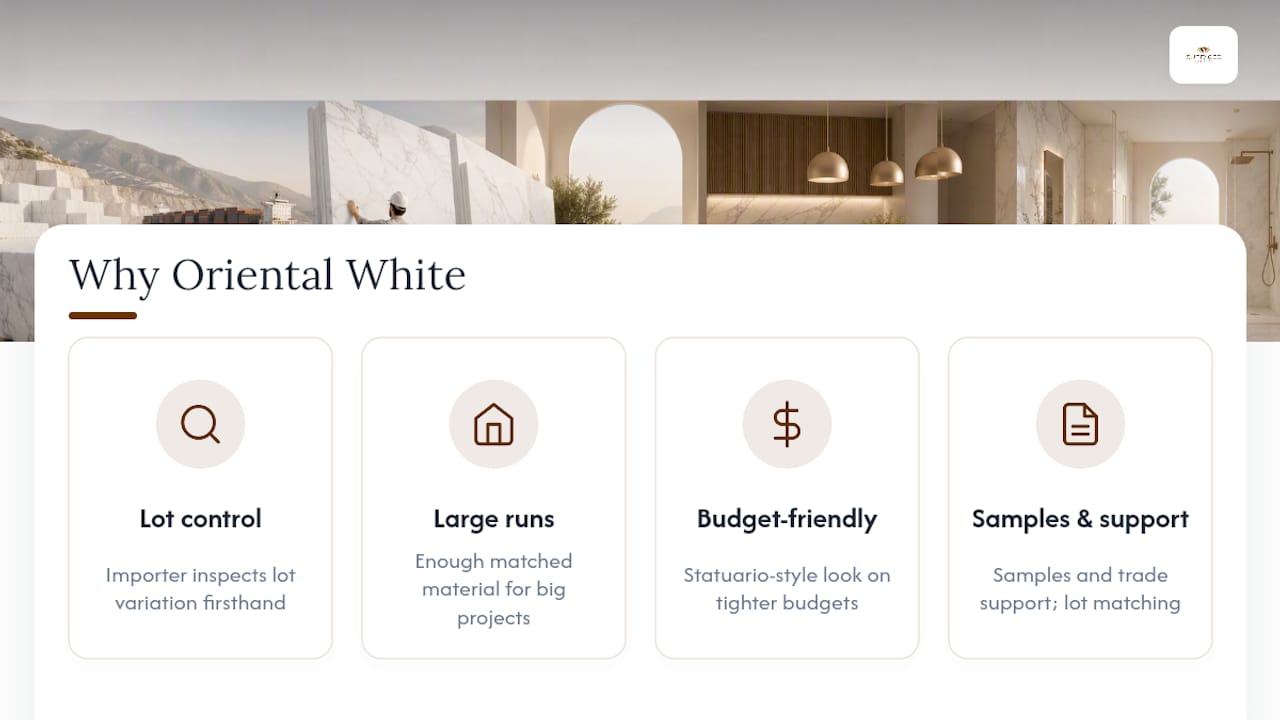
A direct importer sees the lot variation firsthand rather than relying on a broker’s description. We tend to recommend Oriental White when a client wants a Statuario-style look but needs enough matched material for a large kitchen run, a hotel corridor, or a full-floor commercial installation. It performs well against a tighter budget without asking the client to compromise on the finished look.
Samples may be available before any bulk commitment, along with trade support for architects and contractors managing multiphase orders. For projects needing custom cuts or bulk quantities, buyers often coordinate to match lots before material leaves the yard.
— cihan
Order Samples or Request a Project Quote from Surfaces Galore
Buying directly from importers can mean fewer markups between the quarry and the job site compared to purchasing through a multi-layer distributor chain. That difference shows up in both price and in how quickly we can pull matched lots for a large order.
If you’re weighing Oriental White against a Carrara-style import for a kitchen remodel or a commercial floor plan, start by requesting physical samples rather than relying on a screen. Some companies ship nationwide and support trade orders of various sizes, with bulk quotes handled directly by their teams. Contractors and designers working on full-room concepts might also find useful pairing ideas in current interior door trends when finalizing a cohesive look. To move forward, shop natural stone tiles today and request sample pieces or a bulk quote directly from our team.
Sources
- Oriental White Marble | China Factory Price - Stoneembassy
- Global White Marble Quarrying & Commercial Applications: A Technical White Paper
- Oriental White Marble - China Natural Stone Supplier - Sourcing Stone
FAQ
Where Is Oriental White Marble Originally From?
It comes primarily from Baoxing County in Sichuan Province, China, with additional commercial sourcing tied to Guangxi quarries.
Is Chinese Marble Good Quality?
Quality varies by quarry and lot, but Chinese quarries producing Oriental White supply material with bulk density and compressive strength figures comparable to other commercial-grade white marbles, provided you verify lot documentation before ordering.
What Is the Most Expensive Type of White Marble?
Italian varieties like Statuario and high-grade Carrara typically command the highest prices due to limited quarry output, while Oriental White offers a comparable look at a lower cost for large-volume projects.
What Is the Highest Quality White Marble Available?
There’s no single “highest quality” white marble; grading depends on vein consistency, color uniformity, and porosity, and top-tier lots exist within both Italian and Chinese quarry families. Buyers should compare specific lot samples rather than relying on the country of origin alone.
How Do I Clean Oriental White Marble Without Damaging It?
Use a pH-neutral stone cleaner daily, avoid vinegar or bleach, and blot spills immediately rather than wiping them across the polished or honed surface.

Leave a comment