

Silestone Calacatta Gold quartz countertops: Design, performance, and buying guide

Key Takeaways
Silestone Calacatta Gold quartz countertops bring a bright marble-inspired look to practical kitchen and bath designs. The right result depends on careful styling, accurate planning, and honest comparison with natural stone.
- A white ground and warm veining create an immediate focal point.
- Quartz generally offers simple daily care without routine sealing.
- Cabinet, hardware, backsplash, and lighting choices shape the final effect.
- Natural Calacatta Gold marble offers variation and authenticity that quartz interprets.
- Samples, slab review, fabrication details, and installation planning protect the investment.
What makes Silestone Calacatta Gold quartz countertops popular
Silestone Calacatta Gold quartz countertops appeal to homeowners who want the visual calm of pale stone with enough movement to make a room feel designed. The look is polished without being overly formal, and it works especially well when a countertop needs to carry much of the room’s personality. It is a useful starting point for both a full renovation and a focused island upgrade.
White backgrounds and dramatic gold veining
The defining combination is a light background crossed by expressive gold-toned movement, often accompanied by softer gray detail. That contrast gives the surface depth from across the room while retaining a clean overall impression. A large slab can make the pattern feel architectural; smaller applications can turn it into a concentrated accent.
The same visual language appears in natural stone collections too. Surfaces Galore describes its Calacatta Gold Marble as having a white background and dramatic gold veining, with tiles, slabs, mosaics, and backsplashes suited to varied applications. That comparison helps shoppers understand whether they prefer a controlled quartz interpretation or the naturally changing character of marble.
How the pattern complements modern and traditional interiors
In a modern kitchen, the veining softens flat cabinetry and adds warmth to streamlined forms. In a traditional room, it sits comfortably beside framed doors, painted millwork, and classic lighting. The key is proportion: let the countertop have movement, then repeat only one or two of its quieter tones elsewhere.
Warm metal hardware can bring out the gold, while matte black can create a sharper outline. Pale oak, cream paint, and medium-toned flooring tend to keep the room relaxed. The surface can also bridge separate areas when the kitchen opens into a dining or living space.
Why consistent styling appeals to homeowners and designers
A coordinated marble-look surface makes decisions easier because it establishes a palette early. Designers can select cabinet colors, wall finishes, and plumbing details around the slab rather than treating every material as an isolated choice. Homeowners benefit from seeing a clear visual direction before fabrication begins.
Consistency does not mean repetition everywhere. It means allowing the main veining to lead, using supporting finishes with restraint, and checking the result in daylight as well as evening light. That discipline is what keeps a dramatic countertop from becoming visually busy.
Key performance benefits to consider
A countertop has to look good after the photographs are taken. It must also suit cooking habits, cleaning routines, household traffic, and the realities of installation. Quartz is often considered for its practical daily behavior, while natural marble remains attractive to buyers who value authentic variation and a surface that develops character over time.
Resistance to everyday stains and spills
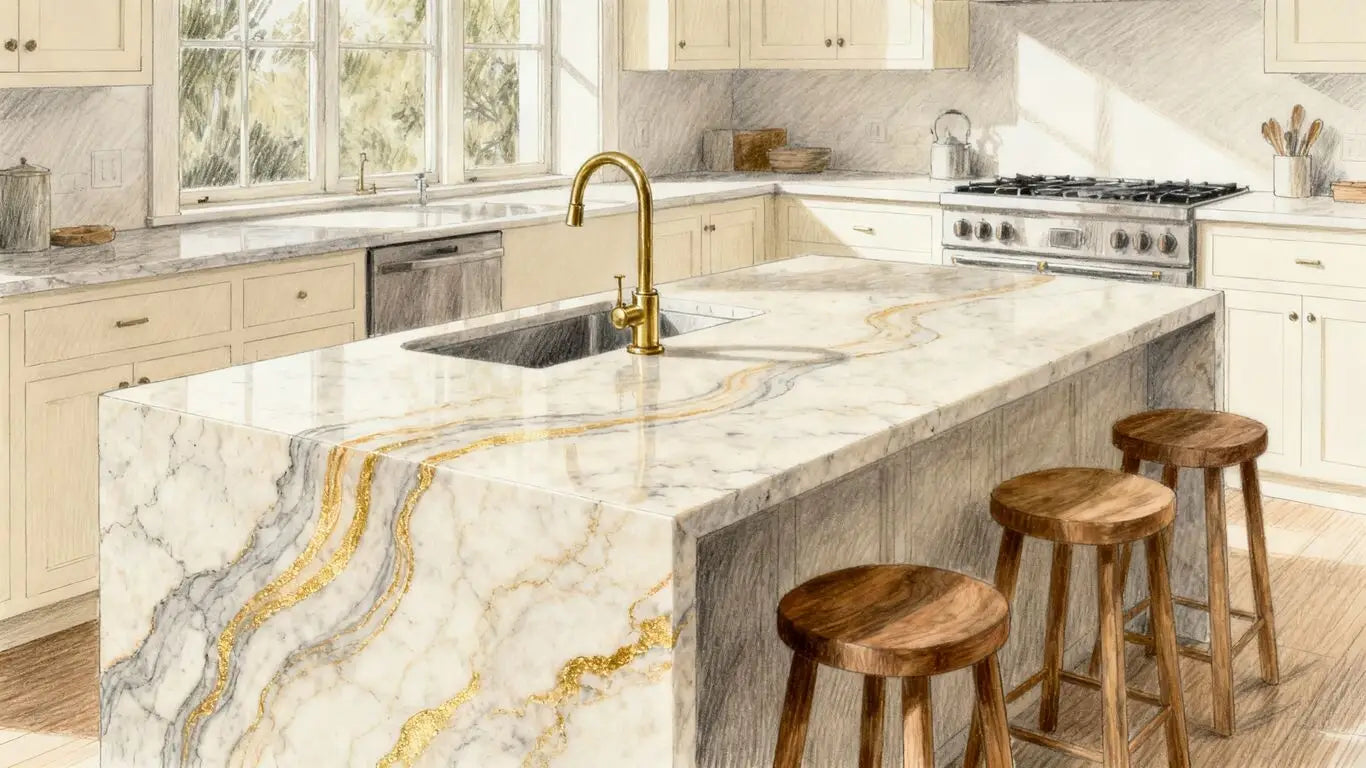
Non-porous quartz surfaces are widely chosen for resistance to ordinary kitchen spills and for the convenience of not requiring routine sealing. Still, resistance is not a reason to leave coffee, oils, or strongly colored ingredients sitting indefinitely. Wipe spills promptly and follow the care guidance supplied with the selected material.
The most useful question is not whether a surface is indestructible. It is whether its expected care matches the way the room is used. Busy households may value a straightforward routine, while a careful natural-stone owner may welcome the maintenance that preserves marble’s distinctive finish.
Low-maintenance care for busy kitchens and bathrooms
Daily care is usually simple: remove crumbs, use a soft cloth, and clean with a product approved for the surface. Avoid abrasive pads and unverified chemicals, since a harsh cleaner can dull the finish or leave residue. Bathrooms benefit from the same habit, particularly around sinks and grooming products.
A short routine is easier to maintain when the countertop design has accessible edges and sensible splash protection. It also helps to keep the manufacturer’s care instructions with the project documents. That small step prevents well-intended cleaning from becoming accidental surface damage.
Heat, impact, and scratch considerations
Quartz is durable for normal countertop use, but it should not be treated as heatproof. Use trivets beneath hot cookware, avoid dropping heavy objects on exposed edges, and use a cutting board rather than cutting directly on the surface. These precautions are modest, but they protect both the finish and the fabrication investment.
A practical care plan can be reduced to four habits:
- Place hot pans on trivets.
- Use boards for chopping and food preparation.
- Clean spills before they dry.
- Keep abrasive cleaners away from the finish.
These habits apply across many countertop materials, though the exact care instructions should always come from the product supplier. They also make it easier for guests and family members to use the kitchen confidently.
When professional installation matters
Professional installation matters when the layout includes long runs, seams, sink cutouts, waterfall ends, fragile corners, or a veining direction that must be coordinated. Fabricators account for support, overhangs, access, and the practical movement of a heavy slab through the home. A beautiful material can still disappoint if the joints and edges are poorly planned.
Ask who measures, who fabricates, who installs, and what each party is responsible for. Natural-stone suppliers may provide product information while responsibility for selection and installation remains with the customer, so written scope and careful review are worthwhile.
How to use Calacatta Gold in your design
Calacatta Gold works best when it is given a clear role. It can quietly connect a neutral kitchen, dominate a waterfall island, or add warmth to a bathroom vanity. Before selecting finishes, decide whether the stone is the background of the room or its central feature.
Coordinating cabinets, flooring, and hardware
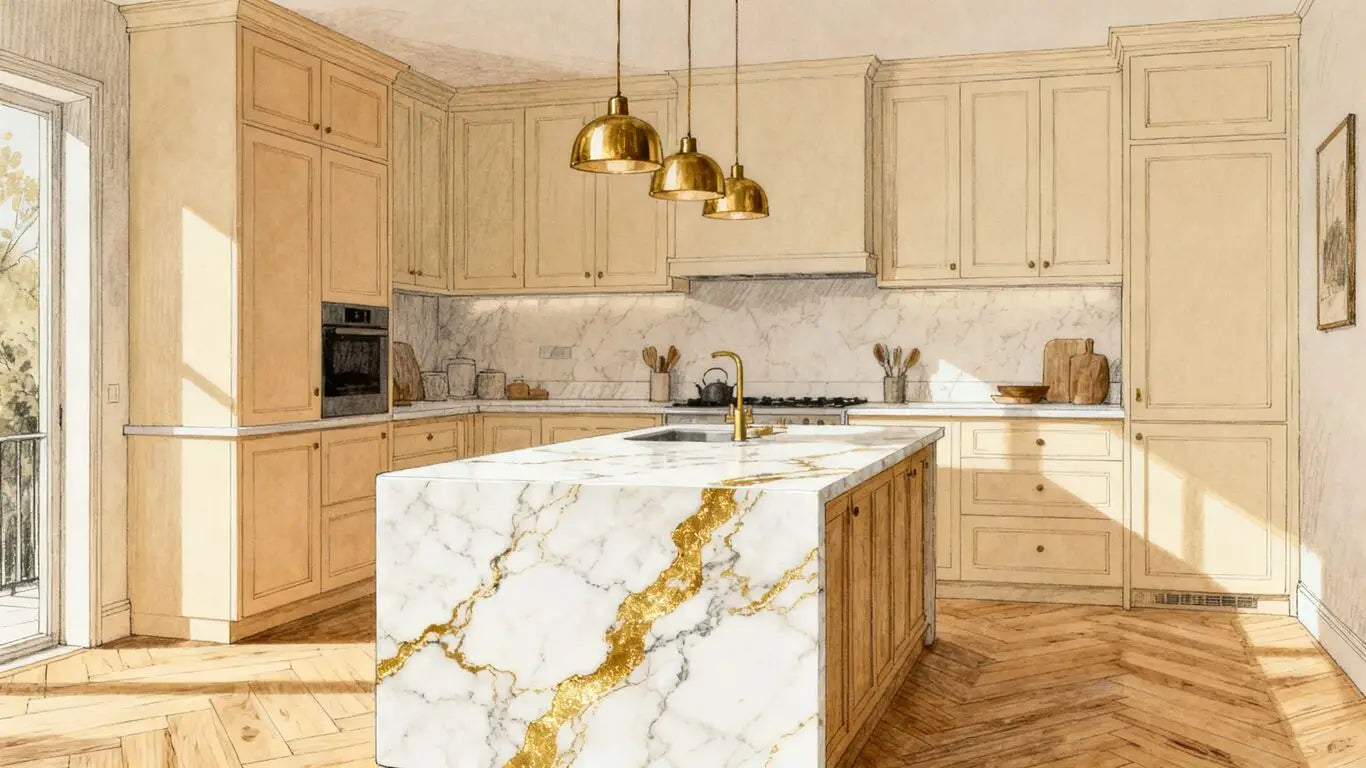
Start by identifying the dominant undertone in the slab. Cream cabinetry and brass hardware create a warm, layered room, while crisp white cabinetry and dark hardware produce stronger contrast. Flooring should support the countertop rather than compete with its movement, especially in open-plan layouts.
Bring physical samples together whenever possible. A cabinet chip that looks neutral online may read yellow beside a pale surface, and a metal finish can change noticeably under warm lighting. A restrained palette usually gives the veining more room to breathe.
Creating a statement kitchen island
An island is an ideal place to use a marble-look surface because it is viewed from several angles and naturally anchors the kitchen. A generous overhang can add seating, while a waterfall edge creates a more sculptural profile. The design should balance drama with clearance around appliances, walkways, and seating.
For strong movement, review how the vein will travel across the top and down any waterfall sides. The goal is not perfect uniformity; it is an intentional composition that looks considered from the main approaches to the room.
Pairing countertops with marble backsplash and wall tile
A marble backsplash can extend the pale background and create a quiet envelope around the countertop. Alternatively, a smaller-format natural stone tile can introduce texture without copying every line in the slab. Matching exactly is less important than coordinating background tone, scale, and finish.
Surfaces Galore offers Calacatta Gold marble tiles in several formats and finishes, including options suited to walls and backsplashes. Its Calacatta Gold 4x12 tiles are one example of a smaller format that can frame a kitchen or feature wall while keeping the countertop visually prominent.
Extending the look into bathrooms and commercial spaces
The same palette can move into a primary bath through a vanity, shower wall, or niche detail. In commercial interiors, it can support reception desks, hospitality counters, and carefully selected feature surfaces, provided the specification suits the traffic and maintenance plan. Repeating the material family rather than the exact product often creates the most natural connection.
For a larger property, document the selected finish, batch, edge profile, and cleaning method. That record helps keep several rooms visually related even when they are completed at different times.
Quartz versus natural Calacatta Gold marble
The decision between quartz and marble is not simply a choice between modern and traditional taste. It is a choice between a more controlled manufactured appearance and the one-of-a-kind variation of natural stone, as well as different care expectations. Both can be beautiful when selected for the project rather than for a trend alone.
Differences in veining, variation, and authenticity
Quartz patterns are designed to provide a repeatable marble-inspired impression, although individual slabs and layouts still deserve review. Natural Calacatta Gold marble forms through geological processes, so color, veining, fissures, and movement vary from piece to piece. That variation is part of its authenticity and cannot be fully predicted from a small photograph.
Surfaces Galore positions its Calacatta Gold marble as authentic natural stone and offers slabs, tiles, mosaics, and related products. Buyers who want a truly individual surface should expect to inspect the actual material and accept that natural variation is not a defect.
Comparing maintenance expectations
Quartz is commonly selected by people who prefer a non-porous, low-maintenance surface and do not want routine sealing. Marble generally calls for more deliberate care, including appropriate sealing and attention to acids, oils, and abrasive cleaning. Neither material removes the need for sensible use and prompt cleaning.
The right comparison is the routine you will genuinely follow. If you enjoy the patina and natural character of stone, marble may reward that care. If ease of everyday management is the priority, quartz may be the more comfortable fit.
Understanding durability and long-term value
Both options can serve for many years when correctly fabricated, installed, and maintained. Quartz offers a consistent design language and practical convenience; marble offers authenticity, depth, and natural variation that can make a space feel distinctive. Long-term value also depends on layout quality, edge details, workmanship, and whether the material suits the building.
Do not evaluate durability from a product label alone. Review the intended use, finish, thickness, support, exposure to heat, and maintenance requirements. A material that fits the household is usually a better investment than one chosen only for appearance.
Choosing the right surface for your project priorities
A simple decision framework keeps the discussion focused. Consider the following priorities before requesting fabrication pricing:
| Priority | Quartz may suit | Natural marble may suit |
|---|---|---|
| Daily care | A simpler, non-porous routine | A maintained, sealed surface |
| Appearance | A more controlled marble-look pattern | One-of-a-kind natural movement |
| Design direction | Consistent contemporary styling | Authentic character and variation |
| Project scope | Countertops and coordinated interiors | Slabs, floors, walls, and feature applications |
The table is a starting point, not a verdict. Bring the room’s use, your tolerance for maintenance, and the desired visual character into the final decision.
Planning your countertop purchase and installation
Good planning prevents expensive surprises. Countertop pricing reflects more than the visible square footage: cutouts, seams, edge work, slab yield, delivery access, and installation all affect the project. A careful brief gives the supplier and fabricator the information needed to respond accurately.
Measuring layouts, edges, sinks, and backsplashes
Record wall lengths, cabinet depths, appliance openings, sink dimensions, overhangs, and backsplash heights. Note walls that are out of square and any narrow passageways from the delivery vehicle to the installation room. The fabricator will verify field measurements, but early information improves the first estimate.
Choose the edge profile at the same time as the sink and backsplash plan. A small change in edge treatment can affect appearance, labor, and the amount of material required. For natural-stone tile work, the Calacatta Gold installation guide is a useful reference for layout, inspection, and maintenance considerations.
Reviewing slabs and matching visible veining
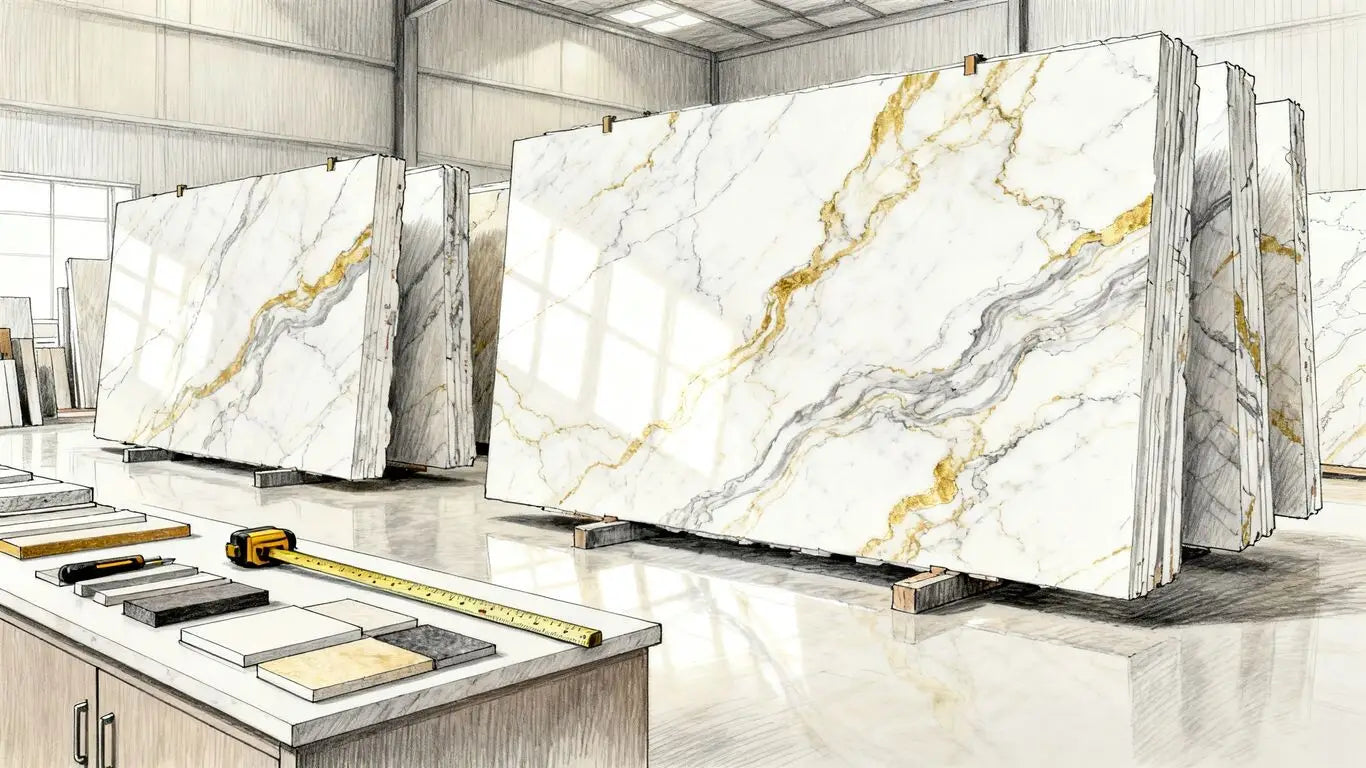
View full slabs when the countertop includes a prominent island or long uninterrupted runs. Mark the areas where seams, sinks, and cooktops will fall, then discuss whether the veining should flow, mirror, or simply remain naturally varied. Digital images are helpful, but they cannot replace seeing the actual slab under suitable light.
Ask about lot consistency and how remnants will be handled. A remnant may be ideal for a small vanity, while a large island usually benefits from a planned slab layout rather than a last-minute substitution.
Estimating material, fabrication, delivery, and installation costs
Request an itemized estimate. It should distinguish material, templating, fabrication, cutouts, edge finishing, delivery, installation, removal, and any special support or access requirements. For tile and natural stone projects, include grout, setting materials, sealing, waste, and trim where applicable.
Do not compare two quotes by square-foot price alone. A lower material figure may exclude fabrication or delivery, while a more complete proposal can be easier to manage. If you are planning a broader renovation, keep separate allowances for adjacent purchases such as a Piscines Ibiza pool project, AquaCalcium water filter, double sheepskin rug, Managed Service Provider, or IPTV service; these are separate decisions and should not be folded into the countertop allowance.
Confirming lead times, availability, and project requirements
Before placing an order, confirm current stock, estimated production time, delivery arrangements, and the date the site must be ready. Ask whether the material is sold by slab, box, or square foot, and verify nominal sizes for tile products. A written confirmation reduces confusion when several trades share the same schedule.
Also clarify inspection expectations and responsibility for final selection. Natural stone can vary, and the customer should approve the material and installation plan with that fact in mind. These details are practical, but they protect the design outcome.
How to source premium surfaces with confidence
A dependable purchase begins with clear product information and a supplier willing to discuss the project. Look for photographs of actual material, finish and size details, availability guidance, and straightforward communication about fabrication or installation. This is especially valuable when ordering from outside your local market.
Evaluating suppliers, slab quality, and product information
Review whether the supplier specializes in the type of surface you need and whether its descriptions explain applications, finishes, and natural variation. Ask for the country of origin when authenticity matters, along with thickness, dimensions, and care guidance. A premium appearance deserves equally careful documentation.
Surfaces Galore is an Anaheim, California–based direct importer and nationwide supplier of premium natural stone, specializing in marble and travertine tiles, mosaics, and moldings. Its Calacatta Gold collection includes slabs, tiles, mosaics, backsplashes, and shower-floor tile, giving buyers several ways to carry one design language through a project.
Ordering samples or viewing materials before committing
Samples help with undertones, but a full slab review is more reliable for a large countertop. Compare the sample against cabinet doors, flooring, paint, grout, and hardware in the actual room. If the project uses natural marble, remember that one sample cannot display every possible vein or color shift.
Ask about sample shipping, return policies, and whether the viewed material is representative of current stock. A short review before commitment can prevent a costly mismatch later.
Shipping materials nationwide from an Anaheim supplier
For customers outside Southern California, ask how material is packed, insured, scheduled, and inspected on arrival. Surfaces Galore serves homeowners, designers, and architects across the United States, and its direct-importer position can be useful for projects that need premium marble or travertine products shipped cross-country. Confirm delivery access and who is responsible for receiving the shipment.
If you are sourcing related surfaces, Calacatta Gold marble tiles can coordinate with a quartz countertop while adding authentic natural movement to a backsplash or wall. Keep the product type clear in the order so the fabricator and installer are working from the same specification.
Requesting a quote from Surfaces Galore for complementary natural stone products
A quote request should include room dimensions, preferred formats, finish, quantity, delivery ZIP code, and photographs or drawings when available. Surfaces Galore can provide a starting point for complementary natural stone products such as Calacatta Gold tiles, slabs, mosaics, backsplashes, and related marble or travertine materials. Requesting current stock and a written estimate is the most efficient way to compare options.
Use request a quote when you are ready to discuss quantities, finishes, and delivery needs. Samples and product information can then be reviewed alongside the countertop plan, rather than chosen in isolation.
CTA: Start Your Stone Project
Bring your countertop plan together with complementary marble or travertine surfaces from Surfaces Galore. Request current availability, discuss your quantities, and move toward a confident purchase with nationwide shipping support.
Conclusion
Silestone Calacatta Gold quartz countertops offer a bright, expressive foundation for kitchens, bathrooms, and other interiors, while natural Calacatta Gold marble brings its own variation and authenticity. The strongest result comes from matching the surface to your care preferences, reviewing the material in person, and planning fabrication, delivery, and installation before ordering. With those decisions in place, the finished space can feel both practical and distinctly personal.
Frequently Asked Questions
Are Silestone Calacatta Gold quartz countertops suitable for busy kitchens?
They can suit busy kitchens when homeowners want a marble-inspired appearance and a straightforward daily cleaning routine. Use trivets, cutting boards, and approved cleaners to protect the surface.
Does quartz need to be sealed like natural marble?
Many non-porous quartz surfaces do not require routine sealing, while natural marble commonly benefits from sealing and more attentive maintenance. Always follow the care guidance for the selected product.
Can Calacatta Gold work with dark cabinets?
Yes. Dark cabinetry creates strong contrast against a pale countertop and can make warm veining appear more pronounced. Balance the room with suitable lighting and flooring.
Should a full slab be viewed before ordering?
Viewing a full slab is wise for large islands, long runs, and layouts where vein placement matters. A sample is useful for color coordination but cannot show the complete pattern.
Is natural Calacatta Gold marble more varied than quartz?
Natural marble generally has more individual variation in color, veining, and geological character. Quartz is typically selected when a more controlled marble-look appearance is preferred.
What costs should a countertop estimate include?
Ask about material, templating, fabrication, cutouts, edge work, delivery, installation, removal, and any access or support requirements. Tile-related projects may also need allowances for setting materials, grout, sealing, and waste.
How can a backsplash coordinate with a Calacatta Gold countertop?
Choose a backsplash that relates to the countertop’s background tone and scale. A matching marble can create continuity, while a quieter tile can keep the countertop as the room’s main feature.
Leave a comment