
Top Decorative Mosaics: Styles, Materials & Buying Guide

TL;DR:
- Natural stone mosaics, including marble waterjets, mixed-stone inlays, and Byzantine styles, lead the market in 2026 due to their tactile, hand-crafted appeal. Homeowners favor earth-toned, textured surfaces in key rooms like kitchens and bathrooms, with natural stone offering longevity and visual richness that defy short-term trends. Proper batch ordering, sealing, and maintenance are essential to ensure lasting beauty and uniformity in high-end mosaic installations.
The top decorative mosaics right now are natural-stone-led: marble geometric waterjet panels, mixed-stone and metal inlays, Byzantine and figurative revivals, micro-mosaics with gradient effects, and glass or pearl-accent designs. Sales trends and designer adoption signals all point toward tactile, earth-toned surfaces that feel handcrafted rather than manufactured.
The leading styles at a glance:
- Marble geometric waterjet — precision-cut star, arabesque, and hexagon patterns in white or veined marble
- Mixed-stone and metal inlays — marble or limestone fields with brass or bronze accent tesserae
- Byzantine and figurative revivals — rich gold-ground compositions and narrative scene panels
- Micro-mosaics and gradient designs — photographic-scale detail and ombre color transitions
- Textured tumbled stone — honed or tumbled travertine and limestone for organic, tactile surfaces
- Glass and pearl-accent mosaics — iridescent tiles for backsplashes, pool interiors, and shower niches
These picks reflect a combination of current sales momentum, designer specification frequency, and alignment with 2026’s “tactile luxury” movement, which favors natural stone over cold minimalism.
Pro Tip: Order the entire quantity for your project from the same production batch. Natural stone varies by quarry run, and even a half-sheet from a different batch can introduce tonal shifts that become obvious once the installation is grouted.
Table of Contents
- What are the top decorative mosaic styles today?
- Which mosaic motifs do homeowners buy most?
- What materials and finishes should you choose?
- Where do decorative mosaics work best in a home?
- How do you choose the right mosaic for your project?
- How do you care for decorative mosaics over time?
- Why are natural stone mosaics surging in 2026?
- What are the three classical mosaic techniques?
- Surfacesgalore: your source for premium natural stone mosaics
- Key Takeaways
- FAQ
What are the top decorative mosaic styles today?
Mosaic art spans thousands of years, but the styles that dominate contemporary interiors share one quality: they reward close inspection. Each style below has a distinct visual language and a set of rooms where it performs best.
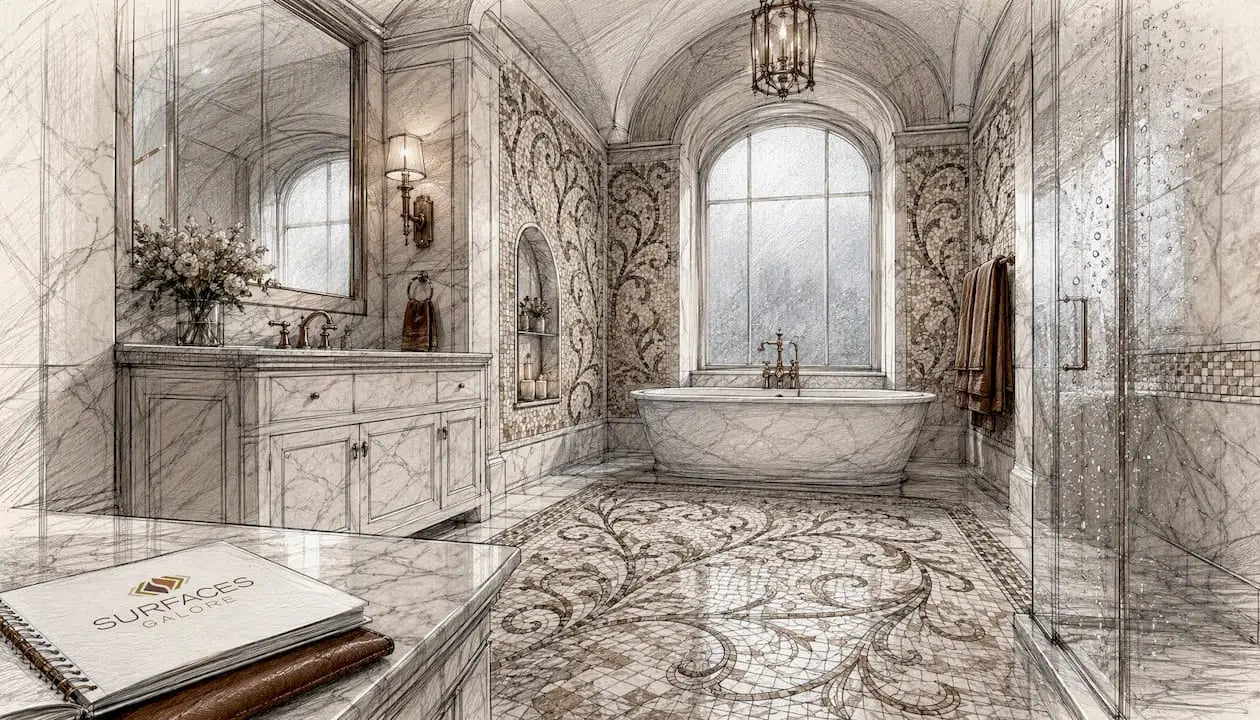
Byzantine and figurative mosaics
Byzantine mosaics use gold-ground fields, bold outlines, and rich jewel tones to create compositions that feel almost architectural. The Hagia Sophia in Istanbul and the church of San Vitale in Ravenna remain the canonical references, but contemporary versions translate the same language into kitchen feature walls and powder room focal points. Tesserae are typically small (5–20 mm), set at slight angles to catch light.
Best rooms: powder rooms, fireplace surrounds, entry medallions.
Art Deco and geometric waterjet marble
Waterjet technology has made the precision geometry of Art Deco accessible at residential scale. Sunburst medallions, chevron fields, and interlocking star patterns cut from Calacatta or Statuario marble are among the best-selling mosaic designs in the luxury residential market. Scale matters here: a large medallion needs a room with enough floor area to read properly, while a chevron border works in a narrow entry hall.
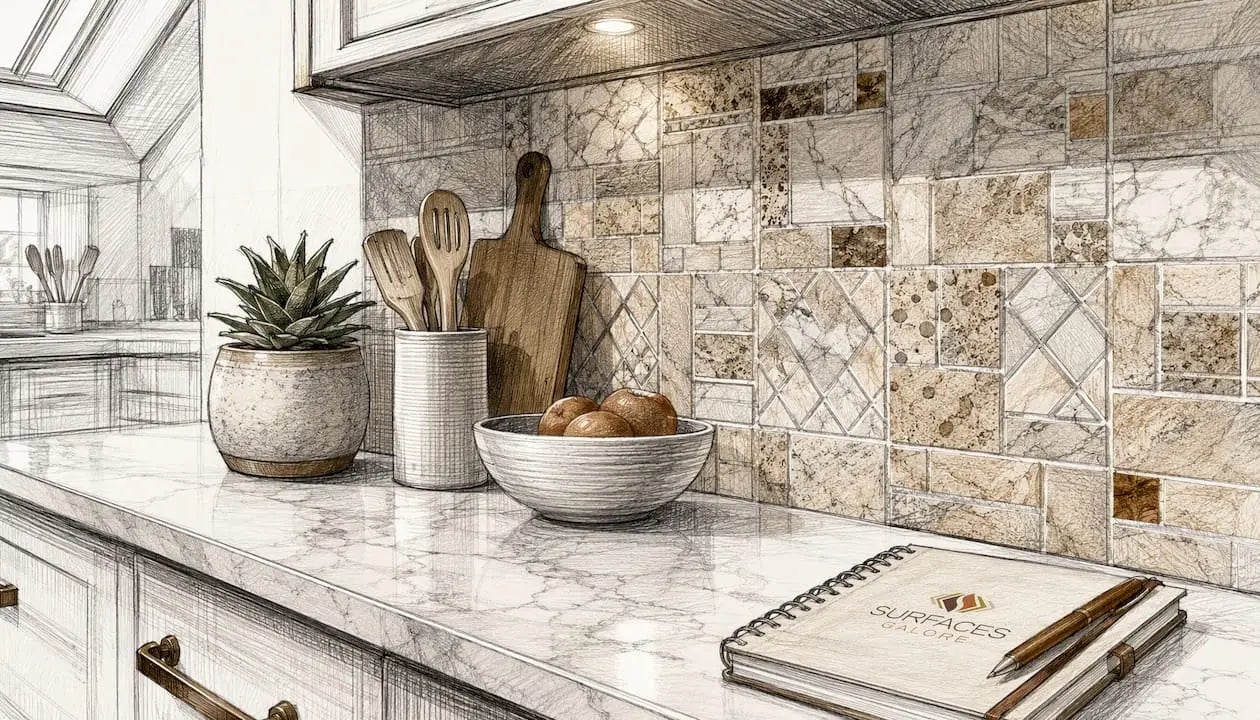
Best rooms: entry floors, master bath floors, kitchen islands.
Mixed-stone and metal inlays
“The inlay movement — mixing metal and stone — is enabling mosaics to function as jewelry-like focal points in kitchens and powder rooms.” — 2026 interior design forecast, Misbell Group
Brass, bronze, or blackened steel tesserae set into a limestone or marble field create a surface that reads differently at every light angle. These panels are typically custom waterjet work, which means longer lead times (four to eight weeks for bespoke pieces) but a result that functions as permanent art.
Best rooms: kitchen backsplashes, powder rooms, fireplace surrounds.
Micro-mosaics and gradient designs
Waterjet precision and micro-format tesserae now allow photographic-scale detail and smooth color gradients that were impractical at reasonable cost even five years ago. Gradient or ombre panels — moving from dark to pale tones across a shower wall, for example — are among the fastest-growing categories in current specification lists.
Best rooms: shower feature walls, spa bathrooms, accent walls.
Textured tumbled stone mosaics
Tumbled travertine and limestone mosaics have rounded edges and a worn, organic surface that reads as ancient even in a new build. The tumbled finish reduces the mirror-like reflectivity of polished stone, making it forgiving in rooms with variable lighting and easier to maintain in high-traffic areas.
Best rooms: kitchen backsplashes, outdoor walls, pool surrounds, casual bathrooms.
Glass and pearl-accent mosaics
Glass mosaics offer color saturation and reflectivity that stone cannot match. Iridescent glass or mother-of-pearl accent rows within a stone field add shimmer without overwhelming a space. Pure glass sheets work well in pool interiors because glass is non-porous and resists chlorine and salt water.
Best rooms: pool interiors, shower niches, backsplash accent rows.
Which mosaic motifs do homeowners buy most?
Certain motifs consistently lead sales across the residential and light-commercial market. Here is what sells, why it sells, and a rough sense of where each falls on the price spectrum.
- Floral and botanical — organic curves, high visual warmth; works in traditional and transitional interiors. Medium price band. Moderate installation complexity.
- Coastal and sea-glass — blue-green glass or mixed stone in wave and pebble patterns; perennially popular for bathrooms and pool areas. Low to medium. Simple mesh-mounted installation.
- Geometric and hexagon — the most versatile category; hex penny-rounds and elongated hexagons suit both modern and classic rooms. Low to medium. Fast to install on mesh backing.
- Medallions — custom waterjet centerpieces for entry floors or bath centers; high focal impact. High. Requires experienced installer for alignment.
- Figurative and scene panels — narrative compositions (hunting scenes, botanical illustrations, architectural vistas); the most labor-intensive category. High. Custom lead times of four to eight weeks.
- Gradient and ombre — contemporary, photographic-scale color transitions; growing fast in 2026 specifications. Medium to high. Requires careful layout planning.
- Abstract and fragmented art — irregular tesserae in curated color palettes; artisanal feel. Medium to high. Variable complexity.
- Penny-round and classic repeats — small circular tiles in marble, ceramic, or glass; timeless, easy to source, and straightforward to install. Low. Beginner-friendly.
Contemporary artists are also pushing mosaic into large-scale urban and residential art, which is raising the ceiling for what homeowners expect from bespoke commissions. A medallion that once felt extravagant now sits at the entry-level of custom mosaic work.
What materials and finishes should you choose?
Natural stone mosaics lead the luxury market for 2026 because of their tactile depth and longevity, but porcelain and glass hold real technical advantages in specific applications. The table below summarizes the key tradeoffs.
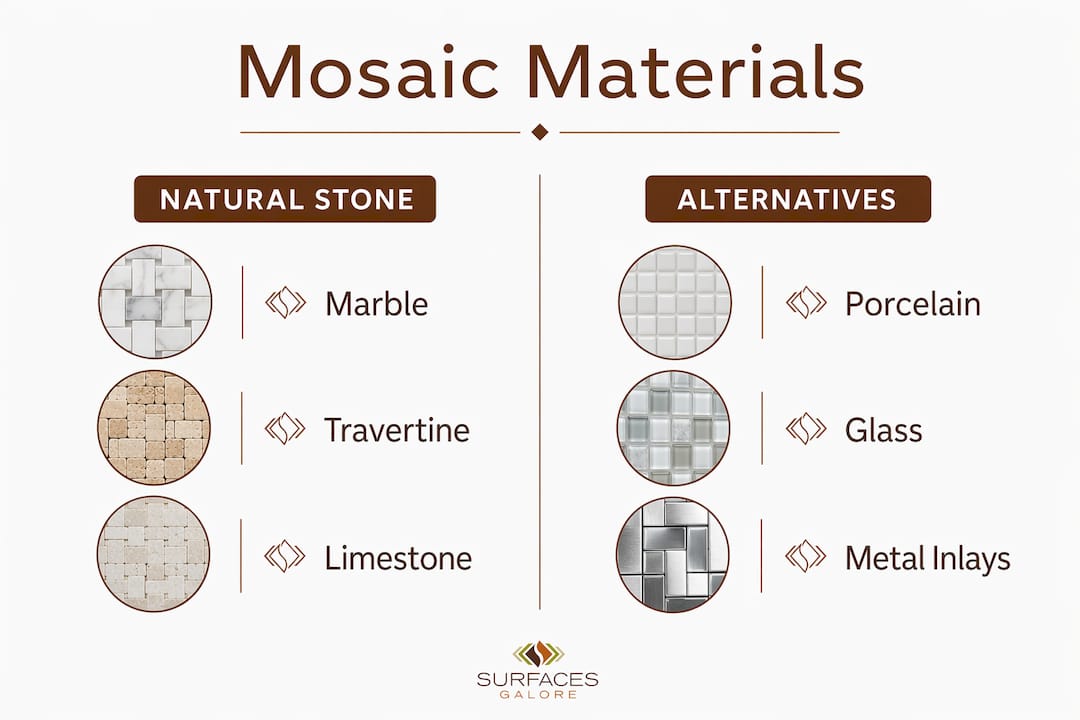
| Material | Look | Durability | Maintenance | Typical price band |
|---|---|---|---|---|
| Marble | Veined, luminous | High (Mohs ~3–4) | Seal annually; avoid acid cleaners | Medium–high |
| Limestone | Matte, earthy | Medium (Mohs ~3) | Seal every 1–2 years; gentle cleaners | Medium |
| Travertine | Pitted, warm | Medium–high (Mohs ~3) | Fill voids; seal annually | Medium |
| Porcelain | Uniform, crisp | Very high (Mohs ~7) | Minimal; grout maintenance only | Low–medium |
| Glass | Glossy, saturated | High (non-porous) | Easy; no sealing required | Medium |
| Metal-inlaid | Metallic accent | High (depends on base) | Polish metal periodically | High |
Performance data on water absorption, Mohs hardness, and DCOF ranges confirms natural marble for luxury applications while pointing to porcelain and glass where technical performance is the priority — pool interiors, commercial floors, and steam showers.
Finish selection by room:
- Polished marble — formal living rooms, dry entry floors, fireplace surrounds
- Honed marble or limestone — kitchen backsplashes, bathroom walls, shower walls
- Tumbled travertine or limestone — outdoor walls, casual kitchens, pool surrounds
- Unpolished or honed stone for floors — better slip resistance and less visible etching than polished
Room-specific material picks:
- Kitchen backsplash: honed marble or luxury tile options in mixed-stone inlay
- Shower walls: honed marble or glass
- Shower floors: small-format stone or porcelain (higher grout density improves grip)
- Pool interiors: glass or porcelain only
- Outdoor walls: tumbled travertine or limestone
Pro Tip: Always use non-staining white thin-set mortar for natural stone mosaics. Standard gray mortar can leach minerals through porous stone and cause permanent staining. Check the packaging for “natural stone compatible” before purchasing.
Where do decorative mosaics work best in a home?
The right mosaic in the wrong room is a maintenance problem. Here is a room-by-room breakdown with the installation cautions that matter most.
- Kitchen backsplash — the single most popular application; honed stone and glass both perform well. Keep grout joints tight (1/16 to 1/8 inch) to minimize cleaning surface.
- Kitchen feature wall — larger-format panels or medallion centerpieces; substrate must be flat and stable to prevent cracking at grout joints.
- Shower walls — glass and honed marble are the top choices; avoid highly polished stone in steam showers where thermal cycling can stress the surface.
- Shower floors — small-format mosaics improve slip resistance because the increased grout line density creates mechanical grip; verify DCOF rating of 0.42 or higher for wet areas.
- Bathroom floors — penny-rounds and small hex in honed stone or porcelain; use a waterproof membrane beneath.
- Fireplace surrounds — marble and limestone are heat-tolerant; avoid glass tesserae directly adjacent to open flames.
- Entry floor medallions — waterjet marble medallions are the classic choice; use a hard-wearing sealer and consider traffic patterns before choosing a polished finish.
- Pool interiors and waterline accents — glass or porcelain only; natural stone is too porous for constant submersion. Mosaic tile’s grout density also improves slip resistance at pool edges.
- Outdoor walls — tumbled travertine and limestone handle freeze-thaw cycles better than polished stone; check the tile’s frost rating for cold climates.
Treating architectural elements as visual focal points — whether a mosaic panel or a statement door — is a consistent principle in high-end residential design. A mosaic placed where the eye naturally lands (the end of a hallway, the wall behind a freestanding tub) delivers far more impact than the same tile spread across a large, undifferentiated surface.
How do you choose the right mosaic for your project?
Start with scale, material, finish, grout plan, and batch consistency — in that order. Everything else follows from those five decisions.
Step-by-step checklist:
- Measure the site — calculate square footage plus 10–15% overage for cuts and future repairs.
- Order samples — live with physical samples in the actual room under natural and artificial light before committing.
- Confirm batch availability — for natural stone, source the full project quantity from the same production batch to ensure consistent veining and tone.
- Prepare the substrate — walls must be flat to within 1/8 inch over 10 feet; floors need a crack-isolation membrane for stone.
- Select grout — use polymer-modified, non-staining grout; match grout color to the stone’s secondary tone, not its dominant one, for a natural look.
- Plan sealing — schedule first seal before grouting (for porous stone) and a second coat after grout cures.
Questions to ask your supplier or installer:
- What is the water absorption rate of this stone, and is it suitable for my application?
- What is the DCOF rating for floor applications?
- Do you carry non-staining white thin-set mortar rated for natural stone?
- What is the lead time for custom waterjet inlays versus ready-stock mesh-mounted sheets?
- Can you confirm the batch number and available inventory for my full project quantity?
Cost and lead-time guidance:
Ready-stock mesh-mounted mosaics (penny-rounds, standard hex, subway-scale glass) typically ship within one to two weeks and run in the low-to-medium price band. Custom waterjet inlays and bespoke medallions require four to eight weeks from design approval and sit in the medium-to-high band. The stone mosaic installation workflow for luxury projects adds another variable: experienced natural-stone installers book out weeks in advance in most major markets, so factor that into your timeline.
How do you care for decorative mosaics over time?
With proper sealing and maintenance, natural stone mosaics can last for decades. How often you need to intervene depends on the finish, the room’s exposure to water and traffic, and the stone type.
Daily cleaning is straightforward: a damp microfiber cloth and a pH-neutral stone cleaner. Never use vinegar, lemon juice, or any acid-based cleaner on marble or limestone. Acid etches the calcium carbonate in the stone, leaving dull spots that require professional honing to remove.
Sealing schedule varies by stone and finish. Polished marble in a dry location may only need resealing every two years. Honed travertine in a shower should be sealed annually. A simple water-drop test tells you when it is time: if water soaks in rather than beading, the sealer has worn through. Use a penetrating (impregnating) sealer, not a topical coating, for natural stone mosaics.
Grout inspection should happen every six to twelve months in wet areas. Cracked or missing grout in a shower allows water to reach the substrate and can cause tile failure over time. Re-grout damaged sections promptly using polymer-modified grout that matches the original color.
Pro Tip: For marble accent pieces and high-value mosaic panels, professional restoration — honing, polishing, and resealing by a stone care specialist — can return an etched or scratched surface to near-original condition. It is far less expensive than replacement.
Professional restoration is a realistic option for high-value mosaics. A skilled stone care technician can address etching, minor scratches, and grout discoloration without disturbing the installation.
Why are natural stone mosaics surging in 2026?
The short answer: people are tired of flat, cold surfaces. 2026 trend forecasts show clear growth in demand for high-end inlay materials and a decisive shift toward tactile, earth-toned natural stone over the digital minimalism that dominated the previous decade.
“Mosaics are being chosen as storytelling surfaces — hyper-natural textures, handmade revival, gradient effects and muted metallics are the leading directions for 2026.” — Mosaic Design Trends 2026, Davinci Ceramics
This is a biophilic response. Designers are specifying surfaces that feel grounded and organic because they contrast with the screens and synthetic materials that fill the rest of daily life. Natural stone mosaics — with their inherent variation, weight, and warmth — deliver that quality in a way no manufactured tile can replicate.
2026 palette and pairing suggestions:
- Warm white or cream marble mosaic + matte brass fixtures + white oak cabinetry
- Charcoal limestone inlay + blackened steel accents + concrete walls
- Travertine tumbled mosaic + terracotta tones + rattan or woven textiles
- Mixed-stone gradient panel + warm greige plaster + aged bronze hardware
Where to place a mosaic for maximum storytelling impact:
- Entryway floor medallion — the first surface a visitor sees; sets the entire tone of the home
- Kitchen “jewel” backsplash — the focal wall behind the range, framed by cabinetry on both sides
- Powder room — a small room where a bold, all-over mosaic is proportionate and immersive
Pairing a statement mosaic with glass interior elements — a glass door at the end of a hallway, for example — amplifies the depth and light-play of the stone surface behind it.
What are the three classical mosaic techniques?
Three techniques defined Roman and Byzantine mosaic practice and still inform how contemporary mosaics are designed and classified.
Opus tessellatum is the foundational method: small, roughly uniform square tesserae (typically 0.5–1.5 cm) laid in regular rows to build up a composition. It is the technique behind the vast floor mosaics of Pompeii and the carpet-like geometric fields of Byzantine churches. Most mesh-mounted residential mosaics today are a direct descendant of this approach.
Opus vermiculatum (“worm-work”) uses tiny, irregularly shaped tesserae to follow the contours of a figure or motif, creating a halo of closely fitted pieces that defines the subject against its background. The Alexander Mosaic from the House of the Faun in Pompeii — composed of over one million tesserae — is the most celebrated example. Contemporary micro-mosaics and photographic-detail panels draw directly on this technique.
Opus sectile takes a different approach entirely: large slabs of colored marble or stone are cut into specific shapes and fitted together like a puzzle, rather than built up from small uniform pieces. The result reads as bold, graphic, and architectural. Modern waterjet-cut stone inlays and medallions are essentially opus sectile executed with computer-controlled precision.
Understanding these three techniques helps you ask better questions when evaluating mosaic art for home. A “waterjet medallion” is opus sectile. A “micro-mosaic portrait panel” is opus vermiculatum. A standard hex or penny-round field is opus tessellatum. The vocabulary is ancient; the applications are current.
Surfacesgalore: your source for premium natural stone mosaics
If you have been researching natural stone mosaics and keep running into the same problem — inconsistent quality, limited selection, or suppliers who cannot confirm batch availability — Surfacesgalore is built to solve exactly that.
Surfacesgalore is a direct importer of premium marble, limestone, and travertine mosaics, tiles, and decorative pieces, based in Anaheim, California and shipping nationwide. Because the stone comes directly from the source, you get authentic material at prices that reflect the supply chain, not a retail markup. Every order can be traced to a specific production batch, which matters enormously for large installations where tonal consistency is non-negotiable.
What Surfacesgalore offers:
- Marble, limestone, and travertine mosaics in stock and available for immediate shipment
- Custom waterjet cuts and bespoke mosaic panels with design support
- Sample boxes so you can evaluate stone in your actual space before committing
- Installation guidance for contractors and homeowners
- Nationwide shipping with careful packaging for fragile stone
Whether you are sourcing a single marble mosaic collection for a powder room or specifying natural stone across an entire residence, the team at Surfacesgalore can confirm availability, batch numbers, and lead times before you commit. Shop natural stone tiles today at surfacesgalore.com.
Key Takeaways
Natural stone mosaics — particularly marble, limestone, and travertine — lead the top decorative mosaic categories in 2026, driven by the tactile luxury trend and strong designer adoption of geometric waterjet, mixed-inlay, and Byzantine revival styles.
| Point | Details |
|---|---|
| Top styles for 2026 | Marble geometric waterjet, mixed-stone metal inlays, Byzantine revival, micro-mosaics, and tumbled stone lead current demand. |
| Material priority | Natural stone offers tactile depth and longevity; porcelain and glass suit pools, steam showers, and high-traffic floors. |
| Buying guidance | Order the full project quantity from the same production batch to guarantee tonal consistency across the installation. |
| Maintenance reminder | Seal natural stone annually (or per the water-drop test), use pH-neutral cleaners only, and inspect grout in wet areas every six to twelve months. |
| Source samples first | Surfacesgalore offers sample boxes and custom waterjet work with nationwide shipping from Anaheim, California. |
Why natural stone mosaics deserve more than trend coverage
Most mosaic guides treat material selection as a footnote. The real decision — the one that determines whether an installation looks extraordinary or merely adequate in ten years — is the stone itself. Veining, density, finish, and batch consistency are not details you can evaluate from a screen. They require physical samples in the actual room, under the actual light.
The styles covered here were selected because they represent genuine longevity: designs that have held their appeal across decades of interior fashion cycles, now reinforced by 2026’s clear move toward surfaces that feel handmade and grounded. A marble geometric waterjet floor or a mixed-stone inlay backsplash is not a trend piece. It is a permanent architectural decision, and it should be treated as one. The curation here reflects that standard — sales momentum matters, but so does whether a style will still feel right in fifteen years.
Useful sources and further reading
- What is mosaic art — TilesWorkshop — overview of historical techniques and natural-stone prominence in contemporary design
- 2026 interior design forecast — Misbell Group — market forecast on the shift toward tactile, earth-toned natural stone surfaces
- The 2026 Ultimate Guide to Mosaic Tiles — Caron Stone — material performance data (Mohs hardness, DCOF, water absorption) and sourcing guidance
- Mosaic and Tile Guide: Patterns, Safety, and 2026 Trends — Stone Center Online — pattern-to-function guidance and slip-resistance notes for wet areas
- Mosaic Design Trends 2026 — Davinci Ceramics — stylistic directions including gradient mosaics, muted metallics, and mixed-media inlays
- 7 Artists Reinventing the Ancient Art of Mosaics — Artsy — contemporary artist case studies showing the range of modern mosaic practice
- Mosaic — World History Encyclopedia — authoritative historical reference covering Roman, Byzantine, and global mosaic traditions
- Surfacesgalore — natural stone mosaics, tiles, and decorative pieces — direct importer of marble, limestone, and travertine; sample boxes and custom waterjet available
FAQ
What are the three types of mosaics?
The three classical mosaic techniques are opus tessellatum (uniform small tesserae in regular rows), opus vermiculatum (tiny irregular pieces that follow a figure’s contours), and opus sectile (large shaped stone slabs fitted together like a puzzle). Modern waterjet medallions descend from opus sectile; micro-mosaic portrait panels draw on opus vermiculatum.
Who is the most famous artist associated with mosaics?
Gnosis is the earliest known named mosaic artist — his signature appears on the Stag Hunt Mosaic from Pella, the only surviving artist name on an ancient pebble floor. In the modern era, Sir William Blake Richmond is celebrated for his decorative mosaics in St Paul’s Cathedral in London.
What is the best material for a shower floor mosaic?
Small-format stone or porcelain mosaics are the best choice for shower floors because the higher density of grout lines improves slip resistance compared with large-format tiles. Verify a DCOF rating of 0.42 or higher for wet-area safety, and use a penetrating sealer on any natural stone.
How long do natural stone mosaics last?
With annual sealing and pH-neutral cleaning, natural stone mosaics can last for decades. Marble, limestone, and travertine installations in well-maintained historic buildings have survived centuries; in a residential setting, a properly installed and sealed stone mosaic should outlast most other finish materials in the home.
Where can you buy top decorative mosaics in the United States?
Surfacesgalore is a direct importer of marble, limestone, and travertine mosaics based in Anaheim, California, shipping nationwide. They offer ready-stock mesh-mounted sheets, custom waterjet panels, and sample boxes — all traceable to a specific production batch for consistent results across large installations.

Leave a comment