
Top Tile Finishes Compared: Natural Stone Choices for Homeowners

For most modern homes, honed and leathered natural stone finishes deliver the best balance of texture, low glare, and practical wear resistance. Polished stone earns its place on feature walls and low-traffic vanities; flamed and sandblasted surfaces belong outdoors where grip is non-negotiable. The finish you choose shapes not just how a room looks, but how safe, how easy to clean, and how long-lasting your investment will be.
Here are the quick matches to orient you before the deep dive:
- Honed — bathroom floors, high-traffic hallways, shower walls
- Leathered — kitchen countertops, vanities, statement islands
- Polished/glossy — feature walls, fireplace surrounds, low-traffic powder rooms
- Tumbled/antiqued — mudrooms, rustic kitchens, pool surrounds with mosaic inserts
- Flamed/sandblasted — outdoor terraces, pool decks, commercial walkways
Pro Tip: Before committing to any finish, order physical samples and test them wet underfoot. A finish that looks perfect dry can feel dangerously slick when water hits it.
For room-by-room guidance tied to Surfacesgalore’s natural stone collections, the tile finishes explained guide walks through application photos and specific product examples.
Key Takeaways
Honed and leathered finishes give most homeowners the best combination of safety, aesthetics, and manageable maintenance across both natural stone and porcelain tile options.
| Point | Details |
|---|---|
| Finish drives safety | Polished stone typically falls below the ≥0.42 DCOF wet-grip threshold; use honed or textured finishes for any wet floor. |
| Honed leads in 2026 | Designers specify honed and leathered finishes for Quiet Luxury interiors; polished is reserved for low-traffic verticals. |
| Sealing is non-negotiable | Natural stone needs a penetrating sealer before use and on a regular schedule; glazed porcelain does not. |
| Material changes everything | Calcite stones (marble, limestone, travertine) require white thin-set adhesive and pre-grouting sealing; porcelain does not. |
| Surfacesgalore | Direct importer of honed, leathered, and tumbled marble, limestone, and travertine, with nationwide shipping and specification support. |
Table of Contents
- How do the top tile finishes compare at a glance?
- Is polished tile right for your space?
- Why honed finish is the go-to choice for 2026 interiors
- Leathered, satin, and brushed finishes: tactile surfaces with real advantages
- Tumbled, antiqued, and rustic finishes: when aged texture is the right call
- High-texture finishes for outdoor and extreme wet applications
- Porcelain and ceramic versus natural stone: what actually changes
- Slip resistance and safety: what DCOF means for your tile choice
- Maintenance, sealing, and lifespan by finish and material
- How do you choose the right tile finish for your project?
- What Surfacesgalore recommends for 2026 projects
- The finish decision most people get wrong
- Explore Surfacesgalore’s natural stone collections
- Sources
- FAQ
How do the top tile finishes compare at a glance?
The table below covers the seven finish categories most commonly specified in residential and light-commercial projects. DCOF (Dynamic Coefficient of Friction) is the US standard wet-slip metric; the practical floor threshold for general wet areas is ≥0.42, with higher values recommended for barefoot zones like showers and pool decks.
| Finish | Look / Sheen | Wet Grip (DCOF) | Best For | Maintenance | Durability / Scratch Risk | Porosity / Sealing | Cost / Install |
|---|---|---|---|---|---|---|---|
| Polished | Mirror-gloss, high reflectivity | Low (often <0.42) | Feature walls, vanities, dry floors | Low cleaning, etching visible | Scratches show easily | Low porosity; sealing optional on porcelain | Mid–high / standard |
| Honed | Velvety, low-sheen matte | Moderate (≥0.42 typical) | Bathroom floors, high-traffic areas | Medium; sealing needed | Hides scratches well | More porous than polished; seal regularly | Mid / standard |
| Leathered | Soft texture, subtle sheen | Moderate–good | Countertops, vanities, islands | Medium; wipe-clean friendly | Hides wear, fingerprint-resistant | Moderate; seal on natural stone | Mid–high / standard |
| Satin / Brushed | Smooth texture, low-mid sheen | Moderate | Walls, light-traffic floors | Medium | Good; minor scratches less visible | Moderate; seal natural stone | Mid / standard |
| Tumbled / Antiqued | Rough, aged, matte | Good | Mudrooms, pool surrounds, rustic floors | High; deep sealing needed | Forgiving of chips | High porosity; frequent sealing | Low–mid / moderate |
| Flamed / Sandblasted / Bush-hammered | Very rough, matte | Excellent | Outdoor decks, pool edges, ramps | High; traps dirt | Very durable | Moderate–high; seal exterior stone | Mid / moderate–high |
| Natural Cleft | Irregular, split-face texture | Excellent | Outdoor paths, feature walls, rustic floors | High | Very durable | Varies; seal porous types | Low–mid / moderate |
Reading the table:
- Low maintenance = wipe-clean, infrequent sealing. High maintenance = vigorous scrubbing, annual or biannual sealing.
- DCOF bands are typical ranges; actual values vary by stone type, tile size, and grout joint width.
- Cost ranges reflect finish processing only, not stone grade or installation labor.
Finish categories are compared generically here because performance varies by stone species. A honed quartzite behaves very differently from a honed marble, even though both carry the same finish label.
Is polished tile right for your space?
Polished stone is ground progressively finer until the surface becomes a near-mirror. The result is high visual depth, crisp veining, and a reflective quality that makes rooms feel larger and brighter. On marble, it is genuinely striking.
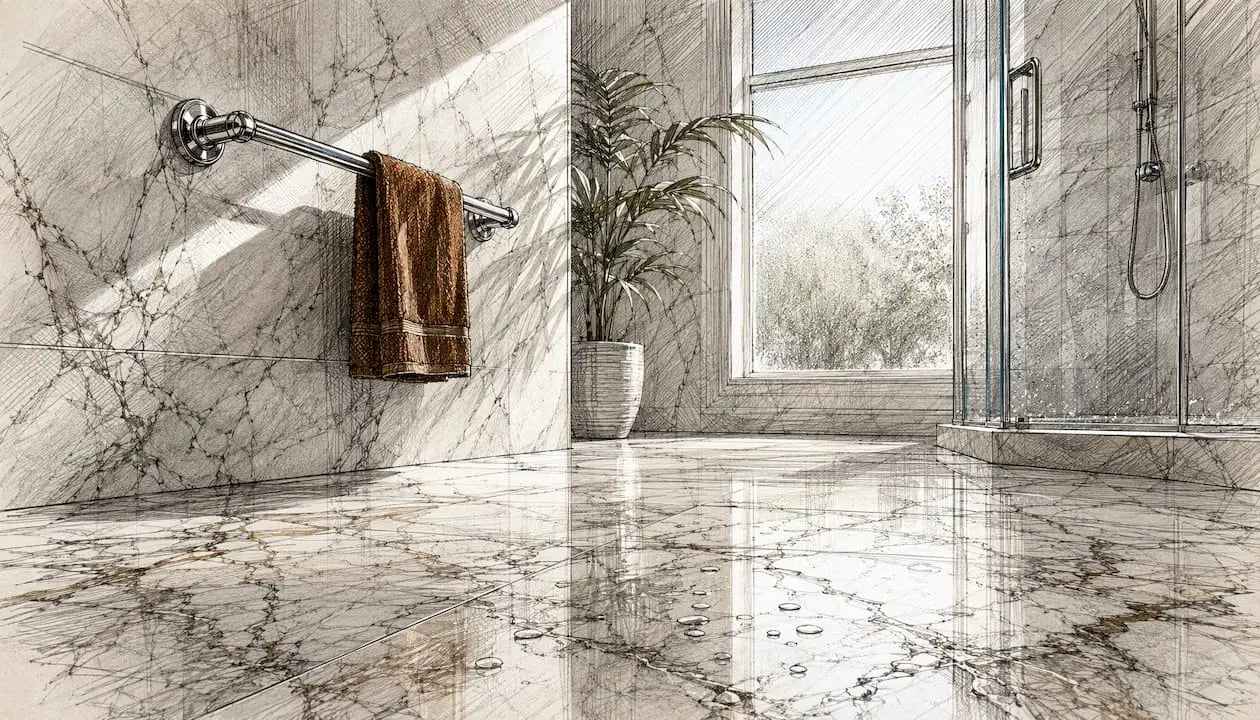
The trade-offs are real, though. Wet grip on polished surfaces typically falls below the ≥0.42 DCOF threshold recommended for general wet areas, which rules it out for shower floors and pool surrounds. On calcite-based stones like marble and limestone, polished surfaces show acid etching immediately because the reflected light amplifies every dull spot. A splash of lemon juice or a glass of wine left too long leaves a visible mark.
Where polished works well:
- Vertical feature walls and fireplace surrounds
- Powder room floors with very low foot traffic
- Backsplashes above countertops (not the countertop itself)
- Decorative insets and medallions
Where to avoid it:
- Shower floors and wet room floors
- Pool decks or any exterior surface
- Kitchen countertops in active cooking households
- High-traffic hallways
Pro Tip: If you love the polished look on a kitchen counter but cook regularly with acidic ingredients, consider a dense non-calcite stone like quartzite. It polishes beautifully and resists etching far better than marble or limestone.
As Wificeramics notes, polished marble is best reserved for low-traffic vertical surfaces where its reflectivity can be appreciated without the safety and etching risks of a floor application.
Why honed finish is the go-to choice for 2026 interiors
Honed stone is ground to a smooth, flat surface but stopped before the polishing stage that creates gloss. The result is a velvety, low-sheen surface that reads as calm and understated rather than flashy.
The practical advantages are significant. Honed surfaces typically meet or exceed the ≥0.42 DCOF wet-grip threshold that general wet areas require, making them a safer floor choice than polished stone. Etching still occurs on calcite stones, but the matte surface diffuses light so the marks are far less visible. Scratches from everyday use blend into the texture rather than catching the light.
Pros of honed:
- Reduced glare, easier on the eyes in bright rooms
- Better slip profile than polished on the same stone
- Hides everyday scratches and minor etching
- Works with a wide range of design styles
Cons of honed:
- More porous than polished on the same stone species; requires regular penetrating sealer
- Stains can absorb faster if sealing lapses
- Less dramatic visual depth than polished
Design professionals increasingly specify honed and leathered finishes to achieve the Quiet Luxury aesthetic in hospitality and upscale residential projects, according to StoneTrades’ 2026 trend analysis. The look pairs naturally with warm neutrals, linen textiles, and unlacquered brass hardware. For a deeper look at honed stone specifications, Surfacesgalore’s honed finish guide for homeowners covers sealing schedules and product recommendations.
Leathered, satin, and brushed finishes: tactile surfaces with real advantages
These three finishes occupy the space between honed and rough-textured. Each process is distinct, but all three share a low-to-moderate sheen and a surface that rewards touch as much as sight.
Leathered is produced by running diamond-tipped brushes across a honed surface. The process opens the stone’s pores slightly and creates a gentle undulating texture. The sheen is subtle, somewhere between honed and polished. On dark granites and marbles, the color saturation deepens noticeably.
Satin is a controlled polish that stops short of full gloss, producing a smooth surface with a soft, semi-reflective quality. It reads as refined without the maintenance demands of a full polish.
Brushed uses wire or abrasive brushes to soften the surface and expose the stone’s natural grain. The result is slightly more textured than leathered and works particularly well on limestone and travertine.
Shared advantages:
- Fingerprint-resistant compared to polished surfaces
- Tactile quality that reads as premium in person
- Hides everyday wear and minor scratches
- Moderate wet grip, generally better than polished
Watch out for:
- Leathered and brushed surfaces can trap fine grit in their texture, requiring more thorough cleaning than honed
- Satin finishes on calcite stones still show etching, though less dramatically than polished
Best uses center on surfaces you touch constantly: kitchen countertops, bathroom vanities, and statement kitchen islands. The fingerprint resistance of leathered stone is a genuine advantage on dark-toned counters where polished surfaces would show every handprint.
Pro Tip: For a dark marble or granite island, leathered finish is the practical choice. It deepens the color, hides smudges, and feels substantial underhand in a way that polished stone simply cannot match.
Tumbled, antiqued, and rustic finishes: when aged texture is the right call
Tumbled stone is produced by placing cut tiles or pieces into a rotating drum with abrasives. The edges round off, the surface softens, and the result looks as though the stone has been worn by centuries of foot traffic. Antiqued finishes achieve a similar effect through acid washing, brushing, or a combination of mechanical and chemical treatments.
Both processes increase surface texture substantially, which translates directly into better slip resistance. The trade-off is maintenance: more texture means more places for dirt, grime, and grout haze to hide.
Pros:
- Excellent slip resistance, well above the ≥0.42 DCOF threshold in most cases
- Forgiving of small chips and edge damage, which blend into the aged aesthetic
- Visually warm and characterful; suits rustic, Mediterranean, and transitional styles
Cons:
- Higher porosity than smoother finishes; sealing is non-negotiable and needs to be done more frequently
- Grout haze can lock into the surface if stone is not sealed before grouting
- Vigorous cleaning required to keep textured surfaces looking fresh
Best uses include shower floors with mosaic inserts, pool surrounds, mudrooms, and rustic kitchen floors where the aged look fits the design intent. For pool surrounds specifically, the pool tile design guide from Classic Marcite covers slip-resistance considerations in detail.
Pro Tip: Always seal tumbled or antiqued stone before grouting. Grout pigment will absorb into the open pores and create a permanent haze that no amount of cleaning will fully remove.
High-texture finishes for outdoor and extreme wet applications
When grip is the primary requirement, four finishes stand apart: flamed, sandblasted, bush-hammered, and natural cleft. All four dramatically increase surface roughness, and all four are specified primarily for exterior and high-wet-exposure applications.
Flamed is produced by applying an intense flame to the stone surface. The heat causes the crystals to fracture and pop, creating a rough, non-slip texture. Granite responds particularly well; the color lightens slightly after treatment.
Sandblasted uses high-pressure abrasive media to erode the surface uniformly. The result is a fine, consistent texture with good grip and a matte appearance. It works on a wider range of stone types than flaming.
Bush-hammered uses a mechanical hammer with a grid of pyramid-shaped points to dimple the surface systematically. The texture is regular and pronounced, with excellent traction and a distinctive industrial character.
Natural cleft is not a processed finish but a split surface: the stone is cleaved along its natural grain planes, leaving an irregular, layered texture. Slate and quartzite are the most common natural cleft materials.
Shared advantages:
- Superior slip resistance for wet exterior applications, including pool surrounds and ramps
- Weather resistance; the rough surface handles freeze-thaw cycles better than polished
- Very durable; surface damage is difficult to detect against the existing texture
Practical considerations:
- Dirt and organic debris collect in the texture; plan for regular pressure washing outdoors.
- Color shifts after flaming or sandblasting can be significant; always view a treated sample before ordering.
- Ordering and installation: specify the finish in writing on your purchase order, confirm the lot number, and budget for slightly higher installation labor due to the irregular surface profile.
- For pool decks and wet commercial walkways, ask your supplier for the DCOF test report for the specific stone and finish combination you are ordering.
For pool-specific finish selection in humid climates, the Florida pool tile guide from Classic Marcite offers practical finish recommendations worth reviewing alongside your stone selection.
Porcelain and ceramic versus natural stone: what actually changes
The finish names are the same, but the underlying material changes everything about how a finish performs.
Porosity and sealing: Porcelain tile has an absorption rate below 1% and generally does not require a topical sealer. Glazed porcelain is essentially impervious. Natural stone, by contrast, ranges from moderately porous (granite, quartzite) to highly porous (travertine, limestone), and most natural stone floors and countertops need a penetrating sealer applied before use and refreshed on a schedule.
Stain and etch susceptibility: Glazed porcelain resists both staining and etching because the glaze forms a sealed barrier. Natural calcite stones like marble and limestone etch when they contact acids, regardless of finish. No sealer prevents this; it is a chemical reaction between acid and calcium carbonate.
Abrasion resistance: Unglazed porcelain and dense natural stones like quartzite and granite handle abrasion well. Softer natural stones like marble and limestone scratch more readily, which is why finish choice matters so much for floors.
Cost trends: Porcelain tiles that mimic natural stone have narrowed the price gap considerably, but authentic natural stone still commands a premium for tactile realism, unique veining, and resale value perception.
Installation notes that change by material:
- Natural calcite stones (marble, limestone, travertine) require white thin-set adhesive to prevent color bleed-through from gray adhesives, as noted in natural stone installation guidance.
- Travertine often has natural voids that must be filled before grouting to prevent grout from sinking and cracking.
- Glazed porcelain does not need pre-sealing before grouting; natural stone does.
- Polished natural stone shows lippage (height variation between tiles) more visibly than honed, so substrate flatness is more critical.
When to choose porcelain: When low maintenance and consistent appearance matter more than tactile authenticity. A honed-look porcelain in a rental property or high-traffic commercial space is a sound practical choice.
When to choose natural stone: When the tactile quality, unique character, and long-term value of authentic material justify the care requirements. For more on material-specific porosity and etch susceptibility across marble, limestone, and travertine, the WillyHomes comparison is a useful reference.
Slip resistance and safety: what DCOF means for your tile choice
DCOF stands for Dynamic Coefficient of Friction, the US standard for measuring wet slip resistance on tile surfaces. The higher the number, the more grip the surface provides when wet.
The practical threshold most US specifications reference is generally considered to be DCOF 0.42 or higher for general wet areas. Barefoot zones like shower floors and pool decks warrant higher targets; some specifications recommend higher DCOF values or European barefoot-class ratings (B or C) for those applications.
DCOF values are typical ranges based on finish category. Always request the test report for your specific stone and finish combination.
Tile format also affects grip. Smaller tiles mean more grout joints per square foot, and grout joints add traction. A 2×2-inch mosaic on a shower floor provides meaningfully better grip than a 12×24-inch slab of the same stone and finish, even with identical DCOF ratings on the tile face itself.
On-site measures to improve safety outcomes:
- Specify mosaic formats (2×2 or smaller) for shower floors and pool steps
- Use sanded grout with wider joints in wet exterior areas
- Consider anti-slip coatings for existing polished surfaces in wet zones
- Ask your installer for the DCOF test report before finalizing finish selection for any wet application
- For pool surrounds, review pool tile design considerations alongside your DCOF targets
Maintenance, sealing, and lifespan by finish and material
Finish choice is a long-term commitment. The table below translates maintenance requirements into realistic schedules.
| Finish | Cleaning Frequency | Sealing Cadence | Key Sensitivities |
|---|---|---|---|
| Polished (natural stone) | Weekly | Every 1–2 years | Acid etching highly visible; scratches show |
| Honed (natural stone) | Weekly | Every 1–2 years | Etching less visible; stains absorb faster if unsealed |
| Leathered / Brushed | Weekly | Every 1–2 years | Texture traps grit; requires thorough wiping |
| Tumbled / Antiqued | Twice weekly | Every 6–12 months | High porosity; grout haze risk if not pre-sealed |
| Flamed / Sandblasted | As needed (pressure wash outdoors) | Every 1–2 years (exterior) | Traps dirt; color may shift after treatment |
| Glazed porcelain (any finish) | Weekly | None required | Grout joints stain; glaze can chip at edges |
Cleaning dos and don’ts:
- Use pH-neutral stone cleaners on all natural stone surfaces
- Never use vinegar, lemon juice, or citrus-based cleaners on marble, limestone, or travertine; the acid etches the surface chemically, and no sealer prevents it
- Avoid abrasive scrubbing pads on polished or honed surfaces
- Blot spills immediately on calcite stones rather than wiping, which spreads the liquid
Durability notes: Honed and leathered finishes hide wear better than polished over time, which is why they tend to look better longer in high-traffic areas. Polished stone requires periodic professional re-polishing to restore its surface after scratching or etching accumulates. Flamed and bush-hammered exterior surfaces are among the most durable long-term because surface damage is nearly invisible against the existing texture.
For travertine-specific sealing schedules and product recommendations, Surfacesgalore’s travertine maintenance guide covers the full care workflow. Marble care steps are detailed in the marble maintenance guide.
How do you choose the right tile finish for your project?
Work through these decisions in order before you commit to a finish.
- Define the room’s use and moisture level. Is this a dry living area, a wet bathroom, or an outdoor surface? Wet areas immediately eliminate polished stone from floor consideration.
- Set your slip-resistance target. Shower floors and pool decks need ≥0.42 DCOF minimum; barefoot wet zones should target higher. Ask your supplier for the DCOF test report.
- Assess your maintenance willingness honestly. Tumbled and flamed surfaces look great but require more frequent cleaning and sealing. Polished stone needs professional restoration over time.
- Set your budget. Finish processing adds cost beyond the stone grade itself. Flamed and bush-hammered finishes typically cost more to produce than honed; polished is mid-range.
- Order samples and test them wet. Wet a sample tile and step on it. View it in the room’s actual lighting at different times of day.
- Confirm production-lot matching. Natural stone varies between production lots. Order your full quantity from a single lot and add 10–15% for cuts and future repairs. Always order extra material from the same lot.
Questions to ask your installer or supplier:
- What DCOF value has this stone and finish combination been tested to?
- What sealer do you recommend, and how often should it be reapplied?
- Is white thin-set required for this stone? (Always yes for marble, limestone, and travertine.)
- How do you handle travertine voids before grouting?
- Can you confirm the production lot number and that the full quantity is available from that lot?
Red flags that should pause a purchase:
- Supplier cannot confirm the production lot or says “close enough” about lot matching
- No sealing guidance provided or conflicting advice from installer and supplier
- Installer proposes spot-bonding natural stone rather than full-bed installation
- No DCOF test data available for a finish specified in a wet area
For a practical checklist and installer questions, Surfacesgalore’s honed tile guide for homeowners covers the full specification process.
What Surfacesgalore recommends for 2026 projects
The Textural Realism trend documented by StoneTrades and the broader shift away from mirror gloss noted by FineHomeKeeping point in the same direction: honed and leathered finishes for interiors, flamed and sandblasted for exteriors where grip matters.
Surfacesgalore’s expert verdict for 2026:
- Interiors: Specify honed for floors and walls; leathered for countertops and vanities. Both finishes align with Quiet Luxury palettes and reduce the maintenance burden of polished stone.
- Wet zones: Target ≥0.42 DCOF for bathroom floors; use tumbled mosaic formats for shower floors and pool steps.
- Exteriors: Specify flamed or sandblasted for pool decks and terraces. Request the DCOF test report before ordering.
- Calcite stones (marble, limestone, travertine): Always specify white thin-set adhesive. Pre-seal before grouting. Fill travertine voids before applying grout.
Sample spec guidance:
- Honed marble floor, bathroom: penetrating silicone sealer, reapplied annually; pH-neutral cleaner only; white thin-set adhesive.
- Leathered granite countertop: penetrating sealer at installation, refreshed every 18–24 months; no acid cleaners.
- Flamed limestone pool deck: penetrating sealer every 12–18 months; pressure wash annually; DCOF ≥0.65 confirmed before installation.
Pro Tip: Ask your stone supplier for the natural stone finishes guide before finalizing your specification. Seeing the finish on the actual stone species you are buying is the only reliable way to confirm the look and texture.
The finish decision most people get wrong
Most homeowners spend their energy choosing between stone species and almost no time thinking about finish. That is backwards. A honed Calacatta marble and a polished Calacatta marble are the same stone, but they behave like completely different materials in a bathroom. One hides the inevitable etch marks from daily use; the other displays every one of them under the light.
The 2026 trend toward textured, lower-sheen finishes is not just an aesthetic preference. It reflects a practical correction. Years of polished marble bathrooms that looked stunning in showrooms and required professional restoration within two years taught designers and homeowners the same lesson: the finish you can live with is better than the finish you have to maintain constantly.
Leathered stone on a kitchen island is a good example of this thinking in practice. The texture deepens the color, resists fingerprints, and hides the minor scratches that accumulate from daily use. A polished version of the same stone would show every mark. The leathered version looks better at year five than it did at installation.
The maintenance-versus-grip trade-off that Decorative Materials’ 2026 trend report identifies is real, but it is manageable when you match the finish to the application honestly. Flamed granite on a pool deck traps more dirt than polished, but you are pressure washing it seasonally anyway. Tumbled travertine in a mudroom needs more frequent sealing than honed, but it also hides the chips and scuffs that a mudroom floor will inevitably collect.
Choose the finish that fits how the space will actually be used, not how you hope it will be used.
Explore Surfacesgalore’s natural stone collections
Surfacesgalore imports premium marble, limestone, and travertine directly, which means you get authentic natural stone at prices that reflect the source rather than a retail markup. The collections span honed, leathered, polished, and tumbled finishes across all three stone families, with nationwide shipping from Anaheim, California.
If you are specifying a project and need sample tiles to test finish, color, and texture in your actual space, Surfacesgalore can help. The team works with homeowners, designers, and contractors to match the right finish to the right application, including guidance on sealing, adhesive selection, and production-lot availability. Visit Surfacesgalore to browse marble, limestone, and travertine collections, or reach out for specification support on your next renovation.
Sources
The following sources informed the technical guidance, trend context, and specification recommendations in this article.
- Beyond the shine: Textural realism dominates natural stone trends for 2026 | StoneTrades
- The one-stone home trend: How natural stone is transforming interiors in 2026 - FineHomeKeeping
- Prosoco stone & tile guide (product and maintenance guidance)
- Natural stone tiling knowledge (installation and material notes)
- Types of natural stone finishes and use cases
- Stone Tile Finishes Explained: Polished, Honed, Tumbled & Brushed
A note on specification: always ask your supplier for the DCOF test report for the specific stone and finish combination you are ordering, and confirm the production lot number before placing a full order. No two lots of natural stone are identical.
FAQ
What are the different tile finishes?
The main tile finishes are polished, honed, leathered, satin, brushed, tumbled, antiqued, flamed, sandblasted, bush-hammered, and natural cleft. Each finish changes the surface texture, sheen level, slip resistance, and maintenance requirements of the tile.
What is the best finish for tile floors?
Honed is the most practical finish for most indoor floors because it meets the ≥0.42 DCOF wet-grip threshold, hides scratches, and suits both high-traffic and wet areas. Tumbled or flamed finishes are better for outdoor floors and pool surrounds where maximum grip is required.
What tile finish is easiest to maintain?
Glazed porcelain in any finish requires the least maintenance because it does not need sealing and resists staining. Among natural stone finishes, polished surfaces are easiest to wipe clean but show etching and scratches most visibly; honed is the practical middle ground for most homeowners.
Does tile finish affect slip resistance?
Yes, significantly. Polished tile typically falls below the ≥0.42 DCOF threshold recommended for wet areas, while honed, tumbled, and flamed finishes progressively increase grip. Tile format also matters: smaller mosaic tiles with more grout joints provide better traction than large-format tiles of the same finish.
Which tile finish works best for countertops?
Leathered and honed finishes are the strongest choices for countertops. Leathered stone resists fingerprints, deepens color, and hides minor scratches; honed provides a clean, matte surface that is easier to keep looking uniform. Polished countertops look striking but show every etch mark on calcite stones like marble and limestone.

Leave a comment