
Calacatta Gold Marble: What Buyers Need to Know Before They Order

Calacatta Gold marble is a premium Italian stone quarried in the Apuan Alps, prized for its bright white background and dramatic gold and gray veining. It carries a luxury price tag and needs regular sealing, so it earns its place best on surfaces where you want maximum visual impact rather than heavy daily abuse.
It fits a specific kind of project:
- Kitchen islands and waterfall countertops where the veining becomes the room’s focal point
- Primary bathroom vanities and feature walls in showers
- Commercial lobbies, boutique hotel reception desks, and other spaces built to impress
Expect stone-only pricing to run well into the premium tier before fabrication and installation, with the exact number depending heavily on grade and slab yield, both covered below.
Key Takeaways
Calacatta Gold marble delivers a distinctive white and gold look that costs more and demands more upkeep than most alternatives, making grade verification and a sealing routine the two decisions that matter most.
| Point | Details |
|---|---|
| Confirm grade before buying | Ask for Standard, Extra, or Premium grade documentation and slab-specific photos, not catalog images. |
| Match finish to use | Choose honed for kitchens prone to etching, polished for low-touch feature walls and vanities. |
| Reseal on a use-based schedule | Reseal every 6 to 18 months, more often for kitchens than bathroom vanities. |
| Budget for overage and grade | Add 10 to 15% for bookmatching and expect higher costs for Extra or Premium grade slabs. |
| Buy from a direct importer | Surfacesgalore ships authentic Calacatta Gold nationwide with sample orders and slab-selection support. |
Table of Contents
- What Are the Technical Specs of Calacatta Gold Marble?
- What Formats and Sizes Does Calacatta Gold Come In?
- What Drives the Price of Calacatta Gold Marble?
- How Do Origin and Grade Affect Slab Quality?
- Where Should You Use Calacatta Gold, and Which Finish Fits?
- How Do You Care for Calacatta Gold Marble Long Term?
- What Should You Ask Before Ordering Slabs?
- What Warranty and Return Terms Should You Expect?
- Is Quarrying Calacatta Gold Marble Environmentally Sustainable?
- What Buyers Get Wrong About Calacatta Gold Marble
- Where to Find Authentic Calacatta Gold Marble
- Sources
- FAQ
What Are the Technical Specs of Calacatta Gold Marble?
Calacatta Gold rates roughly 3 to 5 on the Mohs hardness scale, softer than granite or quartz, which means it scratches more easily under cutting boards, dropped cookware, or gritty foot traffic. It’s also calcareous, so it reacts to acid.
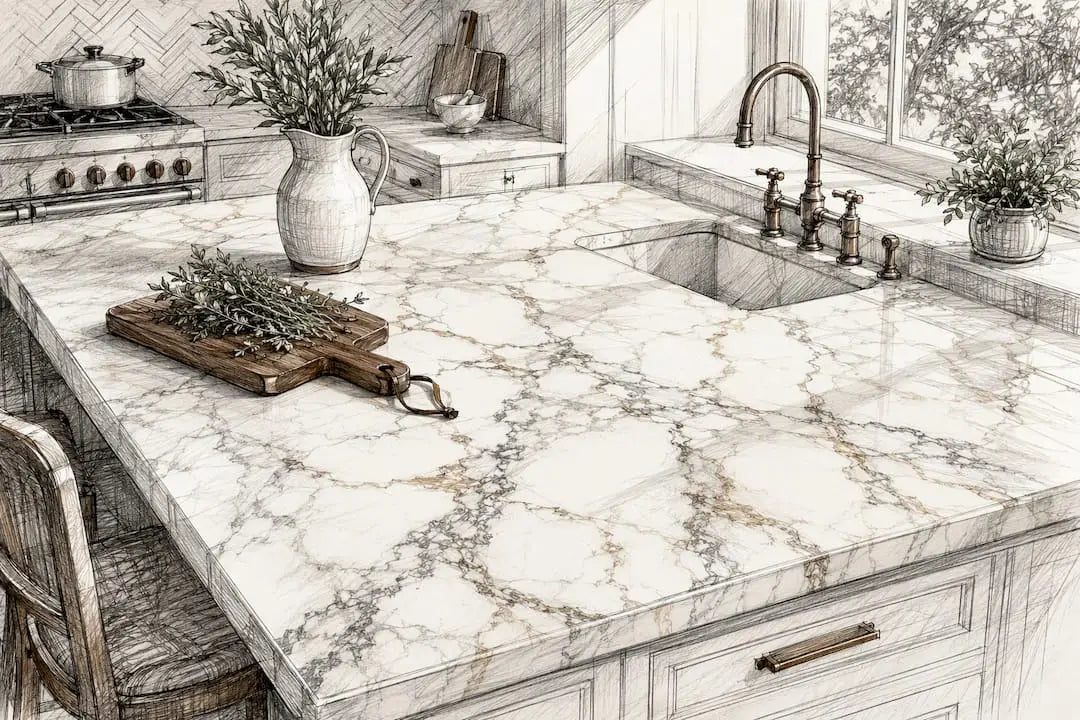
Statistic Callout: Calacatta Gold’s Mohs rating of 3 to 5 puts it in the same durability range as most natural marbles, well below quartzite or granite. That gap is the reason so many fabricators steer buyers toward honed finishes in working kitchens.
Porosity varies slab to slab, but every finish benefits from sealing before grout and sealant lock in. Wine, lemon juice, and vinegar will etch the polished surface within seconds of contact, leaving a dull spot rather than a stain.
Finish choice changes the daily experience:
- Polished: maximum shine and vein contrast, but etch marks show up fastest
- Honed: matte surface that hides light scratching and etching far better
- Leathered: textured surface, less common on Calacatta Gold, used mainly on accent walls
Industry references generally point to ASTM C503 as the baseline specification for exterior marble building stone, a useful benchmark when comparing quoted material to trade standards.
What Formats and Sizes Does Calacatta Gold Come In?
Format decisions shape both your budget and your seam pattern more than most buyers expect. Slabs typically arrive in dimensions near 55 by 108 inches, though exact sizes vary by quarry block, while tiles commonly come in 12x24, 18x18, and 24x24 formats for floors and walls.
- Slabs: best for countertops, waterfalls, and shower walls where seam placement matters
- Tiles: economical for flooring and backsplashes, with more repeat pattern across a large area
- Mosaics: ideal for shower floors, accent bands, and backsplash details
- Moldings and trim: finish edges cleanly around vanities, thresholds, and niche returns
Thickness matters for structural spans. Two-centimeter slabs cost less and suit vertical applications, while 3 cm slabs handle waterfall edges and unsupported island overhangs with far less risk of cracking. If you want a continuous vein flow across a seam, known as bookmatching, you need to order both slabs from the same block and confirm lot continuity before fabrication begins.
What Drives the Price of Calacatta Gold Marble?
Installed costs for Calacatta Gold commonly land in a wide range, often $100 to $300 or more per square foot depending on grade and finish, with premium slabs pushing well past that ceiling. Stone-only quotes and fully installed quotes are two different numbers, and confusing them is the single most common budgeting mistake buyers make.
Several factors push a quote up or down:
- Grade: Extra and Premium tiers cost more because they yield cleaner backgrounds and bolder veining
- Slab yield: fractured blocks produce less usable stone, and that lost yield gets built into the per-square-foot price
- Thickness: 3 cm slabs cost more than 2 cm for the same footprint
- Fabrication: waterfall edges, mitered corners, and sink cutouts add labor
- Shipping: freight from Italy fluctuates with fuel costs and container availability
Statistic Callout: Market analysis shows selection and visual rarity, not raw tonnage, drive most of the price premium on Calacatta-family marble. Two slabs of identical size can carry very different price tags based on how clean the background reads and how dramatic the veining runs.
When a quote arrives, ask for stone cost, fabrication cost, and installation cost as separate line items. Bundled numbers make it nearly impossible to compare two suppliers fairly. If bookmatching matters to your design, budget extra for overage since matching veins across a seam usually means buying more slab than the footprint alone requires.
How Do Origin and Grade Affect Slab Quality?
All authentic Calacatta Gold comes from the Apuan Alps near Carrara, but not every block from that region looks the same. Quarry names like Borghini, Bettogli, and Vagli each produce slightly different vein character, and grading tiers reflect how consistently a given lot delivers a clean background with bold gold veining.
- Standard grade shows more gray background variation and thinner veining, and costs less as a result.
- Extra grade delivers a brighter white field with stronger, more continuous gold veins.
- Premium grade is the scarcest tier, reserved for slabs with the cleanest backgrounds and the most dramatic veining, priced accordingly.
When you inspect a slab or even high-resolution photos, look for background uniformity across the full panel, vein flow that doesn’t abruptly stop or fracture, and any dark speckling that could signal iron deposits capable of oxidizing later. Origin and grade together determine both usable yield and the price per square foot, which is why two “Calacatta Gold” quotes from different suppliers can differ so sharply.
Where Should You Use Calacatta Gold, and Which Finish Fits?
Calacatta Gold performs best where it’s seen, not stepped on constantly. Kitchen islands, vanity tops, and feature walls let the veining do the work it’s meant to do. High-wear commercial floors and exterior applications are poor fits, since the softer hardness and acid sensitivity wear down faster under heavy foot traffic or weather exposure.
- Islands and countertops: honed finish resists etching better in daily cooking use
- Vanity tops and feature walls: polished finish maximizes shine where spills are rare
- Shower walls and floors: honed or textured finish improves slip resistance
- Exterior or high-traffic commercial floors: better handled by harder stone, not Calacatta Gold
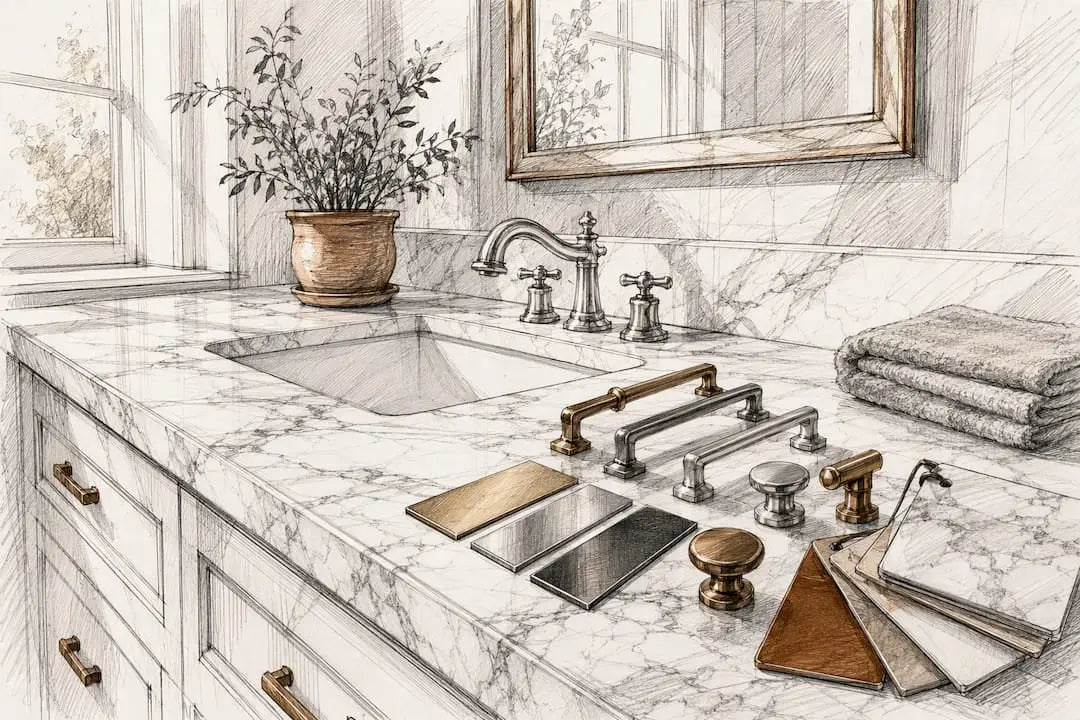
Honed finishes tend to forgive light wear in kitchens, while polished surfaces maximize contrast in lobbies and editorial spaces meant purely to be admired. In wet areas, choose a grout close in tone to the veining rather than the white field, since a stark grout line competes with the marble’s natural movement. Brushed brass and warm bronze fixtures pair especially well with the gold veining, while polished chrome tends to look cold against it.
Pro Tip: Order your cabinet or vanity hardware samples at the same time as your slab selection. Metal finishes look different under showroom lighting than they do next to the actual vein color, and matching them side by side avoids a costly reorder.
How Do You Care for Calacatta Gold Marble Long Term?
A realistic maintenance plan keeps Calacatta Gold looking sharp for decades. Skip it, and etching and staining show up within the first year.
- Seal on a schedule. Trade guidance recommends resealing every 6 to 18 months depending on use, kitchens on the more frequent end, bathroom vanities less often. Test the sealer first by dripping water on an inconspicuous spot; if it beads, you’re covered, if it soaks in, reseal.
- Clean daily with pH-neutral products. Manufacturer guidance steers buyers away from vinegar, bleach, and ammonia-based cleaners, which strip sealer and etch the surface.
- Wipe spills immediately. Wine, coffee, and citrus juice etch on contact; a paper towel and rinse within seconds prevents a permanent dull mark.
- Poultice deep stains. Oil and pigment stains that soak past the surface need a poultice paste left to draw the stain out over 24 to 48 hours, not a quick scrub.
- Watch for rust-colored spots. Trace iron inside the stone can oxidize under moisture and cause internal staining that standard cleaners can’t touch; call a restoration professional rather than attempting to grind it out yourself.
Statistic Callout: That 6 to 18 month resealing window isn’t arbitrary. Countertops handling daily cooking oils and acidic ingredients wear through sealer faster than a guest bathroom vanity touched twice a day, which is why the range is so wide.
What Should You Ask Before Ordering Slabs?
A short checklist at the ordering stage prevents most of the expensive mistakes buyers make with Calacatta Gold.
- Request origin and grade documentation. Ask specifically whether the slab is Standard, Extra, or Premium grade, and from which quarry.
- Get slab-by-slab photos. For bookmatched pairs, insist on photos of the exact slabs you’ll receive, not stock catalog images.
- Ask about edge sealing. Cut edges absorb oil and adhesive faster than the face; confirm the fabricator seals cut edges and uses non-staining epoxy to prevent dark seam lines.
- Watch for red flags. Vague origin claims, “Calacatta-style” labeling with no provenance, and unusually steep price drops from typical market rates all signal a stone that may not be authentic Calacatta Gold.
- Order overage. Add 10 to 15% beyond your measured footprint for standard layouts, more if bookmatching or continuous veining across a large island is part of the design.
Pro Tip: Ask your supplier if you can visit the warehouse or request a live video walkthrough of the actual slabs on the rack. A five-minute call catches vein flow and background issues that a single catalog photo often hides.
What Warranty and Return Terms Should You Expect?
Natural stone doesn’t come with the kind of blanket warranty you’d see on engineered quartz, and that catches first-time buyers off guard. Because every slab is a unique piece of geology, most suppliers warranty against manufacturing or fabrication defects rather than the stone’s natural variation, which means veining, mineral deposits, and color shifts between slabs are expected characteristics, not grounds for a claim.
Reasonable return policies typically distinguish between stock inventory and special-order or custom-cut material. Stock tiles or remnant pieces are often returnable within a set window if unused and in original condition, while slabs cut to a specific countertop template, fabricated pieces, and custom mosaics are usually final sale once fabrication begins, since that stone can’t be resold to another buyer. Ask about this distinction before you commit to a custom cut, not after.
A fair warranty should also cover fabrication workmanship separately from the stone itself, things like seam quality, edge finishing, and installation defects. That’s a different guarantee than one covering the marble’s natural composition, and a supplier who conflates the two in their paperwork is worth a follow-up question.
Before ordering, get the return and warranty terms in writing, including any restocking fee on canceled custom orders and the timeline for reporting a fabrication defect after installation. A supplier confident in their material and their fabricators will put these terms in plain language rather than burying them in fine print.
Is Quarrying Calacatta Gold Marble Environmentally Sustainable?
Quarrying any natural stone from a mountain range carries a real environmental footprint, and the Apuan Alps are no exception. Extraction involves cutting large blocks from the mountainside, which disturbs local terrain, generates stone dust and waste rock, and requires energy-intensive cutting and polishing before a single slab ships anywhere.
Marble does have advantages over some manufactured alternatives on the sustainability ledger. It requires no petroleum-based resins in its raw form, unlike engineered quartz surfaces, and a well-maintained marble surface can last generations rather than being replaced on a renovation cycle. That longevity offsets some of the extraction impact over the life of the material.
The bigger sustainability lever most buyers overlook is waste rock. Fractured blocks and off-cuts from Calacatta Gold quarrying often get repurposed into smaller tiles, mosaics, and trim pieces rather than discarded, which improves the yield of usable stone per block extracted. Choosing tile or mosaic formats over full slabs for secondary applications, like a shower floor or backsplash, is one practical way buyers can favor material that makes fuller use of each quarried block.
Shipping distance also factors in. Since Calacatta Gold ships from Italy to markets worldwide, freight adds to its carbon footprint compared to domestically quarried stone, a tradeoff buyers weighing sustainability against the specific look of this marble should factor into their decision alongside cost and lead time.
What Buyers Get Wrong About Calacatta Gold Marble
The conventional advice treats Calacatta Gold like a single, consistent product: choose the color, get a quote, done. That framing undersells how much a name like this can vary slab to slab, block to block, even within the same quarry. Two invoices that both say “Calacatta Gold” can describe genuinely different stone, and the gap between them is exactly where buyers get burned on price and appearance alike.
The bigger misstep is treating maintenance as an afterthought instead of part of the purchase decision. A homeowner who picks polished Calacatta Gold for a busy kitchen without understanding the etch risk isn’t buying the wrong stone, they’re buying the right stone for the wrong finish. That distinction should shape the conversation before fabrication starts, not after the first wine glass leaves a ring on the counter.
If there’s one priority to put ahead of everything else, it’s provenance. Confirm origin and grade in writing, see actual slab photos, and ask pointed questions about iron content before signing off on an order. Price matters, finish matters, but none of it holds up if the stone underneath isn’t what the invoice claims it is.
— cihan
Where to Find Authentic Calacatta Gold Marble
Sourcing genuine Calacatta Gold starts with a supplier who controls the import chain, not one reselling through several middlemen. Surfacesgalore imports premium natural stone directly, including Calacatta Gold slabs, tiles, and mosaics, and ships nationwide to designers, architects, contractors, and homeowners from its Anaheim, California base.
That direct-import model matters because it’s exactly how the provenance and grade questions raised throughout this guide get answered honestly, with documentation and slab-specific photos rather than vague sourcing claims. Surfacesgalore offers sample orders so you can check vein color and background tone against your actual cabinetry and lighting before committing to a full slab, along with custom bulk quotes for trade professionals managing multiple units. If you’re ready to move forward, explore the current marble collections or request samples to compare grades side by side before you finalize a design.
Sources
- Calacatta Gold — Stone Intelligence (technical data & care guide)
- Calacatta marble countertops: cost, care, and tradeoffs — SlabWise
- Calacatta Gold Marble: Costs, Value, and Care Essentials — Signature Stone
- Rust stains on marble — Tile Doctor
FAQ
Is Calacatta Gold Marble Expensive?
Yes. Installed costs commonly fall in a wide $100 to $300 or more per square foot range, with grade, veining intensity, and slab yield pushing premium selections toward the higher end.
Is Calacatta Marble the Most Expensive Option?
Calacatta-family marbles rank among the priciest natural stones due to rarity and slab yield rather than raw material cost, though exact standing versus other rare stones varies by quarry and grade.
Is Calacatta Gold the Most Expensive Marble?
It’s consistently among the higher-priced marbles because of its bold gold veining and limited premium-grade yield, though Statuario and other rare Carrara varieties can command comparable or higher prices depending on grade and availability.
What Is the Difference Between Calacatta and Calacatta Gold?
Calacatta marble covers a broader family of white Italian stone with dramatic veining, while Calacatta Gold specifically features warm gold tones running through that veining alongside the gray, a distinction grading and quarry origin help clarify when comparing slabs.

Leave a comment