
Limestone Kitchen Maintenance: Cleaning, Sealing and Repair

Limestone stays beautiful in a kitchen when you do four things: clean it with a pH-neutral product, keep acids off it, seal it on a schedule, and blot spills instead of wiping them. Most of the work is a five-minute routine. The rest is knowing which cleaners to keep away from the stone and when a mark needs a restoration specialist instead of a DIY fix. We import limestone tile directly, so this guide is built around what installed limestone actually needs once the grout cures and the household moves in.
TL;DR
- Clean daily and weekly with warm water and a neutral stone cleaner, stone soap or a mild liquid dish detergent. Rinse and dry with a soft cloth.
- Limestone is calcium carbonate, so vinegar, lemon, wine, tomato and many cleaners can etch it. Blot spills right away.
- Seal with an impregnating sealer, then test with water drops. In busy kitchens, plan on resealing roughly every 6 to 12 months for countertops, and check floors on the same test.
- Light haze on honed limestone can often be treated at home. Deep etching, polished finishes and large areas call for a stone restoration professional.
Table of Contents
- Why limestone needs its own kitchen routine
- Daily and weekly cleaning
- What to keep away from limestone
- Spills, stains and acidic liquids
- Sealing limestone in a kitchen
- Removing stains, etching and dullness
- DIY or professional?
- Maintenance by kitchen type
- Our perspective
- Choosing limestone for the kitchen
- FAQ
- Sources
Why limestone needs its own kitchen routine
Limestone is a sedimentary stone made largely of calcium carbonate. That is what gives it the soft, matte, quiet look designers want in a kitchen. It is also why acids react with it. The Natural Stone Institute, the trade association for the stone industry, notes that products containing lemon, vinegar or other acids may dull or etch calcareous stones like limestone.
The Dimension Stone Design Manual excerpt published by NSR Stone describes etching as a dull, whitish mark caused by a chemical reaction between an acidic or caustic liquid and calcium carbonate. Etching is not a stain, and that distinction drives everything below. A stain is a substance that has soaked into the pores. An etch is a change to the surface itself. Sealing helps with the first. Cleaning and quick action help with both.
Not every limestone behaves the same way. The same guide separates porous limestones (under 150 lbs/ft³ in density, such as Crema Europa or Beaumaniere) from dense ones (160 lbs/ft³ and up, such as Jerusalem/Ramon or Jura). The porous types absorb roughly 100 to 200 percent more sealer to be protected properly, and the dense types behave more like marble. If you are choosing a stone for a cooking-heavy kitchen, ask for the density and finish of the specific tile before you order. A honed or brushed surface is also easier to touch up than a polished one, since a fine haze blends into a matte face.
Daily and weekly cleaning
A limestone kitchen does not need harsh products. It needs the right ones, used with little water.
The basic routine
The Natural Stone Institute recommends cleaning stone with a neutral cleaner, stone soap, or mild liquid dishwashing detergent and warm water. Use a clean rag mop on floors and a soft cloth on other surfaces, rinse thoroughly, and dry with a soft cloth.
Here is how that looks in practice:
- Dust first. Dust mop or vacuum floors often. Grit acts like sandpaper under shoes and chairs.
- Wipe with warm water and a neutral cleaner. Mix per the label. More soap does not mean cleaner stone, it means residue.
- Rinse with clean water. Soap film dulls a honed surface and attracts dirt.
- Dry with a soft cloth. Standing water is the enemy of a porous surface, and drying prevents streaks and water spots.
Place slip-resistant mats at entrances and in front of the sink and range. The same Institute guidance points to mats at entrances to minimize grit, and the spot in front of the sink is where kitchen floors take the most abuse.
Go easy on water
More moisture does not mean a deeper clean. Limestone is porous, so a dripping mop pushes dirty water into the stone and into grout joints. Wring the mop until it is barely damp, and dry the floor afterward. Skip steam cleaners on stone floors, which force hot moisture into the pores.
Can you use Dawn on limestone?
A mild liquid dishwashing detergent is on the Natural Stone Institute’s list of acceptable cleaners, used diluted in warm water and rinsed well. Treat it as an occasional option, and use a pH-neutral stone cleaner for routine mopping, since it is made for the job and leaves less residue. Avoid detergents that advertise lemon, citrus or vinegar, and anything with added bleach or abrasives.
What to keep away from limestone
The Natural Stone Institute’s warnings are specific, and they are worth printing and taping inside the cleaning cabinet:
- Acids: lemon, vinegar and similar products can dull or etch limestone.
- Scouring powders and creams: they contain abrasives that can scratch stone.
- Rust removers: many commercial products contain trace hydrofluoric acid, which attacks all stones.
- Ammonia and bleach together: never mix them. The combination creates a toxic, potentially lethal gas. Keep the kitchen ventilated whenever you clean with any chemical.
The general rule from LATICRETE’s stone care page is that cleaners not designed for natural stone may etch the polish, discolor or scratch the stone, or degrade the sealer. Bathroom tile cleaners, grout cleaners and all-purpose sprays with citrus fall into this group. Check the label for the words “safe for natural stone” before it touches the countertop.
For a broader look at stone care across rooms, our natural stone maintenance guide covers products and routines in more detail. The cleaner-selection logic in our acid-safe cleaner and spot-test guide for marble applies to limestone as well, because both are calcium carbonate stones.
Spills, stains and acidic liquids
Speed matters more than the product you reach for. The Natural Stone Institute’s spill steps are simple: blot with a paper towel instead of wiping, flush with water and mild soap, rinse several times, and dry thoroughly with a soft cloth. Repeat if needed. Wiping spreads the liquid across the surface and into more pores.
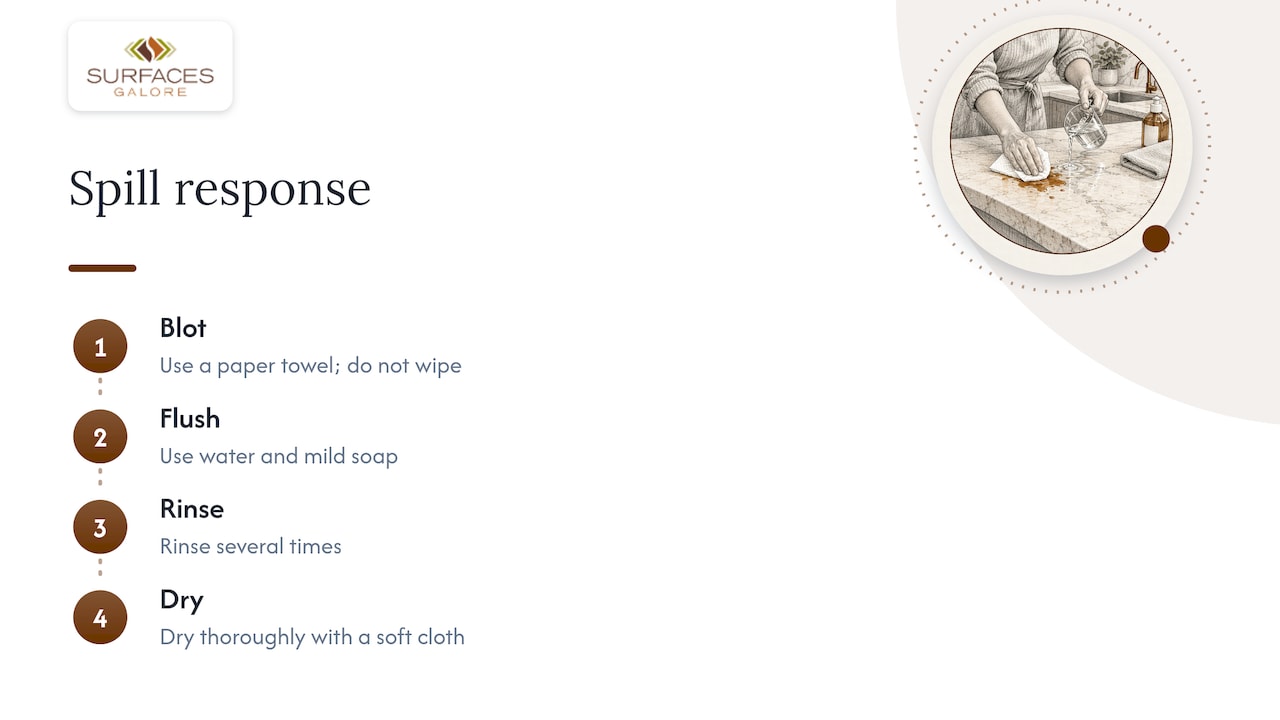
LATICRETE adds a useful detail: use a clean, dry, white cloth and turn it frequently as you blot, then spray the spot with a neutral stone cleaner and wipe off the excess. The white cloth matters because colored fabric can transfer dye onto a damp, porous surface.
Know the usual suspects
LATICRETE lists the substances that etch most marble, limestone and travertine: orange juice, coffee, vinegar, wine, tomato products, mustard and many soft drinks. That is most of a kitchen. Its page also says sealing gives you time to wipe up a spill but cannot stop the chemical reaction that may leave a dull mark. The Natural Stone Institute makes a related point: sealers are really impregnators that act as repellents, so sealed stone is more stain-resistant, not stain-proof.
So the habit that protects a limestone kitchen is not a product. It is a cloth within reach. Keep one near the range and one near the sink.
Daily protection checklist
- Cutting boards under anything you slice, especially lemons, limes and tomatoes.
- Trivets under hot pots, and coasters under glasses.
- A tray for oil, vinegar and wine bottles, so drips land on something replaceable.
- A dish or mat under pet bowls on floors.
If you want to know how limestone compares with other stones on staining before you buy, read does limestone stain easily. For a practical list of habits, see how to prevent stains on natural stone tile.
Sealing limestone in a kitchen
Sealing is the step that buys you time to react. It is also the step people skip or get wrong.
What a sealer does
The industry term “sealer” is a little misleading. These products are impregnators: they soak into the pores and repel liquids rather than forming a film. In a food-preparation area, the Natural Stone Institute says the product must be non-toxic and safe for that use, and the sealer manufacturer sets the type and frequency. Read the label for food-contact suitability and follow the manufacturer’s directions for coats and cure time.
For limestone, Dynamic Stone Tools recommends an impregnating sealer rated for high-porosity stone, applied in two or three coats before installation. Sealing before the stone is set protects the faces and edges, and your installer can then seal the grout joints once they have cured.
How often to reseal
The same source says limestone countertops typically need resealing every 6 to 12 months in kitchen use. Your sealer’s label is the final word. Rather than going by the calendar alone, run this test:
- Clean and dry a spot, such as near the sink or range.
- Place a few drops of water on the stone.
- Wait a few minutes.
- If the drops bead, the sealer is working. If they soak in and darken the stone, it is time to reseal.
Test monthly on countertops and every few months on floors, especially in front of the sink and range. A floor that sees light traffic may hold its seal longer than a prep surface, and the water test tells you which you have. Our guides on why to seal natural stone in kitchens and baths and when stone should be sealed lay out the timeline in more detail.
Quick comparison: care by kitchen surface
| Surface | Main risk | Routine | Sealer check |
|---|---|---|---|
| Floor | Grit, standing water, drips near sink and range | Dust mop, damp mop with neutral cleaner, dry | Water-drop test every few months |
| Countertop | Acids, heat, cutting | Wipe with neutral cleaner, trivets and boards | Monthly water-drop test |
| Backsplash | Splatter from oil, tomato, wine | Wipe after cooking, neutral cleaner weekly | Water-drop test near the range |
| Mosaic or grout lines | Dirt in joints, moisture | Soft brush, minimal water, dry | Seal grout when cured |
Our marble backsplash maintenance guide walks through the sealer test on a vertical surface, and the same method works on limestone.
Removing stains, etching and dullness
First work out which problem you have. A dark spot that was a liquid is a stain. A pale, dull patch where the finish has changed is an etch. They need different treatments, and the wrong one can make things worse.
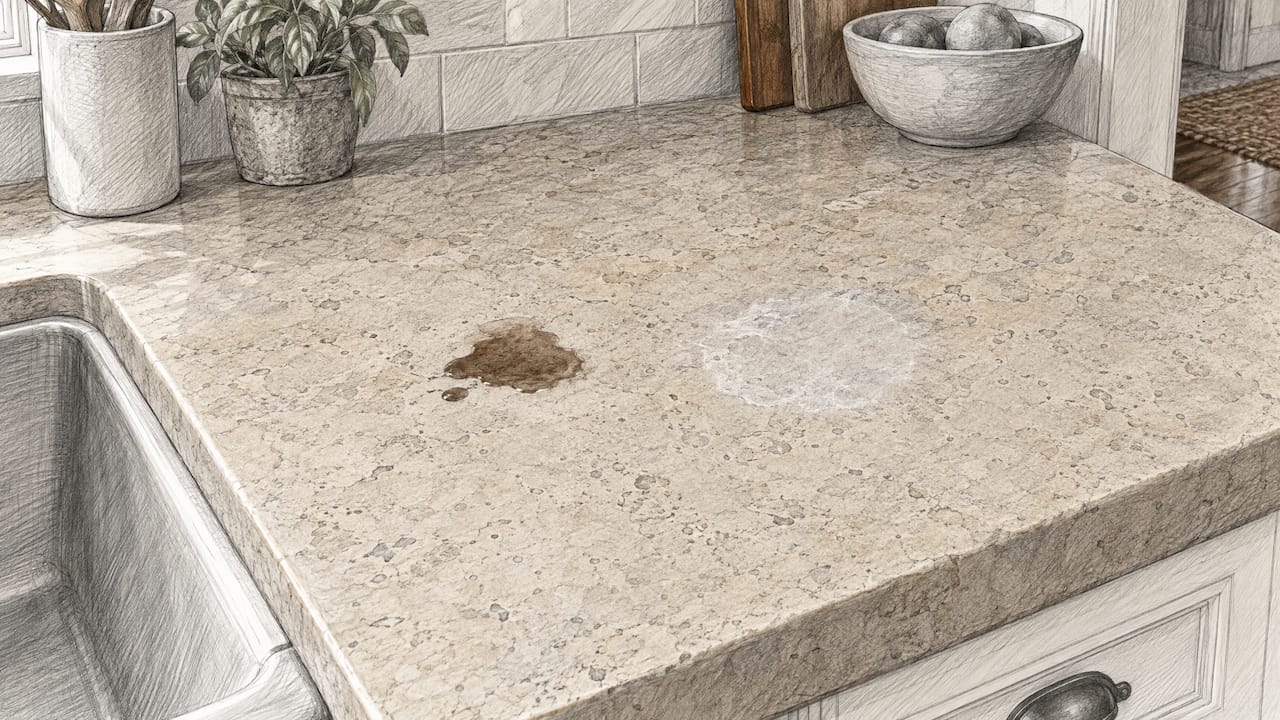
Stains: use a poultice
A poultice is a paste that draws a stain back out of the stone as it dries. Dynamic Stone Tools recommends a baking soda and acetone or mineral spirits poultice for oil-based stains, and baking soda with hydrogen peroxide for organic stains such as coffee or wine. The process:
- Mix the powder and liquid into a paste about the consistency of peanut butter.
- Spread it over the stain, slightly beyond the edges.
- Cover with plastic wrap and tape the edges.
- Leave it for 24 to 48 hours, then remove it, rinse and dry.
- Reseal the treated area.
That guide also says not to use bleach on limestone. Work in a ventilated room, wear gloves, and keep solvents away from flames.
Etching: it is a surface change
The NSR Stone guide is clear that cleaning, polishing or resealing will not simply remove an etch. The stone has to be ground to the depth of the damage and refinished. Etch depth ranges from a minor dull spot to a millimeter or more that you can feel by touch.
For minor etching on honed limestone, Dynamic Stone Tools describes hand-polishing with wet diamond pads, moving from 400 to 800, 1500 and 3000 grit. Work a small area, keep it wet, and blend outward so the repair does not show as a patch. LATICRETE notes that professional refinishing is the best way to permanently remove etch marks and restore an even finish.
DIY or professional?
Handle it yourself when:
- The mark is a fresh spill you can blot and rinse.
- A stain is on the surface and a poultice fits the type.
- Etching is a light haze on a honed or brushed surface and you can blend it with fine pads.
- The stone just needs a clean and a fresh coat of sealer.
Call a stone restoration specialist when:
- The surface is polished. Dynamic Stone Tools says etch repair on polished limestone requires professional re-polishing equipment.
- Etching is significant or covers a large part of a floor or countertop.
- You can feel a clear texture change with a fingernail, or the surface has widespread pitting. A guide on removing etching from marble and limestone lists these as the signs to bring in a pro.
- The stone is a dense limestone that needs the right resin abrasives and a low-acid polishing powder to avoid an orange-peel texture, per the NSR Stone guide.
- A poultice has run its course and the stain is still there.
A uniform refinish is better than several spot repairs, because a patch on a large floor can look different from the surrounding stone. For a sense of what is involved in a home polish, see our DIY polishing guide, which explains where home work stops. After any restoration, the best practices for keeping the finish are the same as the routine above.
Maintenance by kitchen type
Homeowners and remodelers
Pick a finish with the way you cook in mind. A honed or brushed face is forgiving for daily life and easy to touch up. Set your routine before move-in: a neutral cleaner under the sink, a stack of white cloths, a sealer you have read the label on, and a date to run the water-drop test.
Designers, architects and builders
Specify the sealer and the maintenance expectations with the stone. Give the client a one-page care sheet, since most damage in a limestone kitchen comes from the wrong cleaner rather than from the stone. For hospitality or commercial kitchens, write the cleaner and reseal schedule into the facility’s maintenance plan, and keep the staff away from all-purpose sprays.
Installers
Seal before grouting where the manufacturer allows, wipe grout haze with products suited to natural stone, and let the sealer cure fully before returning the kitchen to the client. Hand over the name of the sealer you used, so reapplication matches.
Our perspective
Limestone does not ask for much, but it does ask for consistency. The kitchens we see stay in the best shape are the ones with a simple routine: neutral cleaner, a cloth within reach, a sealer checked with a few drops of water.
As a direct importer, we think the best maintenance starts with the stone you choose. Pick the finish and density for how the room is used, and ask for samples so you can see how the tile looks and handles in your own light. We ship samples free, and our inventory is premium, non-commercial grade stone with strict quality assurance on architectural-grade material.
Natural variation is part of the appeal. Veining, tonal shifts and fine texture are why people choose limestone over a uniform manufactured surface. A little patina from daily use is part of that character, and the care steps above keep it looking intentional.
John | Surfaces Galore
Choosing limestone for the kitchen
If you are planning a new kitchen or a remodel, start with the tile. Our Dolce Crema 12x12 limestone suits warm, soft palettes. For a deeper, cooler tone, look at Obsidian Ash 16x24 limestone in a honed finish or the brushed version, where the texture is forgiving of daily wear.
We import marble, travertine and limestone directly and ship nationwide, with custom orders, bulk quotes and trade options for designers, contractors and builders. Browse the full natural stone collection by type, including tiles and mosaics, and order samples before you commit to a full kitchen.
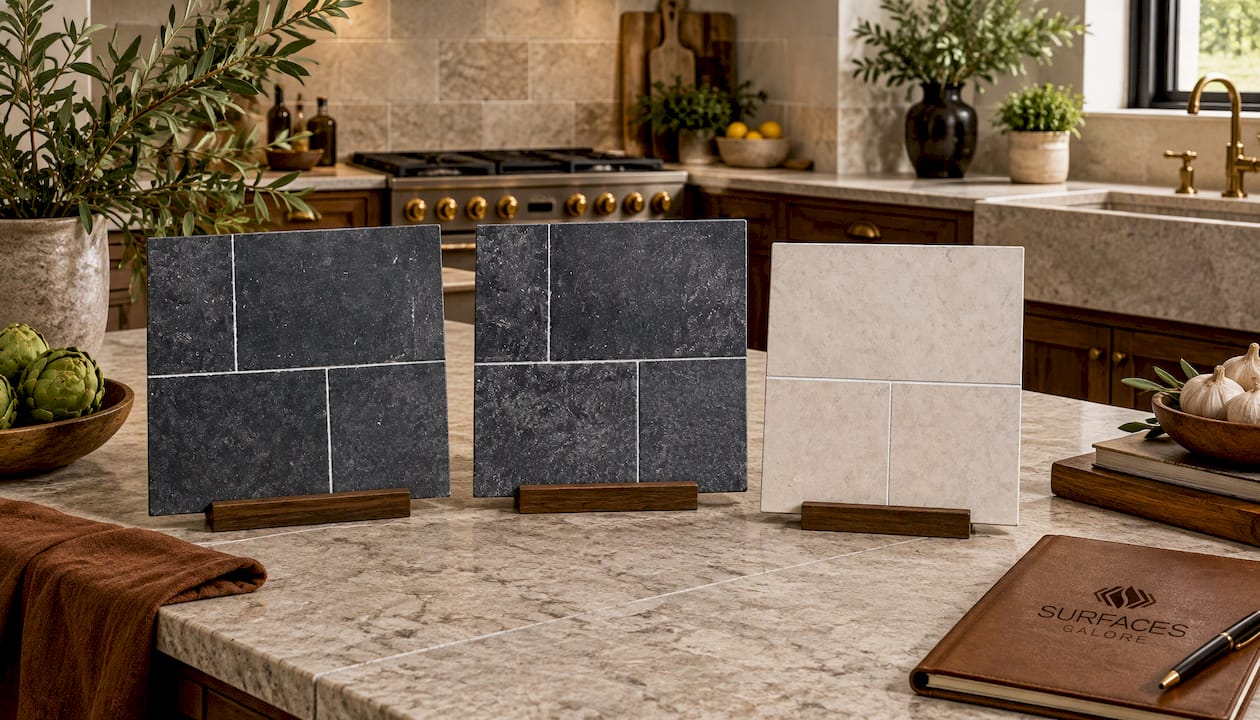
Samples also let you run your own tests. Put a sample by the sink, check how it handles a drop of water and the light in your kitchen, and plan your sealer around what you see.
FAQ
How do I care for limestone countertops?
Wipe daily with warm water and a neutral stone cleaner or mild dish detergent, rinse, and dry with a soft cloth. Use cutting boards, trivets and coasters, and blot spills right away. Check the sealer with the water-drop test each month and reseal when drops soak in.
How do I make limestone look new again?
Start with a thorough cleaning and rinse, then treat any stain with a poultice. Light haze on a honed surface can be blended with fine wet diamond pads from 400 to 3000 grit. Polished surfaces and deeper etching are a job for a stone restoration professional, who can grind and refinish the area evenly.
Is limestone a good choice for a kitchen floor?
Yes, when it is sealed and cared for with the right products. Choose a finish suited to your household, such as honed or brushed, keep grit off with mats and regular dust mopping, and wipe up spills quickly. A floor-specific routine is short, and the water-drop test tells you when to reseal.
Can I use vinegar or a bathroom cleaner on limestone?
No. Vinegar, lemon and many general-purpose or bathroom cleaners contain acids that can dull or etch limestone. Use a pH-neutral cleaner labeled safe for natural stone. Never mix ammonia and bleach, because the combination creates a toxic gas.
Sources
- Natural Stone Institute: Consumer care and cleaning
- LATICRETE: Stone cleaning tips
- NSR Stone: Restoration and maintenance (Dimension Stone Design Manual excerpt)
- Dynamic Stone Tools: Limestone countertops care guide
- Dynamic Stone Tools: How to remove etching from marble and limestone
Recommended
- How to Properly Seal Your Kitchen Backsplash
- Why Seal Natural Stone: Essential Benefits for Kitchens and Baths
- Does Limestone Stain Easily? What to Expect
- Natural Stone Maintenance Guide for Lasting Beauty
This article is provided for general informational guidance only. Natural stone varies in color, veining, texture and performance. For installation, sealing, cleaning and maintenance, follow the product manufacturer’s instructions and consult a qualified installer or stone-care professional. Always test cleaning and sealing products in an inconspicuous area first. Surfaces Galore is not responsible for damage, discoloration, etching, staining, installation issues or other problems resulting from

Leave a comment