
How Marble Forms, Why It Etches: For Designers & Homeowners

Marble is limestone or dolomite that got cooked and compressed underground until its calcite crystals fused into a dense, interlocking network. That single transformation explains almost everything about the stone: the veining that runs through a slab of Calacatta, the way a wine spill can dull a polished countertop overnight, and why marble sculptures have survived for thousands of years while looking softer at the edges than they once did. Understanding that origin story helps you pick the right variety, finish, and maintenance routine for your project.
TL;DR:
- Marble’s porosity and susceptibility to acid etching require regular sealing and the use of pH-neutral cleaners to prevent stains and dulling.
- Fine-grained white marbles transmit more light, making them suitable for backlit panels and creating a soft glow in sculptures and design features.
- Coarser or more porous marbles, like some varieties of Carrara or Crema Marfil, need careful sealing to minimize staining from liquids such as oil or wine.
- Natural marble often exhibits irregular veining and varies in color depending on impurities, with popular varieties differing significantly in appearance and cost.
- Authentic marble is heavier and reacts to acids, unlike synthetic or engineered stones, which often show repeating veining patterns and feel warmer to the touch.
Table of Contents
- What Is Marble and How Does It Form?
- Types of Marble Stone: Which Variety Fits Your Project?
- Physical and Chemical Properties: What Makes Marble Behave the Way It Does
- Common Uses and Applications for Marble
- Durability, Maintenance, and Care: Keeping Marble Looking Right
- How Marble Is Sourced and Processed
- Why Sourcing Matters as Much as the Stone Itself
- How to Tell Real Marble From Synthetic or Engineered Stone
- Choosing Between Marble and the Alternatives
- Get Marble Samples and Direct-Import Pricing
- Sources
- FAQ
What Is Marble and How Does It Form?
Marble starts as ordinary sedimentary rock, usually limestone or dolomite, sitting in the earth’s crust for millions of years. Heat and pressure from tectonic activity then push that rock through metamorphism, a process that recrystallizes the original calcite or dolomite grains into a denser, interlocking crystal structure. The result is a rock that’s harder and more crystalline than its parent limestone, but still built from the same soft carbonate minerals.
The purity of that original limestone determines a lot. Perfectly clean limestone, with almost no other minerals mixed in, recrystallizes into the bright white marble you see in classical sculpture. Nearly every other color and pattern comes from impurities that got trapped in the rock before metamorphism ever started.
- Iron oxides produce the warm gold, pink, and rust tones found in stones like Rosso Levanto.
- Graphite and carbon create the gray and black streaking seen in Bardiglio and similar marbles.
- Serpentine minerals are responsible for the deep greens in Verde Alpi and related varieties.
- Clay and silt bands create the softer, cloudier veining common in Crema Marfil.
Crystal size matters just as much as chemistry. Marble that formed under intense heat and pressure, what geologists call a higher metamorphic grade, develops larger, coarser crystals. Marble that formed under gentler conditions keeps a finer, tighter crystal structure. Finer-grained marble typically takes a higher polish and can show more translucency, which is why sculptors have always hunted for the tightest-grained stone they could find. Coarser marble still polishes well but tends to show more visible crystal sparkle up close.
Types of Marble Stone: Which Variety Fits Your Project?
Not all marble looks or performs the same way, and the differences trace directly back to where and how each stone formed. Marble varieties like Carrara, Calacatta, and Crema Marfil differ widely in color and veining because of what was mixed into the original limestone bed.
- Carrara marble has a soft gray background with fine, feathery gray veining. It’s the most widely available white marble, quarried in massive volume from Italy’s Carrara region, which keeps its price relatively accessible for kitchens and baths.
- Calacatta marble shows a brighter white background with bolder, thicker veining, often in gold or dramatic gray tones. It’s quarried in smaller quantities than Carrara, which pushes cost noticeably higher for slabs with strong, dramatic movement.
- Crema Marfil brings a warm, creamy beige tone with subtle, fine veining. Spanish quarries produce most of the market’s supply, and it reads as more neutral than the white marbles, which makes it a favorite for flooring, wall cladding, and mosaic work where a calmer background is the goal. Formats like the Crema Marfil 1x2 brick mosaic and the 5/8 by 5/8 mosaic show how this stone reads at a small scale, while bamboo stick mosaics in polished or honed finish give designers a linear, textured alternative for accent walls and shower niches.
- Nero Marquina is a striking black marble with white calcite veining, quarried in Spain. It reads dramatic on a floor or a fireplace surround but shows scratches and etching more visibly than lighter stones.
- Emperador ranges from light to dark brown with fine white or gold veins, giving a warmer, more traditional look than the grays and whites.
- Green serpentine marbles, sometimes just called “verde” marbles, contain enough serpentine mineral content to run harder than typical calcite marble, which can make them a slightly more forgiving choice for high-traffic floors.
Designers generally reach for Carrara and Crema Marfil when they want a background stone that won’t fight with cabinetry or furniture, and save Calacatta, Nero Marquina, or bold Emperador for a single statement surface, like an island or an accent wall, where the veining is meant to be the main event.
Physical and Chemical Properties: What Makes Marble Behave the Way It Does
Marble’s defining mineral is calcite, calcium carbonate, though some marbles form from dolomite instead, which contains magnesium alongside the calcium. That chemistry has one major consequence every buyer needs to understand: calcite reacts with acid. Lemon juice, vinegar, wine, and most bathroom cleaners will etch a dull spot into polished marble on contact, sometimes within minutes.
Pro Tip: Keep a coaster policy in the kitchen for anything acidic, and never use a bathroom cleaner labeled for “hard water stains” on marble tile. Most of those formulas are acid-based and will etch grout lines and stone alike.
Porosity is the other property that trips people up. Marble contains microscopic pores that absorb liquid, which is why an unsealed countertop can show a dark stain from olive oil or red wine long after you’ve wiped the surface clean. Denser, fine-grained marbles absorb less than coarser, more porous varieties, but none of them are stain-proof without help.
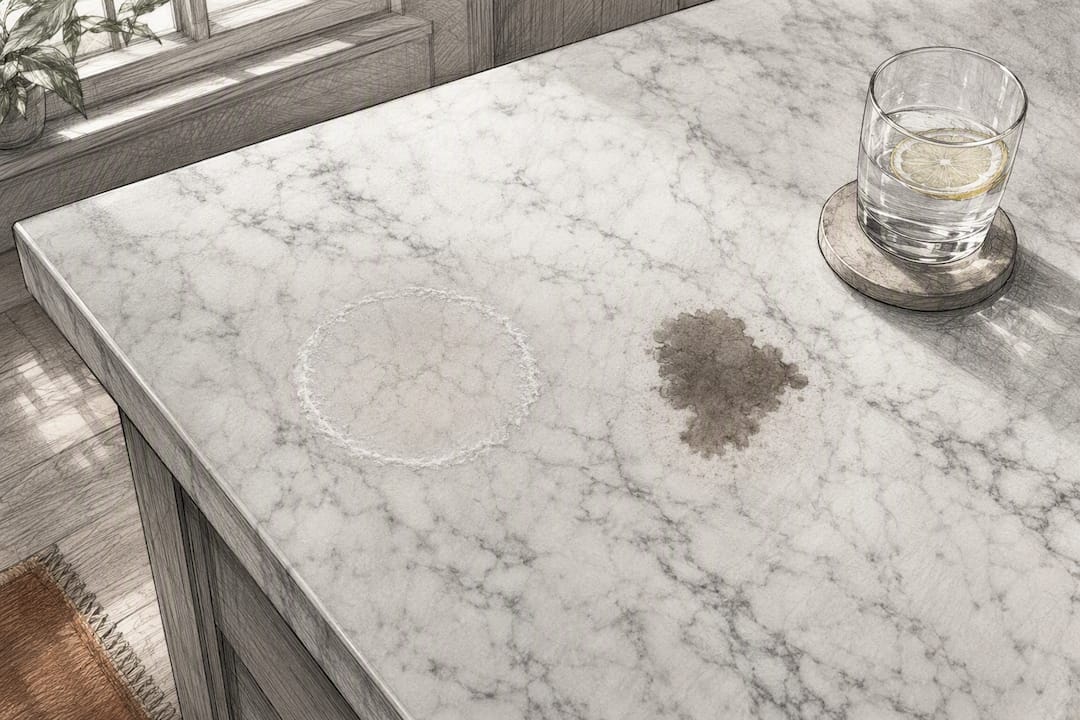
On the Mohs hardness scale, marble sits around 3 to 4, well below granite (roughly 6 to 7) or quartz-based engineered stone (7 or higher). That relative softness isn’t a flaw. It’s simply information: marble scratches more easily than harder stones and needs a sealer and a gentler cleaning routine, but it also machines and carves beautifully, which is exactly why sculptors have preferred it for millennia.
Fine-grained white marbles also carry a degree of translucency, meaning light can pass a short distance into the stone before scattering. That quality is why classical statuary looks like it has a soft glow, and why some designers use thin marble panels as backlit feature walls.
- Calcite marble etches faster and more visibly than dolomite marble when exposed to acid.
- Unsealed marble can absorb a stain within 15 to 30 minutes of contact with oil or wine.
- Mohs hardness around 3 to 4 means marble scratches under sand, grit, and some metal objects.
- Fine-grained white marbles allow the most light transmission, useful for backlit applications.
Common Uses and Applications for Marble
Marble’s color and appearance are its most valuable qualities, while its abrasion resistance and porosity determine where it can realistically be installed. That tradeoff shapes almost every design decision below.
- Sculpture and statuary demand the purest, most consistent white marble available, since even faint veining or color banding can throw off a carved figure’s surface. Fine grain and translucency matter more here than anywhere else.
- Kitchen countertops work well with marble, but expect more upkeep than granite or quartz. A honed finish hides etching better than a high polish, since the matte surface doesn’t rely on reflected light to look flawless.
- Bathrooms are one of marble’s best fits: lower food-and-acid exposure than kitchens, plus the cool, elegant look that makes marble a perennial favorite for vanities, shower walls, and tub surrounds. See more real-world marble applications for layout ideas.
- Flooring benefits from a honed or lightly textured finish in high-traffic areas, since polished marble can get slippery and shows foot traffic wear faster.
- Wall cladding and backsplashes put marble’s veining on full display without exposing it to the abrasion a floor takes.
- Exterior applications need extra caution. Porosity plus freeze-thaw cycles can crack or spall marble in cold climates, so exterior use generally calls for denser, less porous varieties and careful installation drainage.
Durability, Maintenance, and Care: Keeping Marble Looking Right
Marble needs more attention than granite or engineered quartz, largely because calcite etches on contact with acids and sealing helps with stains but does nothing to stop etching. Knowing the difference between those two problems changes how you clean and protect the stone.
- Seal it on a schedule. A penetrating sealer soaks into the stone’s pores and blocks liquids from absorbing into the surface. Most residential marble needs resealing on a regular schedule, typically within several months to a year, depending on traffic and how porous the specific stone is. Topical sealers sit on the surface instead and wear faster, so ask your supplier which type was used before you commit to a maintenance interval.
- Clean with pH-neutral products only. Skip anything labeled “for tile and grout” unless it specifically says safe for marble. A dedicated stone cleaner or a mild dish soap diluted in warm water handles daily grime without attacking the calcite.
- Wipe spills immediately, especially wine, coffee, citrus, and vinegar-based dressings. Blot rather than wipe to avoid spreading the liquid across more surface area.
- Call a professional for honing or repolishing once etching or dulling becomes visible across a wide area. A skilled installer can often restore a marble floor or countertop to near-original condition without replacing the slab.
- Ask sourcing questions before you buy. Request physical samples, confirm the finish (polished, honed, or tumbled), and ask directly whether the slab has been factory-sealed or needs sealing after installation.
Guides like top marble selection tips walk through more of these buying safeguards in detail, including how finish choice affects long-term care.
How Marble Is Sourced and Processed
Marble comes out of the ground in massive blocks, cut from quarries using diamond wire saws and chain saws that minimize cracking. Major sourcing regions include Italy (Carrara, Calacatta), Spain (Crema Marfil, Nero Marquina), Turkey, Greece, and parts of the United States, though Italy and Spain still dominate global supply for the varieties most common in residential design.
Once a block leaves the quarry, it’s cut into slabs and finished in one of a few standard ways:
- Polished finish gives the highest shine and the deepest color saturation, ideal for showcasing veining.
- Honed finish is matte and smoother to the touch, better at hiding etching and scratches over time.
- Tumbled finish has a worn, softened edge and texture, common in mosaic and traditional-style installations.
Before buying, inspect slabs in person or request detailed photos. Look for fissures (natural hairline cracks that are common and usually stable, but worth knowing about), consistent veining across the pieces you’re purchasing, and enough slabs from the same lot if you need color and pattern to match across a large installation. Reputable suppliers also recycle offcuts into smaller format tile, mosaics, and trim pieces rather than sending waste to a landfill, which stretches the value of every quarried block.
Why Sourcing Matters as Much as the Stone Itself
Buying marble directly from an importer rather than through multiple middlemen tends to mean fresher inventory, more consistent lot matching, and pricing that reflects the stone’s actual cost rather than several markups stacked on top of each other. Direct importers and nationwide suppliers let designers and contractors work from architectural-grade inventory instead of commercial-grade leftovers.
- Sample shipping options let you test color and veining against your own lighting before committing to a full order.
- Trade support and bulk quote options help designers, architects, and contractors managing multi-room or multi-unit projects.
- Editorial guides on the Surfaces Galore blog, including breakdowns of marble veining patterns and how to choose marble colors, are written to help buyers make informed decisions before they order.
How to Tell Real Marble From Synthetic or Engineered Stone
Natural marble and its synthetic imitations can look nearly identical in a showroom, but a few checks reveal the truth quickly. Artificial marble is manufactured using resin fillers and binders molded to mimic the look of natural stone, which means its surface pattern often repeats in a way real stone never does.
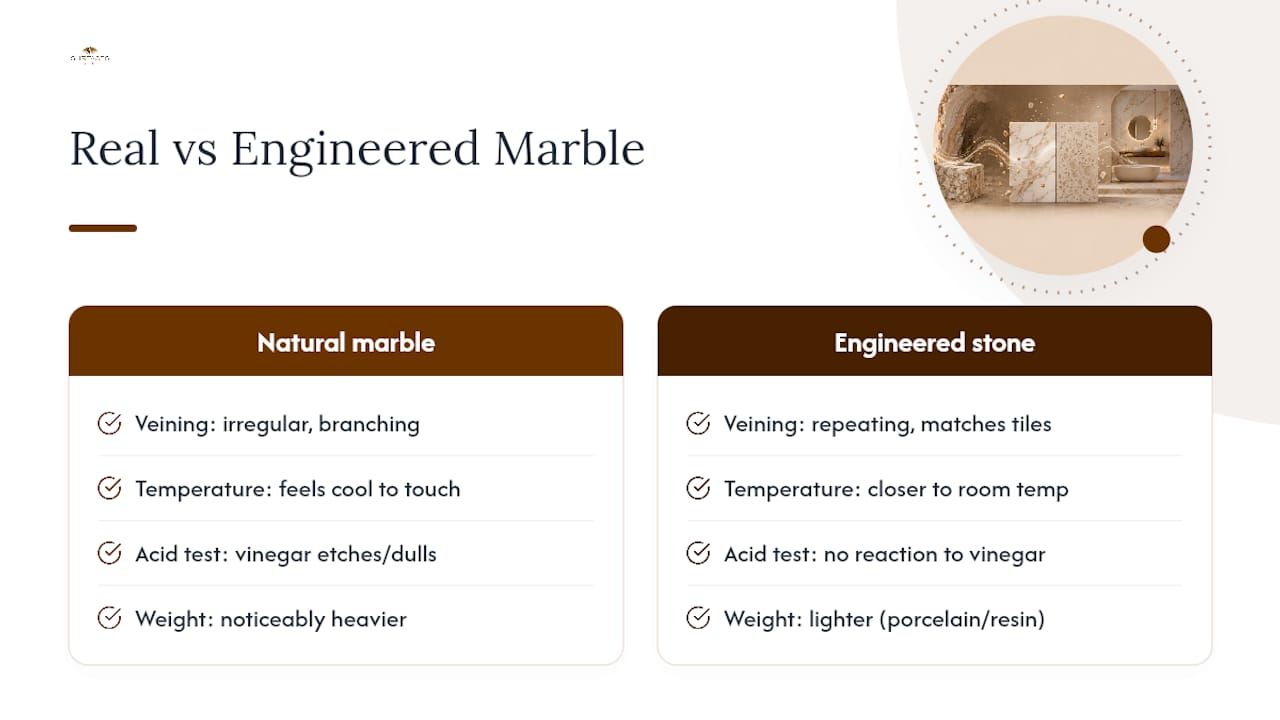
Start with the veining. Natural marble veins run through the stone with irregular branching, sometimes fading or thickening unpredictably. Synthetic versions frequently show repeating patterns, since the same mold or printed pattern gets reused across multiple pieces. Lay two tiles from the same box side by side. If the veining matches exactly, you’re likely looking at an engineered or printed product.
Temperature is another tell. Natural marble feels notably cool to the touch, even in a warm room, because of its dense mineral structure. Engineered stone and porcelain that mimics marble often feels closer to room temperature.
Try the acid test carefully on an inconspicuous edge or a leftover scrap. A drop of white vinegar will etch and dull real calcite marble within a minute or two. Synthetic marble and porcelain won’t react at all, since they contain no calcium carbonate to speak of.
Weight matters too. Natural stone is noticeably heavier than the same size piece of porcelain or resin composite. And if you can see the underside or a cut edge, natural marble shows consistent crystalline structure throughout, while engineered versions often reveal a visible resin layer or backing material.
Choosing Between Marble and the Alternatives
Marble makes the most sense for homeowners and designers who want dramatic, one-of-a-kind veining and are willing to seal and clean the stone on a regular schedule. Bathrooms, accent walls, low-traffic floors, and statement pieces are where it earns its reputation.
If the household leans hard on acidic cooking, has young kids who leave juice cups everywhere, or simply wants a lower-maintenance surface, granite or quartzite is worth comparing before committing. The tradeoff is straightforward: marble wins on beauty and history, harder stones win on forgiveness. For a kitchen island that has to survive real cooking, that tradeoff deserves honest consideration before the slab gets ordered.
— John | Surfaces Galore
Get Marble Samples and Direct-Import Pricing
Some direct-import businesses cut out layers of markup that typically sit between a quarry and your project by importing marble, travertine, and limestone directly and shipping nationwide, aiming to offer architectural-grade varieties at pricing closer to the stone’s actual cost rather than multiple markups.
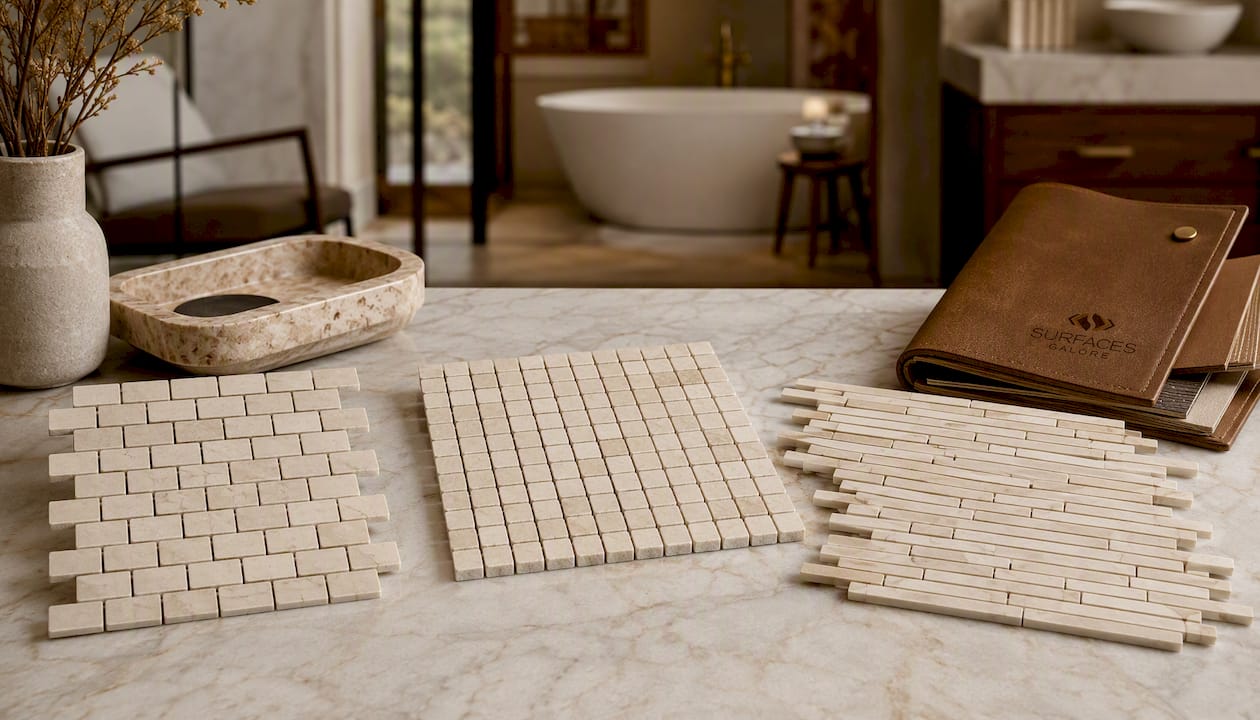
If you’re weighing mosaic formats for a backsplash or shower floor, the Crema Marfil 1x2 brick mosaic and the broader shop-by-type collection are good starting points for comparing finishes and formats side by side. Request physical samples before you commit to a full order. Seeing veining and color under your own lighting, the same advice this guide gave for choosing between marble varieties, is the single best way to avoid surprises once the slab is installed. Reach out for a custom bulk quote if you’re sourcing for a multi-room or commercial project, and the team can walk you through lot matching and finish options directly.
Sources
- How is marble formed? — Britannica
- Types of marble for construction and interior design — Build-Construct
FAQ
What Does “Marble” Mean as a Slang Term?
Outside of geology, “marble” sometimes gets used casually to describe anything smooth, cool, and polished-looking, even materials that aren’t real stone. In design conversations, people occasionally say “marble” as shorthand for any white, veined-look surface, including porcelain or quartz that’s been printed to resemble it. That casual usage is exactly why checking for calcite, cool touch, and irregular veining matters before assuming a surface is genuine.
How Expensive Is Real Marble?
Cost varies widely by variety, rarity, and finish. Widely quarried stones like Carrara tend to run more affordably than rarer, high-contrast varieties like Calacatta, and small-format mosaics or tile are generally more budget-friendly than large slabs. Surfaces Galore’s current pricing for specific products, including Crema Marfil mosaics and tile, is listed directly on the shop-by-type collection.
What Are Some Synonyms or Related Terms for Marble?
In geology, marble is sometimes grouped under the broader term “carbonate rock” alongside limestone and dolomite, though marble specifically refers to the metamorphosed version of those stones. In design and retail contexts, you’ll also see it discussed alongside travertine and limestone, since Surfaces Galore sources and sells all three as related natural stone categories.
Can Marble Form Naturally Without Human Processing?
Yes. Marble is entirely a natural process, formed underground when heat and pressure recrystallize limestone or dolomite over long geological timeframes. Humans only quarry, cut, and finish the stone after nature has already done the actual transformation. That’s different from artificial or engineered marble, which is manufactured using resin and mineral fillers rather than geological heat and pressure.
Is Marble Harder to Maintain Than Granite or Quartz?
Yes, generally. Marble’s calcite content reacts to acids and etches more easily than granite or quartz, so it needs regular sealing and gentler cleaning products. That said, many homeowners find the tradeoff worthwhile for marble’s veining and color, particularly in bathrooms and accent applications with lower daily wear than a busy kitchen.
Recommended
- Homeowners and Designers: How Marble’s Color, Veining, Finish Look
- 4 Phase Marble Design Checklist for Homeowners and Design Pros
- Marble in Kitchen Design Complete Guide to Modern Trends
- What is marble etching? A 2026 guide for homeowners
This article is provided for general informational guidance only. Natural stone varies in color, veining, texture and performance. For installation, sealing, cleaning and maintenance, follow the product manufacturer’s instructions and consult a qualified installer or stone-care professional. Always test cleaning and sealing products in an inconspicuous area first. Surfaces Galore is not responsible for damage, discoloration, etching, staining, installation issues or other problems resulting from

Leave a comment