

Top Marble Picks for Minimalist Homes in 2026

For minimalist interiors, start with Carrara, Bianco Namibia, Calacatta, Crema Marfil, or Thassos as your base stone, then add Nero Marquina or Verde Guatemala as a single, isolated accent. The placement strategy that works every time: one dominant slab surface, large format, with nothing competing around it.
Three rules that keep the look intentional:
- One stone, one surface. Choose a single marble variety for your primary surface (island, wall, or floor) and let it carry the room. Minimalist design relies on a tightly limited palette of exceptional materials, not a collection of decent ones.
- Go large or go home. Small tiles fragment the eye. Full-height slabs, continuous countertop runs, and large-format floors read as calm and deliberate.
- Reserve drama for one spot. If you want Nero Marquina’s bold black veining or Verde Guatemala’s deep green, use it on one wall or one table. Everywhere else stays neutral.
Key Takeaways
Marble works best in minimalist interiors when one high-quality stone anchors the room and everything else recedes around it.
| Point | Details |
|---|---|
| Choose a low-movement base stone | Carrara, Bianco Namibia, Crema Marfil, or Thassos for large surfaces; keep veining subtle. |
| Reserve one dramatic accent | Nero Marquina or Verde Guatemala in a single location per room; never compete with the base stone. |
| Match finish to use | Honed or leathered for kitchens and bathrooms; polished only for low-touch statement surfaces. |
| Specify protection at install | An invisible protective treatment applied before use reduces visible wear on high-use surfaces. |
| Surfacesgalore for sourcing | Direct importer shipping nationwide; request full slab photos, bookmatching options, and finish guidance before buying. |
Table of Contents
- ## 1. Carrara: the reliable white base stone
- ## 2. Calacatta: bold veining as a focal point
- ## 3. Bianco Namibia: warm white with subtle movement
- ## 4. Crema Marfil: beige warmth for soft minimalism
- ## 5. Thassos: pure white for high-contrast schemes
- ## 6. Nero Marquina: the single black accent
- ## 7. Verde Guatemala: green as a grounded accent
- Which applications give marble the most minimalist impact?
- Finishes that suit minimalist living and how to care for them
- How to pick the right marble for a minimalist room
- 2026 trends and pro tips for marble in minimalist spaces
- Budgeting, installation realities, and practical alternatives
- Why one great marble choice beats five good ones
- Surfacesgalore: premium natural stone, shipped nationwide
- Sources
- FAQ
## 1. Carrara: the reliable white base stone
Carrara is the most widely used marble for minimalist designs, and for good reason. Its soft white or light gray background carries fine, feathery gray veining that reads as quiet and organic rather than loud. It never fights the furniture.
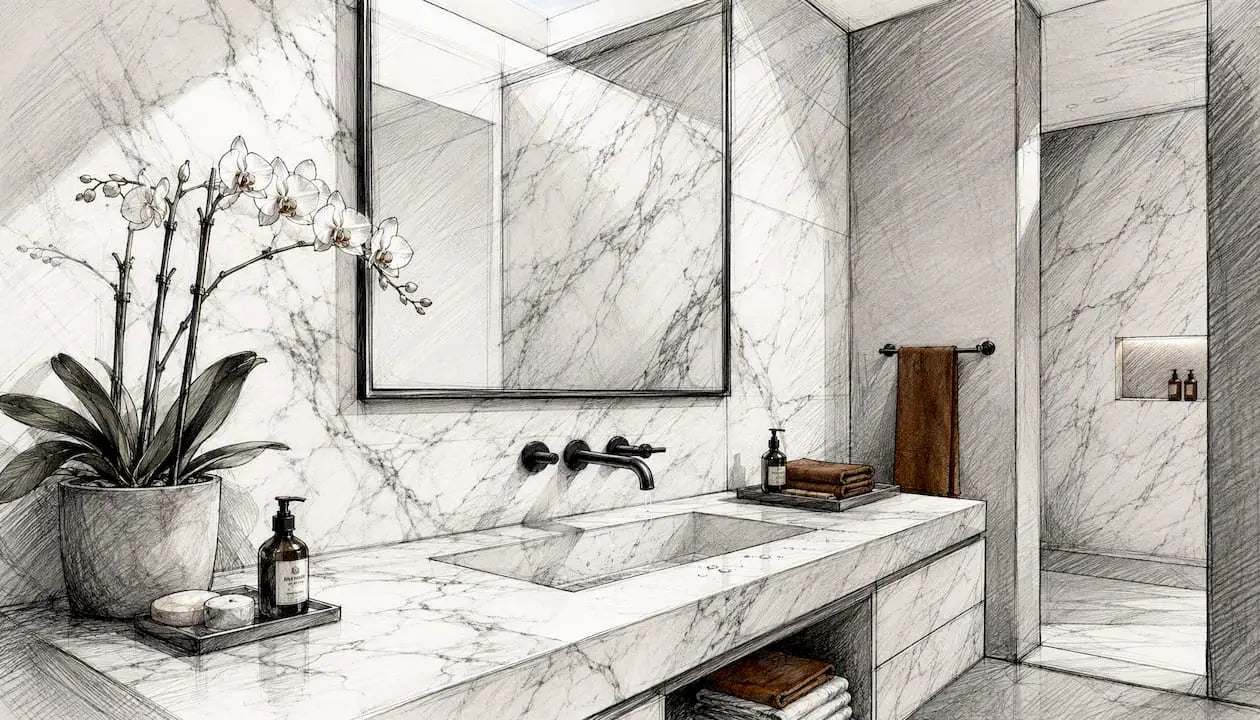
Use it on large kitchen islands, bathroom walls, or continuous flooring runs. The key is slab selection: ask for low-movement slabs with consistent background tone. Carrara with heavy, irregular veining loses the calm quality that makes it work in minimal rooms. Pair it with warm white walls, matte black fixtures, or light oak to keep the palette grounded.
## 2. Calacatta: bold veining as a focal point
Calacatta shares Carrara’s white base but carries thicker, more dramatic veining in gold or gray. That contrast is the point. Use it where you want the stone to function as the room’s artwork: a full-height kitchen backsplash, a bookmatched bathroom feature wall, or a statement dining table.
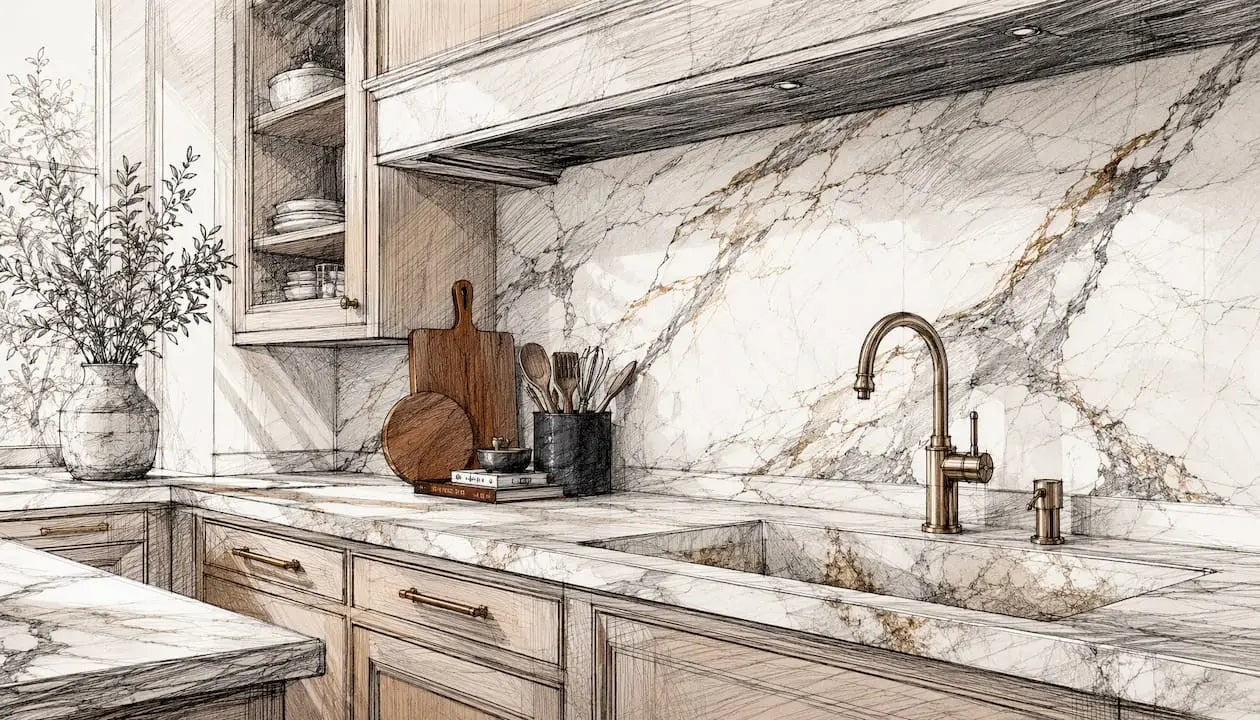
Because the veining is strong, Calacatta works best in one location per room. Pair it with matte metals and keep surrounding surfaces plain. The one-stone approach gaining traction in 2026 design is built around exactly this logic: let one exceptional slab do the visual work.
## 3. Bianco Namibia: warm white with subtle movement
Bianco Namibia sits between Carrara and Calacatta in character. Its creamy white background has soft, irregular veining that reads warmer than Carrara’s cool gray. That warmth makes it a natural fit for the tactile, layered minimalism trending in 2026, where the goal is calm but not cold.
It works beautifully on bathroom slab walls, shower enclosures, and coffee tables. The subtle movement means you can use it across multiple surfaces without visual noise. Pair with warm wood tones, linen textiles, and brushed brass for a cohesive, grounded palette.
## 4. Crema Marfil: beige warmth for soft minimalism
Crema Marfil is a beige-toned marble with very low veining movement, making it one of the most forgiving choices for large continuous surfaces. Its warmth softens the starkness that can make cold minimalism feel uninviting. A minimalist color strategy built on layered whites and warm taupe accents maps directly onto what Crema Marfil delivers naturally.
Use it for flooring in open-plan living areas, bathroom floors, or perimeter countertops. Its low contrast means it reads as a background material, which is exactly what you want for surfaces covering significant square footage.
## 5. Thassos: pure white for high-contrast schemes
Thassos is the whitest marble available, quarried in Greece with almost no veining. In a minimalist room, it creates a clean, luminous surface that amplifies light. That purity is both its strength and its limitation: Thassos demands precision in installation because any grout inconsistency or edge variation is immediately visible.
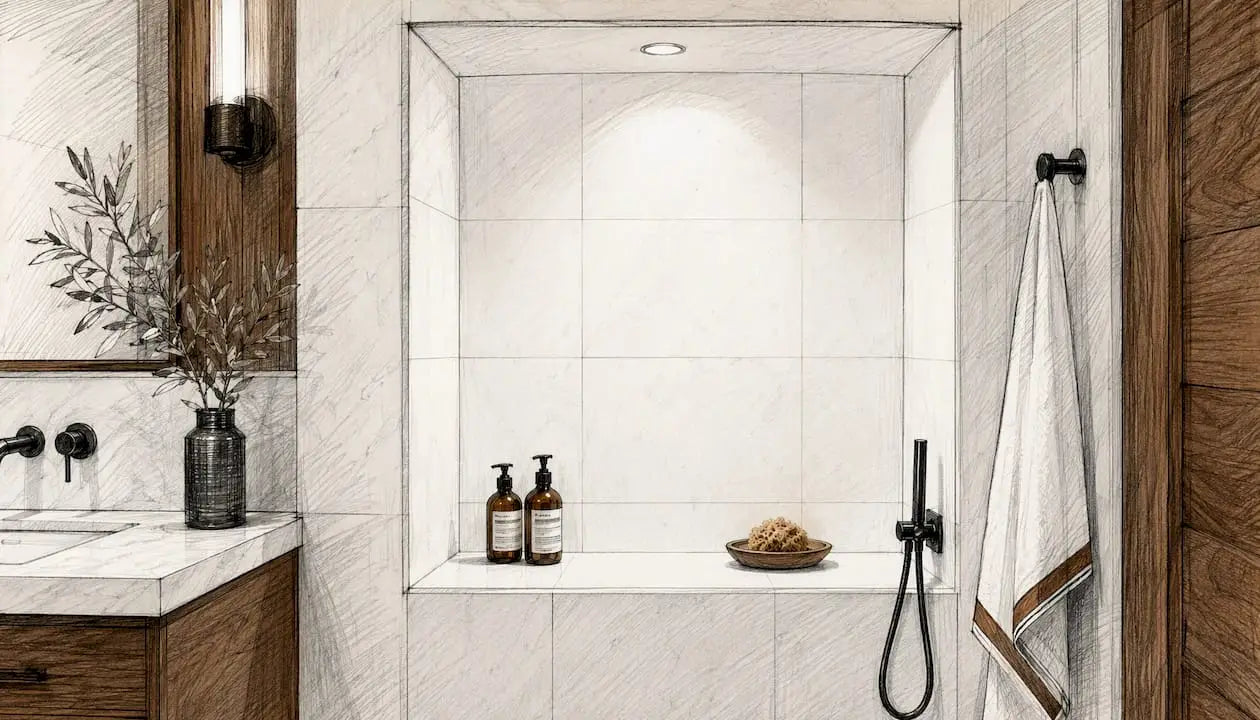
It suits bathroom niches, shower walls, and feature floors where you want a near-seamless white plane. Pair it with matte black fixtures or dark wood for contrast, or with other whites for a tonal, layered effect.
## 6. Nero Marquina: the single black accent
Nero Marquina is a deep black Spanish marble with fine white veining. In a minimalist room, it functions as punctuation. One Nero Marquina slab on a fireplace surround, a bathroom vanity top, or a side table introduces drama without clutter, because the contrast does the work that pattern or color would otherwise do.
The rule is strict: one application per room. Nero Marquina alongside a Calacatta feature wall is too much. Choose one or the other. Case studies of minimalist marble projects consistently show that dramatic stones like Nero Marquina work best as isolated focal elements, not as part of a multi-stone scheme.
## 7. Verde Guatemala: green as a grounded accent
Verde Guatemala is a deep forest-green marble with white veining. It reads rich and grounded rather than decorative, which makes it usable in minimalist schemes when handled carefully. A single Verde Guatemala slab on a bathroom vanity wall or as a dining table surface introduces color without pattern overload.
Keep everything around it neutral: white walls, concrete floors, matte metals. Verde Guatemala is not a background stone. It is a statement, and it needs space to breathe.
Which applications give marble the most minimalist impact?
Marble’s expanded role in 2026 interiors goes well beyond countertops. These applications deliver the highest visual payoff with the least visual noise:
- Full-height slab walls. A floor-to-ceiling marble slab replaces artwork, wallpaper, and decorative objects in one move. The stone’s natural veining carries the visual interest. No frames, no shelves, no accessories needed.
- Waterfall kitchen islands. The countertop continues down the sides of the island in a continuous slab. This only works well with bookmatching or continuous veining; mismatched slabs on a waterfall edge look unfinished and undermine the whole effect.
- Integrated sinks. A marble basin carved from the same slab as the vanity top removes the visual break of a separate fixture. The result is monolithic and calm.
- Single-slab coffee and dining tables. A marble slab on a simple metal or wood base is one of the cleanest minimalist furniture moves. No legs, no ornamentation, just the stone. Keep the base thin and the slab thick.
- Bathroom slab walls and niches. Continuous marble from floor to ceiling in a shower, with a recessed niche cut from the same stone, creates a spa-like coherence. The niche eliminates the need for a separate shelf or caddy.
- Continuous flooring runs. Large-format marble tiles (24x48 inches or larger) with tight grout joints in open-plan living areas read as a single surface rather than a tiled floor. The fewer the grout lines, the calmer the result.
Do: use the same stone for adjacent surfaces (island top and backsplash, floor and shower wall) to create visual continuity. Don’t: mix three or more marble varieties in one room. Two is the practical maximum, and one is usually better.
For marble accent wall ideas that work in minimal rooms, the principle is the same: one wall, one stone, no competing elements.
Finishes that suit minimalist living and how to care for them
The finish you choose affects daily life as much as aesthetics. Here is how the three main options compare:
| Finish | Visual effect | Etching/fingerprints | Best rooms | Protective treatment |
|---|---|---|---|---|
| Honed | Matte, soft, velvety | Hides etching well; low fingerprint visibility | Kitchens, bathrooms, high-traffic floors | Seal at install; reseal annually |
| Leathered | Textured, tactile, low sheen | Very forgiving; texture masks marks | Kitchen islands, casual living areas | Seal at install; reseal every 1–2 years |
| Polished | High gloss, reflective, luminous | Shows etching and fingerprints clearly | Formal bathrooms, feature walls, low-touch surfaces | Seal at install; professional maintenance recommended |
For heavy kitchen use, honed and leathered finishes hide etching and fingerprints far better than polished surfaces. Polished marble remains the right call for formal or statement applications where the surface sees minimal daily contact.
Care checklist
- Seal all marble at installation with a penetrating stone sealer.
- Reseal honed and leathered surfaces annually; polished surfaces may need professional attention sooner if etching appears.
- Wipe spills immediately, especially acidic liquids (citrus, wine, vinegar).
- Clean with a pH-neutral stone cleaner only. Standard household cleaners etch the surface.
- For kitchen islands and high-use countertops, specify an invisible protective treatment at installation. A quality invisible protection layer applied before use can significantly reduce visible wear over time, keeping the surface looking clean without altering the finish.
Pro Tip: For kitchens, specify honed or leathered finish on the island and perimeter countertops. If you want polished marble anywhere in the kitchen, limit it to the backsplash, where it sees no direct contact. You get the reflective quality without the maintenance burden.
Detailed guidance on marble surface treatments covers sealing schedules and protective coating options worth reviewing before you specify.
How to pick the right marble for a minimalist room
The decision comes down to five criteria, in this order:
- Vein scale. Low-movement veining for large surfaces (floors, perimeter countertops, walls). Bold veining only for one focal element per room.
- Background color purity. For white marble, look for consistent background tone across the full slab. Patches of gray or cream in a nominally white stone read as inconsistency, not character.
- Slab size and bookmatching potential. Larger slabs mean fewer seams. For waterfall islands and feature walls, ask whether bookmatched pairs are available from the same block.
- Finish suitability. Match the finish to the use case. Honed or leathered for kitchens and bathrooms; polished for low-touch statement surfaces.
- Maintenance commitment. Be honest about how much upkeep the household will realistically do. A polished Calacatta island in a busy family kitchen is a beautiful idea that often becomes a frustration.
Questions to ask your supplier before buying
- Can I see full slab photos, not just samples?
- Are bookmatched pairs available for this lot?
- What finish do you recommend for my intended use?
- What protective treatment do you recommend at installation?
- Is this stone from a consistent quarry source, or does it vary batch to batch?
Red flags
- Significant color variation between slabs from the same order.
- Slabs that feel thin or show surface cracks under raking light.
- A supplier who cannot provide full slab photos or bookmatching options.
- Prices that seem too low for the stone described. Genuine Calacatta and Thassos carry a premium; a bargain price usually means a different stone or inconsistent quality.
Marble selection tips from Surfacesgalore walk through the slab-evaluation process in more detail.
2026 trends and pro tips for marble in minimalist spaces
The clearest shift in 2026 is the move from cold, stark minimalism toward warm, tactile minimalism. Marble is central to that shift because its texture and natural color variation provide the sensory richness that bare white walls cannot. Bookmatched slabs, mixed-finish countertops, and large-format applications are now mainstream rather than high-end exceptions.
Specific trends worth noting:
- Bookmatched slabs on kitchen backsplashes and bathroom walls, where the mirrored veining pattern becomes the room’s focal point.
- Mixed finishes on the same surface run: a polished island top with honed perimeter countertops on the same stone.
- Color marbles (Verde Guatemala, Nero Marquina) used as single accent elements rather than full-room applications.
- Honed and leathered finishes overtaking polished as the default specification for daily-use kitchens.
Pro Tip: When specifying a mixed-finish scheme, use the same marble variety for both finishes. A polished Carrara island top and a honed Carrara perimeter read as intentional and cohesive. Mixing finishes across different stone varieties looks unresolved.
For a broader view of how these trends are playing out in real projects, the 2026 marble applications design guide from Surfacesgalore is worth a look.
Budgeting, installation realities, and practical alternatives
Marble is not a forgiving material for imprecise installation. Minimalism exposes every flaw: uneven joints, mismatched bookmatching, inconsistent grout lines. Budget for skilled fabrication, not just the stone itself.
Key installation considerations:
- Slab sizing. Larger slabs cost more to fabricate and transport but produce fewer seams. For feature walls and waterfall islands, the premium is worth it.
- Bookmatching. Requires purchasing slabs from the same block and precise alignment during installation. Not every fabricator has experience with it; ask before you commit.
- Substrate and support. Full-height slab walls and thick countertops require adequate structural support. Thin-panel marble (under 3/4 inch) is lighter but needs a solid substrate and specialized adhesive; it is not a DIY installation.
- Protective treatment at install. Specifying invisible protection before the stone goes into use is significantly easier and less expensive than remediation after etching occurs.
Cost drivers to plan for
The major cost variables are stone rarity (Thassos and genuine Calacatta carry higher premiums than Carrara), slab size, fabrication complexity (bookmatching, waterfall edges, integrated sinks), and finish. Honed finishing typically adds modest cost over polished; leathered adds slightly more.
When to consider alternatives
If the budget or maintenance commitment does not support natural marble, quartzite offers similar aesthetics with better scratch resistance. Honed limestone (particularly in beige tones) delivers a similar warmth to Crema Marfil with slightly lower maintenance. Porcelain slabs with a marble look have improved significantly and suit applications where the stone will see heavy abuse, though they lack the depth and variation of natural stone. Pair any of these with interior door styles that complement your stone’s undertone: warm-toned marbles pair well with natural wood doors; cool whites suit painted or dark-stained options.
Why one great marble choice beats five good ones
The instinct to mix materials is understandable. You find a stone you love for the kitchen, another for the bathroom, a third for the entry floor. Each choice is defensible on its own. Together, they compete.
That focal element gets all the visual attention. Everything else recedes. The room feels considered rather than assembled.
What gets underestimated is how much the finish matters to this effect. A polished Carrara floor and a honed Carrara island in the same room read as two different materials to most people. Keeping the finish consistent across a stone variety reinforces the single-material impression that makes minimalism work.
Before you commit to a slab, handle samples in the actual room’s light. Natural stone reads differently under warm incandescent light than under cool daylight. A stone that looks perfect in a showroom can read too yellow or too gray in your specific space. That sample visit is not optional; it is the decision.
Surfacesgalore: premium natural stone, shipped nationwide
Surfacesgalore is a direct importer of premium natural stone based in Anaheim, California, shipping nationwide to homeowners, designers, architects, and contractors. As a direct importer, Surfacesgalore cuts out the middleman, which means you get authentic marble at prices that make full-slab applications genuinely feasible rather than aspirational.
For a minimalist project, the practical starting point is requesting full slab photos and finish samples before committing. Surfacesgalore carries Carrara, Calacatta, Bianco Namibia, Crema Marfil, Thassos, Nero Marquina, and Verde Guatemala, with guidance on bookmatching availability and protective treatment options for each stone. Whether you are specifying a single kitchen island or a full-room stone scheme, the team can walk you through finish selection and installation requirements.
Shop natural stone tiles today or browse the classic marble styles for kitchens and baths to find the right stone for your project.
Sources
- Not Just Countertops Anymore, Marble Is Showing Up in Unexpected Ways in 2026 Interior Design
- Minimalist interior design: the complete guide to less-is-more architecture
- The one-stone home trend: how natural stone is transforming interiors in 2026
- Marble colors and types guide
FAQ
What is the best marble color for a minimalist home?
White and light gray marbles with low-movement veining, such as Carrara, Bianco Namibia, or Thassos, suit minimalist homes best. They read as calm, recede visually, and allow the room’s architecture to lead.
What interior design style uses marble most effectively?
Minimalism and contemporary design use marble most deliberately, treating a single slab as the room’s focal material rather than a decorative surface. Marble’s natural veining provides visual interest without added ornamentation.
How do you use marble in a minimalist room without overdoing it?
Choose one stone variety, apply it to one dominant surface (a full-height wall, an island, or a continuous floor), and keep everything around it plain. If you add a second stone, limit it to one small-scale accent element.
Is marble still in style for modern homes?
Marble remains a strong choice for modern interiors, with demand continuing into 2026 and preferences shifting toward honed and leathered finishes for daily-use spaces. The material’s longevity and natural variation make it more relevant to current design directions, not less.
Leave a comment