
Modern Tile Design Tips for Natural Stone in 2026

What’s driving natural stone tile design in 2026?
The clearest shift in natural stone design right now is away from high-gloss surfaces and toward finishes you actually want to touch. Two movements define the moment: Textural Realism and Quiet Luxury. Both prioritize matte, tactile surfaces over mirror-like polish, and both celebrate what makes each stone genuinely unique.
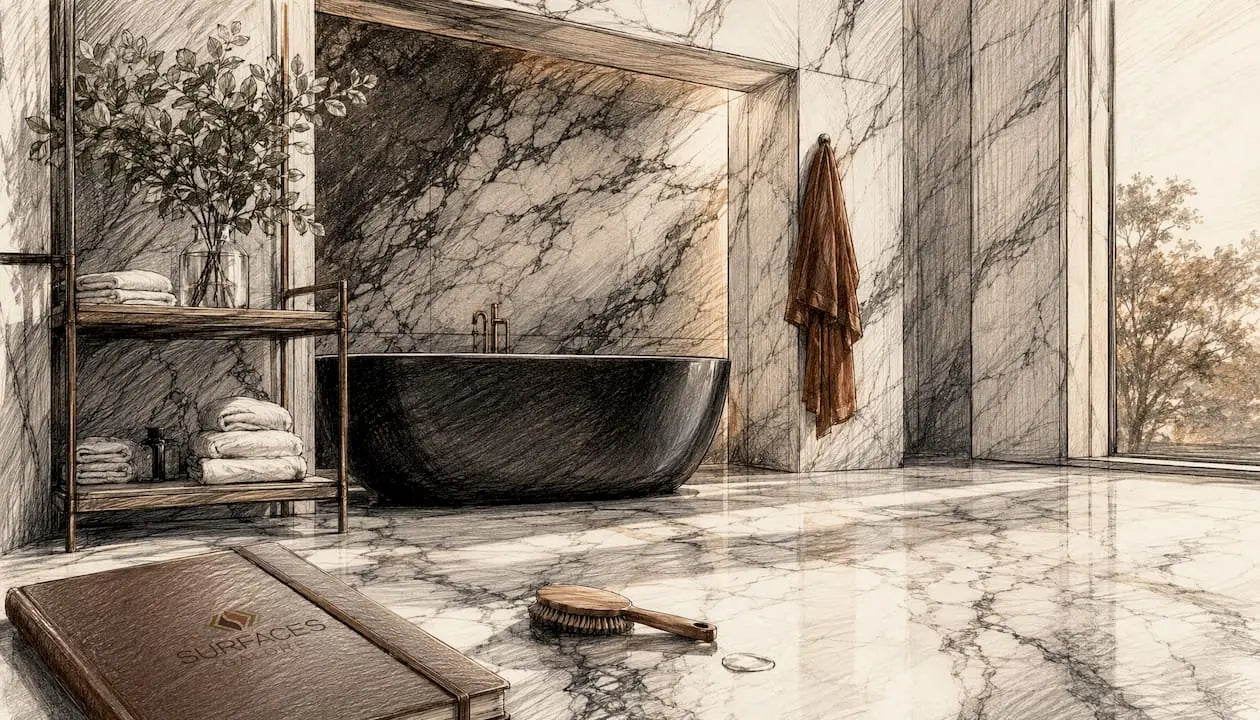
The dominant 2026 palette runs warm: ambers, terracottas, and soft grays have replaced the cold whites that ruled luxury interiors for the past decade. Natural veins, tonal shifts, and even minor surface irregularities are now read as markers of quality, not flaws.
Key characteristics of this trend:
- Honed finishes: Smooth, matte, and slip-resistant. The go-to for floors and wet zones.
- Leathered finishes: Subtle dimpled texture from diamond-tipped brushes. Catches light differently through the day and invites touch.
- Brushed finishes: Softer than leathered, preserving natural character without shine.
- Earthy color palettes: Warm golds, tawny browns, and terracottas replacing stark whites.
- Celebrated imperfections: Veining, tonal variation, and natural voids treated as design assets.
Pro Tip: Always request a physical finish sample before ordering. Leathering and brushing vary between blocks, so what you see in a showroom photo may differ from what arrives on site.
Table of Contents
- How each finish affects look, feel, and performance
- How to create cohesive natural stone interiors
- Technical installation: what actually causes failures
- Applications, maintenance, and sustainability by space
- What to evaluate before buying natural stone tiles
- Common installation problems and how to fix them
- Natural stone versus alternative modern tile materials
- Surfacesgalore: direct-import natural stone for serious projects
- FAQ
- Key Takeaways
How each finish affects look, feel, and performance
Choosing a finish is not purely aesthetic. Each option carries real consequences for slip resistance, maintenance frequency, and long-term wear.
Honed: Ground to a smooth matte surface by stopping before the stone becomes reflective. More porous than polished, so it needs thorough sealing. Hides everyday scratches well and works in wet zones where gloss would be dangerous.
Leathered: Diamond-tipped brushes work the surface to close pores while leaving a subtle undulating texture. Neither matte nor reflective. A leathered marble feature wall or quartzite countertop has a presence polished stone simply cannot match.
Brushed: Similar process to leathering but lighter. Softens the surface while preserving and even enhancing the stone’s natural character beneath.
Polished: The closed-pore structure resists staining but is highly susceptible to acid etching and visible scratching. Still beautiful in low-traffic, dry applications.
Flamed: High-temperature flame causes surface crystals to pop, creating a rugged, slip-resistant profile. Best for exterior terraces and outdoor applications.
Finish suitability at a glance:
| Finish | Best For | Maintenance Level |
|---|---|---|
| Honed | Floors, wet zones, countertops | Moderate (regular sealing) |
| Leathered | Feature walls, countertops | Moderate (impregnator sealer) |
| Brushed | Walls, low-traffic floors | Low to moderate |
| Polished | Dry interiors, vertical surfaces | Low (but acid-sensitive) |
| Flamed | Exterior, outdoor terraces | Low |
How to create cohesive natural stone interiors
The most common mistake in stone design is using too many materials. Designers working at the highest level repeat a single premium stone across multiple zones, letting the finish variation create depth rather than introducing contrasting stones.
A single honed travertine carried through a kitchen, bathrooms, and living area creates a calm, continuous flow. The rooms feel connected without feeling identical. That restraint is the whole point.
Practical strategies for cohesive integration:
- Pick one primary stone and use it across at least two major surfaces.
- Vary the finish rather than the material to add depth (honed floor, leathered island top).
- Pair natural stone with wood, metal, and glass for balance. Stone anchors; the other materials soften.
- Keep the color palette narrow. Brown oak, pale stone, and brass accents work because the range is tight.
- Let the stone’s veining do the decorative work. You rarely need pattern on top of pattern.
The “sensory sanctuary” concept takes this further: layering textures within a single material family rather than mixing contrasting stones. The result feels grounded and restorative rather than busy.
Technical installation: what actually causes failures
Adhesive incompatibility is the leading cause of natural stone installation failures. The fix is straightforward once you understand the logic.
Light-colored stones like marble, limestone, and cream travertine require white thin-set mortar. Standard gray Portland cement adhesive bleeds through translucent stone and causes permanent staining. For dense, low-absorption stones like granite and dark marble, epoxy adhesive systems outperform cement mortars because the cement hydrates too slowly relative to water absorption, creating a weak bond that fails under thermal cycling.
Critical installation checklist:
- Use white C2S1TE adhesive for all marble, limestone, and travertine.
- Back-butter every tile to eliminate voids. Voids under large-format stone cause cracking.
- Seal before grouting. Apply an impregnating sealer to all porous stone before grout goes in. This prevents grout pigment from entering the stone’s pores permanently.
- Install movement joints at perimeters and at maximum 4.5-meter intervals in the field. Natural stone expands more than ceramic under thermal change, and omitting joints leads to cracking.
- Check for lippage at every tile placement. Polished surfaces make even small height differences visible under raking light.
Pro Tip: For large-format stone tiles, confirm the slip-resistance R-rating for the specific application zone before procurement. Wet areas require higher friction ratings than dry interiors.
Applications, maintenance, and sustainability by space
Kitchens
Honed or leathered finishes suit countertops and islands best. They hide daily wear and feel better underhand than polished surfaces. A natural stone backsplash in the same material as the countertop extends the visual line and avoids the fragmented look of mixing materials.
Bathrooms and showers
Honed marble or limestone works well on shower walls and floors. Avoid polished finishes in wet zones. Seal thoroughly and use a pH-neutral cleaner. Acid-based bathroom cleaners etch marble and limestone permanently.
Flooring
For high-traffic floors, honed or brushed finishes offer better slip resistance than polished. Travertine and limestone are warm underfoot and age gracefully. With proper care, premium natural stone can last over 100 years.
Maintenance essentials
- Use a pH-neutral stone cleaner. No vinegar, lemon juice, or bleach.
- Reseal when water stops beading on the surface.
- Honed and leathered finishes need more frequent sealing than polished but hide wear far better.
- Sweep or dust-mop regularly to remove grit before it scratches the surface.
On sustainability: natural stone requires no manufacturing energy beyond quarrying and finishing. Responsibly sourced marble, limestone, and travertine contribute to sustainable construction and carry a lifespan that no engineered alternative matches.
What to evaluate before buying natural stone tiles
Buying natural stone is different from buying ceramic. The material varies between slabs, between blocks, and even within a single batch. These are the factors that matter most:
- Absorption rate: Drop water on the back of a tile. High absorption means more frequent sealing and stricter adhesive requirements.
- Finish consistency: Request a physical sample from the actual batch, not a showroom display piece.
- Calibration: Calibrated stone has consistent thickness and installs more cleanly. Handmade or irregular stone requires more adhesive bed adjustment.
- Sourcing transparency: Ask where the stone was quarried. Responsible sourcing affects both quality and environmental impact.
- Budget for the full system: Stone price is only part of the cost. Factor in white adhesive, penetrating sealer, movement joint materials, and a pH-neutral cleaner.
For guidance on selecting natural stone that fits your specific project, working with a direct importer gives you access to batch-level information that retail distributors rarely provide.
Common installation problems and how to fix them
Gray patches appearing through marble: Almost always gray cement adhesive bleeding through a translucent tile. The stain is typically permanent. Prevention: always use white adhesive with marble and ensure 90% adhesive coverage with no voids.
Grout haze on polished stone: Clean grout haze immediately after grouting. Once dry on marble, it requires an acid-free grout haze remover, which must be tested on a spare tile first.
Cracking in large-format tiles: Usually caused by missing movement joints or voids under the tile from inadequate back-buttering. Both are preventable at installation.
Efflorescence (white mineral deposits): Caused by moisture in the substrate wicking through the stone. Ensure substrate moisture content is within limits and that waterproofing is in place before tiling wet areas.
Lippage on polished floors: Polished surfaces amplify any height difference between adjacent tiles. Target 0.5–1mm lippage for polished stone and check with a straightedge at every placement.
Natural stone versus alternative modern tile materials
Natural stone, porcelain, and engineered stone each solve the same visual problem differently. Understanding the trade-offs helps you choose with confidence.
| Factor | Natural Stone | Porcelain | Engineered Stone |
|---|---|---|---|
| Authenticity | Every slab unique | Digitally printed pattern | Consistent, manufactured |
| Lifespan | 100+ years with care | — | — |
| Maintenance | Sealing required | Minimal | Minimal |
| Slip resistance | Finish-dependent | Consistent by grade | Consistent by grade |
| Sustainability | Quarried, no manufacturing | High kiln energy | Resin binders used |
| Cost | Higher upfront | Lower upfront | Mid-range |
Porcelain has improved dramatically. Digital printing now mimics stone veining convincingly, and some formats replicate the feel of sandblasted limestone. For high-traffic commercial floors where maintenance budgets are tight, porcelain is a practical choice. But it cannot replicate the tactile depth of a leathered quartzite or the geological narrative of unfilled travertine. Those qualities are not aesthetic preferences. They are physical properties that no manufactured surface currently reproduces.
Surfacesgalore: direct-import natural stone for serious projects
Surfacesgalore is a direct importer of premium marble, limestone, and travertine, based in Anaheim, California, shipping nationwide. Because there is no middleman, you get batch-level sourcing information, consistent quality across your order, and pricing that reflects the actual cost of the stone rather than a distributor’s margin.
The product range covers tiles, mosaics, moldings, switch plate covers, custom cuts, and custom mosaics. Whether you are tiling a master bath in honed limestone or sourcing a leathered travertine for a kitchen island, the team can advise on finish compatibility, adhesive requirements, and sealing systems specific to your stone. Shop natural stone tiles at Surfacesgalore and get the material information you need before the order ships.
FAQ
What finishes work best for natural stone bathroom floors?
Honed and brushed finishes offer better slip resistance than polished and are the preferred choice for wet zones. Polished stone is beautiful but becomes slippery when wet.
How often should natural stone tiles be resealed?
Reseal when water no longer beads on the surface. Honed and leathered finishes typically need resealing more frequently than polished, because their more open surface structure absorbs moisture faster.
Why do gray patches appear through marble tiles after installation?
Gray cement adhesive bleeds through translucent marble when coverage is incomplete or gray mortar is used. Always use white thin-set with marble, limestone, and cream travertine, and ensure 90% adhesive contact with no voids.
What is the difference between Textural Realism and Quiet Luxury in stone design?
Textural Realism prioritizes tactile, matte finishes like honed and leathered over polished surfaces. Quiet Luxury is the broader aesthetic movement that values materials aging gracefully and authentically over flawless, high-gloss appearances.
How do natural stone tiles compare to porcelain for a kitchen renovation?
Natural stone offers unmatched authenticity and a lifespan exceeding 100 years with proper care, but requires sealing and careful adhesive selection. Porcelain needs less maintenance and costs less upfront, but cannot replicate the tactile depth or geological character of real stone.
Key Takeaways
Natural stone tile design in 2026 centers on matte, tactile finishes and restrained material use, with proper installation and sealing determining whether that investment lasts decades or fails within years.
| Point | Details |
|---|---|
| Dominant 2026 finishes | Honed, leathered, and brushed finishes have replaced polished as the preferred choice for luxury interiors. |
| Adhesive selection | White thin-set is mandatory for marble, limestone, and travertine. Gray cement causes permanent staining. |
| Movement joints | Install field joints at maximum 4.5-meter intervals to prevent cracking from thermal expansion. |
| Maintenance rule | Use a pH-neutral cleaner only. Acid-based products etch marble and limestone permanently. |
| Surfacesgalore | Direct importer of marble, limestone, and travertine, shipping nationwide with batch-level sourcing information. |

Leave a comment