
Stone Pool Waterline Tile: Choosing, Setting and Caring for It

Stone waterline tile is a band of natural stone, usually about 6 inches tall, set around the pool where the water meets the wall. It protects the shell, gives you a surface that brushes clean, and sets the color and character of the whole pool. The stone you pick, the setting materials behind it and the way you care for it decide whether the band looks refined for decades or turns chalky in a few seasons. We are a direct importer of marble, travertine and limestone, so this guide covers the choices we walk designers, builders and homeowners through before an order is placed.
TL;DR
- The waterline band is the most chemically stressed zone of a pool, so choose dense, low-absorption stone and pool-rated setting materials.
- Specify the stone against the pool: low absorption, a good friction rating, freeze/thaw resistance in cold climates and chemical resistance.
- Seal at installation, then clean with pH-neutral products. Never use muriatic acid or pressure washing on calcareous stone.
- Balanced water protects stone, grout and mortar alike: pH 7.2 to 8.0 per tile-setting guidance, with calcium hardness kept up.
- Travertine, marble and limestone each have a best place: the band, the coping, the raised wall or the deck.
Table of Contents
- What a waterline band does in a pool
- Which stone belongs at the waterline
- What to specify before you order
- Setting the band: materials and method
- Sealing stone at the waterline
- Cleaning and daily care
- Water chemistry: the quiet partner of the stone
- Explore stone for your pool project
- Our point of view
- FAQ
- Sources
What a waterline band does in a pool
The waterline band is a horizontal course of tile around the perimeter, installed at the bond beam level on the vertical face of the shell. It is normally at least six inches tall so that the water level sits near the halfway point. Rock Water Pools describes the band as a roughly 6-inch detail that shields the upper shell from concentrated chemistry and sets the visual tone of the water.
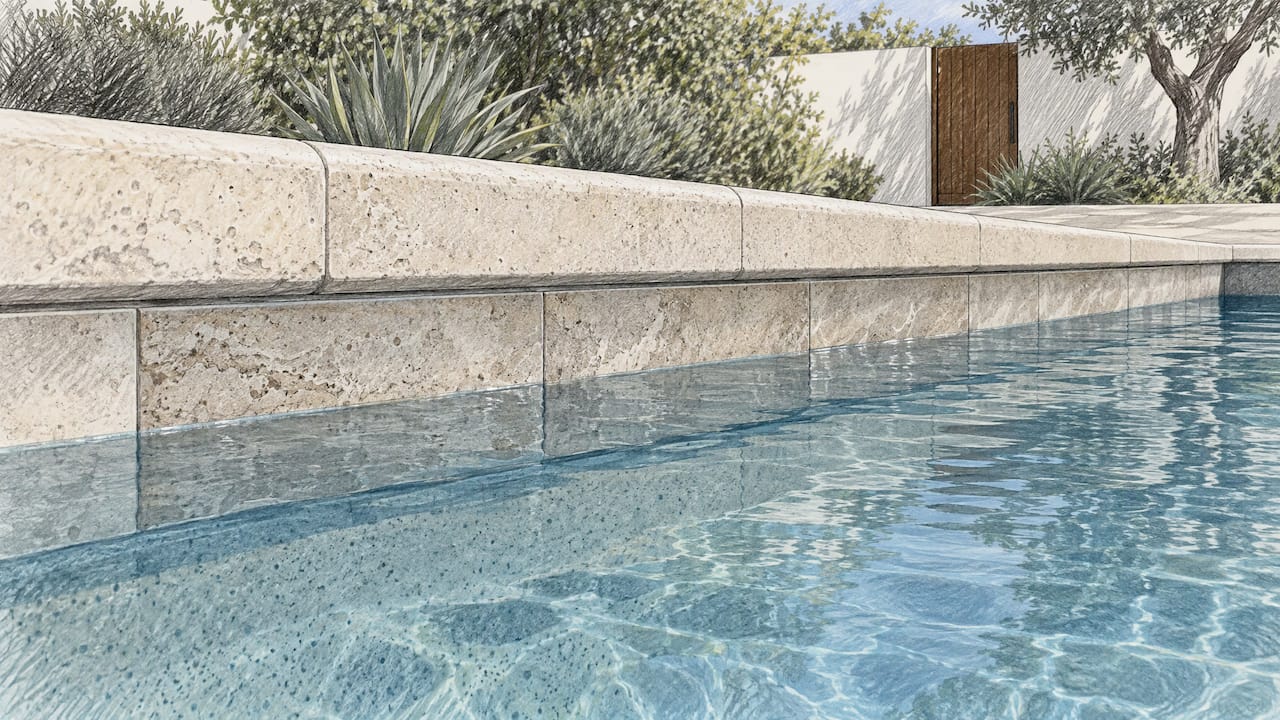
It does two practical jobs. First, it protects the structure. Blue Haven explains that plaster finishes such as marcite and quartz need to stay submerged to remain watertight, and shrink and crack when they are exposed to air. A tile band lifts the wet-dry cycle off the plaster. Second, it keeps the pool easier to clean. A smooth, low-absorption surface lets you brush off the scum line of mineral scale and body oils instead of fighting stains in plaster.
A pebble finish can stay dry without damage, so tile is optional there. Most owners still choose it because the band is the one place the pool looks like architecture rather than plumbing.
Which stone belongs at the waterline
Three natural stones cover most of what designers ask us for: limestone, travertine and marble. All three are calcium-based (calcareous) stones. That gives them their warmth and depth, and it is the reason for the care rules later in this guide: the stones react to acids, so the pool chemistry and the cleaning routine need to be right for them.
Limestone: the natural fit for the band itself
Dense, honed limestone is our first suggestion for the course that sits in the water. Its tight structure and quiet, even color give a calm band that ages gracefully. When you compare stones, look at absorption first: the lower it is, the better the stone handles constant wetting, salts and freezing temperatures.
Travertine: texture and warmth
Travertine brings the Mediterranean, desert and resort look many pools are built around. Filled and honed travertine is a classic choice for coping, steps, decks and the raised wall above the water, where it frames the pool in one continuous material. If your pool uses salt chlorination, read our guide to travertine around a saltwater pool before you finalize the layout. Salt from splash and evaporation affects every porous surface near the water, so sealing and rinsing habits matter.
Marble: refined mosaics and accents
Marble mosaics make elegant waterline accents, spa spillway faces and raised-wall details. Polished marble is a better fit for dry decorative zones than for a band that stays wet, so we point pool projects toward honed or tumbled finishes, which show less wear and feel better underfoot. Our guide to stone mosaics in custom pool applications shows how mosaics, borders and trim combine around water.
A simple way to divide the stones
| Pool zone | Good natural stone choice | Why |
|---|---|---|
| Waterline band | Dense honed limestone, small-format stone mosaics | Low absorption, even color, easy to brush |
| Raised wall, spa face | Marble or travertine mosaic, vein-cut travertine | Rich pattern in a lower-splash zone |
| Coping | Travertine, limestone | Matches the deck, wide range of edge profiles |
| Deck and steps | Filled and honed travertine pavers | Comfortable under bare feet, continuous look |
One caution from the International Watershape Institute applies to every stone: avoid slate, which gets flaky with sharp edges when submerged, and avoid any stone containing iron or other materials that can bleed or stain. The IWI position paper on waterproofing and finishes also steers away from clay, Saltillo and terracotta tile because of their high absorption.
What to specify before you order
Submerged and partly submerged tile is held to a stricter standard than a bathroom wall. The Laticrete technical design manual for tiled pools lists the properties that stone in submerged installations needs:
- Low absorption. Tile should be vitreous (0.5% to 3% absorption) or impervious (under 0.5%).
- High coefficient of friction. Where people walk or stand, such as steps and shelves, slip resistance matters. The IWI paper cites a minimum of 0.42 under the Model Aquatic Health Code.
- Freeze/thaw resistance in cool climates, tested to ASTM C1026.
- Chemical resistance, tested to ASTM C650.
Those numbers are what a designer or installer puts in a submittal. If you are a homeowner, hand the list to your pool builder and match it against the stone’s technical data. Our team can help you line up stone type, finish and format for a pool project, and sample shipping is free, so you can hold a piece next to your plaster color and deck before committing.
Format, finish and thickness
Waterline tile is usually a thin, flat piece, often 1/4 to 3/8 inch, and frequently supplied as mesh-backed sheets. Small formats and mosaics follow curves, spa walls and radius corners more easily than large tiles, and they create more grout lines, which suits a band that needs to look intentional rather than massive. A tumbled or honed finish also hides water spots better than a polished one.
Natural variation is part of the design
Stone changes from piece to piece: veining, tone and filled areas differ. Lay out tile from several boxes at once, and blend them across the whole run so that the band reads as one continuous ribbon around the pool. Order a little extra for cuts, corners and future repairs, and keep a few spare pieces from the same lot.
Setting the band: materials and method
The waterline is where installations fail most often, because the tile lives through constant wetting, drying, sun and chemistry. The IWI paper notes that many tile failures trace back to improper dampproofing, poor setting methods or materials, or a lack of flexible movement joints.
Setting essentials:
- Use pool-rated products. Standard ceramic adhesives can fail under constant wet-dry cycling and chemical exposure. A polymer-modified thin-set or medium-bed mortar rated for wet pool conditions is the baseline. Our mortar guide for outdoor tile explains how to match the mortar to stone and exposure.
- Back-butter completely. Full coverage with no voids leaves no pocket for water to collect. The same guide says hollow-sounding tile should be removed and reset before plaster goes on.
- Choose the right grout. Unsanded grout suits joints under 1/8 inch. Epoxy grout is recommended in high-chemical areas such as spillways and spas.
- Respect the substrate and dampproofing. The IWI paper cautions against fluid-applied elastomeric dampproofing in partly submerged tile applications unless the manufacturer approves it in writing.
- Plan movement joints. Laticrete notes that tile between the waterline and the coping can swing from over 120°F in direct sun to the temperature of 72°F water. It recommends treating movement joints with 100% silicone or urethane sealant per TCNA EJ171 in submerged installations, and spacing them every 8 to 12 feet in each direction.
- Keep the coping joint flexible. In freeze-thaw climates, water infiltration behind tile is the main failure mechanism. A flexible-sealant expansion joint between coping and deck works better than full grouting.
This is work for an experienced pool tile setter and a pool builder who follows the manufacturer’s data sheets. When you order from us, tell us it is for a pool so that we can help you pick the stone, format and trim that suit it.
Sealing stone at the waterline
Seal stone pool tile at installation. Stone care guidance for pools calls for sealing all exposed stone tile, grouting the surrounding tiles, dip-sealing all sides of stone tile near the coping and applying a consolidator sealer around the coping. Plan to reseal about every 2 to 3 years.
Know what a sealer does. Impregnating sealers repel water and some oils rather than blocking pores, and they cannot stop acid etching of calcite-containing stones such as marble, limestone and travertine. A sealer helps against staining. Water balance and neutral cleaning protect the surface itself.
Cleaning and daily care
Stone at the waterline asks for a simple routine:
- Brush weekly with a soft to medium non-abrasive brush, before scale hardens.
- Use fresh water with dish soap or a pH-neutral cleaner. Showtime Pools advises neutral cleaners for travertine, limestone, marble and onyx, because acids strong enough to dissolve scale can also etch calcareous stone.
- Skip muriatic acid and high-alkali products. They can fade or discolor stone.
- Skip pressure washing. It can damage stone surfaces and joints.
- Hold the water level at the tile’s midpoint, about 3 inches submerged for a 6-inch course, so that the wet-dry line stays on the tile instead of the plaster or the coping.
- Cover the pool when it is not in use to cut evaporation, which concentrates minerals at the waterline.
For green or dark film on stone near the pool, our guide to cleaning algae from travertine shows a gentle method.
Reading the white deposits
Not every white mark is the same, and the fix depends on the diagnosis. Showtime Pools separates calcium carbonate scale (white, crusty, flaky), calcium silicate scale (white-gray and very hard), efflorescence (a white powder in grout joints, a sign that water is moving through cement materials behind the tile) and calcium nodules. Efflorescence caught within a few weeks can usually be removed with a dry, stiff natural-bristle brush. Hardened scale on stone is a job for a pool service that works with natural stone.
Water chemistry: the quiet partner of the stone
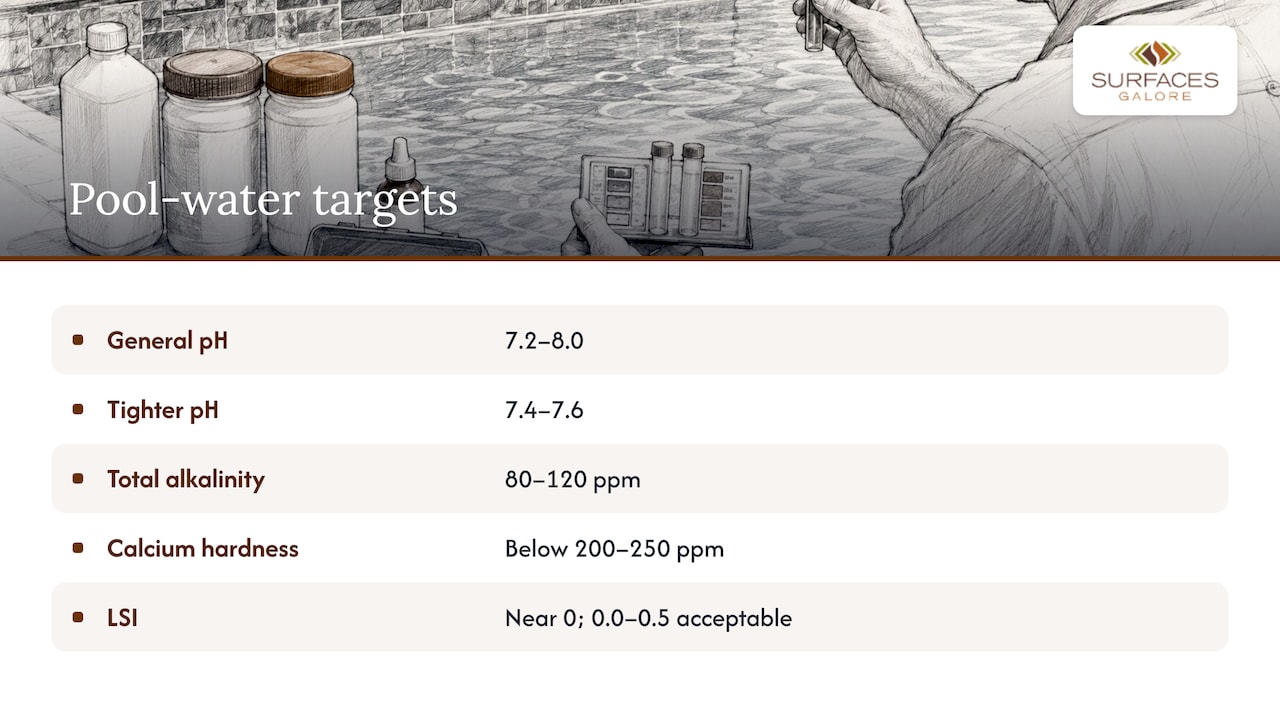
The tile, the grout and the mortar all live in the same water. Laticrete’s pool installation FAQ recommends keeping pool water at pH 7.2 to 8.0. High pH can form mineral deposits on tile and grout at the waterline, and even beneath tile surfaces, causing delamination. Low pH etches and deteriorates cement-based materials. Calcium hardness below 200 to 250 ppm lets chlorine pull calcium out of grout and mortar.
A pool service may aim tighter. Showtime Pools suggests pH of 7.4 to 7.6, total alkalinity of 80 to 120 ppm and a saturation index (LSI) near zero, with 0.0 to 0.5 acceptable. Above that, scaling speeds up. Negative readings corrode plaster, grout and metal.
Test on a schedule your pool professional sets, and adjust slowly. In salt-chlorinated pools, rinse splash zones with fresh water, because salt crystallizing as splashed water evaporates can stain and wear stone.
Explore stone for your pool project
We import marble, travertine and limestone directly and ship nationwide, with free sample shipping, custom orders and bulk or trade quotes for contractors, designers and builders. Browse marble and travertine tiles and mosaics to find a waterline mosaic, a matching coping or deck stone, or a vein-cut travertine for the raised wall. For a coordinated pool deck, look at the Roman Silver travertine 12x24 vein-cut tile.
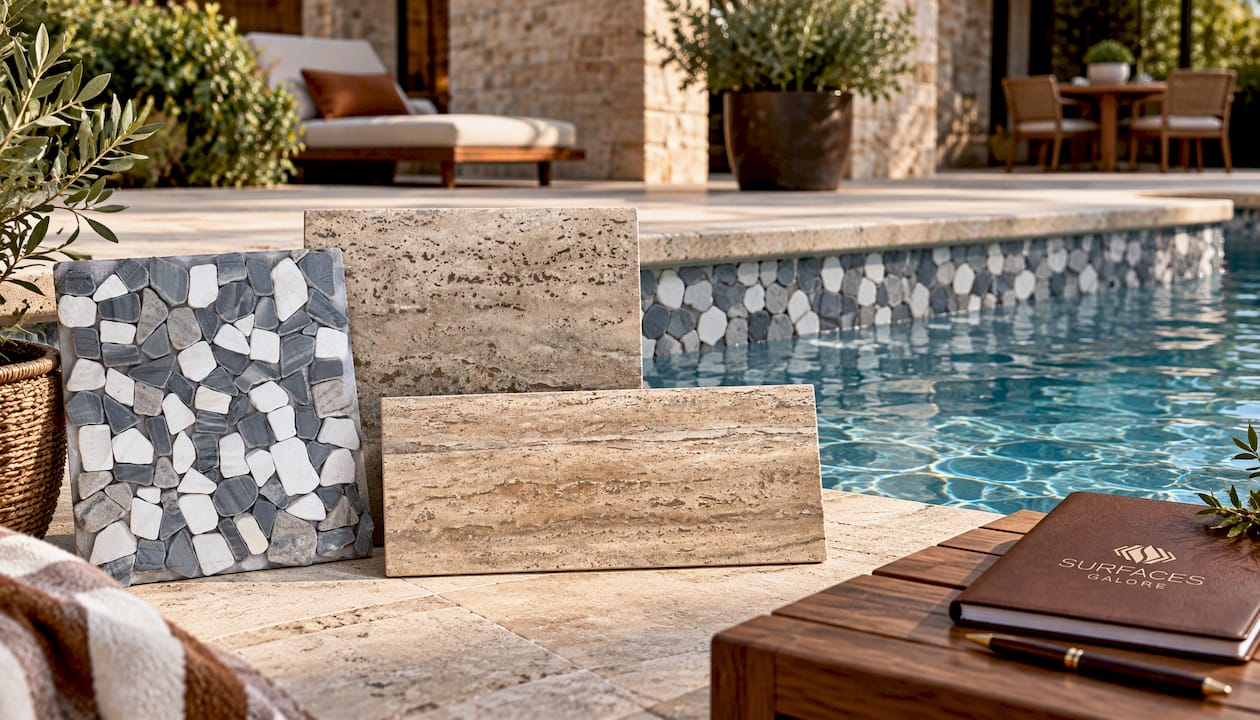
For larger jobs, send us your quantities and formats and we can put together a quote through our trade program. Our inventory is premium only, not commercial grade, and the Marble, Travertine and Limestone home page is a good starting point.
Our point of view
We see the waterline as the place where stone choice, setting and care meet. A pool band that looks right on day one is easy. One that looks right in year ten comes from three decisions made early.
First, treat the band as a technical element, not just a color. Ask for absorption, friction and freeze/thaw data, and match the stone to the zone it will sit in. Dense limestone for the band, travertine for coping and deck, marble mosaic for the details above the water: the materials work together when each is placed where it performs best.
Second, buy direct from an importer who stocks premium, architectural-grade material. We bring in stone ourselves, so you get consistent lots, matching trim and coping, and sample shipping that lets you judge color and finish against your plaster before committing.
Third, give the stone a care routine from day one: seal at installation, keep the water balanced, brush weekly and use only neutral cleaners. Natural stone rewards this routine with a band that deepens in character rather than wearing out.
John | Surfaces Galore
FAQ
Can you use natural stone tile at a pool waterline?
Yes. Choose stone with low absorption and the right test ratings, set it with pool-rated mortar and grout, and seal it at installation. Dense honed limestone and small-format stone mosaics are a strong place to start, with travertine and marble working well in coping, raised walls and decorative details.
How tall should waterline tile be?
Six inches is the usual height, with the water level held near the midpoint, about 3 inches submerged. Some designs run wider for a bolder band. A taller band also gives you more margin when the water level rises and falls with weather and use.
How often should stone waterline tile be sealed?
Seal at installation and plan to reseal roughly every 2 to 3 years, according to stone care guidance for pools. Coping stone in freeze-thaw climates benefits from annual sealing. Sealing helps against stains, so it works alongside balanced water and neutral cleaners.
What can I use to clean white buildup on stone pool tile?
Start with fresh water, dish soap or a pH-neutral cleaner and a non-abrasive brush. Avoid muriatic acid and pressure washing. If deposits are hard, ask a pool service experienced with natural stone to diagnose the type of scale before treating it.
Does a saltwater pool change the stone choice?
Salt makes sealing, rinsing and drainage more important, but stone can still be used. Choose low-absorption pieces, keep the splash zone rinsed with fresh water and review our saltwater travertine guide before you finalize the deck and coping.
Sources
- Rock Water Pools: waterline tile design guide
- Blue Haven: waterline swimming pool tiles 101
- International Watershape Institute: waterproofing and finishes for watershapes
- Laticrete: tiled swimming pools technical design manual
- Laticrete: installation of tile in pools FAQ
- PoolBuilderHQ: coping and tile installation
- How to maintain stone pool tile at the waterline
- Natural stone maintenance guide
- Showtime Pools: white buildup on pool tile
Recommended
- Natural Stone Maintenance Guide for Lasting Beauty
- Stone Mosaic Custom Pool Applications: A Complete Guide
- Step-by-Step Tile Demo for Natural Stone: DIY Guide
- Travertine Around a Saltwater Pool: What to Know First
This article is provided for general informational guidance only. Natural stone varies in color, veining, texture and performance. For installation, sealing, cleaning and maintenance, follow the product manufacturer’s instructions and consult a qualified installer or stone-care professional. Always test cleaning and sealing products in an inconspicuous area first. Surfaces Galore is not responsible for damage, discoloration, etching, staining, installation issues or other problems resulting from

Leave a comment