
Top Backsplash Tile Picks for Kitchens and Baths 2026

TL;DR:
- Porcelain and quartzite slabs are top choices for durable, low-maintenance backsplashes in 2026. Natural stones like marble, travertine, and limestone offer warmth and aesthetic appeal but require sealing and careful upkeep. Most natural stone backsplashes need sealing once or twice a year to maintain their beauty and longevity.
The top backsplash tile picks for 2026 are porcelain, ceramic, marble, travertine, limestone, glass mosaic, subway tile, and large-format slabs — quartzite slabs emerging as the standout natural stone for statement kitchens, a trend NKBA design coverage has flagged as a defining move of the year. Surfacesgalore, a direct importer of premium marble, limestone, and travertine, sees the strongest demand right now in full-height natural stone and warm-neutral mosaics.
Quick “best for” matchups:
- High-traffic cooktop zone, low maintenance: porcelain tile
- Luxury statement, full-height slab: quartzite or marble slab
- Budget-friendly classic with DIY appeal: ceramic subway tile
Table of Contents
- Top backsplash tile picks: types, pros/cons, best uses, and costs
- Backsplash trends for 2026: what designers are specifying now
- How to choose the right backsplash tile for your kitchen or bathroom
- Installation, timeline, and cost estimates (materials and labor)
- Care and maintenance: keeping your backsplash looking new
- Design pairings and layout ideas: real use inspiration
- Why natural stone slabs are a standout 2026 pick: Surfacesgalore insight
- Key Takeaways
- What most homeowners get wrong about backsplash tile
- Premium natural stone for your backsplash project
- Useful sources and further reading
- FAQ
Top backsplash tile picks: types, pros/cons, best uses, and costs
Every tile type below has a real use case. The question is which one fits your kitchen or bathroom — your cooking habits, your budget, and how much maintenance you’re willing to do five years from now.
| Tile Type | Best For | Durability / Water Resistance | Maintenance / Sealing | Materials Cost (per sq. ft.) | Install Difficulty / Labor | Visual Effect | Trendiness / Resale |
|---|---|---|---|---|---|---|---|
| Porcelain | High-heat cooktop zones, wet baths | Excellent; near-zero porosity | None required | $3 | Moderate; heavy slabs need pro | Clean, precise, large-format capable | High; timeless |
| Ceramic | Budget kitchens, DIY projects | Good; slightly more porous than porcelain | None required | $1–$8 | Easy; DIY-friendly | Classic, wide color range | Moderate |
| Marble | Luxury kitchens, powder rooms | Moderate; etches with acid | Seal annually | $10–$30+ (Carrara lower; Calacatta higher) | High; hire a pro | Dramatic veining, polished or honed | Very high |
| Travertine | Warm, organic kitchens; Mediterranean style | Good when filled and sealed | Seal annually; fill voids | $5 | Moderate | Earthy, textured, natural variation | High |
| Limestone | Soft, muted palettes; bathrooms | Moderate; more porous than travertine | Seal annually | $5–$15 | Moderate | Subtle, chalky, refined | Moderate–high |
| Glass Mosaic | Accent bands, small kitchens needing light | Good; non-porous surface | Wipe clean; no sealing | $30 | Moderate; mesh-backed sheets help | Reflective, jewel-like, color-rich | Moderate |
| Subway Tile | Classic kitchens, farmhouse, transitional | Good (ceramic or porcelain body) | Grout sealing only | $2–$8 | Easy to moderate | Timeless, grid or herringbone | High |
| Large-Format Slabs | Full-height feature walls, luxury remodels | Excellent (porcelain or quartzite) | Minimal (porcelain); seal stone annually | $15–$50 | High; requires pro | No grout lines, monolithic, architectural | Very high |
Porcelain
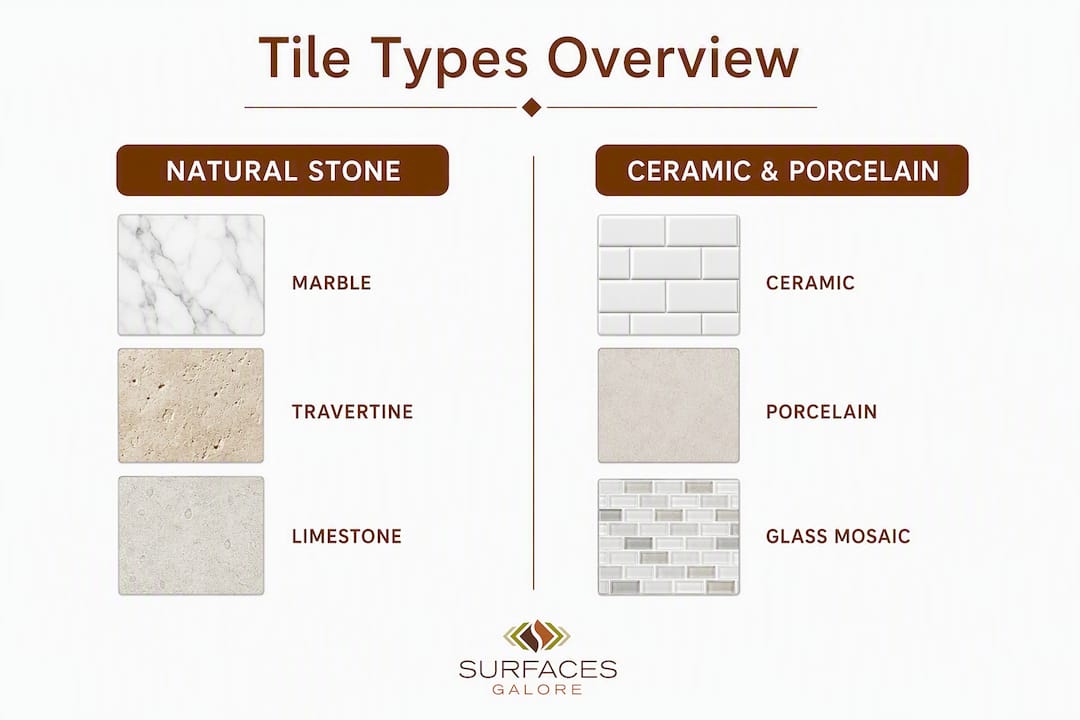
Porcelain is the workhorse of the group. Its near-zero water absorption makes it the right call behind a range where steam, grease, and heat are daily realities. Large-format porcelain panels can mimic marble or concrete without the maintenance commitment. The tradeoff: heavier slabs need professional installation, and the look, while clean, lacks the organic variation of real stone.
Ceramic
Ceramic costs less than almost anything else on this list and cuts easily with a standard tile saw, which is why it dominates DIY projects. It handles moisture well but is softer than porcelain, so it chips more readily in high-impact zones. For a rental property or a first-time renovation where budget is the primary constraint, ceramic subway tile is hard to beat.
Marble
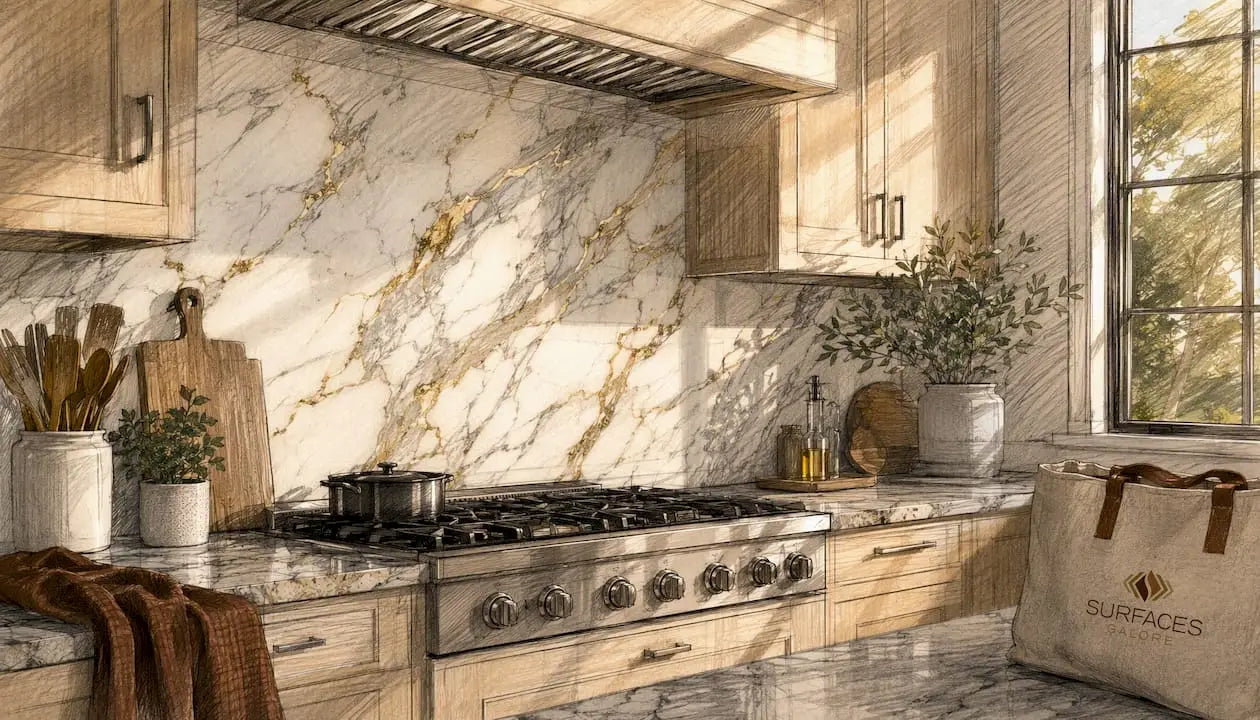
Marble is the tile that stops people in a kitchen. The veining in Calacatta Gold or Statuario is genuinely irreplaceable — no engineered product fully copies it. The catch is real: marble etches when it contacts acidic foods or cleaners, and a polished finish shows every fingerprint under recessed lighting. Choosing a honed finish over polished hides minor etching and grease film far better in a working kitchen. Carrara sits at the lower end of the marble price range; Calacatta commands a significant premium. For a detailed look at marble applications, Surfacesgalore’s marble backsplash ideas guide covers layouts and maintenance in depth.
Travertine
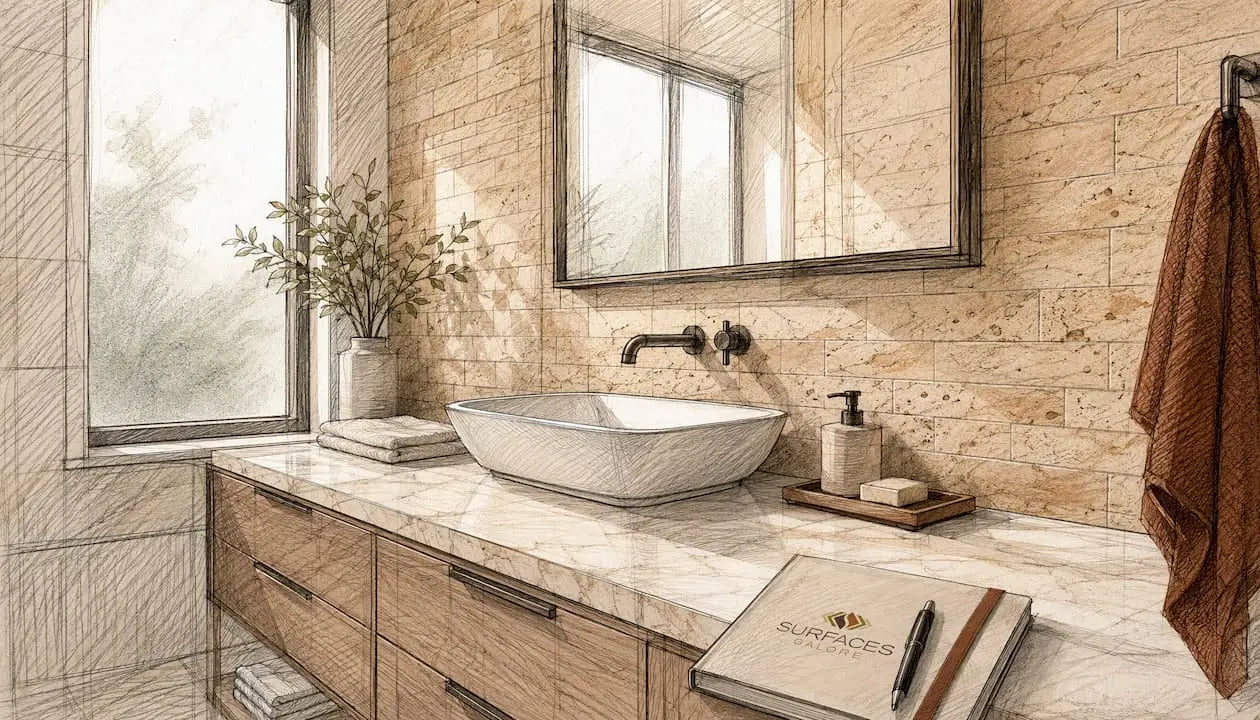
Travertine brings warmth that porcelain simply cannot manufacture. Its natural pitting and color variation — creamy ivory, walnut, gold — suit Mediterranean, Tuscan, and organic-modern kitchens. Filled-and-honed travertine is the practical choice for backsplashes; unfilled versions trap grease in the voids. Material cost guidance confirms travertine generally runs lower than premium marbles, making it one of the more accessible natural stone options.
Limestone
Limestone reads quieter than marble — softer tones, less dramatic veining, more of a chalky refinement. It works beautifully in bathrooms and in kitchens where the cabinetry or countertop is already doing the visual heavy lifting. Higher porosity than travertine means sealing is non-negotiable, and you’ll want a pH-neutral cleaner to avoid surface degradation over time.
Glass mosaic tile
Glass mosaic’s superpower is light. In a galley kitchen or a windowless bathroom, a glossy glass tile backsplash bounces light around in a way no stone can. The mesh-backed sheets make installation manageable for a careful DIYer. The main limitation is grout: the joints between small tiles collect grime, so keep the grout lines tight and use an epoxy grout in high-splash zones.
Subway tile
Subway tile is not a material — it’s a format (typically 3×6 inches, though 4×8 and 4×12 are gaining ground). The body is usually ceramic or porcelain. Its staying power comes from versatility: stack it horizontally for classic, run it in herringbone for energy, or go vertical for a modern elongated effect. Grout color is where subway tile gets interesting — a dark grout on white tile creates a grid that reads almost graphic.
Large-format slabs
Full-slab backsplashes create continuity from countertop to ceiling, eliminate grout lines entirely, and are one of the strongest luxury signals in a 2026 kitchen. Quartzite is the material getting the most attention here — it offers the dramatic veining of marble with considerably better hardness and acid resistance. Porcelain slabs (often called “sintered stone”) deliver a similar no-grout look at lower cost and weight. Either way, full-height slab installation is not a DIY project: the panels are heavy, the substrate must be perfectly flat, and seam placement requires a skilled hand.
Natural stone vs. engineered tile: the short version. Choose marble, travertine, limestone, or quartzite when you want organic variation, warmth, and long-term resale appeal — and when you’re prepared to seal and maintain them. Choose porcelain when you need maximum durability, zero porosity, and minimal upkeep. Many designers now specify both: a porcelain field tile with a natural stone accent strip or full-height slab feature wall.
Backsplash trends for 2026: what designers are specifying now
The single biggest shift in 2026 kitchen and bath design is the move away from the tile-as-backdrop approach. Backsplashes are now treated as architectural surfaces, not afterthoughts.
Full-height slabs are the defining move
Large-format stone slabs installed floor-to-ceiling behind ranges and along entire kitchen walls are the most-cited trend in 2026 design coverage. No grout lines means no grout to scrub, and the monolithic effect makes a kitchen feel custom-built rather than assembled. Quartzite is the stone designers keep reaching for — its dramatic veining and strong performance make it the rare material that satisfies both the style-first and the durability-first buyer.
Warm neutrals replace cool gray
2026 palettes have shifted decisively toward warm, organic neutrals — creamy taupe, honey, sandy beige — and away from the cool gray that dominated the previous decade. This plays directly into natural stone’s strengths: travertine, warm limestone, and honey-toned marble all land squarely in this palette. Pair these stones with brushed brass or warm bronze hardware and wood-tone cabinetry for a cohesive result.
Glossy finishes and textured shapes
Glossy tile is back, but with more restraint than its 2000s incarnation. Glossy ceramic and glass tiles are being used in smaller kitchens specifically to amplify light — a semi-gloss subway tile offers the shine without the visual noise of a full mirror finish. Alongside gloss, hexagon, scallop, and fluted tile shapes are gaining ground as a way to add texture and dimension without introducing color. A field of white hexagon tile reads modern and tactile in a way that a flat grid simply doesn’t.
Mixed-material layering
The old rule of matching stone throughout a space is fading. Designers are now layering complementary materials — a honed limestone field tile with a glass mosaic accent band, or a travertine slab with brushed metal inlays. Stone and mineral-based finishes combined with honed or soft matte textures add dimension without excess. The key is keeping the palette tight: two or three materials maximum, unified by tone.
Metal and cabinet pairings by trend:
- Warm neutral stone + brushed brass + white or cream cabinetry
- Glossy white subway + chrome or nickel + navy or forest green cabinetry
- Full-height quartzite slab + warm bronze + walnut or oak cabinetry
- Hexagon/textured tile + matte black hardware + flat-front gray cabinetry
How to choose the right backsplash tile for your kitchen or bathroom
Most homeowners start with aesthetics and work backward to practicality. The smarter sequence runs the other way.
Durability and exposure first
Behind a range, you’re dealing with heat, grease splatter, and steam daily. Porcelain or a sealed natural stone with a honed finish handles this zone best. A bathroom backsplash behind a vanity sees far less abuse — limestone or polished marble is perfectly reasonable there.
Cleaning habits matter more than people admit
A marble backsplash with tight grout lines behind a gas range is a maintenance commitment. If you cook frequently and clean quickly, it’s manageable. If you let grease sit for days, porcelain or glass is the honest choice. Grout lines compound the issue: fewer and wider joints are easier to clean than a mosaic grid.
Scale, grout lines, and visual weight
Large-format tiles and slabs minimize grout lines and make a space feel larger. Small mosaics add texture but visually busy up a small kitchen. A standard 3×6 subway tile hits a middle ground that works in almost any room size. Consider the countertop pattern too: a heavily veined stone countertop usually pairs better with a quieter tile than with another busy pattern.
Budget envelope
Materials are only part of the cost. Labor for a full-height natural stone slab installation runs significantly higher than a standard ceramic tile job. Set a total project budget, not just a materials budget, before you fall in love with a specific tile.
Resale considerations
A well-executed natural stone backsplash — particularly marble or quartzite — tends to read as a premium upgrade to buyers. A quality backsplash can contribute to higher perceived home value alongside other finish upgrades. Ceramic tile in a dated color or pattern can work against you. When in doubt, neutral reads better than bold for resale.
DIY vs. hiring a pro
Small ceramic or porcelain subway tile projects are genuinely DIY-friendly, especially with mesh-backed sheets. Mosaic tile with mesh backing is also manageable for a careful first-timer. Full-height natural stone slabs, complex herringbone patterns in large-format tile, and any project requiring significant substrate repair should go to a professional. The cost of a botched slab installation — cracked stone, uneven seams, failed adhesion — exceeds the labor savings.
What to ask your contractor: How will you prep the substrate? What adhesive and grout type do you recommend for this material? Will you seal before grouting? What’s the warranty on labor? How long will the project take from demo to final seal?
Pro Tip: Designers often select the grout color last, not first. Hold a grout sample against your tile under the actual kitchen lighting before committing — the same grout reads completely differently under warm incandescent versus cool LED.
Installation, timeline, and cost estimates (materials and labor)
Budgeting a backsplash project requires separating materials from labor, and both vary more than most homeowners expect.
Typical material cost ranges
| Tile Type | Materials Cost (per sq. ft.) | Notes |
|---|---|---|
| Ceramic | $1–$8 | Widest selection; lowest entry point |
| Porcelain | $3 | Large-format panels push toward the high end |
| Subway tile (ceramic/porcelain) | $2–$8 | Format, not material; cost depends on body |
| Travertine | $5 | Lower than premium marble; filled-and-honed most practical |
| Limestone | $5–$15 | Varies by origin and finish |
| Marble (Carrara) | $10–$15 | Carrara is the accessible marble entry point |
| Marble (Calacatta) | $20–$30 | Premium veining commands a significant premium |
| Glass mosaic | $30 | Handmade or specialty glass at the high end |
| Large-format slab (quartzite/porcelain) | $15–$50 | Material plus fabrication; highly variable |
Material costs sourced from supplier and trade guidance; regional pricing varies.
Labor costs and timeline
Labor for a standard kitchen backsplash typically runs between moderate and higher rates per square foot in most U.S. markets, with coastal metros and complex installations pushing costs higher. A straightforward ceramic or subway tile job on a prepped substrate takes one to two days. Natural stone with substrate repair, full-height slab work, or intricate mosaic patterns can stretch to three to five days.
The timeline breakdown: substrate prep (half a day to a full day for repairs), tile setting (one to two days), grouting (half a day), and final sealing (a few hours, often the following day after grout cures). For step-by-step stone installation guidance, Surfacesgalore’s process guide covers the sequence in detail.
Regional variability and getting accurate quotes
Labor rates in San Francisco or New York run 30–50% above national midpoints; rural markets run below. Get at least three quotes, and ask each contractor to break out substrate prep separately — that’s where surprise costs hide. Specify the tile type and format in writing before quotes are submitted, since a contractor pricing “tile installation” without knowing it’s a full-height quartzite slab will underbid significantly.
Lead times
Stocked porcelain and ceramic tile ships within days from most distributors. Natural stone, particularly custom-cut slabs and specialty mosaics, typically requires two to four weeks from order to delivery. If your contractor has a tight schedule, order stone samples and confirm your selection before booking the installation date.
Care and maintenance: keeping your backsplash looking new
The maintenance gap between tile types is wider than most people realize at the point of purchase.
By material:
- Porcelain and ceramic: Wipe with a damp cloth and mild dish soap. No sealing required. Grout lines are the only maintenance point — seal grout annually in high-splash zones.
- Glass mosaic: Non-porous surface cleans easily. Use a streak-free glass cleaner for shine. Epoxy grout in the joints eliminates most staining risk.
- Slate: Dense and low-porosity; occasional sealing recommended but less critical than softer stones. Avoid abrasive scrubbers that scratch the surface.
- Travertine (filled): Seal annually. Use a pH-neutral stone cleaner. Avoid vinegar, lemon juice, or any acid-based cleaner — they dissolve the calcium carbonate in the stone.
- Limestone: Seal one to two times per year. More porous than travertine, so prompt cleanup of spills is important. pH-neutral cleaners only.
- Marble: Seal one to two times per year. A honed finish hides etching and grease film better than polished under kitchen lighting, making it the practical choice for a working kitchen. Never use vinegar or bleach. For a full breakdown of why sealing matters, Surfacesgalore’s natural stone sealing guide explains the chemistry and schedule.
The water bead test
Sprinkle a few drops of water on your stone backsplash. If the water beads up, the sealer is intact. If it soaks in within a minute or two, re-seal immediately. This takes thirty seconds and can prevent a stain that no cleaner will remove.
Contractors commonly recommend applying a penetrating sealer before grouting during installation — this step prevents grout from staining the stone face during the cure period, a detail that’s easy to skip and hard to fix after the fact.
Pro Tip: For cooking grease embedded in grout lines, apply a paste of baking soda and water, let it sit for ten minutes, then scrub with a stiff nylon brush. Avoid wire brushes — they scratch grout and leave metal deposits that rust.
Long-term durability
Properly sealed marble and travertine backsplashes last decades. The question is never whether to re-seal but when. A stone that’s been neglected for years may need a professional deep clean before re-sealing is effective. Cracked or hollow-sounding tiles indicate adhesion failure — that’s a replacement job, not a maintenance one.
Design pairings and layout ideas: real use inspiration
Layout options:
- Classic horizontal subway: the default for a reason — clean, readable, works with any cabinet style
- Herringbone: adds movement and energy; best in a single tile color so the pattern reads clearly
- Stacked grid (vertical or horizontal): modern and graphic; pairs well with flat-front cabinetry
- Full-height slab: architectural and grout-free; the strongest luxury signal in a kitchen
- Small mosaic accent band: a cost-effective way to introduce natural stone or glass as a detail between field tile
- Half-height vs. countersplash: a countersplash (4–6 inches above the counter) costs less and suits rentals; full-height reads more finished and protects more wall
Material and countertop pairings:
- White quartz countertop + warm gray subway tile + brushed nickel hardware: clean and timeless
- Butcher block + cream travertine mosaic + brass fixtures: warm, organic, farmhouse-adjacent
- Concrete countertop + large-format matte porcelain + matte black hardware: industrial-modern
- Dark cabinetry + Calacatta marble slab + polished chrome: high-contrast luxury
Grout color and perceived scale
Light grout on light tile makes the wall read as a single surface — larger and quieter. Dark grout on light tile emphasizes the grid and makes each tile read individually, which adds graphic energy but can shrink a small space visually. A rule of thumb: match grout to tile color within two shades for a seamless look; go two or more shades darker for a deliberate grid effect. In a small kitchen, the seamless approach almost always serves the space better.
Interior design trends across the home are moving toward cohesive, tonal palettes — a principle that applies directly to backsplash and grout selection.
Why natural stone slabs are a standout 2026 pick: Surfacesgalore insight
Surfacesgalore imports marble, limestone, travertine, and quartzite directly from quarries, which means the finish consistency and material quality are controlled at the source rather than filtered through multiple distributors. For a full-height backsplash where a single slab runs from countertop to ceiling, that consistency matters: veining continuity, uniform thickness, and predictable porosity all affect how the installation looks and how long it holds.
Practical installation notes from contractor practice:
- Substrate flatness is critical for large-format slabs. Any variation greater than 1/8 inch over 10 feet will telegraph through the stone.
- Full-height slabs require professional handling — the weight and fragility of a large stone panel make solo installation a liability.
- Seam placement should be planned before cutting, ideally at a natural break in the veining pattern.
- Apply a penetrating sealer to the stone face before grouting to protect against grout haze and staining during cure.
Surfacesgalore ships nationwide from Anaheim, California, and carries marble, limestone, travertine, and mosaic collections suited to both full-height slab applications and traditional tile formats. For buyers planning a natural stone backsplash, ordering physical samples before committing to a full quantity is standard practice — stone varies by lot, and what looks right on a screen may read differently against your actual cabinetry and lighting. The natural stone backsplash guide at Surfacesgalore covers material selection and professional installation notes in detail.
Key Takeaways
Porcelain is the most practical all-around backsplash tile for high-use kitchens, while quartzite slabs deliver the strongest luxury and resale impact — the right choice depends on how much maintenance you’re willing to commit to.
| Point | Details |
|---|---|
| Best all-around for durability | Porcelain handles heat, moisture, and daily cleaning with no sealing required. |
| Statement pick for 2026 | Quartzite slabs deliver dramatic veining and strong performance; hire a pro for full-height installation. |
| Maintenance commitment | Natural stone (marble, limestone, travertine) requires sealing one to two times per year and pH-neutral cleaners only. |
| DIY vs. pro threshold | Ceramic and subway tile are DIY-friendly; full-height slabs and complex natural stone patterns need a professional. |
| Surfacesgalore for natural stone | Surfacesgalore direct-imports marble, limestone, travertine, and quartzite with nationwide shipping for homeowners and contractors. |
What most homeowners get wrong about backsplash tile
The conventional wisdom says: pick a tile you love, then figure out the rest. That sequence produces a lot of beautiful backsplashes that are miserable to maintain.
For a budget-conscious cook who uses the kitchen hard, porcelain is the honest recommendation — not because it’s the most exciting tile, but because it performs without asking anything of you. A large-format porcelain panel in a warm stone look gives you 90% of marble’s aesthetic at a fraction of the upkeep. Pair it with a simple white grout and you’re done.
For a style-first renovator with a higher budget, a quartzite or Calacatta marble slab is worth the investment and the maintenance commitment. The visual impact of a full-height veined stone wall behind a range is something no engineered tile replicates. Budget for a professional installation and factor in annual sealing — it’s a two-hour job, not a burden.
For a family home where durability and easy cleaning are the priority, a honed porcelain or a filled travertine in a simple layout is the call. Travertine’s warmth reads more livable than cold porcelain in a family kitchen, and a filled-and-honed surface handles the daily reality of cooking with kids better than polished marble ever will.
The one thing all three profiles share: get physical samples, hold them against your actual cabinets under your actual lighting, and live with them for a day before ordering. Tile decisions made from a screen alone are the most common source of renovation regret.
Premium natural stone for your backsplash project
Surfacesgalore is a direct importer of marble, limestone, travertine, and quartzite tiles, mosaics, and decorative pieces — shipped nationwide from Anaheim, California. Buying direct means you get authentic stone at prices that don’t include a distributor’s markup, with the finish consistency that full-height slab projects require.
The practical next step: measure your backsplash area, then browse the natural stone collections at Surfacesgalore and request physical samples before placing a full order. For full-slab installations, Surfacesgalore’s team can advise on material selection, quantity calculation, and contractor coordination. Shop natural stone tiles today and see what the right stone does for your kitchen.
Useful sources and further reading
- Natural Stone Backsplash Ideas: Marble, Travertine, and Slate (D and G Flooring) — material cost ranges, maintenance notes, and finish guidance for natural stone backsplashes
- The One-Stone Home Trend: How Natural Stone Is Transforming Interiors in 2026 (FineHomeKeeping) — 2026 slab trend coverage and warm-neutral palette shift
- Which Top 10 Natural Stone Trends Are Reshaping Luxury Interiors in 2026 (China Stone Select) — quartzite and luxury stone trend analysis
- Luxury Kitchen Backsplash Trends 2026 (Leicht CA) — textured shapes, glossy finishes, and mixed-material layering trends
- Kitchen and Bath Design Trends for 2026 (Natura Stone) — honed finishes, fluted surfaces, and stone-mineral texture trends
- DynamicStoneTools — Marble Finish and Care Guidance — practical guidance on honed vs. polished marble for kitchen applications
FAQ
Should your backsplash be lighter or darker than the countertop?
Lighter backsplashes tend to open up a space and keep the countertop as the visual anchor; darker backsplashes add drama but work best in larger kitchens with strong natural light. The most reliable approach is to stay within two to three shades of the countertop tone and let grout color do the contrast work.
What backsplash tile is trending in 2026?
Full-height natural stone slabs (quartzite and marble) are the dominant 2026 trend, alongside warm neutral palettes in creamy taupe and sandy beige, textured shapes like hexagon and scallop, and mixed-material layering combining stone with glass or metal accents.
Is porcelain or natural stone better for a kitchen backsplash?
Porcelain wins on durability and zero maintenance; natural stone wins on visual character and resale appeal. For a high-use cooking kitchen, porcelain is the practical choice. For a statement kitchen where aesthetics drive the decision, marble or quartzite delivers something porcelain cannot replicate.
How often does a natural stone backsplash need to be sealed?
Most natural stone backsplashes need sealing once to twice per year, depending on the stone type and how heavily the kitchen is used. The water bead test is the simplest diagnostic: if water soaks into the surface rather than beading, it’s time to re-seal.
Can you install a backsplash tile yourself?
Ceramic and porcelain subway tile on a sound substrate is a realistic DIY project for a careful first-timer. Mesh-backed mosaic sheets are also manageable. Full-height natural stone slabs, large-format porcelain panels, and any project requiring substrate repair should be handled by a professional to avoid adhesion failure and cracked stone.

Leave a comment