
Hotel Lobby Marble: Choosing Stone for High-Traffic Entrances

The best marble for a hotel lobby is a dense, well-graded stone in a honed or lightly textured finish, specified against abrasion and slip-resistance tests and backed by a realistic cleaning plan. Polished white and grey marbles still set the tone for luxury entrances. But a lobby floor takes thousands of footsteps, rolling luggage, wet shoes and daily cleaning, so the stone you pick and the way you finish it matter as much as the color.
This guide is written for designers, architects, contractors and owners who are specifying marble for a lobby, reception area or entrance, and for anyone weighing it against other materials.
TL;DR
- Marble is a classic lobby material because of its warmth, veining and sense of arrival. It is calcite-based, so it reacts to mild acids and will develop a patina over time.
- For public floors, specify performance, not just looks. Ask for abrasion (ASTM C241), flexural strength and slip-resistance data on the actual stone and finish.
- Honed and textured finishes hide wear and give better footing than a mirror polish. Use polish on walls, desks and feature inlays.
- Plan maintenance before you order: pH-neutral daily cleaning, entry matting, and a sealer program.
- Order enough extra material from one lot, and review samples in your own lighting before committing.
Table of Contents
- Why marble still defines the hotel entrance
- Choosing the right marble for a lobby
- Finish matters more than most people expect
- Specify for performance, not just appearance
- Design ideas that make marble work in a lobby
- Lobby marble and current hotel design trends
- Protecting marble in a working lobby
- Installation: where lobby floors succeed or fail
- Perspective: what we tell hotel teams about lobby marble
- Sourcing marble for a hotel project
- Explore marble tiles and mosaics from Surfaces Galore
- Marble versus other lobby materials
- FAQ
- Sources
Why marble still defines the hotel entrance
Guests form an opinion about a property in the first few seconds. A stone floor that runs from the door to the front desk tells them the building is serious about quality. Marble does that better than most materials because no two slabs or tiles read the same. Veining, cloudiness and subtle tonal shifts give a large floor depth that printed surfaces rarely match.
The Natural Stone Institute lists foyers, bathrooms, floors and hearths among the best uses for marble, and describes it as a favored material for upscale entrances. The same page is candid about the trade-off: marble’s calcite crystal structure is vulnerable to mild acids, including some common cleaners and spilled drinks. That is the central tension in every lobby project. You get an unmistakable look, and in return you commit to a maintenance routine.
Longevity is part of the case too. The Natural Stone Institute notes that natural stone often lasts the life of a building, frequently cited as 100 years or more, is fully recyclable and can be cleaned with simple pH-neutral detergents. For a hotel that renovates soft finishes every seven to ten years, a floor that is refreshed rather than replaced is a real advantage. For more on how stone shapes the guest experience, see our piece on marble in hotels.
Choosing the right marble for a lobby
There is no single best marble. The right choice depends on traffic, color goals, budget and how much visible aging the owner will accept. Here is how the common families behave.
White and light marbles
Carrara-type whites with soft grey veining are the most recognized lobby marbles. They read as clean and timeless, and the gentle veining is forgiving: small scratches and etch marks blend into the pattern more easily than on a plain, uniform stone. Bolder white-and-gold or white-and-grey veined marbles make a stronger statement and suit a reception wall or a central floor field.
Very pure whites show every mark, so reserve them for areas where staff can maintain them closely, or use them with a honed finish.
Warm beige and cream marbles
Cream and beige marbles make a lobby feel welcoming rather than formal. They also hide dust, footprints and minor wear better than pure white or black. Many resort and business hotels choose warm tones for the main floor and bring in contrast through the front desk, columns or an inlay border.
Dark and grey marbles
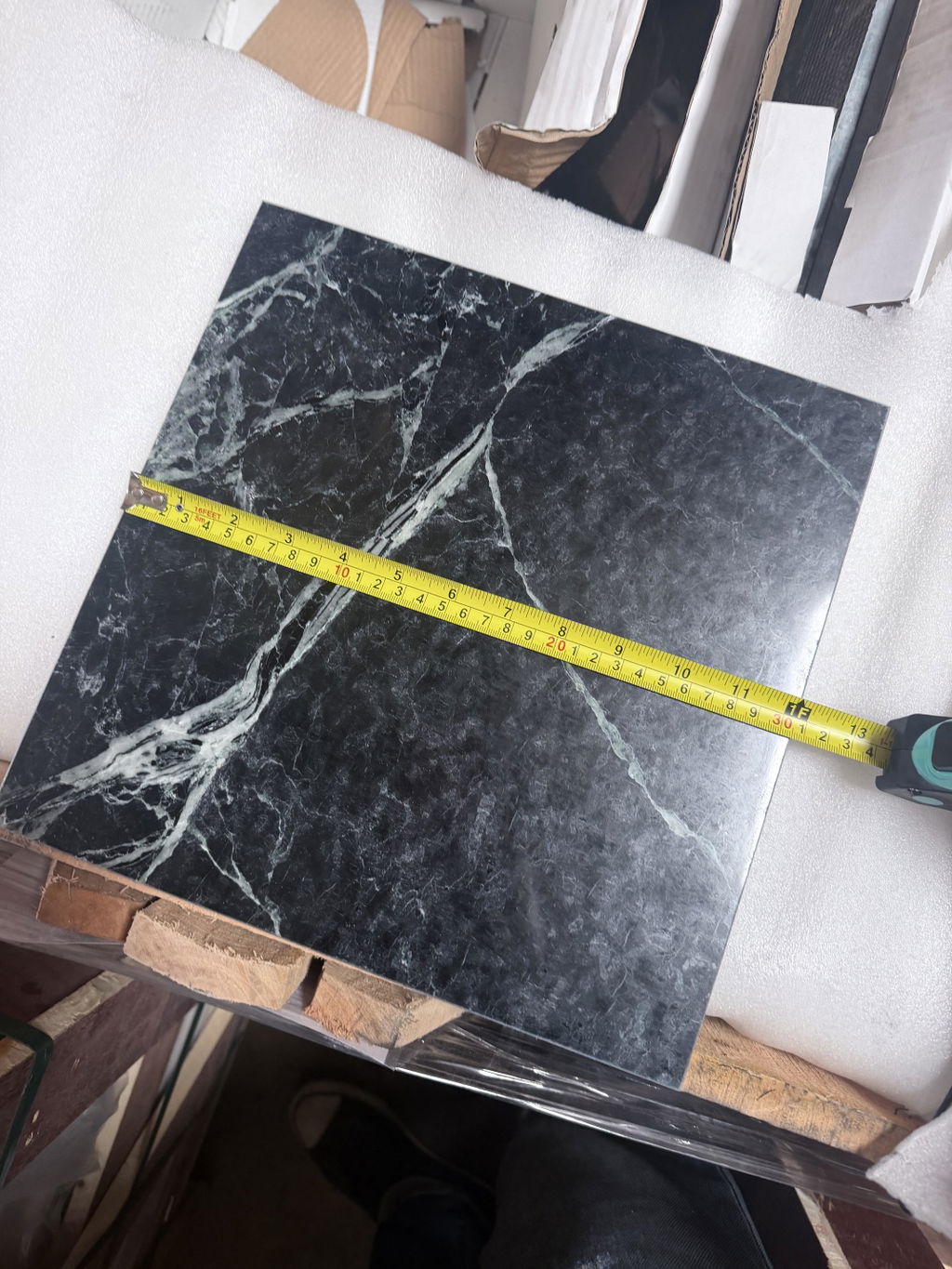
Grey marbles, such as Bardiglio, give a modern lobby weight and calm. Darker stone is often a good border, threshold or feature-wall material because it frames lighter fields. Be aware that on black or very dark stone, dust, water spots and etching can show more clearly, especially in a polished finish.
Marble, serpentine and what to ask your supplier
The Natural Stone Institute points out that true marble and serpentine are different stones. Serpentine is magnesium-silicate based and offers noticeably better resistance to acids and abrasion, which can make it a lower-maintenance choice for punishing conditions. Many green stones sold commercially fall in this category.
That is why you should always ask what a stone actually is, not just what it is called in the trade. Trade names cover a lot of ground, and two stones sold under similar names can behave differently underfoot.
Quick comparison
| Lobby need | Stone direction | Finish to consider |
|---|---|---|
| Classic, timeless main floor | Carrara-type white or grey veined marble | Honed |
| Warm, welcoming resort entrance | Cream or beige marble | Honed or lightly textured |
| Modern, dramatic reception | Grey or dark marble with strong veining | Honed floor, polished accents |
| Very heavy traffic or exposure | Dense marble or serpentine, confirmed by test data | Textured or honed |
| Feature walls and desks | Boldly veined marble | Polished |
Finish matters more than most people expect
The finish changes how a floor looks, how it feels underfoot and how fast it appears to age.
Polished marble gives the deepest color and reflection. It is gorgeous in a quiet, low-traffic area and on vertical surfaces. On a busy floor, a mirror polish dulls unevenly along the main walking lines, and it can feel slick when wet.
Honed marble has a soft, matte surface. Etch marks and light scratches are far less obvious because there is no gloss to interrupt. Most designers who specify marble for entrances and corridors today choose honed for exactly this reason.
Textured or brushed finishes add grip and hide wear further. They suit exterior entry steps, vestibules and porte-cochère areas where rain is a given.

A simple approach that works well: honed floor, polished walls and reception desk, with a textured finish outdoors. You keep the shine where guests look, and the grip and forgiveness where they walk.
Specify for performance, not just appearance
A lobby is a public-access space, and stone flooring there has to perform like it. The Natural Stone Institute stresses that ASTM standards are relevant to specifying natural stone and that slip resistance, abrasion resistance and flexural strength testing help prevent accidents and structural problems in commercial installations. Their guidance cites ASTM C241 for abrasion resistance.
In practice, that means building a short checklist into the submittal process:
- Abrasion resistance. Ask for test data appropriate to the stone and the traffic category. A soft, high-porosity marble may be fine in a boutique hotel but a poor match for a convention property.
- Flexural strength. Especially important for thinner tiles over raised or flexible subfloors, or for large formats.
- Slip resistance. Request data for the finish you are actually specifying, in wet and dry conditions. Do not assume a polished sample will behave like a honed one. Your local code, insurer and the project’s design team set the thresholds that apply.
- Absorption and porosity. These influence staining, so they inform your sealer plan.
- Consistency across lots. Confirm that the delivered material matches the approved samples, within the natural variation you agreed to.
If you are unsure which standard applies to a particular installation, talk with your architect of record or a qualified testing laboratory. Liability for a slip-and-fall in a lobby sits with the project team and owner, so this is not the place to guess.
Design ideas that make marble work in a lobby
Choosing the stone is half of the job. The other half is how you lay it out. These are approaches that tend to work well in hotel entrances.
Let the floor lead the layout
Large-format tiles with tight joints give a calm, expansive look and keep grout lines from competing with the veining. Square formats suit formal lobbies, while rectangular tiles in a running bond or staggered pattern add rhythm to long corridors from the entrance to the elevators.
Use patterns for arrival points
A checkerboard field in contrasting stones remains one of the most recognizable hotel floor patterns. It works in a traditional boutique setting and, scaled up with subtle tones, in a contemporary one. Borders, inset bands and medallions help mark the path from the door to reception, and a feature at the center of a rotunda or beneath a chandelier turns a floor into a landmark.
Bring marble up the walls
Marble on the reception wall, behind the front desk or around the elevator core extends the effect without adding foot-traffic wear. Book-matched slabs and polished tiles do well here, because walls are not subject to the slip and abrasion concerns of the floor.
Add texture with mosaics
Mosaics suit smaller, high-impact moments: a lounge fireplace, a bar front, a column base, or the floor of a powder room off the lobby. A herringbone or basketweave mosaic in a white marble gives a refined, finer-grain look against larger floor tiles. Our guide to stone mosaic installation covers the substrate and setting steps that keep those small pieces flat and evenly spaced.

Mix materials on purpose
Marble pairs well with brass, warm wood, plaster and textiles. Keep the palette tight. A lobby with one stone as the hero, one supporting stone and two or three accent materials looks calmer and more expensive than one that uses every material the designer likes.
Lobby marble and current hotel design trends
Hotel design is moving away from cold, mirror-polished formality toward warmer, quieter spaces that feel residential. In marble terms, that tends to mean:
- Honed and softly textured surfaces rather than high-gloss floors.
- Warm neutrals and soft greys alongside the classic whites.
- Strong veining in small doses, such as on a desk, a wall or an inlay, instead of across the entire floor.
- Mixed patterns, including checkerboards and herringbone, used as accents.
- Lobbies that double as lounges, cafes and work areas, which puts more wear on the stone in more places.
That last point deserves attention. As lobbies become social spaces with seating and food service, spill and furniture-movement risks increase. Plan for felt pads on chair legs, rugs under dining zones, and a cleaning protocol that staff can follow quickly.
There is also a building-systems angle. ASHRAE notes that hotel public spaces such as lobbies are designed primarily for aesthetics and function, with open plans and high ceilings, and that their ventilation has to be thought through alongside the architecture. Hard, non-porous-looking stone surfaces fit well into that conversation, but loop in your mechanical engineer early, because large open volumes affect comfort and air movement as much as finishes do.
Protecting marble in a working lobby
Marble does not fail in a lobby because it is marble. It fails when the maintenance plan does not match the use. A few habits cover most of the risk.
Keep grit out
Most floor wear is abrasive dirt carried in on shoes. Long entrance mats outside and inside the door, with a stretch of at least several steps, capture much of it. Sweep or dust-mop frequently, because grit grinds the finish like sandpaper.
Clean with the right products
Because marble reacts to mild acids, avoid vinegar, citrus-based cleaners, bathroom descalers and generic all-purpose sprays. The Natural Stone Institute says natural stone can be cleaned with simple pH-neutral detergents. Train housekeeping and any outside cleaning contractor in writing, and keep an approved product list at the janitor’s closet. Our guide to acid-safe marble cleaners includes a simple spot test you can run on a spare tile before any new product touches the floor.
Seal, but do not expect a miracle
A good penetrating sealer slows liquid absorption and gives staff more time to wipe up a spill. It does not make marble immune to etching from acids. Read our explanation of what marble sealer does and does not do, and set a re-sealing schedule based on how the surface behaves, not a fixed calendar. Our broader marble maintenance guide walks through routine care and restoration.
Accept a patina, or choose honed
Owners who expect a floor to look brand new for a decade will be disappointed. Owners who accept gentle aging often find it adds character, and a honed floor can be re-honed in place by a stone restoration professional when the time comes. Set that expectation in the design phase, and mention it in the owner’s operating manual.
Installation: where lobby floors succeed or fail
A beautiful stone can be ruined by a poor installation. Pay particular attention to these points.
- Substrate flatness. Large tiles show lippage quickly. The substrate must be flat within the tolerance recommended by the tile setting standards your installer follows.
- Setting materials. Use thinset products suited to natural stone, and take care with white or light marbles, which can show through or be stained by dark setting materials.
- Movement joints. Large lobbies need them. Your architect and installer should locate them to follow the structure and the layout.
- Dry-lay before setting. Blend tiles from several boxes so that color and veining are distributed across the floor rather than clustered.
- Protection after setting. Cover the finished floor during the rest of construction, since trades traffic wears new stone faster than guests.
Our marble floor installation guide covers the sequence in more detail, and is a good reference to hand to a general contractor who has not set a lot of natural stone.
Perspective: what we tell hotel teams about lobby marble
We import natural stone directly and ship it nationwide, so most of our lobby conversations begin with the same two questions: how much traffic will the floor take, and who will be cleaning it?
Our view is simple. Marble is a very good lobby material when the team goes in with open eyes. It is not the right answer for every inch of every property, and pretending otherwise is how owners end up disappointed. We would rather help a designer pair a honed marble floor with polished marble on the walls and desk than sell a mirror-polished floor that will look tired in two years.
For trade buyers, we suggest three habits. First, request samples early and look at them under the lobby’s real lighting, with the actual wall color and fixtures beside them. Second, bring the cleaning crew into the conversation before the stone is ordered, not after it is installed. Third, order a little more than the takeoff requires and keep it from the same lot, so that future repairs match.
Natural variation is part of why people choose stone in the first place. A tile with a stronger vein or a cloudier patch is not a defect, it is the material. A good project plan expects it, mixes boxes during layout and agrees on tolerance up front.
— John | Surfaces Galore
Sourcing marble for a hotel project
If you are buying for a hospitality project, a few practical points will save you time.
- Request samples first. Seeing and handling the stone is the only reliable way to judge color, finish and veining.
- Confirm quantities and lot consistency. Large lobbies need more material from one production run than a typical home project.
- Ask about edges, trim and specialty pieces. Thresholds, bases, moldings and steps are part of how a lobby looks and should be ordered with the field tile.
- Check lead times against the schedule. Imported stone travels a long way, so build slack into the construction timeline.
- Ask what is provided with the material. For commercial work, ask for the documentation your design team needs for submittals.
Explore marble tiles and mosaics from Surfaces Galore
Surfaces Galore is a direct importer of marble, travertine and limestone tiles, mosaics, moldings, pavers, pool coping and decorative stone, based in Anaheim, California and serving trade professionals and homeowners across the United States. We offer free sample shipping, custom project support and bulk quotes for contractors, designers and commercial buyers, and we carry premium material only.
For a lobby, start with our marble tiles and mosaics by type to compare field tile, trims and accent pieces. If you are planning a reception wall, bar front or powder room floor, a pattern such as our Carrara White herringbone mosaic in polished or honed marble adds a fine-grained accent to a larger floor.

Marble versus other lobby materials
Marble is not the only way to build an elegant entrance, and being honest about alternatives helps you choose well.
| Material | Strengths | Watch-outs |
|---|---|---|
| Marble | Distinctive veining, high-end look, long service life | Reacts to acids, shows etching, needs a care plan |
| Limestone | Soft, matte, quiet look | Can be more porous, so sealing and stain plans matter |
| Travertine | Warm tones, textured character, good for resort settings | Voids and pits are part of the look, filled or unfilled |
| Serpentine | Better acid and abrasion resistance than true marble | Limited color range, mostly green tones |
| Manufactured tile (porcelain-type) | Uniform, low upkeep | Repeating patterns, no natural variation |
If the owner wants a stone look with the least upkeep, the honest answer may be a mix: natural stone where guests linger and see it, and a more forgiving material in back-of-house and service corridors. For a lobby where the stone is the brand, though, natural material is hard to replace.
FAQ
What is the best marble for a hotel lobby floor?
There is no single best stone, but dense, well-graded marbles in Carrara-type whites, warm creams and soft greys are common choices. Pair them with a honed or textured finish and check abrasion and slip-resistance data for the exact stone and finish you plan to use. If the lobby will see extreme traffic or heavy exposure, ask whether a harder stone, such as serpentine, is a better fit for part of the space.
Is polished or honed marble better for a lobby?
Honed is usually the better floor choice. It hides etching and light scratches, and it generally feels less slick than a mirror polish. Polished marble still works very well on walls, reception desks and feature inlays where guests look but do not walk.
Does marble stain and scratch in a busy hotel entrance?
It can, because marble is calcite-based and reacts to mild acids, which is why cleaning products matter. Entry matting, regular dust mopping, pH-neutral cleaners and a sealer program reduce most problems. Some wear and patina are normal over time, and a honed floor can be refreshed by a stone restoration professional.
How do I make sure a marble lobby floor is safe?
Specify stone against the relevant ASTM tests, including abrasion resistance and slip resistance for the actual finish, and confirm what your local code and insurer require. Use entrance matting to limit moisture tracked in from outside, and have cleaning staff use proper wet-floor signage. Your architect of record or a testing laboratory can confirm which standards apply to your project.
Can I order marble samples for a hotel project?
Yes. We ship samples free and offer custom project support and bulk quotes for trade and commercial buyers. Review the samples under your lobby’s real lighting before you commit to a full order.
Sources
- Natural Stone Institute: What Is Marble, Onyx & Serpentine? Technical Data And Best Practices
- Natural Stone Institute: Mother Nature’s Original Sustainable Building Material
- Natural Stone Institute: Which ASTM Standards Are Relevant To Natural Stone
- ASHRAE Journal: Mitigating COVID-19 in hotel public spaces
Recommended
- Durable Checkerboard Entryway Floor Ideas
- Select Perfect Stone For Luxury Home Design
- Marble in Hotels Enhancing Guest Experiences
- Luxury Marble Tile Flooring Guide
This article is provided for general informational guidance only. Natural stone varies in color, veining, texture and performance. For installation, sealing, cleaning and maintenance, follow the product manufacturer’s instructions and consult a qualified installer or stone-care professional. Always test cleaning and sealing products in an inconspicuous area first. Surfaces Galore is not responsible for damage, discoloration, etching, staining, installation issues or other problems resulting from

Leave a comment