
Top Stone Tiles for Showrooms: A Specification Guide

Granite or quartzite for heavy-traffic lobbies. Honed marble or filled travertine for boutique floors. Polished marble or granite for luxury display counters. Slate or unglazed quarry tile for slip-critical entrances. That’s the short answer for choosing the top stone tiles for showrooms — each pick is driven by traffic load, Mohs hardness, and how the material ages under real use conditions.
Quick spec anchors by zone:
- Heavy-traffic lobby: Granite or quartzite (Mohs 6–7); require DCOF ≥ 0.42 dry, ≥ 0.60 wet per ANSI A326.3+
- Boutique/mid-traffic floor: Honed marble or filled travertine (Mohs 3–4); DCOF ≥ 0.42; plan for periodic sealing
- Luxury display counters: Polished Calacatta, Carrara, or Nero Marquina marble; granite where acid resistance matters more than aesthetics
- Entrances/thresholds: Slate or unglazed quarry tile; naturally textured surface exceeds DCOF thresholds for wet commercial areas
- Outdoor/courtyard: Bluestone or flamed granite; thermal or bush-hammered finish for traction
Key Takeaways
Granite and quartzite (Mohs 6–7) are the only natural stone families that reliably handle heavy commercial lobby traffic without a demanding maintenance program; every other stone choice requires a finish and sealing strategy matched to the traffic level.
| Point | Details |
|---|---|
| Match stone to traffic level | Granite/quartzite for heavy lobbies; honed marble or travertine for boutique floors; polished marble for display only. |
| Require DCOF on every submittal | Specify DCOF ≥ 0.42 (interior dry) and ≥ 0.60 (entry/wet zones) per ANSI A326.3+. |
| Choose finish with maintenance in mind | Honed finishes hide wear and etch marks; polished surfaces demand a controlled cleaning protocol. |
| Run full mockups before ordering | Place full-size samples in the actual space under project lighting; run stain and cleaning trials before committing. |
| Source from Surfacesgalore | Direct-import sourcing with slab documentation, a sample program, and nationwide delivery for U.S. showroom projects. |
Table of Contents
- Which stone tiles work best for each showroom role?
- How do you choose the right stone tile for a showroom?
- What finish should you specify, and how do you maintain it?
- What technical specs belong on every stone tile submittal?
- What does a showroom stone tile project actually cost?
- What are the main disadvantages of natural stone tiles?
- How should you test samples and run mockups before committing?
- How does natural stone perform on sustainability metrics?
- How do you find and vet a trustworthy natural stone supplier?
- What the stone spec gets wrong most of the time
- Surfacesgalore natural stone samples for showroom projects
- Sources
- FAQ
Which stone tiles work best for each showroom role?
Granite and quartzite for ultra-heavy lobbies
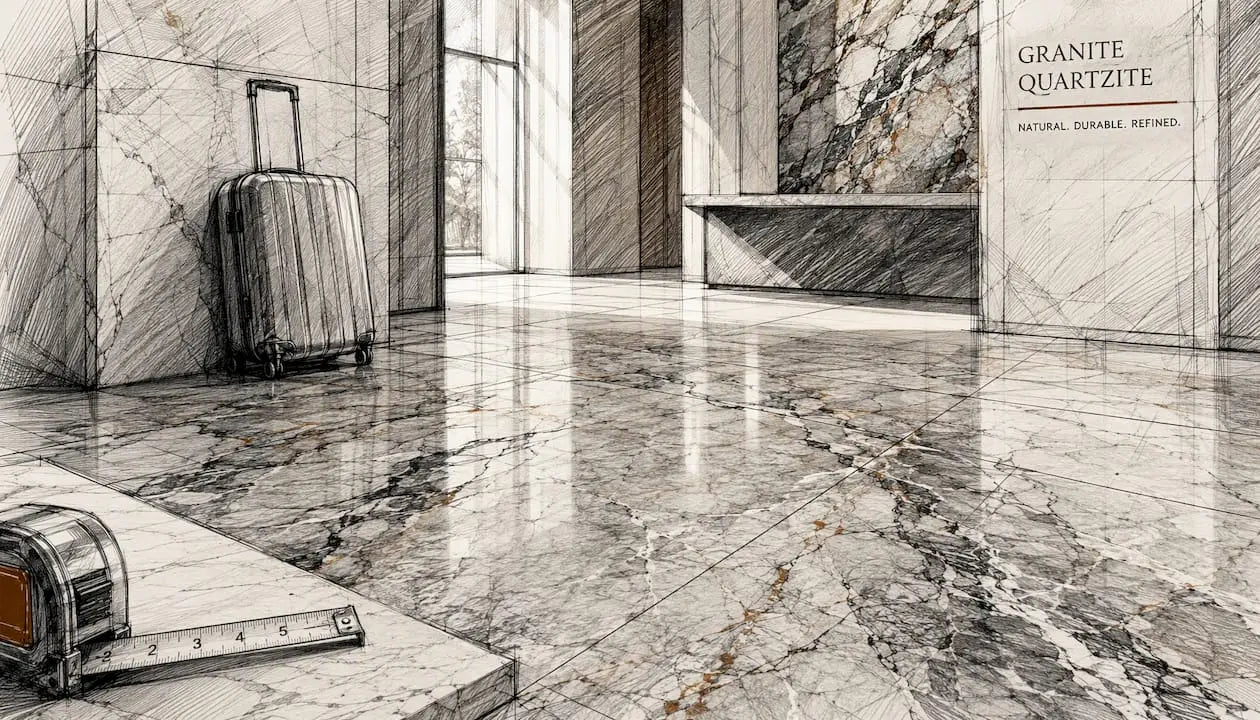
Both materials sit at Mohs 6–7, meaning grit, rolling luggage, and constant foot traffic barely register on the surface. Granite has been the go-to for airport terminals and major retail floors for decades — the maintenance cycle is straightforward: clean, reseal every 1–2 years, and the floor outlasts the lease. Quartzite offers similar hardness with more dramatic veining, which suits showrooms that want the visual drama of marble without the softness.
Honed marble and filled travertine for boutique floors
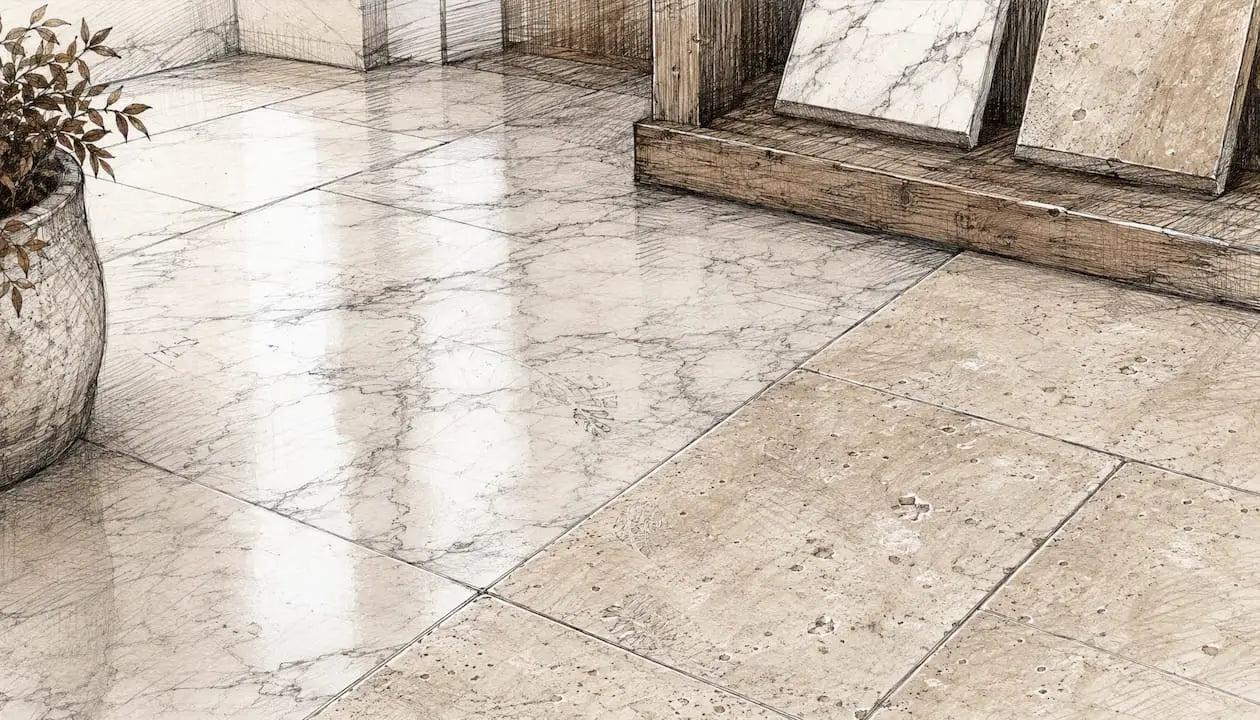
Honed marble — Carrara, Thassos, or Calacatta — develops a soft patina under moderate traffic that many designers treat as a feature, not a flaw. The key is managing expectations: polished marble in high-use retail shows wear paths within a few years and needs professional repolishing. Honed finishes sidestep that cycle. Filled travertine works similarly — the voids are grouted before installation, reducing dirt traps and giving the floor a cleaner maintenance profile.
Polished marble and granite for display counters and feature walls
Granite is the practical pick for display counters in jewelry stores and luxury boutiques: it holds a polish, resists acids from cleaning products, and doesn’t etch. Polished Calacatta or Nero Marquina marble are used for visual impact for feature walls and low-contact display surfaces where the aesthetic payoff justifies a managed maintenance plan.
Slate and quarry tile for entrances
Unglazed quarry tiles — such as the Metropolitan Quarry line from Florida Tile — provide naturally high DCOF values and a matte, textured surface that performs well in wet entry zones. Slate behaves similarly: the cleft surface adds traction without requiring a special finish treatment.
Pro Tip: Align stone choice to brand language first, then confirm it meets the traffic spec. Limestone and travertine read as organic and warm — right for wellness brands and home furnishing showrooms. Polished marble signals luxury fashion. Granite reads as precision and permanence. Pick the stone that tells the right story, then verify the hardness and DCOF numbers hold up.
How do you choose the right stone tile for a showroom?
Start with traffic classification, then layer in the hard specs.
Traffic-level matrix:
| Traffic Level | Typical Use | Recommended Stone Families |
|---|---|---|
| Light boutique | Low daily volume, no rolling loads | Honed marble, filled travertine, limestone |
| Moderate retail | Steady foot traffic, occasional carts | Honed marble, quartzite, granite |
| Heavy lobby | High volume, rolling luggage, dollies | Granite, quartzite |
Specification checklist — require these on every submittal:
- Mohs hardness — minimum 6 for heavy traffic; 3–4 acceptable for managed boutique floors
- Water absorption — per ASTM C373; ≤ 0.5% for dense stones, note higher values for travertine
- Breaking strength — per ASTM C99; confirm for large-format tiles (36×36 and above)
- Thickness — 10–20 mm for floor tiles; 20–30 mm for counters and thresholds
- DCOF — per ANSI A326.3+; ≥ 0.42 for dry interior, ≥ 0.60 for wet or entry zones
- PEI rating — relevant for glazed tiles; for natural stone, Mohs and DCOF carry more weight
- ANSI A137.1 — dimensional tolerances and warpage limits for large-format stone
Sample testing steps:
- Place full-size samples in the actual space under the project’s lighting conditions
- Lay grout samples alongside to preview joint color and width
- Walk the traffic path in shoes typical of the showroom’s visitors
- Apply a common cleaning product and check for etching or color shift
- Test the sealer on a corner piece; confirm it doesn’t alter sheen or color
- For large-format panels (36×36 or larger), check substrate flatness — self-leveling underlayment is often required
What finish should you specify, and how do you maintain it?
Finish options and their trade-offs:
- Polished: Maximum reflectivity; shows scratches and etch marks quickly on soft stones; best reserved for display counters, feature walls, and low-traffic zones
- Honed: Matte to satin; hides wear better than polished; the practical default for primary circulation in marble showrooms
- Brushed/leathered: Textured surface; good traction; suits quartzite and granite in contemporary spaces
- Textured/flamed: Highest slip resistance; used for exterior and entry zones; not suitable for display surfaces
Maintenance schedule template:
- Daily: Dry dust-mop, then damp-mop with a pH-neutral stone cleaner; never use vinegar, bleach, or general-purpose floor cleaners on natural stone
- Monthly: Inspect sealer integrity on high-traffic paths; spot-reseal if water no longer beads
- Annually: Full reseal on marble, travertine, and limestone; assess polish wear on polished surfaces
- Every 3–5 years: Professional repolishing for marble in display or feature-wall applications; honed surfaces typically need only a light re-hone
Commercial cleaning routines are the primary risk factor for stone degradation. Aggressive machines, hard water, and wrong-pH chemicals degrade sealers faster than foot traffic. Train cleaning staff on approved products before the floor opens.
Pro Tip: Choose finish based on what your in-house cleaning team can realistically maintain. A polished Calacatta floor looks extraordinary on day one — but if the cleaning crew uses a multi-surface spray, it will etch within months. Specify honed if you can’t control the cleaning protocol.
What technical specs belong on every stone tile submittal?
Every material submittal for a showroom stone tile installation should include the following data points. Request lab reports referencing the specific ASTM/ANSI test methods.
Also request:
- GREENGUARD certification or equivalent indoor air quality documentation for adhesives, grouts, and sealers — particularly relevant for LEED-targeted projects
- Recycled-content statements if the project requires environmental product declarations (EPDs)
- Slab provenance: quarry name, country of origin, and batch/lot number for color consistency
What does a showroom stone tile project actually cost?
Natural stone installed in a commercial showroom typically runs $20–$40+ per square foot, compared to $6–$15/sf for luxury vinyl tile. The upfront gap is real. Over a 20-year operating period, however, stone’s durability and repairability often make it the lower total-cost option — a scratched LVT plank gets replaced; a scratched granite tile gets repolished.
Timeline checklist:
- Sample approval: 2–4 weeks for standard stock; longer for book-matched slabs
- Lead time: 4–12 weeks for imported stone; domestic granite typically faster
- Substrate prep: 1–3 days for self-leveling compound; cure time before tile installation
- Installation: 1–3 days per 1,000 sf for standard formats; longer for large-format or pattern work
- Curing/grouting: 24–72 hours before light foot traffic; 7 days before full load
Long-lead items to flag early: book-matched slabs for feature walls, custom mosaics, and oversized thresholds. These can add 4–8 weeks to procurement.
What are the main disadvantages of natural stone tiles?
Every material has trade-offs. Here’s where natural stone creates risk in showroom applications, and how to manage each one:
- Porosity and staining: Marble, limestone, and travertine absorb liquids without a sealer. Specify a penetrating sealer at installation and reseal annually. Test the sealer on a sample before committing.
- Etching: Calcium-based stones (marble, limestone, travertine) react to acids — coffee, citrus, cleaning products. Honed finishes make etch marks less visible; polished surfaces show them immediately.
- Polish wear: Polished marble in primary circulation shows wear paths. Specify honed for floors; reserve polished for display counters and walls.
- Lippage and cracking: Large-format tiles on uneven substrates crack or tent. Require ANSI A137.1 dimensional tolerances and a flat substrate (no more than 1/8" variation over 10 feet).
- Slip risk: Polished stone wet is genuinely slippery. Require DCOF ≥ 0.42 for all interior floors; ≥ 0.60 for entry zones. Honed, brushed, or textured finishes improve traction significantly.
- Sintered alternatives: For showrooms where maintenance control is limited, sintered stone (porcelain with stone-look printing) offers near-zero porosity and consistent DCOF. It doesn’t carry the same brand signal as natural stone, but it’s a legitimate trade-off when the maintenance program can’t support natural material.
How should you test samples and run mockups before committing?
The sample process is where most specification errors get caught before they become expensive installation mistakes.
- Request full-size samples (minimum 12×12; ideally 24×24 for large-format selections) from the actual production lot, not a display board
- Place samples in the space under the project’s lighting — natural stone reads completely differently under warm LED versus cool daylight
- Lay grout alongside at the specified joint width; grout color shifts the entire floor’s visual weight
- Simulate the traffic path — walk it, roll a cart across it, check for sound (hollow spots indicate substrate issues)
- Run a stain trial — apply water, oil, and a common cleaning product; wait 10 minutes; wipe and assess
- Confirm cleaning and repair protocol — ask the supplier how to address a scratch or etch mark on that specific material
Supplier contact checklist:
- Quarry provenance and batch/lot documentation
- Slab photos (not just tile samples) for veined materials
- Fabrication tolerances and calibration method
- Delivery lead times and minimum order quantities
- Sample availability and return policy
Pro Tip: For highly veined materials like Calacatta or Nero Marquina, request slab-edge photos and ask explicitly about book-matching capability. Two tiles from different slabs can look like entirely different stones. Surfacesgalore provides slab photos and sourcing documentation on request — use that information before finalizing a specification.
How does natural stone perform on sustainability metrics?
Natural stone is a quarried material, so the sustainability conversation is nuanced. On the positive side, stone requires no manufacturing energy beyond extraction and cutting, carries no VOC emissions, and lasts decades without replacement — a genuine lifecycle advantage over synthetic flooring that gets replaced every 10–15 years.
The sourcing side matters more than most spec sheets acknowledge. Stone quarried in regions with weak environmental regulation can carry a significant carbon and water footprint. When sustainability is a project requirement:
- Request an Environmental Product Declaration (EPD) from the supplier; these are increasingly available for major quarry operations
- Specify domestic or North American stone where the design allows — shorter transport distance reduces embodied carbon
- Ask about quarry certifications (ISO 14001 environmental management is a reasonable baseline to request)
- Confirm GREENGUARD certification for adhesives, grouts, and sealers used in the installation — these products contribute more VOCs than the stone itself
- Consider reclaimed stone for feature walls and display surfaces; it carries a compelling sustainability story and often superior character
Stone’s durability is its strongest environmental argument. A granite lobby floor installed today will still be performing in 50 years. That longevity offsets the extraction impact in most lifecycle assessments.
How do you find and vet a trustworthy natural stone supplier?
The supplier relationship matters as much as the material spec. A stone tile that arrives off-color, undersized, or from a different quarry batch than the sample is a project failure regardless of how good the spec sheet looked.
Criteria for evaluating a natural stone supplier:
- Direct-import sourcing: Suppliers who import directly from quarries control provenance and batch consistency better than distributors who buy from intermediaries
- Sample program: A credible supplier ships samples from the actual production lot, not a showroom display piece
- Slab documentation: For veined materials, the supplier should provide slab photos and lot numbers before you commit to a quantity
- Nationwide delivery: Confirm the supplier can deliver to your project site on a schedule that fits your installation window
- Technical support: Can they answer questions about DCOF, ASTM test results, and sealer compatibility? If not, that’s a gap in the relationship
Avoid suppliers who can’t provide quarry provenance, won’t share lab test results, or can’t confirm that the production lot matches the sample. Those are the three most common sources of costly mid-project surprises.
What the stone spec gets wrong most of the time
The standard approach to specifying stone for showrooms focuses almost entirely on aesthetics and hardness. Both matter, but the variable that actually determines long-term performance is the maintenance program — specifically, whether the cleaning staff knows what products to use and whether the sealer schedule gets followed.
A Mohs 7 granite floor will degrade if it’s mopped daily with a citrus-based cleaner. A Mohs 3 honed marble floor will hold up beautifully for decades if it’s sealed on schedule and cleaned with a pH-neutral product. The spec sheet is the starting point, not the guarantee.
The other underweighted factor is brand fit. Designers often default to the hardest available stone for any commercial project, which produces technically correct but aesthetically generic results. Travertine in a wellness brand showroom, limestone in a home furnishings space, polished Thassos in a high-fashion boutique — these choices communicate something specific about the brand. Granite in all three would be technically defensible and visually forgettable.
Specify for the traffic, then specify for the brand. Then write the maintenance protocol into the project handoff documents, not just the spec sheet.
Surfacesgalore natural stone samples for showroom projects
Surfacesgalore is a direct importer of premium marble, limestone, and travertine tiles, mosaics, and decorative stone — based in Anaheim, California, and shipping nationwide. For showroom projects, that direct-import model means consistent batch sourcing, slab-level documentation, and a sample program that sends you material from the actual production lot.
Request samples, ask for slab photos on veined materials, and confirm lead times before finalizing your specification. The project team can advise on DCOF-compliant finishes, sealer compatibility, and large-format substrate requirements. Browse the natural stone tile collections at Surfacesgalore or contact the team directly to start a sample request for your next showroom project.
Sources
- Geology
- Natural stone flooring for commercial spaces — Dynamic Stone Tools
- Best flooring for high-traffic retail stores & showrooms — Block Renovation
- Best natural stone for high-traffic commercial — Granite Heroes
FAQ
What is the best stone tile for showroom flooring?
Granite and quartzite are the strongest performers for high-traffic showroom floors, with Mohs hardness of 6–7 and low maintenance requirements. For boutique or lower-traffic spaces, honed marble or filled travertine are strong choices when paired with a regular sealing schedule.
What are the disadvantages of natural stone tiles in commercial spaces?
The main trade-offs are porosity (requires sealing), acid sensitivity in calcium-based stones like marble and limestone, slip risk on polished finishes, and higher upfront installed cost ($20–$40+ per square foot) compared to synthetic alternatives. All are manageable with the right finish selection and maintenance protocol.
What is the best tile for commercial flooring overall?
For pure durability, granite leads — it handles rolling loads, resists scratching, and holds a polish for years. For spaces where aesthetics and brand signal matter as much as durability, honed marble or quartzite offer a strong balance of performance and visual impact.
How do I verify slip resistance before specifying a stone tile?
Request DCOF test results from the supplier, referencing ANSI A326.3+. Interior dry floors require a minimum DCOF of 0.42; entry zones and wet areas require 0.60 or higher. Honed, brushed, and textured finishes consistently outperform polished finishes on this metric.
Where can I request samples of natural stone tiles for a showroom project?
Surfacesgalore ships samples from actual production lots, with slab documentation available for veined materials. Contact the team at Surfacesgalore to request samples, confirm lead times, and get project-specific sourcing support.

Leave a comment