
DCOF 0.42 Ready Bathroom Floor Tile Ideas for Safer, Stylish Floors

The fastest way to pick bathroom floor tile ideas that actually work is to choose by zone first, not by pattern. Match the shower floor, main floor, and tub surround to the right slip rating and maintenance level, then let the look follow. Matte porcelain handles most main floors, small mosaics grip best in showers, and honed natural stone earns its place where you’re willing to seal it. Surfaces Galore can help you compare samples once you’ve narrowed the field.
TL;DR:
- For wet zones, use at least a 0.42 DCOF rating, with small-format mosaics preferred for showers and curbless floors to follow slopes easily.
- Large-format planks in light gray or greige can visually enlarge small bathrooms, but require a flat subfloor to prevent cracks over time.
- Honed travertine or filled limestone offers a good balance of natural stone appearance with manageable sealing needs, especially in high-traffic areas.
- DIY installation is feasible for straightforward plank porcelain floors, but complex projects like curbless showers must be handled by professionals to avoid costly errors.
- Natural stone floors need resealing every 12 to 24 months, and testing samples in actual bathroom lighting helps ensure color accuracy before ordering full batches.
Table of Contents
- Design Inspiration: Bathroom Floor Tile Patterns Worth Copying
- Materials And Performance: Porcelain, Ceramic, And Natural Stone
- How To Choose Bathroom Tiles: A Zone-First Checklist
- Installation Choices That Determine How Long Your Floor Lasts
- Maintenance And Care: What Sealing And Cleaning Actually Do
- What Surfaces Galore Recommends When Specifying Natural Stone
- Budgeting For A Bathroom Floor Tile Project
- Coordinating Floor Tile With Walls And Fixtures
- Bathroom Tile Color Trends And What They Do To A Room
- Eco-Friendly Considerations For Bathroom Tile
- DIY Or Pro: An Honest Look At What You Should Tackle Yourself
- Shop Bathroom Floor Tile Ideas At Surfaces Galore
- Sources
- FAQ
Design Inspiration: Bathroom Floor Tile Patterns Worth Copying
Every strong bathroom floor starts with a pattern decision, and the pattern you pick changes how big or small the room feels before you even touch color. This is the fun part of bathroom floor tiles design, but it only works when the pattern fits the room’s actual footprint and the tile’s actual performance.
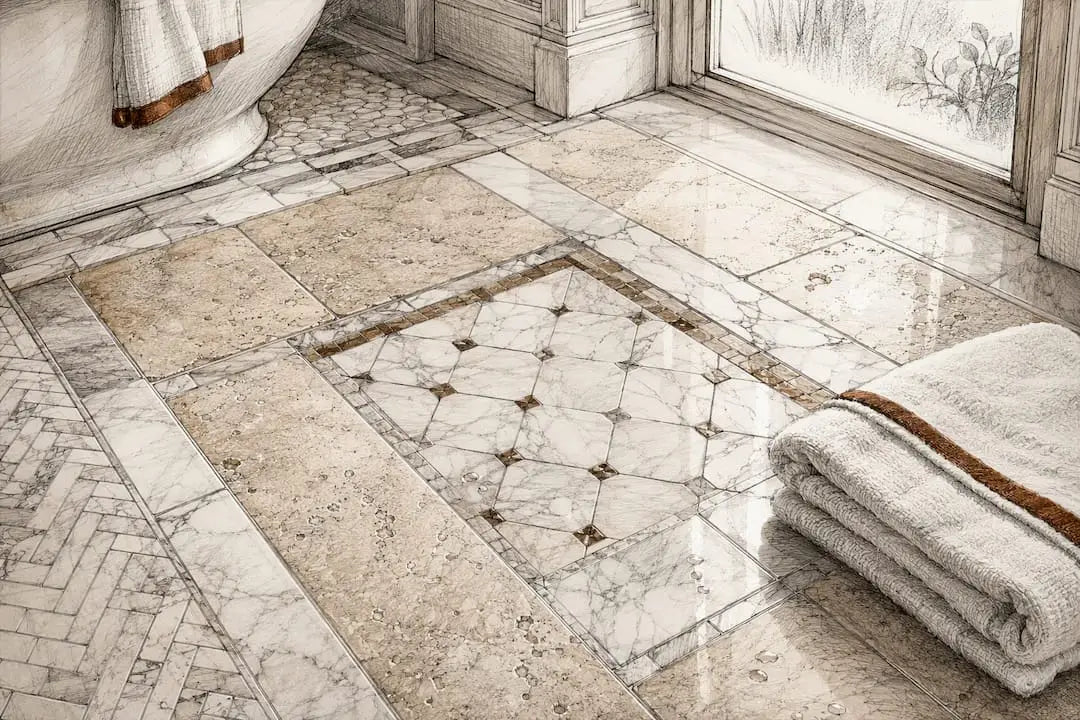
Hexagon and penny tile bring a vintage, almost apothecary feel, especially in white or black and white combinations. They’re a natural fit for powder rooms and smaller full baths where you want texture without visual noise. Because the pieces are small, grout lines multiply, which is good for grip but means more cleaning.
Herringbone creates a sense of motion that makes narrow bathrooms feel longer. Laid with plank-style pieces running toward a focal wall, it pulls the eye forward and can make a cramped layout read as intentional rather than tight.
Large-format planks (think 12x24 or bigger) do the opposite job: they minimize grout lines and let the floor read as one continuous surface. That reduction in grout lines is exactly why large-format tile can visually enlarge a small bathroom according to design guides, though it demands a flatter subfloor to avoid lippage, the slight height mismatch between tile edges.
Encaustic and cement-look tile patterns work best contained to a powder room or as a floor “rug” bordered by plain tile in a larger bath. The bold graphics get busy fast in a big room, but in a small one they become the whole design statement.
Mosaics deserve their own mention because they solve a problem the other patterns don’t: curbless and standard shower floors need slope, and small-format pieces are the only practical way to follow that slope without a maze of cut tile.
A few pattern and finish pairings that consistently work:
- Hex or penny mosaic with matte porcelain body for main-floor transitions
- Herringbone plank in a stone-look matte finish for a modern, elongated feel
- Large-format plank in a light gray or greige for maximum square footage
- Encaustic pattern in a powder room, paired with a plain wall tile to balance the busy floor
- Small hex mosaic on shower floors, glossy on walls for light reflection
Readers consistently gravitate toward galleries that pair a strong visual with a reason it works, which is exactly why editorial idea collections pair photos with practical notes rather than images alone. For more current pattern examples, Surfacesgalore’s popular bathroom floor tile looks for 2026 is worth a browse before you commit to a layout.
Pro Tip: Order at least three samples of your top pattern choice and lay them on the actual bathroom floor under both daytime and evening light. A tile that looks warm gray in the showroom can read cool blue under your bathroom’s LED fixtures.
Materials And Performance: Porcelain, Ceramic, And Natural Stone
Picking the right material matters more than picking the prettiest one, because a gorgeous tile that’s wrong for a wet floor becomes a maintenance headache or a safety issue within a year.
Porcelain is the workhorse for a reason. It typically absorbs less than 0.5% water, which makes it resistant to staining and freeze damage and a safe default for both floors and shower pans. It comes in stone-look, wood-look, and solid-color finishes, so you’re not sacrificing style for durability.
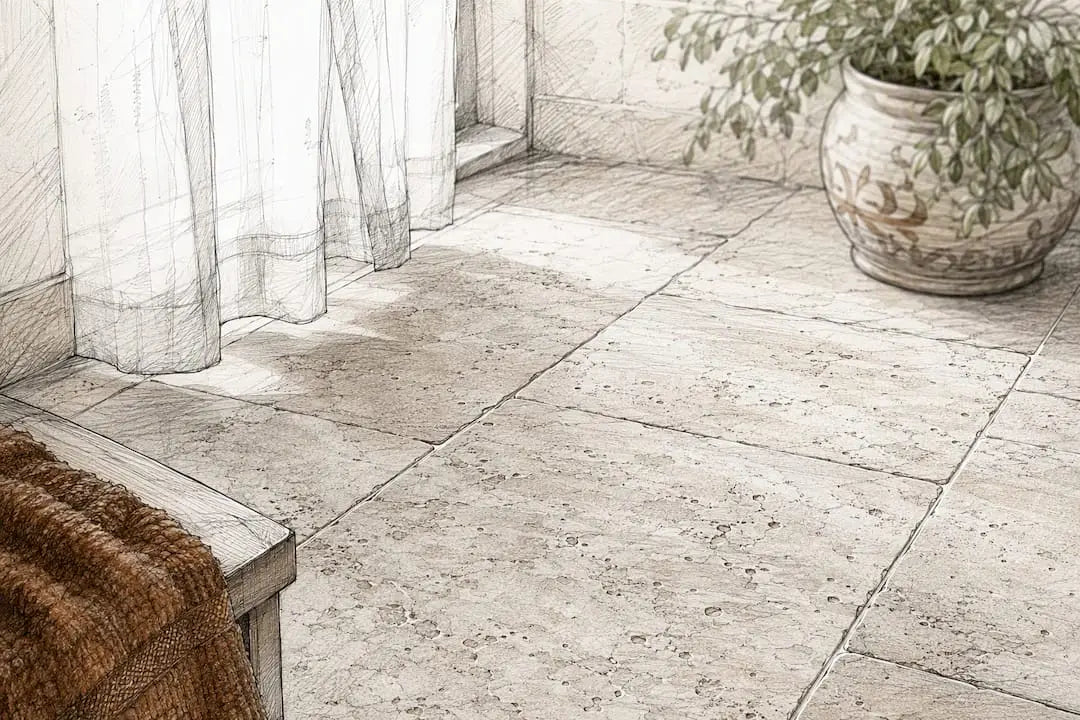
Ceramic costs less and looks nearly identical to porcelain in many lines, but it’s more porous. That makes it a better fit for walls and low-traffic floors than for a shower pan or a floor that sees standing water regularly.
Natural stone is where things get more nuanced. Marble is stunning but etches when acidic products touch it, and its polished finish can be slippery when wet. Travertine and limestone, especially honed and filled versions, offer a softer, more matte texture that grips better underfoot. Slate and basalt tend to perform best in wet conditions among stone options, since certain stones like slate and compact limestone provide better wet traction than polished marble. Every natural stone floor needs periodic sealing, and that’s a maintenance commitment you should accept going in, not discover later.
Slip resistance is measured by DCOF (Dynamic Coefficient of Friction), and it’s the single most overlooked spec in bathroom tile shopping. The Tile Council of North America recommends a wet DCOF of 0.42 or higher for interior wet-area floors, with even higher values preferred for barefoot shower floors. Matte and honed finishes generally test higher than polished or glossy finishes, and smaller formats with more grout lines add grip that large-format tile can’t match.
Material shortlist by zone:
- Shower floor: matte porcelain mosaic or honed stone mosaic
- Main bathroom floor: matte or textured porcelain in any format
- Tub surround: glossy or matte porcelain, ceramic, or sealed natural stone
- Powder room floor: any finish, since foot traffic is dry and light
If you want the natural stone look without the etching risk, filled travertine or honed limestone in a matte finish is the closer compromise, and Surfacesgalore’s tile finish guide breaks down how finish choice shifts both appearance and slip performance.
How To Choose Bathroom Tiles: A Zone-First Checklist
Knowing how to choose bathroom tiles starts with mapping the room into zones, because each zone has a different job to do and a different failure mode if you get the spec wrong.
- Map your zones. Shower floor, shower walls, main floor, and tub surround each need their own tile decision, even if you unify the look with color or grout choice.
- Set a minimum DCOF for wet zones. Confirm 0.42 or higher for the main floor and look for the highest available rating on shower floors, since bare feet and soap film are a rough combination.
- Match tile size to the zone’s slope needs. Curbless and standard shower floors need slope to drain, and small-format tile or mosaic sheets are the only practical way to follow that slope cleanly.
- Decide on grout type. Epoxy grout resists stains and water absorption better than cement grout, though it costs more and is trickier to install, which matters if you’re doing this yourself.
- Test before you commit. Bring a sample home, wet it, and stand on it in socks. The single most common mistake buyers make is falling for a showroom photo without checking the DCOF rating or testing the actual sample underfoot, since spec has to come before aesthetics, not after.
- Confirm the spec sheet matches the box. Absorption rate, DCOF, and finish should all be printed on the manufacturer’s data sheet, not just verbally promised by a salesperson.
- Compare lifecycle cost, not just price per square foot. A $4 porcelain tile that never needs sealing can beat a $3 stone tile that needs resealing every year or two.
Pro Tip: Keep a printed or saved copy of every tile’s spec sheet before you order. If a batch arrives with a different finish or shade than the sample, you’ll need that document to get it corrected or returned.
Installation Choices That Determine How Long Your Floor Lasts
The tile matters less than what’s underneath it, and that’s the part most DIY guides skip past too quickly.
Uncoupling membranes, like Schluter DITRA, are close to mandatory over plywood subfloors and are smart insurance over slabs with hairline cracking. These membranes absorb the small amounts of lateral movement that would otherwise crack tile or grout, and installing one over problematic substrates is one of the cheapest failure-prevention steps in the entire project.
Large-format tile needs back-buttering (spreading thinset on the tile itself, not just the floor) and the correct trowel notch size to avoid hollow spots underneath. Hollow spots don’t just sound different when you tap them, they crack under weight over time. The strongest large-format installs Surfacesgalore sees consistently share one trait: a substrate that was checked and corrected for flatness before a single tile went down.
Curbless showers need a properly sloped mortar bed and a certified waterproofing membrane, tested to the TCNA A118.10 flood-test standard before tile ever goes in. This is also why mosaics dominate curbless shower floors: sheets of small tile flex slightly at the grout lines to follow the slope, where a single large tile simply can’t.
Radiant heat systems require checking the tile manufacturer’s thickness and expansion tolerances, since some stone and large-format porcelain react differently to heat cycling than standard tile does.
Key installation safeguards:
- Uncoupling membrane over plywood or cracked slabs
- Back-buttered large-format tile with correct trowel notching
- Flood-tested waterproofing membrane under curbless showers
- Manufacturer-approved thinset for radiant heat systems
For a full walkthrough of sequencing these decisions, Surfacesgalore’s bathroom tile design workflow guide covers planning order from layout to grout.
Maintenance And Care: What Sealing And Cleaning Actually Do
Sealing a natural stone floor protects against staining, but it does very little against etching from acidic spills like vinegar or citrus. That distinction trips up a lot of new stone owners who assume “sealed” means “bulletproof.” Most honed stone floors need resealing every 12 to 24 months depending on traffic, while polished stone can sometimes stretch longer between applications.
Cleaning chemistry matters as much as sealing frequency. Use pH-neutral cleaners on stone and porcelain alike, and skip anything labeled as a heavy-duty bathroom cleaner unless it’s specifically marked safe for natural stone. Bleach, vinegar, and ammonia-based products are the most common culprits behind dulled finishes and etched marble.
Grout maintenance splits along the same lines as tile: epoxy grout resists staining well enough that it rarely needs sealing, while cement-based grout should be resealed roughly once a year in a wet bathroom to keep it from absorbing moisture and growing mildew.
Daily habits that add years to a tile floor:
- Run the bathroom fan or crack a window after every shower
- Squeegee shower walls and floors to cut down standing water
- Wipe up soap and shampoo residue weekly to prevent buildup in grout
- Avoid dragging bath mats with rubber backing across stone, which can trap moisture underneath
Surfacesgalore’s grout sealing guide walks through the actual resealing process step by step if you’re tackling it yourself.
What Surfaces Galore Recommends When Specifying Natural Stone
As a direct importer of marble, limestone, and travertine, Surfacesgalore sees the same question from homeowners constantly: is stone worth the upkeep for a bathroom floor? The honest answer depends on the room. Honed compact limestone or filled travertine handles main bathroom floors well, since their matte, textured surface resists slipping better than polished stone. Save polished marble for accent borders, niches, or low-traffic powder rooms where etching risk is low.
Before ordering, ask any supplier for the tile’s absorption rate, DCOF rating, and, for outdoor-adjacent spaces, freeze-thaw data. Request the recommended sealer and setting materials in writing, not just verbally, so your installer has the exact spec on hand. Surfacesgalore provides sample ordering and project support for exactly this reason, and the bathroom tile trends roundup is a useful starting point for seeing current stone applications before you order swatches.
Budgeting For A Bathroom Floor Tile Project
Material cost is only part of the bathroom floor tile budget, and it’s usually not the biggest part. Porcelain typically runs from budget-friendly to mid-range per square foot, ceramic sits at the lower end, and natural stone like marble or travertine climbs higher, especially in larger formats or unique veining.
Installation labor often costs as much as or more than the tile itself, particularly for patterns like herringbone or mosaic sheets that take longer to lay than straightforward plank tile. Curbless showers add cost because of the sloped mortar bed and waterproofing membrane, and large-format tile can add labor cost too, since it demands more substrate prep and careful handling to avoid cracking during installation.
Budget line items worth planning for separately:
- Tile material, plus 10 to 15% overage for cuts and future repairs
- Substrate prep, including any uncoupling membrane or self-leveling compound
- Waterproofing membrane for shower floors and curbless designs
- Labor, which varies significantly by pattern complexity
- Grout, sealer, and any specialty trim or transition pieces
A useful rule of thumb: if your budget is tight, spend more on the shower floor’s slip performance and less on decorative extras elsewhere. Safety costs less to build in up front than to retrofit later.
Coordinating Floor Tile With Walls And Fixtures
The floor and walls don’t need to match exactly, but they do need to agree on tone, scale, or finish, or the room can start to feel disjointed. A common approach: pick one surface as the visual anchor, usually the floor if it has pattern or the wall if it has color, and keep the other simpler.
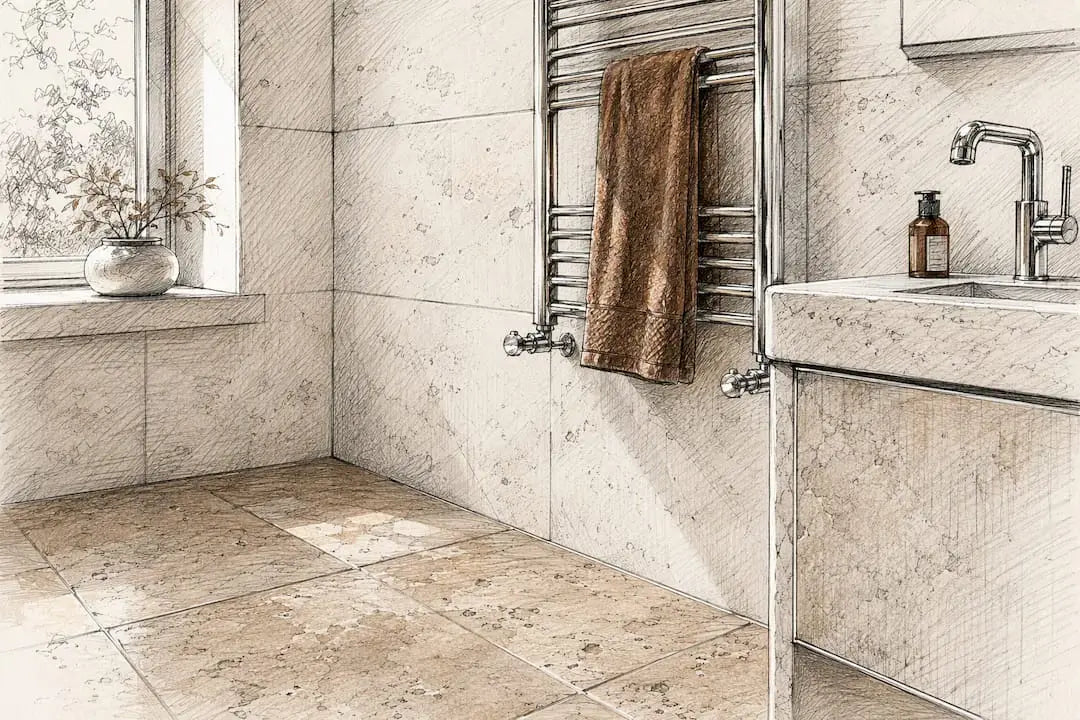
If your floor is a bold pattern like encaustic tile or hexagon mosaic, keep the wall tile plain and let the floor carry the design. If the walls are the statement, with a bold color or large-format slab look, a quiet neutral floor keeps the room from competing with itself.
Grout color matters here too. A dark grout on a light floor tile reads more graphic and modern, while a grout matched closely to the tile color keeps the floor looking like a single continuous surface, which helps in smaller rooms. Fixture finishes should echo somewhere in the tile choice: warm brass fixtures pair naturally with warm-toned travertine or cream porcelain, while matte black fixtures suit cooler grays and charcoal tile.
Surfacesgalore’s wall tile workflow guide covers how to sequence these decisions so the wall and floor choices reinforce each other instead of getting picked in isolation. If you’re finishing the room’s other surfaces, coordinating your interior door style with your tile palette rounds out the space instead of leaving the door as an afterthought.
Bathroom Tile Color Trends And What They Do To A Room
Color changes how a bathroom feels more than almost any other decision in the room, which is why bathroom tile color trends shift as much as they do year to year.
Warm neutrals, think travertine beige, warm gray, and greige, make a bathroom feel calm and larger than it is, since they reflect light without the sterile feel of pure white. Cool grays and charcoals lean modern and work well with matte black or brushed nickel fixtures, though they can make a small, poorly lit bathroom feel closed in if used on every surface.
Deep, saturated color, forest green, navy, terracotta, has become a common choice for a single wall or the shower surround rather than the whole room, letting the floor stay neutral to balance it. White remains the safest resale-friendly choice and continues to dominate smaller bathrooms because it maximizes reflected light, an approach detailed further in Surfacesgalore’s white bathroom tile ideas.
For genuinely small bathrooms, color and tile size work together: light, large-format tile with minimal grout contrast tends to outperform any dark or heavily patterned option for making the room feel open, a strategy covered in more depth in small bathroom tile design.
Eco-Friendly Considerations For Bathroom Tile
Natural stone and porcelain both have a legitimate sustainability case, just for different reasons. Porcelain is manufactured from abundant raw materials and, because of its density and low absorption, tends to outlast more porous options, which reduces landfill waste from repeated replacement over a home’s lifetime.
Natural stone is a quarried, finite material, but a well-sealed and maintained stone floor can last for decades, arguably generations, which makes it one of the lowest lifecycle-waste flooring choices available when it’s cared for properly. Buying from a direct importer also cuts down on the layers of distribution that add shipping and handling waste to the process.
If sustainability is a priority, ask suppliers about sourcing transparency and whether tile is fired or quarried using recycled water systems, and favor tile with a long realistic lifespan over the cheapest option, since replacement is the biggest environmental cost in flooring, not the initial material itself.
DIY Or Pro: An Honest Look At What You Should Tackle Yourself
A straightforward main-floor replacement with plank-format porcelain is a reasonable DIY project if you’ve tiled before and the subfloor is flat. Herringbone and mosaic patterns take longer but are still manageable for a patient first-timer.
Curbless showers, large-format stone, and anything involving a flood-tested membrane belong with a professional. The margin for error on slope and waterproofing is too small, and a mistake there means tearing out a floor, not just a tile.
Before hiring anyone, get a written spec sheet, ask them to inspect the substrate first, and check local permit requirements for plumbing or structural changes. Get at least two bids. Then start with samples on your actual floor before ordering a single box.
— cihan
Shop Bathroom Floor Tile Ideas At Surfaces Galore
Once you know your zones, your slip requirements, and your maintenance appetite, the next step is seeing real material in your own light. Surfacesgalore is a direct importer of marble, limestone, and travertine, which means fewer markups between quarry and your bathroom floor and more room in the budget for the finish you actually want.
Browse curated natural stone tile collections to compare finishes side by side, request samples before committing to a full order, and reach out to the Surfacesgalore sales team for a custom quote if you’re working with a contractor or ordering in bulk. Whether you’re leaning toward honed travertine for a main floor or a marble accent border for a powder room, shop natural stone tiles today and get samples in hand before your installer’s first day on the job.
Sources
- 12 Types Of Natural Stone For Bathrooms – Properties, Slip Ratings & Costs - ArchitectureLab
- Bath Floor Tile: Complete Guide for Homeowners - D and G Flooring
- Bathroom Tile Buying Guide: Slip Resistance, Grout, and Maintenance | Rohrer for Construction
- How to Choose Bathroom Tile: Material, Size, Slip Ratings
- Our Fave Bathroom Tile Design Ideas - HGTV
FAQ
What Is A Good DCOF Rating For Bathroom Floor Tile?
Look for a wet DCOF of 0.42 or higher for main bathroom floors, and the highest available rating for shower floors where bare feet and soap create extra slip risk.
Is Porcelain Or Natural Stone Better For A Bathroom Floor?
Porcelain absorbs less than 0.5% water and needs no sealing, making it the lower-maintenance choice, while natural stone like honed travertine or limestone offers a warmer, more organic look in exchange for periodic sealing.
What Tile Size Makes A Small Bathroom Look Bigger?
Large-format planks or tiles reduce grout lines and can visually enlarge a small bathroom, provided the subfloor is flat enough to prevent lippage between tile edges.
Why Do Shower Floors Use Small Mosaic Tile?
Small mosaic sheets follow the slope needed for water drainage and add grip through extra grout lines, which is why they’re standard on curbless and traditional shower floors alike.
How Often Should I Reseal A Natural Stone Bathroom Floor?
Most honed stone floors need resealing every 12 to 24 months depending on foot traffic and humidity, while polished stone can sometimes go longer between applications.
Where Can I Find Authentic Natural Stone For A Bathroom Floor?
Surfacesgalore imports marble, limestone, and travertine tile and mosaics directly, offering sample ordering and custom quotes for homeowners and contractors nationwide.

Leave a comment