
Marble stone: A guide to types, uses, finishes, and care

Key Takeaways
Marble brings natural variation and a distinct sense of depth to a room, but it also asks for thoughtful selection and care. Use the stone’s color, finish, and intended setting to guide your choice.
- Marble forms through changes to limestone or dolomite, and its veining reflects natural variation.
- White, beige, dark, and colorful marbles offer different ways to shape a room’s mood.
- Marble can suit floors, walls, and decorative details when the finish matches the setting.
- Samples, dry layouts, and a careful stock check help avoid surprises during installation.
- Gentle cleaning and appropriate sealing help protect marble from stains and surface wear.
What marble stone is and what makes it distinctive
Marble stone is a natural material valued for its varied color, distinctive veining, and smooth, refined appearance. Those differences are part of the appeal: even tiles from one selection can vary in tone and pattern. Marble also needs more thoughtful upkeep than some harder, less porous surfaces, so the right choice balances looks with daily use. For a concise geological overview, see this guide to how marble forms.
How marble forms and why its patterns vary
In geological terms, marble forms when limestone or dolomite is altered by heat and pressure, changing its structure into a crystalline stone. Minerals and other materials present during that process contribute to the color and pattern, which is why one piece may have fine, quiet lines while another has bold movement. The broad term marble is also used in the stone trade for some similar decorative stones, so product descriptions and samples matter when comparing options. Each slab or tile carries its own character rather than a printed repeat.
Common colors, veining, and natural characteristics
Marble ranges from bright white and soft beige to gray, green, and deep black, with veining that may be delicate or dramatic. Its natural variation makes it expressive, but it also means that a small sample cannot show every shift across an entire floor or wall. When a particular look matters, compare several pieces and consider the room’s lighting before settling on a selection. Natural variation is part of the design—plan for it rather than expecting every tile to match exactly.
How marble compares with limestone and travertine
Marble, limestone, and travertine are all natural stones, but they do not look or behave exactly alike. Marble is often chosen for its crystalline appearance and flowing veining; limestone tends toward a quieter, more even look, while travertine is known for its characteristic pores and earthy texture. All can require sealing and careful cleaning, with specific needs depending on the stone and finish. For a kitchen renovation, it can help to think beyond the counter too: a suitable cutting board and its care are covered in this guide to maple cutting boards, while stone itself needs stone-appropriate care.
Popular marble stone types and colors
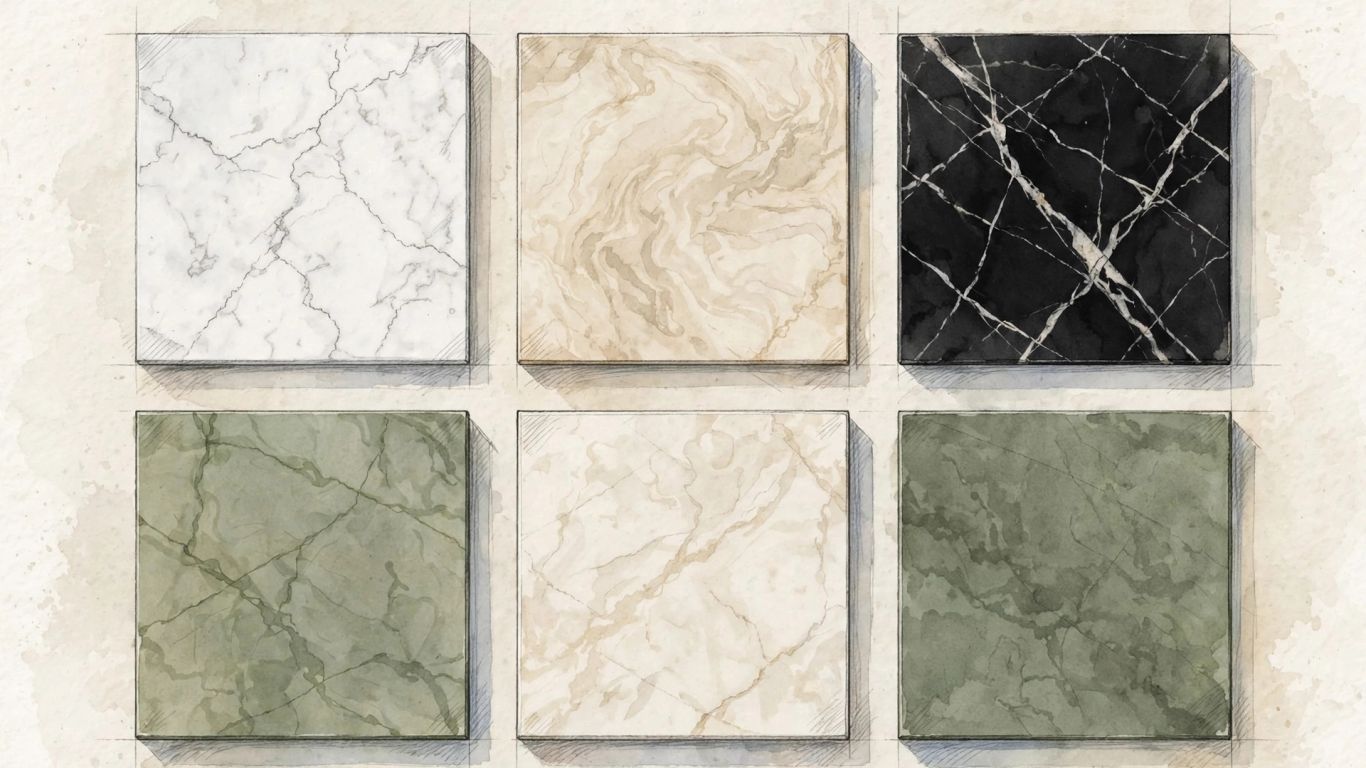
Color is often the first thing people notice, but veining, finish, and the scale of the room matter just as much. A bright white tile can feel crisp and open, while a dark stone may create a more intimate, graphic effect. Names such as Statuario, Crema Marfil, Nero Marquina, and Ming Green are useful starting points, though natural batches can still vary. Surfaces Galore offers marble tiles and mosaics in a range of colors and styles; the specific appearance should be judged from the material available for your project.
White marble, including Statuario and Thassos
White marble can brighten a room and provide a calm backdrop for wood, metal, and painted finishes. Statuario is associated with a white ground and pronounced gray veining, while Thassos is a Greek white marble known for a clean, bright appearance. Both work best when the particular lot suits the amount of contrast you want; inspect actual pieces rather than relying on a name alone. For a closer look at a specific format, Statuario White 12x24 tile is one example of white marble tile available in polished or honed finishes.
Beige marble, including Crema Marfil and Botticino
Beige marble brings warmth without the strong contrast of some white-and-gray stones. Crema Marfil and Botticino are familiar choices for rooms where cream, sand, or taupe tones feel more at home than a cool white. Their subtle shifts can pair well with natural wood and soft neutral paint, though the exact veining varies from piece to piece. For a scheme that needs warmth but not a bold focal point, compare samples beside the room’s fixed finishes.
Dark and colorful marble, including Nero Marquina and Ming Green
Dark and colorful marble can turn a smaller surface into a clear design feature. Nero Marquina is a black marble with contrasting light veining, while Ming Green offers a green-toned alternative to more conventional neutrals. These stones can work as a floor accent, a vanity detail, or a backsplash, especially when surrounding finishes are kept simple. If you are weighing marble against countertop choices, this overview of marble slabs and counters offers a separate look at colors and surfaces.
Where marble stone works best
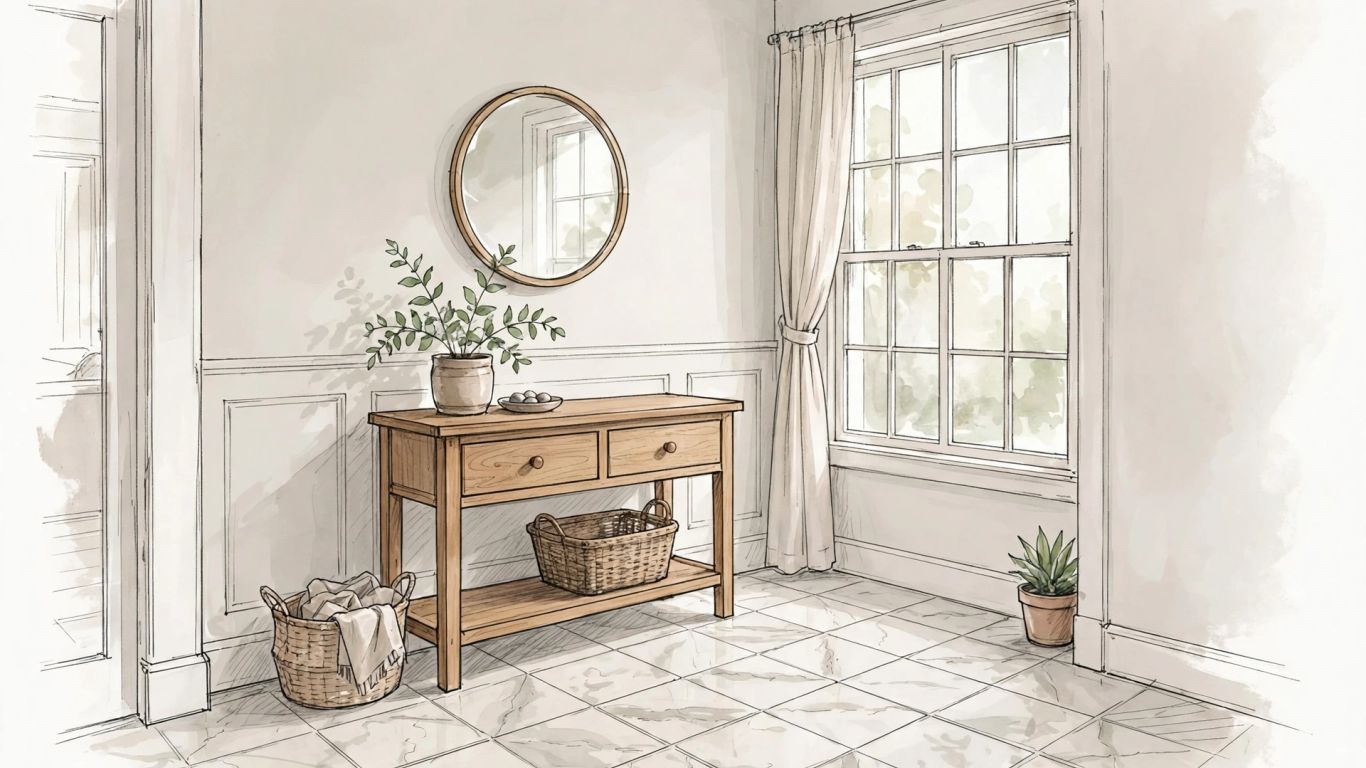
Marble is used across a home, from flooring and wall tile to mosaics and decorative details. The best application depends on how much traffic or moisture the area sees, along with the look and upkeep you are comfortable with. A thoughtful design can use marble as a restrained accent or as a broad, continuous surface. For example, a homeowner planning a busy entry might reserve a strongly veined tile for a smaller focal area, while using a quieter pattern across the main floor.
Marble flooring for entryways and living spaces
Marble flooring gives an entryway or living space a distinctive sense of welcome, and its natural pattern can make a simple layout feel considered. In busy areas, weigh the stone’s softer surface and maintenance needs against the expected foot traffic; marble can scratch or stain more readily than harder stone. A honed finish may be worth considering where a reflective surface is not the right fit. Dry-laying tiles before installation helps preview how the veining and color variation will read across the room.
Marble wall tile for bathrooms and feature walls
Walls let marble’s pattern stand out without putting the stone under the same foot traffic as a floor. Marble wall tile can bring quiet movement to a bathroom or make a feature wall feel more layered, while the choice between large tiles and smaller pieces changes the visual rhythm. In wet areas, consider the finish and the surface’s suitability for the specific application, and follow product and installer guidance. Some readers may also be weighing other personal appearance choices, such as natural-looking veneers; that is a separate topic from selecting stone for a room.
Marble mosaics and backsplashes for decorative detail
Mosaics are a way to add pattern and smaller-scale detail to a backsplash, shower wall, or niche. Their many joints can create a textured look and help form shapes that are difficult to achieve with large tiles. Surfaces Galore specializes in marble and travertine tiles, mosaics, and moldings, giving shoppers several types of stone detail to consider alongside one another. If your design calls for a distinctive focal point, compare the mosaic’s color and scale with the larger surfaces around it.
Choosing a marble finish, tile, or pattern
Finish and format shape the way marble feels as much as its color does. A polished surface catches more light, a honed finish reads softer, and a tumbled finish has a more aged character. Tile size and layout can either quiet the stone’s natural movement or bring it forward. A separate marble types guide can help with variety names, while the choices below focus on how the material works in a room.
Polished, honed, and tumbled finishes
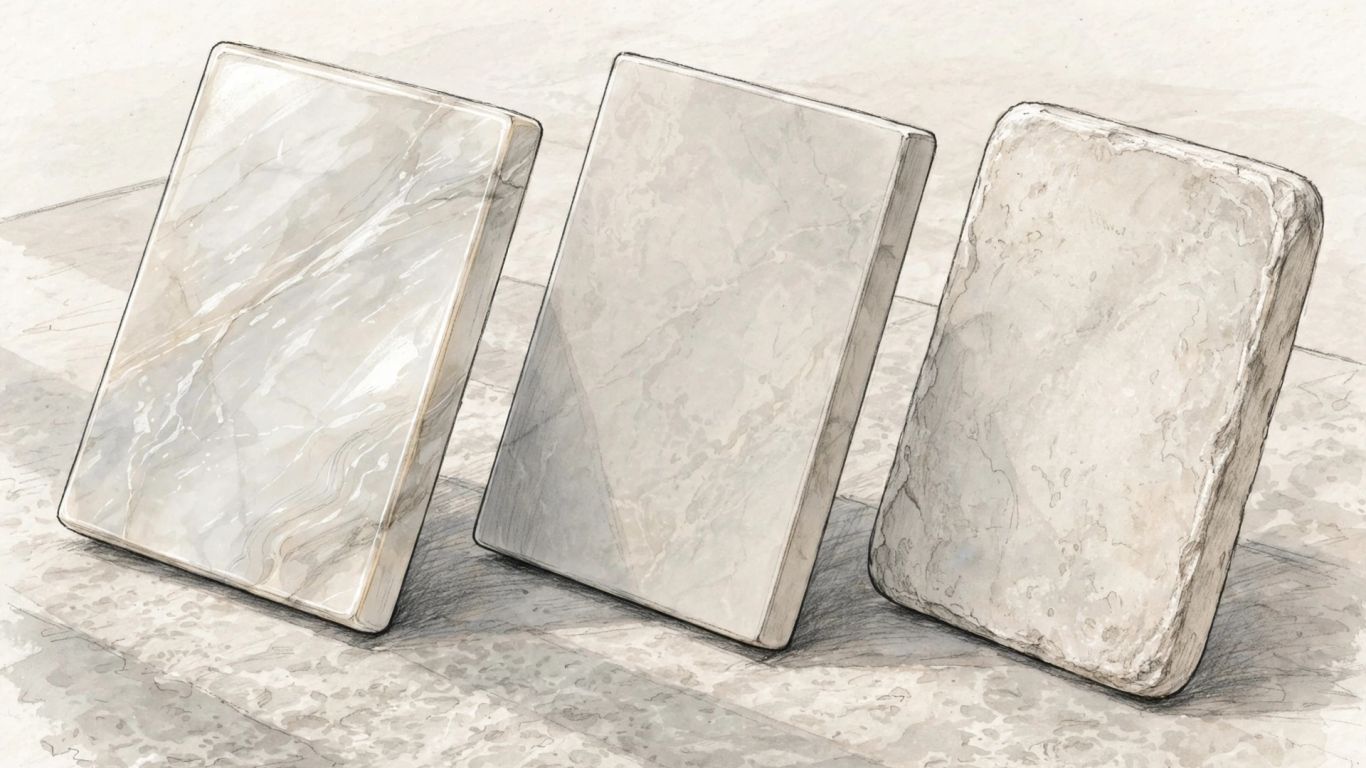
Polished, honed, and tumbled finishes offer different visual and tactile impressions, and the right one depends on both style and setting. Polished marble has a reflective look; honed marble is matte and more understated; tumbled marble has softened edges and an aged appearance. Use this comparison as a starting point, then confirm the finish on a sample in the actual room.
| Finish | Appearance | A practical consideration |
|---|---|---|
| Polished | Smooth and reflective | Shows light clearly; consider upkeep in daily-use spaces |
| Honed | Matte and soft-looking | A quieter surface option; assess suitability where moisture is present |
| Tumbled | Aged, with softened edges | Adds a rustic feel; check dimensions and edge variation |
A finish changes the overall mood, but it does not remove the need to check the stone’s care instructions. Samples are useful for judging texture as well as color, especially under the room’s real lighting.
Tile sizes, mosaics, and layout patterns
Large tiles create fewer visible joints, while mosaics introduce a more intricate pattern and a different sense of scale. A simple grid can let veining take the lead; a diagonal or repeating pattern can make the layout itself a feature. Before committing, use a short planning sequence to see how the stone will actually come together:
- Lay out several tiles dry to check color and veining distribution.
- Mix pieces from different boxes when the material has natural variation.
- Review edge cuts so narrow slivers do not dominate the borders.
- Confirm joint spacing using the product and installation guidance.
Once the dry layout looks balanced, the plan can guide installation and help make small adjustments before adhesive is applied. Inspecting each tile at this stage also gives you a chance to set aside pieces with cracks, chips, or other concerns before they are installed.
Coordinating marble trim, borders, and moldings
Trim, borders, and moldings give an installation a more finished edge and can make a transition between materials feel intentional. A matching stone keeps the design cohesive; a contrasting border can define a niche, floor inset, or wall panel. Consider the profile and scale in relation to nearby tile so that trim supports the surface instead of competing with it. Marble selections may include coordinating moldings and border details, but confirm the available styles and dimensions before finalizing the plan.
How to choose marble for your project
A good marble selection begins with the room, not a color name. Think about traffic, moisture, available light, and how much upkeep makes sense for your household. Then compare samples and the stock that can actually be supplied for the full project. For a kitchen, a homeowner might choose marble for a decorative backsplash while selecting a different surface for a heavily used work area; the best material is the one that fits the use as well as the look.
Match the stone to the room and its daily use
Marble often makes sense in decorative settings and lower-traffic areas where its natural character can be enjoyed without demanding more maintenance than you want to provide. In floors or wet rooms, consider texture, slip resistance, and the specific product’s recommendations. A bathroom wall and a busy entry floor may use the same stone family but call for different finishes and care expectations. Set those practical needs first, then narrow the color and pattern choices.
Compare color, veining, finish, and available stock
Samples can reveal whether a stone looks warm or cool in your lighting and whether the veining feels too quiet or too bold. Compare a few tiles together rather than making a decision from a single small piece, since natural color and pattern can shift. Confirm the finish, dimensions, and quantity available before you settle on a layout. This extra review is especially useful if the design relies on a continuous look across several boxes.
Plan quantities, installation, and project costs
Project costs include more than the tile price: include installation, cuts, trim, delivery, and any additional material needed for the layout. Natural stone tiles can vary, so inspect the order before installation and plan the dry layout to distribute the variation. A professional installer can advise on substrate, setting materials, and the requirements of the particular product. To check current options as you plan, browse marble and travertine and compare selections with your project’s dimensions and finish needs.
Marble stone care and buying considerations
Marble rewards a little planning before purchase and consistent care after installation. Cleaning products, sealing instructions, and repair needs can differ by product, so follow the manufacturer’s and installer’s guidance rather than assuming every stone behaves the same way. Before ordering, confirm the material, finish, quantity, and delivery details. Surfaces Galore is a direct importer and nationwide supplier of natural stone; shoppers can compare current stock and ask about project requirements before placing an order.
Everyday cleaning and sealing practices
For everyday cleaning, remove grit and spills promptly and use a pH-neutral cleaner intended for natural stone. Avoid assuming that ordinary household cleaners are safe for marble; acidic ingredients can damage the surface. Sealing can help protect porous stone, but the product instructions determine when and how to apply it and whether it needs to be refreshed. A sample can also be a useful place to test a care product before using it on a finished installation.
Preventing stains, etching, and surface damage
Marble can be vulnerable to stains, scratches, and etching, so prevention is more reliable than expecting every mark to disappear. Wipe spills promptly, use suitable protective measures where the surface is exposed to food or drink, and avoid dragging heavy objects across the stone. Acidic liquids such as lemon juice or vinegar can dull marble; do not use them as cleaners. If a mark or change in finish occurs, seek advice from a stone-care professional before attempting an abrasive fix.
Comparing suppliers, shipping options, and bulk pricing
When comparing suppliers, ask for clear details on finish, dimensions, available quantity, sample options, and delivery arrangements. For larger orders, check whether the same selection can cover the full project and ask how natural variation is handled across boxes. Surfaces Galore serves homeowners, designers, and architects across the United States, and its source information describes nationwide shipping and bulk discounts; confirm current terms and availability directly before ordering. Another kind of planning entirely, such as teen residential treatment, calls for specialized professional guidance rather than product selection.
For a design-minded break from project planning, an exhibition visit guide is a separate resource; back at home, the useful next step is to compare stone samples in your own light. Viewing material in person or requesting a sample can help you judge its color, texture, and natural variation before committing to a larger quantity.
Explore Marble Options
Ready to narrow down a color, finish, or format? Visit Surfaces Galore to review marble and travertine selections, request project information, and plan an order that fits your space.
Conclusion
Marble brings individual character to floors, walls, and decorative details, with a range of colors and finishes to suit many design styles. Choose with the room’s daily use in mind, compare real samples, plan the layout, and follow stone-specific care guidance to enjoy the material with fewer surprises.
Frequently Asked Questions
What is marble stone?
Marble is a natural stone formed when limestone or dolomite changes under heat and pressure. It is used for surfaces and decorative details and is known for natural color variation and veining.
Does every marble tile look the same?
No. Color and pattern can vary from piece to piece, even within one selection. Reviewing several tiles and arranging them in a dry layout helps you understand how the variation will look across a larger area.
Is marble suitable for flooring?
Marble can be used for flooring, but the room’s traffic and maintenance needs matter. Consider the finish, the expected wear, and the product’s installation guidance before choosing it for a busy area.
What is the difference between polished and honed marble?
Polished marble has a reflective, smooth-looking surface, while honed marble has a matte appearance. The finish affects the room’s overall look and feel, so comparing samples is helpful.
Does marble need to be sealed?
Many porous natural stones benefit from sealing, but the exact recommendation depends on the product and its use. Follow the stone and sealer manufacturers’ instructions, including any guidance on resealing.
How should marble be cleaned?
Use a pH-neutral cleaner intended for natural stone and wipe spills promptly. Avoid acidic household products such as vinegar or lemon juice, which can etch marble.
How can I estimate how much marble tile to buy?
Measure the planned area and account for cuts, layout, and any extra pieces recommended by your installer. Confirm tile dimensions and available stock before ordering, and inspect the material before installation.

Leave a comment