
Order Flawless Tumbled Checkerboard Tile: Same Lot Specs for Designers

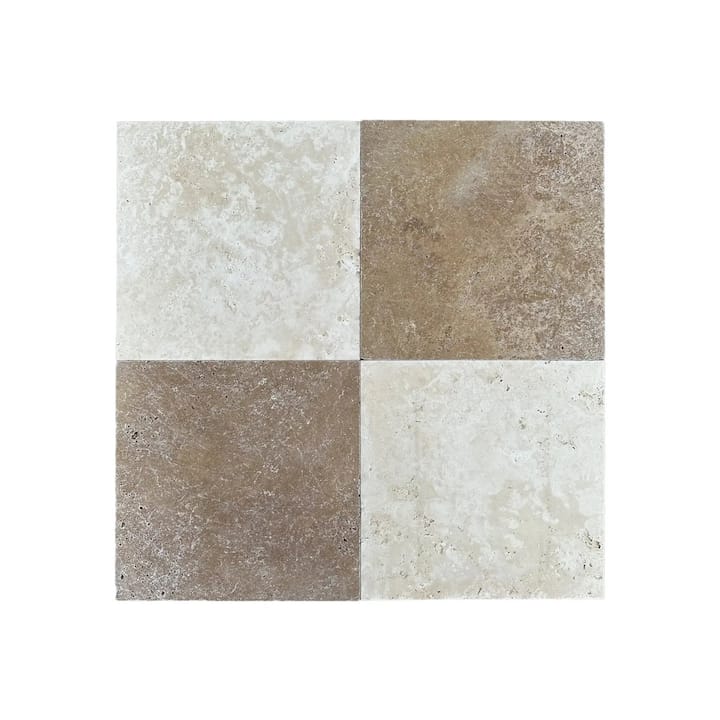
Tumbled checkerboard tile is a durable, textured natural-stone flooring option that gives the classic checkerboard pattern a softer, aged look, and it works well in hallways, kitchens, and select bathrooms where a warm, tactile surface matters more than a mirror-flat shine. Several ready-made checkerboard tile sets are available, including options in Ivory and Noce Travertine in both 18"x18" and 12"x12" sizes, as well as Bardiglio and Oriental White Marble 12"x12" tumbled sets for a refined finish. Whichever you pick, plan on tighter setting-out work than a standard floor and a sealing schedule to keep the surface protected.
TL;DR:
- Tumbled checkerboard tiles have irregular sizes and thicker grout joints, which enhance their organic look and improve slip resistance.
- Contemporary trends favor softer, tone-on-tone color pairings like ivory and noce travertine, with high contrast options suited for entryways.
- Proper planning of layout, centerline, and lot matching is crucial to prevent patchiness, as uneven setting and batch differences are common pitfalls.
- Sealing is necessary every 12 to 24 months with pH-neutral products, and filled travertine is more resistant to water and grime in wet areas.
- The installation and labor costs of tumbled stone are comparable to honed or polished finishes, but irregular sizing and waste increase project complexity.
Table of Contents
- What “Tumbled” Actually Means for Checkerboard Tile
- Choosing Colors and Scale That Read Current
- Sizes, Thicknesses, and Specs to Confirm Before You Order
- Installation Checklist: Setting Out a Checkerboard Without Regret
- Sealing and Maintenance Without Losing the Tumbled Look
- Buying Checklist: From Sample to Installer Handoff
- Sourcing and Same-Lot Support Behind Every Checkerboard Order
- What Tumbled Checkerboard Actually Costs Compared to Other Finishes
- How Well Tumbled Checkerboard Holds Up to Daily Traffic
- The Real Trade-Off Nobody Mentions About Checkerboard Tile
- Shop Surfaces Galore’s Checkerboard Sets and Request Samples
- Sources
- FAQ
What “Tumbled” Actually Means for Checkerboard Tile
Tumbled is a finish, not a stone type. Manufacturers load cut stone into rotating drums with abrasive media, which knocks down sharp corners and roughens the face until the tile looks worn and antique rather than freshly quarried, according to a breakdown of the tumbling process. That mechanical action is very different from honing, which grinds the surface flat and smooth, or polishing, which adds a reflective shine. The result carries real physical consequences for a checkerboard layout, not just a style choice.
- Rounded edges and a pitted face increase surface friction, which helps with slip resistance in kitchens and bath areas
- Thickness and size vary tile to tile, so grout lines have to work harder to hide those inconsistencies
- The matte, textured look breaks up the checkerboard’s usual sharp geometry into something that reads more organic and less like a game board
Because no two tumbled tiles are perfectly uniform, checkerboard grids built from this finish need wider grout joints than a polished or honed layout would use. That width becomes part of the pattern’s visual rhythm, not just a functional gap.
Choosing Colors and Scale That Read Current
The stark black-and-white checkerboard of decades past has given way to something softer. Design coverage for 2026 points toward warmer stone pairings and tone-on-tone combinations, a shift echoed in current checkerboard trend reporting from Homes & Gardens and in broader industry commentary that checkerboard floors remain a design staple even as the contrast levels soften. Ivory and noce travertine is a good example: the tones sit close enough on the color wheel to feel calm underfoot, while still reading as a clear checkerboard from across the room.
High contrast still has its place. A Bardiglio and Oriental White marble pairing works in an entry or formal hallway where you want the pattern to announce itself. Muted, tone-on-tone travertine tends to suit kitchens and smaller baths better, since a busy high-contrast grid can overwhelm a tight footprint.
- Large rooms and hallways handle bigger formats and bolder contrast well
- Small bathrooms and backsplashes usually look better scaled down, using 12"x12" tiles or mosaic-sized pieces instead of 18"x18"
- Diagonal layouts read more dynamic but demand more precise perimeter cuts than a straight grid
Pro Tip: If you’re unsure how a pattern will feel at scale, lay out a few loose tiles on the actual floor in daylight before ordering. Photos and small showroom samples almost always undersell how a checkerboard reads at full size.
Sizes, Thicknesses, and Specs to Confirm Before You Order
Tumbled checkerboard sets typically come in 12"x12" or 18"x18" formats, though mosaics and smaller 4"x4" or 6"x6" pieces show up in backsplash and accent applications. Thickness commonly runs from roughly 3/8" to 1/2", and that number matters more than it sounds. A thicker tile transitions differently at doorways and next to hardwood or carpet, and it changes how much mud bed a contractor needs to level things out.
- Confirm the exact tile size and thickness against your transition points and existing floor height before you finalize a quote.
- Order samples first, and specifically ask whether a full-room order will ship from the same production lot, since stone tumbling happens in batches and color can shift lot to lot.
- Check whether the travertine is filled or unfilled. Filled travertine has its natural surface voids packed with resin or grout, which matters for wet floors because open pits trap water and grime and are harder to seal properly.
- Read the spec sheet for finish intensity (light versus heavy tumble) and record it on your purchase order along with the tile code and lot number, so the installer has exactly what was ordered in writing.
Skipping the lot check is the single most common reason a finished checkerboard floor looks patchy instead of intentional.
Installation Checklist: Setting Out a Checkerboard Without Regret
Setting-out is where a checkerboard floor either comes together or falls apart, and experienced tilers consistently say the planning stage matters more than the actual laying, a point reinforced by tiling trade guidance on checkerboard layouts. Once tile is stuck down, a bad centerline is expensive to fix.
- Find the room’s true center and dry-lay a full run in both directions before mixing any thinset, so you can see where the perimeter cuts will fall.
- Adjust the starting point so cut tiles at opposing walls come out roughly equal in width. Nothing kills a checkerboard’s symmetry faster than a full tile on one wall and a sliver on the other.
- Check subfloor flatness with a straightedge. Tumbled stone already has inconsistent backs, and an uneven substrate compounds that into visible lippage.
- Back-butter every tile and aim for full thinset coverage, ideally over 90 percent, since irregular tile backs otherwise leave voids that crack under foot traffic, per fabricator guidance on tumbled stone installation.
- Set grout joints between 1/4" and 1/2" for most tumbled checkerboard work, and switch to sanded grout once you’re past 1/8", since unsanded grout shrinks and cracks in wider joints.
- For diagonal layouts, expect more waste and more cutting labor. Mosaic-scale checkerboard tends to forgive thickness variation better than large single tiles, which show lippage more, obviously.
Pro Tip: Keep a tile gauge or a handful of shims on the truck. Floating individual tiles slightly higher or lower in the thinset bed, tile by tile, is often faster than fighting a subfloor that’s slightly out of flat.
Sealing and Maintenance Without Losing the Tumbled Look
Tumbled marble, travertine, and limestone are all porous, and a matte, aged surface makes that easy to forget. A penetrating, impregnating sealer soaks into the stone and blocks moisture and stains from the inside without adding sheen, so the tile keeps its soft, worn character, in line with standard guidance on tumbled marble care and durability.
- Reseal every 12 to 24 months depending on foot traffic, and check protection with a simple water-drop test: if water beads up, the seal is holding; if it darkens the stone quickly, it’s time to reseal
- Skip acidic cleaners entirely. Vinegar, lemon-based products, and most bathroom sprays etch marble and limestone on contact
- Use a pH-neutral stone cleaner and a soft brush to work grime out of the tumbled texture, since flat mopping alone tends to leave residue in the pitted surface
- For wet floors and showers, filled travertine is the safer call, since open pores in unfilled stone hold water and make consistent sealing much harder
Buying Checklist: From Sample to Installer Handoff
Retail listings for checkerboard tumbled tile tend to emphasize photos and pricing, but the details that actually prevent a bad install live in the spec sheet and the purchase order. Before you commit to a full-room quantity, work through this list.
- Order at least two or three samples, not one, so you can see the natural range of tone before committing
- For any full-room job, confirm the supplier can pull from the same production lot. Tumbling is done in batches, and lot-to-lot shifts in shade are common in natural stone
- Write the tile code, lot number, fill status, and finish intensity directly on the purchase order rather than trusting memory or a verbal confirmation
- Hand your installer written notes on layout preference (straight or diagonal), target grout width, and the sealer you’ve chosen, before they show up on-site
- Confirm lead time, minimum order quantity, shipping method, and sample return or credit policy up front, since natural stone orders often move on longer timelines than manufactured tile
A related resource on matching tile patterns walks through more of this same-lot logic if you’re coordinating a larger, multi-room project.
Sourcing and Same-Lot Support Behind Every Checkerboard Order
Surfaces Galore imports natural stone directly and ships checkerboard sets nationwide, which matters most at the sample stage. Same-lot calibration, matching the shade and tumble intensity across an entire order, is easiest to confirm before material leaves the warehouse, not after it’s already on a truck. That’s the detail John, who covers stone specification and pattern-matching for Surfaces Galore, comes back to most often: a floor rarely fails because the stone was wrong, it fails because two different lots got mixed on the same job. Trade customers working on multi-room or commercial jobs can request bulk quotes and lot confirmation before scheduling installation, which is the single easiest way to avoid a patchy-looking checkerboard.
What Tumbled Checkerboard Actually Costs Compared to Other Finishes
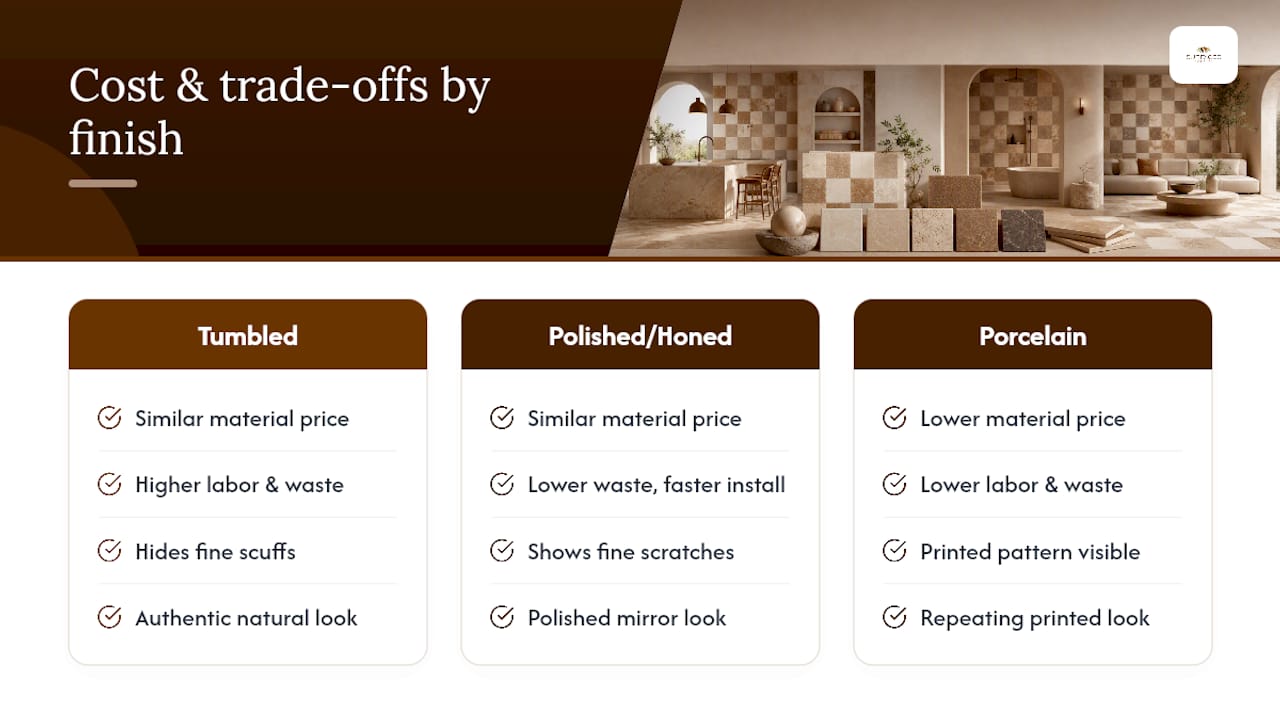
Tumbled natural stone generally lands in a similar price range to honed or polished stone in the same material, since the tumbling process is a finishing step, not a change in the raw stone grade. Where the cost difference shows up is in labor and waste, not the tile itself.
Wider grout joints and more back-buttering mean a slower install, and tumbled tile’s irregular sizing typically produces more cutting waste than a calibrated, rectified honed tile would. Diagonal checkerboard layouts add another layer of labor cost on top of that, regardless of finish, because of the extra perimeter cutting a 45-degree layout requires.
Compared to porcelain look-alikes, natural tumbled stone usually costs more upfront but avoids the printed, repeating pattern look that gives porcelain away under close inspection. Compared to polished marble or travertine in the same checkerboard pattern, tumbled finishes often run close in material price but save a little on light-scratch touch-up over time, since a matte, textured surface simply doesn’t show fine surface scuffs the way a mirror-polished tile does. If budget is tight, a 12"x12" format in either travertine or marble generally costs less per square foot to install than an 18"x18" set, mostly because smaller tiles are easier to level and cut without waste.
How Well Tumbled Checkerboard Holds Up to Daily Traffic
The rounded edges and matte texture that define a tumbled finish also happen to be why it wears so well in high-traffic checkerboard layouts. A polished floor shows every scuff and scratch because light bounces cleanly off a flat, reflective surface. Tumbled stone scatters that light across an already-uneven texture, so the same wear marks are far less visible, a durability advantage borne out in guidance on tumbled marble’s wear characteristics.
That doesn’t mean tumbled checkerboard is maintenance-free. The stone itself, whether marble, travertine, or limestone, is still susceptible to etching from acidic spills and staining if the sealer lapses. But mechanically, the finish tends to age gracefully rather than looking damaged, which is part of why it suits hallways and kitchen floors that see constant foot traffic and the occasional dropped pan. Checkerboard patterns specifically benefit from this forgiving wear pattern, since any scuffing that does happen tends to blend into the tile’s existing texture instead of standing out against a contrasting color block the way it would on a polished floor.
The Real Trade-Off Nobody Mentions About Checkerboard Tile
Most articles on this topic treat tumbled checkerboard as purely a style decision, warm versus stark, light versus dark. That undersells the bigger issue. The real trade-off is precision versus forgiveness, and it runs in both directions at once. Tumbled stone forgives wear beautifully; it does not forgive sloppy setting-out. A crooked centerline or unbalanced perimeter cut is far more obvious in a checkerboard than in a single-color floor, because the eye tracks the grid pattern automatically.
Conventional advice tends to focus on picking colors first and worrying about layout later. That’s backward. Get the centerline, cut balance, and grout width settled before you fall in love with a specific stone pairing, because those decisions constrain what tile sizes and layouts will actually look right in the space. Sample and lot consistency deserves the same priority, not an afterthought after the order is placed. A gorgeous ivory-and-noce pairing still looks off if half the room ships from a different tumbling batch than the other half. Get the planning right first. The stone choice is the easy part.
— John | Surfaces Galore
Shop Surfaces Galore’s Checkerboard Sets and Request Samples
Surfaces Galore skips the markup layers of a typical stone distributor by importing directly and shipping checkerboard sets nationwide, so you’re specifying from the source instead of a middleman’s leftover inventory.
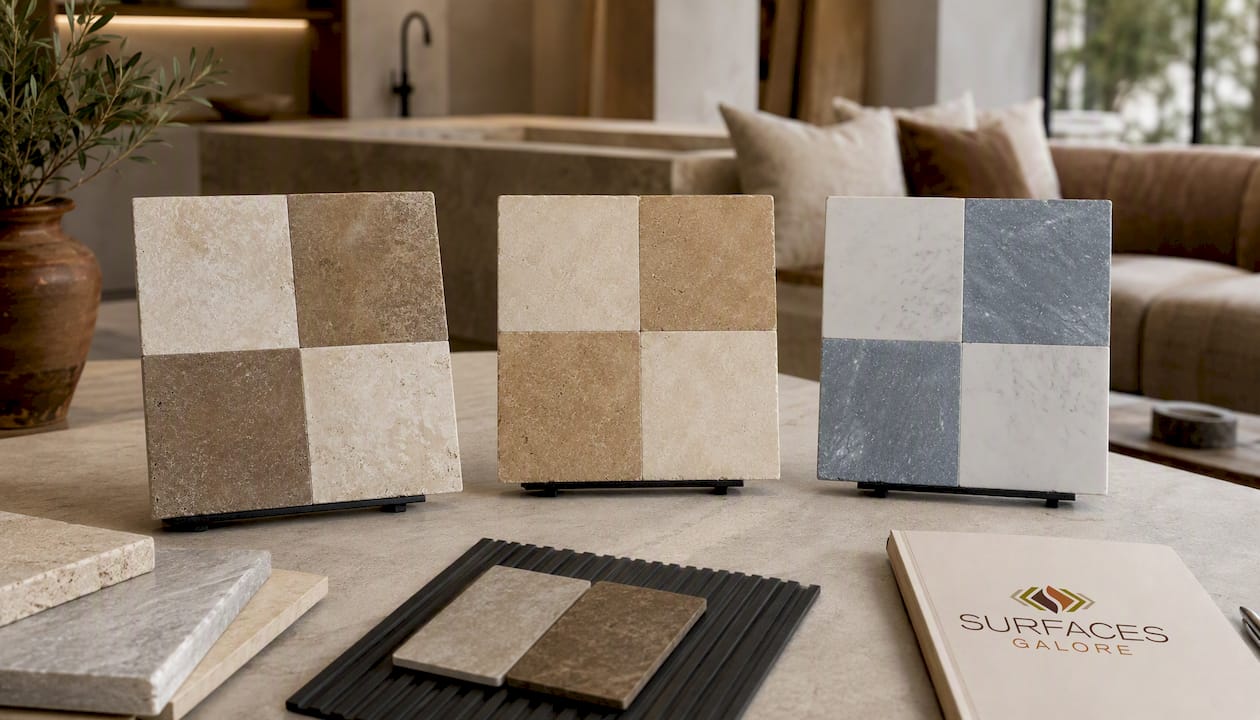
For larger rooms and hallways where you want the pattern to breathe, the Checkerboard Ivory and Noce Travertine Tumbled 18"x18" Set delivers that warmer, tone-on-tone look at a scale that suits open floor plans. For kitchens, entryways, and tighter footprints, the 12x12 travertine checkerboard set gives you the same ivory-and-noce pairing in a size that’s easier to lay and cut cleanly. If you want a more refined, higher-contrast option, the Bardiglio and Oriental White marble tumbled set brings that classic marble checkerboard look with the softer edges tumbling provides.
Before you place a full-room order, request samples and ask for same-lot confirmation on your quantity. It’s a quick step that heads off the shade-mismatch problems that cause the most callbacks on checkerboard installs. Reach out through the product pages above to start a sample request or get a trade quote for your project.
Sources
- What is Tumbled Finish in Stone? | McCoy Mart
- Tumbled Stone Tiles: Properties, Applications, and Fabricator Guide – Dynamic Stone Tools
- Checkerboard Tile Floors: Beyond Black and White | Bromley Tiler
- Tumbled Marble Tile: Complete Guide for Homeowners - D and G Flooring
FAQ
What’s the Difference Between Tumbled and Honed Finishes?
Tumbled tile goes through a rotating drum with abrasive media that rounds the edges and roughens the surface, while honed tile is ground flat and smooth without that texture or edge softening, according to the breakdown of the tumbling process.
What Does the Checkerboard Pattern Signal in Design?
Checkerboard flooring has long read as a classic, formal statement, but current design coverage shows the pattern shifting toward warmer, tone-on-tone stone pairings instead of stark black-and-white contrast for a softer, more livable feel.
Is Tumbled Marble Durable Enough for High-Traffic Floors?
Yes. The matte, textured surface hides scuffs and light wear better than a polished finish, though it still needs regular sealing since the stone remains porous and can stain or etch without protection.
What Does “Tumbled Tile” Actually Mean?
“Tumbled tile” refers to the finishing process, not the stone type. It describes stone that has been mechanically tumbled to soften its edges and texture its surface, whether the underlying material is marble, travertine, or limestone.
Does Surfaces Galore Offer Sample Sizes for Checkerboard Sets?
Surfaces Galore supports sample requests and same-lot confirmation for its checkerboard sets. Current pricing and sample availability are listed on each product page.
Recommended
- How to Match Tile Patterns for Flawless Design Results
- Same Lot Calibration for Flawless Black and White Checkerboard Marble
- Natural Stone Tile Batch Matching: A Complete Guide
- Marble Tile Matching for Cohesive Luxury
This article is provided for general informational guidance only. Natural stone varies in color, veining, texture and performance. For installation, sealing, cleaning and maintenance, follow the product manufacturer’s instructions and consult a qualified installer or stone-care professional. Always test cleaning and sealing products in an inconspicuous area first. Surfaces Galore is not responsible for damage, discoloration, etching, staining, installation issues or other problems resulting from

Leave a comment