
What Is Onyx Marble? Composition, Uses, and Care

In the stone trade, “onyx marble” means a banded, translucent calcium carbonate stone made of calcite or aragonite, not the silica-based chalcedony that geologists call true onyx. That distinction matters the moment you plan to install it: this is a soft, acid-sensitive material that rewards careful placement and punishes careless cleaning.
- Trade name: banded carbonate stone (calcite/aragonite), sold under the “onyx” label for its resemblance to gemstone onyx
- Look: parallel or wavy banding, often semi-translucent when cut thin
- Practical takeaway: softer and more reactive to acids than granite or standard marble, so it needs different handling from day one
The sections below walk through what it’s made of, how it forms, and where it earns its price tag.
Key Takeaways
Onyx marble is a banded, translucent calcium carbonate stone prized for backlit and decorative use, but its low hardness and acid sensitivity limit it to light-traffic applications.
| Point | Details |
|---|---|
| Trade name, different mineral | “Onyx marble” is calcite or aragonite, not the silica chalcedony called true onyx. |
| Soft stone, handle with care | Mohs hardness of roughly 3 to 3.5 makes it far easier to scratch than granite. |
| Beauty comes from light | Translucent banding forms in thin slabs and depends on consistent thickness for backlighting. |
| Sealing helps, doesn’t fix everything | Sealer slows staining but does not prevent acid etching on the surface. |
| Best for accents, not counters | Reserve onyx for vanities, feature walls, and art pieces; choose denser stone for kitchens. |
| Where to see it firsthand | Surfacesgalore ships samples nationwide so buyers can check banding and translucency before ordering. |
Table of Contents
- What Is Onyx Marble Made Of?
- How Does Onyx Marble Form?
- How Hard and Durable Is Onyx Marble?
- Is Onyx Marble Real Marble?
- Where Onyx Marble Works Best
- How Do You Clean and Maintain Onyx Marble?
- Why the Trade Still Calls It “Onyx”
- Sources
- FAQ
What Is Onyx Marble Made Of?
Onyx marble is a carbonate rock, built almost entirely from calcite or aragonite crystals that precipitated out of mineral-rich water over time. That puts it in a completely different mineral family from true geological onyx, which is chalcedony, a form of silica related to quartz and agate. The Natural Stone Institute’s stone-variety definitions confirm the trade groups stone by look and performance rather than strict mineralogy, which is exactly why a carbonate banded stone ended up borrowing the “onyx” name in the first place.
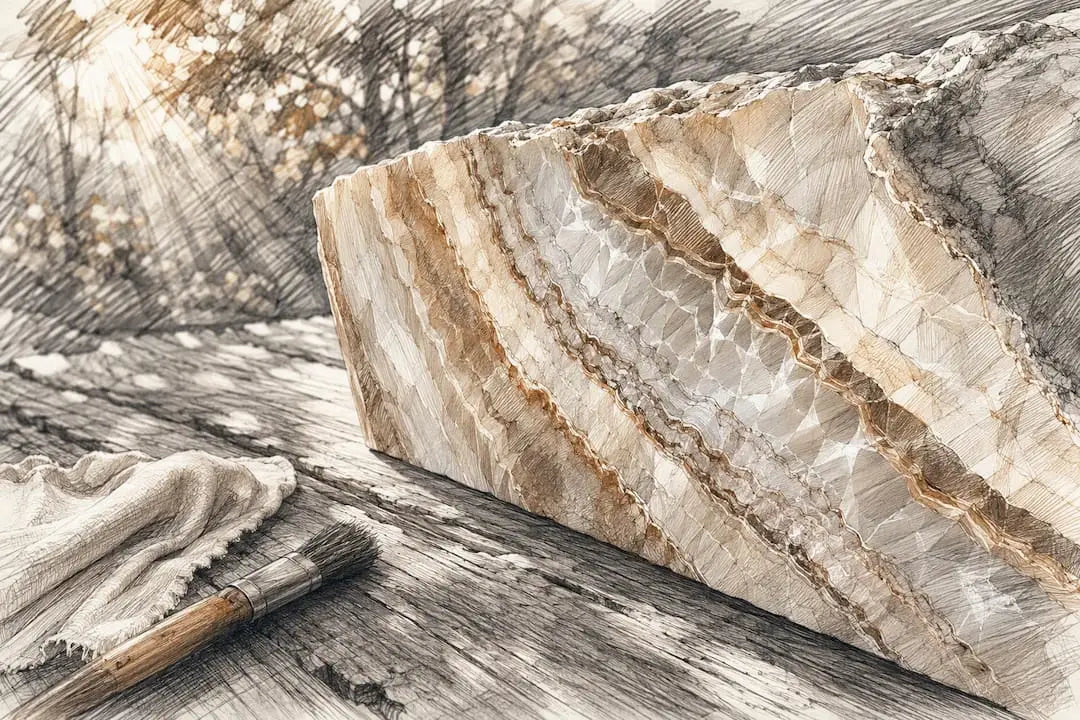
Britannica describes these stones as concentric zones of calcite or aragonite deposited from cold-water solutions in caves and rock crevices, a formation story with nothing to do with metamorphic marble or silica onyx despite sharing both names.
Two quick field tests separate the categories fast:
- Scratch test: onyx marble scratches with a steel point or even a hard fingernail edge; true chalcedony onyx does not.
- Acid test: a drop of vinegar fizzes and dulls onyx marble almost instantly; true onyx shows no reaction at all.
That fizz reaction is the single most reliable way to know which stone you’re actually holding.
How Does Onyx Marble Form?
Banded onyx marble builds up the way a stalactite grows, just wider and flatter. Mineral-saturated water moves slowly through limestone caves or hot springs, and as it cools or loses pressure, it drops calcite or aragonite in thin layers on whatever surface it touches. Each layer differs slightly in mineral content, iron, and trace impurities, which is what produces the parallel color bands designers prize.
- Water dissolves limestone underground, picking up dissolved calcium carbonate.
- Slow evaporation or temperature change forces that mineral to precipitate out in thin sheets.
- Repeated cycles stack hundreds of these sheets, each one a slightly different shade depending on iron, manganese, or organic material present at that moment.
- Compression over centuries locks the banding into a solid, cuttable block.
The npj Heritage Science study on onyx-travertine deposits links this layering directly to hydrothermal and volcanic-influenced environments, and documents real differences in porosity and mechanical strength between deposits. That’s the scientific reason two onyx slabs from different quarries can behave very differently under a saw blade.
How Hard and Durable Is Onyx Marble?
Onyx marble sits at roughly 3 to 3.5 on the Mohs hardness scale, which puts it well below granite (6 to 7) and even below many standard marbles. That number matters in a kitchen: a house key or a ceramic mug can leave a visible scratch on a polished onyx surface in a way it never would on granite.
- Translucency: thin-cut slabs (often ¾ inch or less) let light pass through, which is why backlit onyx walls have become a signature feature in upscale bathrooms and hotel lobbies.
- Porosity: onyx marble is more porous than dense granite, so liquids soak in faster if the surface isn’t sealed.
- Acid sensitivity: contact with vinegar, citrus juice, or wine causes visible etching, a dulled or frosted patch where the acid has eaten into the polished surface.
Translucency also depends on more than the stone itself. Slab thickness has to stay consistent across a panel, and the adhesive behind it can’t be opaque, or you get uneven light and visible seams once the LEDs go on behind it.
Is Onyx Marble Real Marble?
Not in the geological sense, and that’s the confusion worth clearing up. True metamorphic marble forms from limestone under heat and pressure deep underground. Onyx marble forms at or near the surface through mineral deposition in caves and springs, a completely different process that happens to produce a similarly polishable, carbonate-based stone. The commercial world calls both “marble” because they share chemistry, workability, and market position, even though a geologist would put them in separate categories.
Where does that leave your project?
- Choose onyx marble for low-traffic, decorative surfaces where light and color matter more than daily wear.
- Choose true marble or granite for kitchen counters, floors, and anywhere acids and abrasion are a daily reality.
- Choose true chalcedony onyx only for small decorative or jewelry-scale pieces. It’s far too rare and expensive to slab for architectural use.
Where Onyx Marble Works Best
Onyx marble earns its reputation in places built to show it off, not survive daily abuse.
- Backlit feature walls. LED panels behind a thin-cut slab turn the natural banding into a glowing focal point in a lobby, spa, or master bath.
- Bar tops and accent panels in low-splash areas, where the color show matters more than resistance to lemon wedges.
- Powder room vanities and low-use bathroom counters, where light traffic and light cleaning routines fit the stone’s limits.
- Sculptural and decorative pieces, from vessel sinks to inlay work, where the goal is visual drama in a small footprint.
Skip it for kitchen counters, outdoor patios, and any high-traffic floor. Granite, quartzite, or a denser marble handle acids and foot traffic far better.
Pro Tip: Before you commit to a backlit onyx installation, ask your fabricator for a lit mock-up using the exact LED color temperature you plan to install. Onyx translucency shifts dramatically between warm and cool light, and what looks stunning under one bulb can look flat under another.
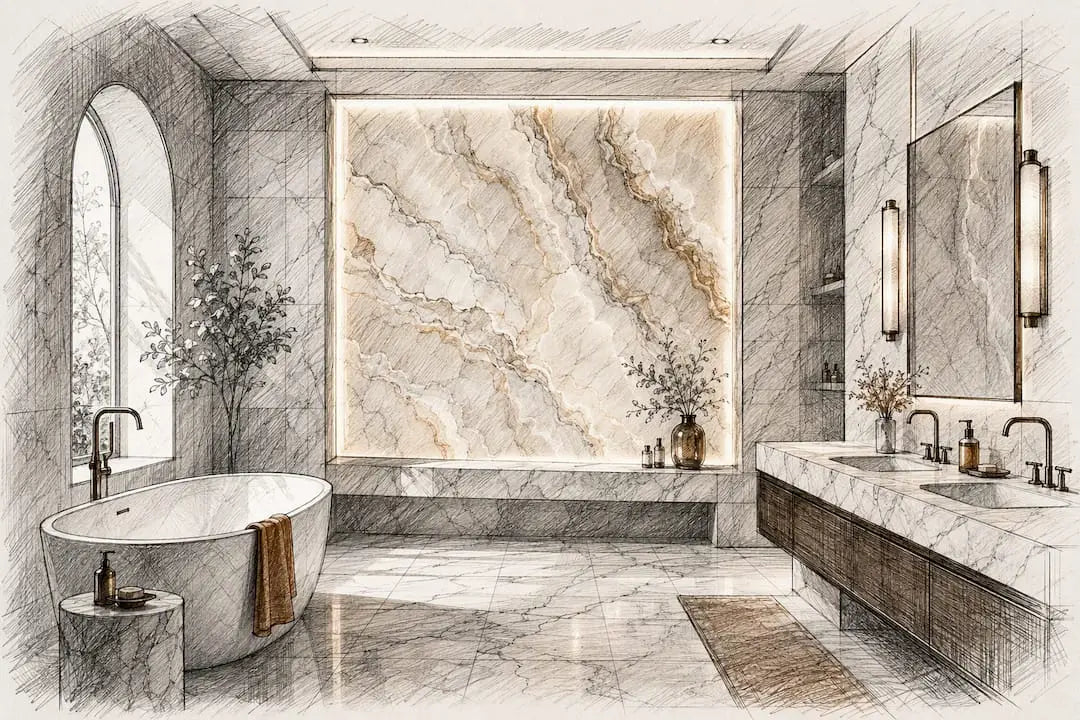
Fabricators typically back fragile onyx slabs with a resin mesh for stability and orient the slab bookmatched, so the banding mirrors across a seam rather than clashing. Our guide to onyx stone characteristics and care covers slab selection in more detail if you’re comparing pieces for a specific room.
How Do You Clean and Maintain Onyx Marble?
Sealing is the first line of defense, and it’s a maintenance step you can’t skip. A quality penetrating sealer slows how fast liquids soak into the stone’s pores, but it does not stop etching, since acid sensitivity is a property of the calcium carbonate itself, not something a topical product can block. Reseal roughly once a year in normal residential use, more often in a bathroom that sees heavy moisture.
Daily care is simple if you keep it simple:
- Use only pH-neutral stone cleaners, never generic all-purpose sprays.
- Wipe with a soft microfiber cloth. Skip anything abrasive, including the rough side of a sponge.
- Blot spills immediately, especially wine, coffee, and citrus.
- Keep vinegar-based cleaners and bleach nowhere near the surface.
Pro Tip: Keep a small bottle of pH-neutral stone cleaner right under the sink where the onyx piece lives. The single biggest cause of etching isn’t a dramatic spill, it’s someone grabbing a random bathroom cleaner out of habit.
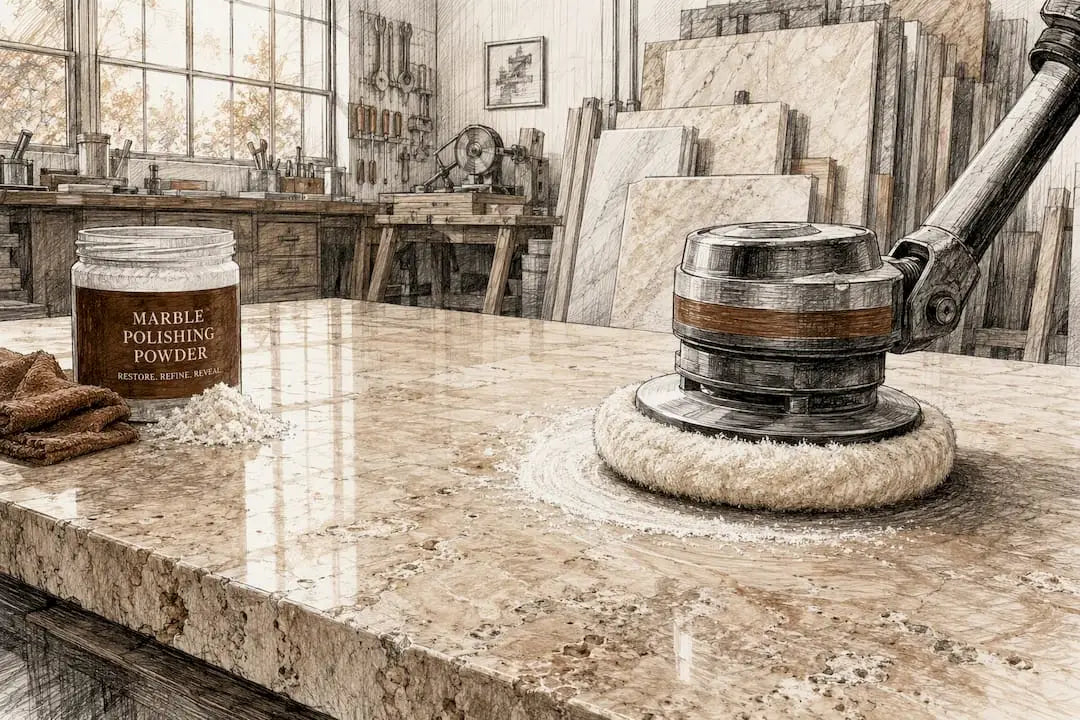
Minor etches often buff out with a marble polishing powder and a soft buffing pad. Chips or cracks need resin fill work, and hairline fractures across the banding call for a professional restoration crew rather than a DIY fix. Our marble maintenance guide and marble sealer breakdown both apply directly to onyx care routines, since the underlying chemistry is the same family of stone.
Why the Trade Still Calls It “Onyx”
The commercial stone industry sorts materials by appearance and performance, not textbook mineralogy, and that’s the entire reason this naming overlap survives. A Natural Stone Institute overview puts it plainly: banded carbonate stones get sold as “onyx marble” because they resemble gemstone onyx, not because they share its chemistry.
Fabrication best practice for fragile, high-translucency slabs starts with a light-table and tap-test inspection before cutting, since banded onyx can carry cryptic fissures that only show up under strong backlight.
- Inspect every slab on a light table before committing to a cut.
- Use resin-mesh backing on thin or fragile panels headed for vertical installation.
- Orient slabs to match banding direction across seams for a continuous visual flow.
Surfacesgalore ships natural stone nationwide from Anaheim, California, and offers samples so you can see banding and translucency in person before you specify a slab for a real project.
A Straight Answer on Where Onyx Marble Fits
Onyx marble rewards restraint. It’s not a stone you fight with on durability, it’s a stone you design around, putting it where light and pattern do the work and keeping it away from acid and heavy traffic. The most common mistake I see isn’t choosing onyx, it’s choosing the wrong room for it. If you’re weighing onyx against a more traditional marble selection, start with how the room gets used, not how the stone looks in a showroom. Request a physical sample before you decide anything.
— cihan
See Onyx Marble in Person Before You Specify It
Photos and screens flatten exactly what makes onyx marble worth choosing: the way light moves through it changes room to room, fixture to fixture. Surfacesgalore ships natural stone nationwide from Anaheim, California, and works directly with designers, contractors, and homeowners who want to hold a slab before committing a budget to it.
You can request samples, compare banding patterns side by side, and get a bulk quote if you’re speccing a full commercial installation, all without going through a middleman markup. Shop natural stone tiles today or browse the current onyx and marble collections to start narrowing down the slab that fits your project’s light, layout, and budget.
Sources
- Natural Stone Institute – Varieties/definition
- Onyx marble | Britannica
- npj Heritage Science – quantification of physico-mechanical properties of onyx-travertines
FAQ
Is Onyx Marble Real Marble?
Not geologically. It’s a carbonate stone formed by mineral deposition in caves and springs, while true marble forms from limestone under heat and pressure, but the trade calls both “marble” based on shared workability and appearance.
Why Is Onyx Marble So Expensive?
Slow, layer-by-layer formation limits how much usable stone any deposit produces, and fragile slabs require extra fabrication steps like resin backing, which drives up cost compared to more abundant stones.
Is Onyx Better Than Marble?
Neither is “better” outright. Onyx wins on translucency and dramatic banding for accent features, while standard marble and granite win on hardness and daily durability for counters and floors.
What Are the Disadvantages of Onyx Marble?
Its low Mohs hardness of around 3 to 3.5 means it scratches easily, and its acid sensitivity leaves it vulnerable to etching from vinegar, citrus, and wine, limiting it to low-traffic, low-acid environments.

Leave a comment