
Best Tile for Bathrooms: Natural Stone Guide 2026

Marble, limestone, and travertine are the best tiles for bathrooms when you want surfaces that age with character rather than just wear out. Each stone brings something distinct: marble delivers dramatic veining and a refined finish; limestone offers a quieter, more uniform texture; travertine brings warmth, grip, and a naturally porous surface that works especially well underfoot. Surfacesgalore imports all three directly, giving homeowners, designers, and contractors access to authentic material at prices that make large-format installations realistic.
At a glance:
- Marble: High visual impact, dense crystalline structure, low porosity, requires sealing and careful maintenance
- Limestone: Subtle grain, calm uniform appearance, moderate porosity, excellent for walls and low-traffic floors
- Travertine: Warm beige and cream tones, naturally slip-resistant, highest porosity of the three, must be filled and sealed before wet-area use
- Quartzite and slate: Dense, low-absorption alternatives suited to high-moisture feature walls and accent applications
Table of Contents
- What are the best tile options for bathrooms?
- How to install and waterproof natural stone bathroom tiles
- What 2026 design trends look like for natural stone bathrooms
- How to maintain natural stone tiles in a bathroom
- How much do natural stone bathroom tiles cost?
- Sourcing and sustainability for natural stone bathroom tiles
- Are natural stone tiles compatible with radiant heat and bathroom ventilation?
- Surfacesgalore: direct access to premium natural stone
- Key Takeaways
- FAQ
What are the best tile options for bathrooms?
Natural stone tiles divide into three practical categories based on how they perform in wet environments: high-drama stones for focal points, workhorse stones for floors and walls, and accent stones for texture and depth.
Marble sits in the focal-point category. Its dense crystalline structure gives it relatively low porosity compared to travertine, but it etches easily from acidic cleaners and needs sealing to prevent staining. Reserve polished marble for vanity tops and low-moisture accent walls; use a honed finish anywhere water lands regularly.
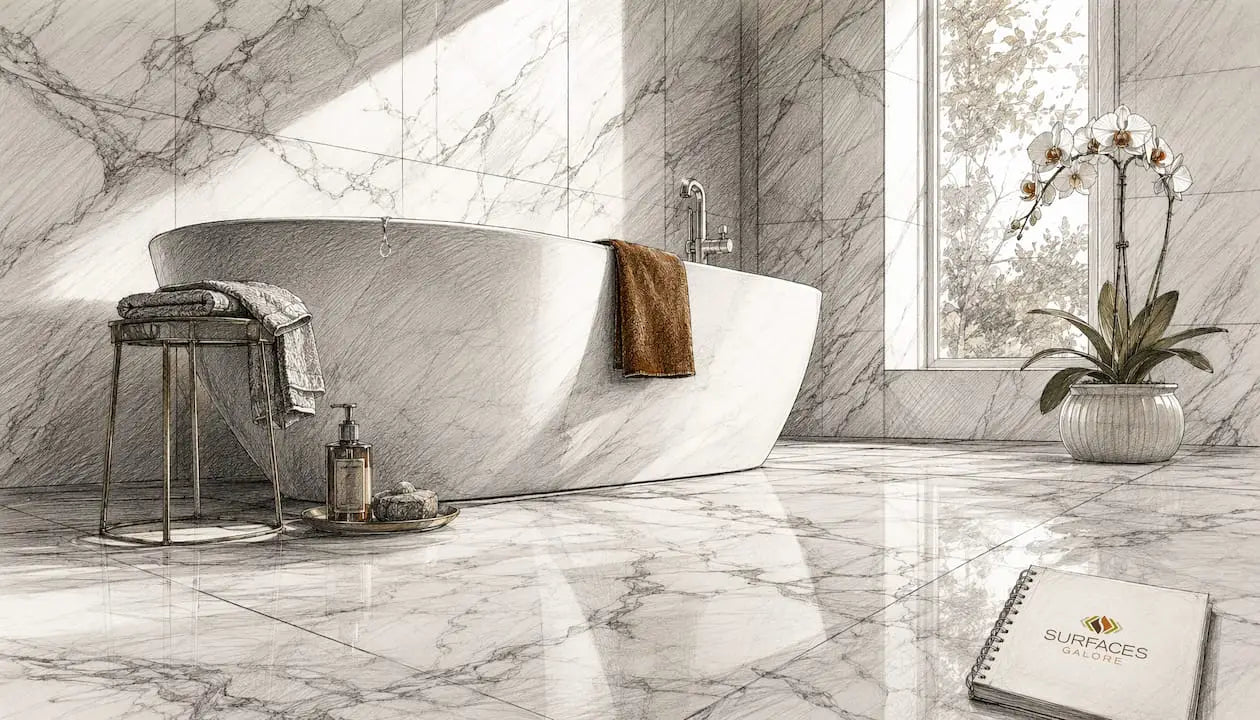
Limestone reads calmer than marble. Its subtle grain and pale gray-beige tones create a monolithic look that works beautifully on large-format wall slabs. Porosity is low to moderate, sealing is required but less frequent than travertine, and denser varieties handle residential floor traffic without issue.
Travertine is the floor tile standout for 2026. Its warm beige tones, naturally porous texture, and slip-resistant surface make it a strong choice for bathroom floors and shower surrounds. The visible pits must be filled with epoxy or a cementitious compound before installation in wet areas.
Quartzite and slate earn their place on primary wet walls. Both stones offer dense, low-absorption qualities that reduce capillary uptake and staining risk, making them practical for textured feature walls and shower surrounds where marble would demand more upkeep.
- Honed finish: matte, slip-resistant, best for floors and wet zones
- Leathered finish: subtle dimpled texture, enhances natural veining, ideal for feature walls
- Brushed finish: softer texture, works well on travertine and limestone
- Polished finish: high gloss, reserved for vanity tops and low-moisture surfaces only
How to install and waterproof natural stone bathroom tiles
Getting the substrate right is the single most important step. Shower installations require bonded waterproofing membranes that extend behind stone cladding and into niches. Liquid membranes need surface moisture below 3%, and every installation must pass a full flood test before tiling begins.
Adhesive application follows strict coverage standards. Back-buttering stone tiles and achieving thorough mortar coverage eliminates voids near corners, which is where failures typically start. Substrate flatness matters too: any variation beyond a small tolerance over an eight-foot span creates stress points that crack tiles over time.
Pro Tip: Seal porous stones like marble, limestone, and travertine with a penetrating sealer before grouting. Allow it to cure fully. This step prevents grout pigment from absorbing into open stone pores and leaving permanent staining that no amount of cleaning will fix.
Uncoupling membranes, such as ARDEX UI 740 FLEXBONE, protect against substrate movement that would otherwise crack tiles. Hairline grout cracks are almost always a symptom of substrate flexing, not grout failure. Filling them without addressing the underlying movement is a temporary fix at best; the correct repair uses polymer-modified grout after the structural issue is resolved.
- Use bonded waterproofing membranes in all wet zones
- Confirm surface moisture below 3% before applying liquid membranes
- Back-butter tiles for full mortar contact
- Install uncoupling membranes on wood subfloors
- Seal stone before grouting, not after
What 2026 design trends look like for natural stone bathrooms
The Textural Realism movement is the defining shift in natural stone design for 2026. Designers are specifying honed, leathered, and brushed finishes over polished gloss because these surfaces offer better slip resistance, hide wear more effectively, and create a tactile warmth that polished stone simply cannot replicate.
Quiet Luxury pairs with Textural Realism as its aesthetic counterpart. The focus is on monolithic slabs with subtle veining, earthy tones like amber, taupe, and warm beige, and surfaces that age gracefully without artificial enhancement. Busy patterns are out; a single large-format travertine or limestone slab as a statement bathroom wall is in.
Large-format tiles are replacing small mosaics across floors and walls. Fewer grout lines mean easier cleaning and a calmer visual field, which is exactly what the Quiet Luxury aesthetic calls for. A continuous stone panel behind a vanity unit, combined with large-format floor slabs, creates the spa-like atmosphere that homeowners are actively seeking.
- Honed and leathered finishes now preferred over polished in high-end specifications
- Earthy tones: warm beige, taupe, cream, and greige dominate
- Large-format slabs reduce grout lines and visual clutter
- Bookmatched marble creates mirrored veining for dramatic focal points
- Fluted stone surfaces appearing on vanities and accent walls
How to maintain natural stone tiles in a bathroom
Sealing is the foundation of any maintenance plan. Marble needs regular resealing in humid bathrooms; limestone and travertine generally require resealing less frequently depending on use and porosity. Apply a penetrating impregnator sealer, not a topical coating, so the stone can breathe while staying protected.
Cleaning products matter more than most people realize. Neutral pH cleaners are the only safe choice for natural stone. Acidic cleaners, including many common bathroom sprays, etch marble and limestone surfaces and dull the finish permanently. Avoid anything containing vinegar, lemon, or bleach.
Ventilation after every shower is non-negotiable for vapor-permeable finishes. Surfaces need to dry completely between uses to prevent deterioration. For stones with leathered or brushed finishes, a high-quality impregnator sealer applied more frequently than you would for polished stone keeps the more open surface structure protected.
- Seal before installation and before grouting
- Reseal marble every 6–12 months; other stones every 1–3 years
- Use only neutral pH cleaners
- Ventilate the bathroom after every use
- Address hairline grout cracks by fixing substrate movement first
How much do natural stone bathroom tiles cost?
Natural stone pricing varies by type, origin, and format. Travertine is generally the most accessible entry point for authentic stone, with installed costs for floor tile typically ranked below marble and limestone in both European and U.S. markets. Marble spans a wide range depending on variety and origin, with Italian and onyx varieties sitting at the top of the market. Limestone falls between the two.
Budget planning should account for more than material cost. Large-format slabs require more precise substrate preparation, professional installation, and higher adhesive coverage standards, all of which add to labor costs. For any continuous run longer than 1.5 meters, ordering stone in quarry-consistent batches with approximately 95% hue uniformity prevents visible color variation across the finished wall.
Finish choice also affects cost. Leathered and brushed finishes involve additional mechanical processing and typically price higher than honed. Polished is often the baseline. Factor in sealing products and periodic resealing as ongoing costs, particularly for marble in high-use bathrooms.
Sourcing and sustainability for natural stone bathroom tiles
Authentic natural stone is a genuinely sustainable material. It requires no synthetic manufacturing, lasts decades with proper care, and does not off-gas chemicals into living spaces. The environmental footprint concentrates at extraction and transport, which is why sourcing from a direct importer matters: fewer intermediaries means a shorter supply chain and better traceability back to the quarry.
Batch consistency is a sourcing issue as much as a design one. Specifying stone from the same quarry run protects against color shifts mid-project, particularly on large vanity walls or continuous shower surrounds. Ask your supplier for documentation on quarry origin and batch matching before ordering.
For coastal or high-humidity U.S. climates, specify stone that meets ASTM freeze-thaw resistance standards where applicable, and confirm UV stability for any installation near skylights or large windows. Dense stones like quartzite and slate perform best in these conditions.
Are natural stone tiles compatible with radiant heat and bathroom ventilation?
Natural stone conducts heat well, making it one of the better flooring choices for radiant heating systems. Soapstone is particularly noted for heat retention, but travertine and limestone also perform reliably over in-floor heating when installed with appropriate flexible mortars that accommodate thermal expansion.
The key installation requirement is using a flexible, polymer-modified mortar rather than a rigid thinset. Thermal cycling creates movement, and a rigid adhesive bond will eventually crack. Uncoupling membranes add another layer of protection by absorbing the minor movement that heating cycles produce.
Ventilation compatibility is straightforward: natural stone tolerates humidity well when properly sealed, but the bathroom itself needs adequate airflow. A ventilation fan rated for the room’s square footage, run during and for at least 15 minutes after each shower, keeps moisture from accumulating on grout lines and stone surfaces. This is especially relevant for honed and leathered finishes, which have a more open surface structure than polished stone.
Surfacesgalore: direct access to premium natural stone
Surfacesgalore imports marble, limestone, and travertine directly from the source, which means you get authentic material without the markup that comes from multiple distribution layers. Based in Anaheim, California, with nationwide shipping, Surfacesgalore serves homeowners, designers, architects, and contractors who need quality stone that performs as well as it looks.
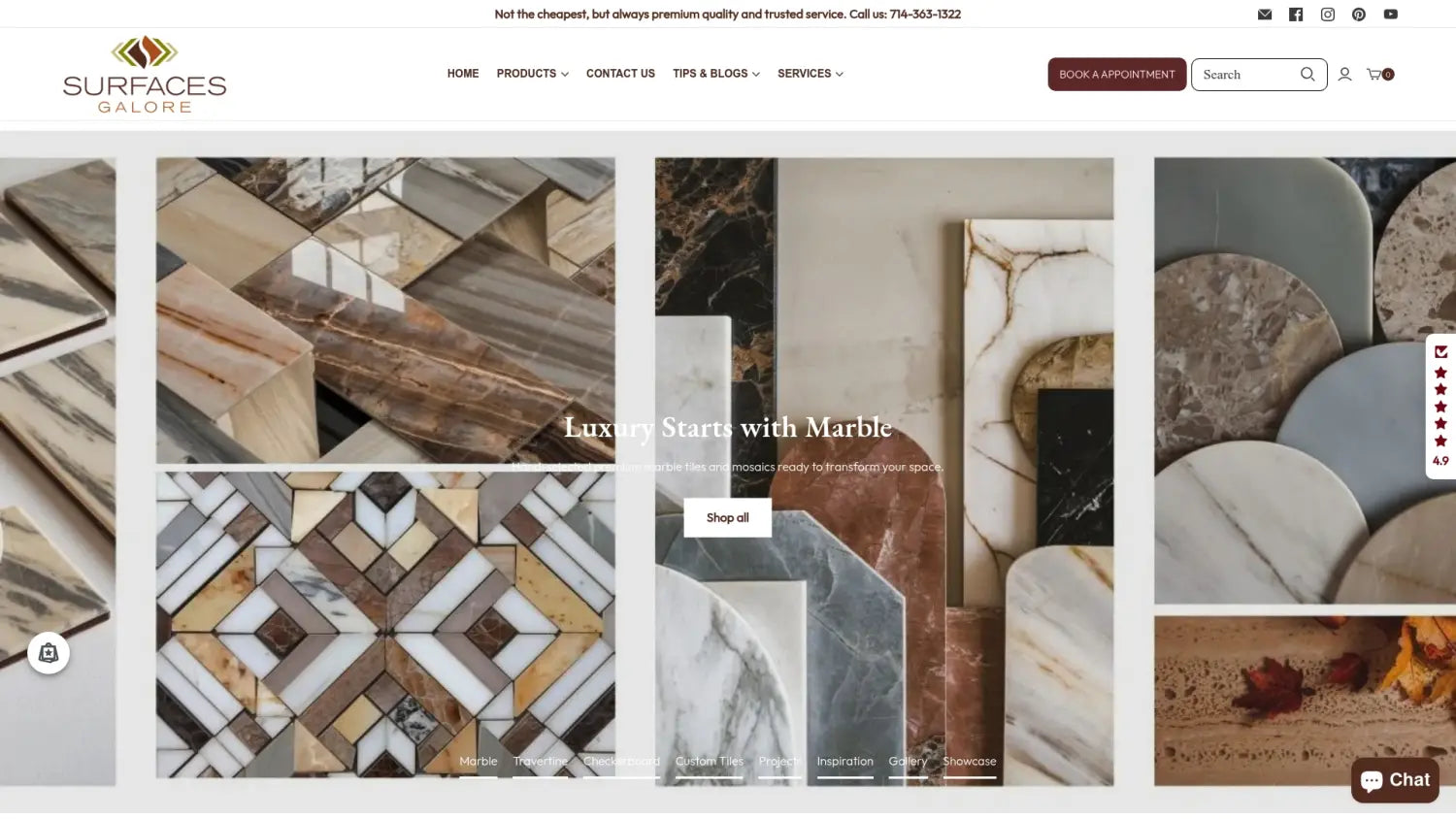
The selection covers tiles, mosaics, moldings, and custom cuts, so whether you are planning a full bathroom renovation or a single statement wall, the material range supports it. Every piece is vetted for the consistency and quality that large-format bathroom installations demand. Browse the marble and limestone collections at Surfacesgalore and request samples before committing to a full order.
Key Takeaways
Marble, limestone, and travertine are the most reliable natural stone choices for bathrooms, each suited to specific applications based on porosity, finish, and maintenance tolerance.
| Point | Details |
|---|---|
| Stone selection by application | Use travertine for floors, limestone for walls, marble for vanity tops and low-moisture focal points. |
| Sealing frequency | Marble needs resealing every 6–12 months; limestone and travertine typically every 1–3 years. |
| 2026 design direction | Textural Realism favors honed, leathered, and brushed finishes over polished gloss in high-end bathrooms. |
| Installation priority | Bonded waterproofing membranes and full mortar coverage are required for any wet-zone stone installation. |
| Surfacesgalore | Direct importer of marble, limestone, and travertine with nationwide U.S. shipping and custom cut options. |
FAQ
Which natural stone tile is best for bathroom floors?
Travertine is the strongest choice for bathroom floors because its naturally porous, textured surface provides grip when wet. Fill and seal it before installation in any wet area.
How often does natural stone tile need to be resealed in a bathroom?
Marble typically requires resealing every 6–12 months in humid bathrooms. Limestone and travertine generally need resealing every 1–3 years, depending on use and porosity.
Can natural stone tiles be used with radiant floor heating?
Yes. Natural stone conducts heat effectively and works well over radiant heating systems when installed with a flexible, polymer-modified mortar and an uncoupling membrane to handle thermal movement.
What finish is best for natural stone bathroom tiles in 2026?
Honed and leathered finishes are the preferred choice in 2026, offering better slip resistance than polished stone and aligning with the Textural Realism and Quiet Luxury design trends.
Where can I source authentic natural stone tiles for a bathroom project in the U.S.?
Surfacesgalore is a direct importer of marble, limestone, and travertine based in Anaheim, California, shipping nationwide to homeowners, designers, and contractors.

Leave a comment