
Calacatta backsplash ideas: How to choose the right marble tile for your kitchen

Key Takeaways
A Calacatta backsplash can make a kitchen feel brighter, more layered, and distinctly personal. The best result comes from balancing the marble’s natural movement with the room’s scale, lighting, and daily demands.
- Start with the background color and direction of the veining.
- Choose tile, mosaic, or slab format according to the visual effect you want.
- Compare polished, honed, and brushed finishes before ordering.
- Plan quantities, cuts, grout, sealing, and installation in advance.
- Request samples and current availability before committing to the full project.
Define your Calacatta backsplash style
A successful Calacatta backsplash begins with a clear design direction. Calacatta marble naturally attracts attention, so the surrounding cabinetry, counters, hardware, and lighting should support rather than fight its character. Consider the whole kitchen from the beginning, not only the wall behind the range.
Compare Calacatta Gold’s white background and dramatic veining
Calacatta Gold is recognized for a stunning white background with dramatic gold veining. That contrast gives the stone a bright, luxurious presence, while gray movement can add another layer of depth. If the kitchen already contains several strong materials, a quieter selection of the same marble can keep the room composed.
Coordinate veining with countertops and cabinetry
Look at the backsplash sample beside the actual countertop and cabinet door, preferably in both daylight and evening light. Warm gold movement can sit comfortably with natural wood or brass, while gray veins often connect well with cooler cabinetry and stainless details. A coordinated material palette makes the marble feel intentional instead of decorative afterthought.
For kitchens with Calacatta Gold quartz counters, this countertop pairing guide offers another useful way to think about white, gray, and gold movement without letting one surface overwhelm the other.
Choose between a classic, modern, or statement-making design
A classic kitchen may call for restrained subway tile and a simple border. A modern room can benefit from a stacked layout, a narrow joint, and minimal trim. For a statement installation, use a bold mosaic or carry the marble higher behind the range while keeping the remaining walls more understated.
Use natural variation to create a one-of-a-kind installation
Natural marble is not printed, so pieces will vary in tone, movement, and veining. That variation is part of the appeal, but it should be reviewed before installation so the installer can arrange the most expressive pieces thoughtfully. The result is a backsplash with character that cannot be duplicated exactly in another kitchen.
Choose the right marble backsplash format
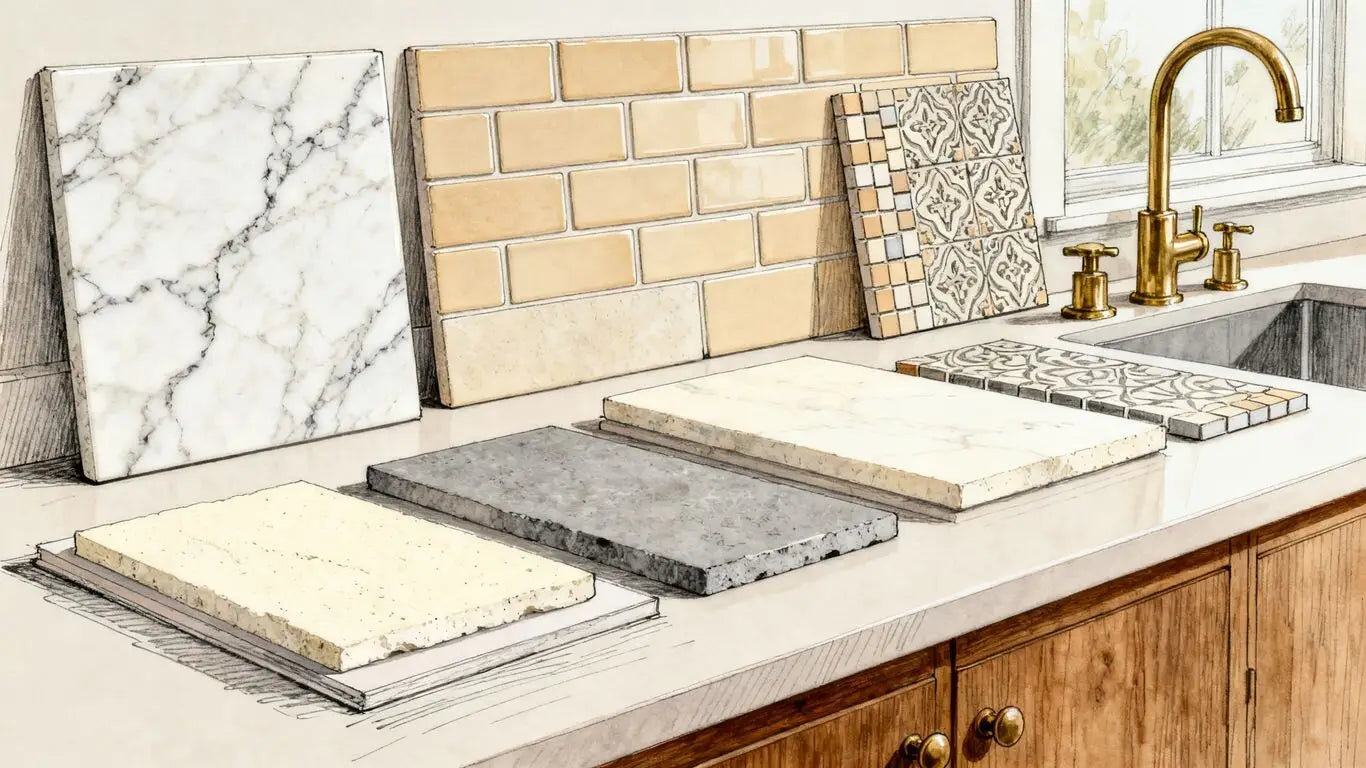
Format changes the personality of the stone as much as color does. Small mosaics create rhythm and detail, subway tiles feel familiar and adaptable, and large pieces allow the veining to read as a broader composition. Select the format after considering the wall dimensions, cabinet breaks, and amount of grout you prefer.
Explore Calacatta marble subway tile layouts
Subway tile is a dependable choice for a Calacatta backsplash because its simple shape gives the veining room to breathe. A running bond feels traditional, while a stacked arrangement looks cleaner and more current. For a classic 3-by-6-inch proportion with a matte surface, consider this Calacatta Gold field tile as a reference point.
Add dimension with mosaics and decorative patterns
Mosaics bring a smaller scale and more visible pattern to the wall. Chevron, herringbone, mini brick, and geometric shapes can frame a range hood or add interest to a compact kitchen. A black-and-gold mosaic variation can create stronger contrast, while a small white-and-gold mosaic keeps the mood lighter.
Surfaces Galore lists multiple Calacatta Gold mosaic formats, including polished and honed options, so compare the pattern and surface together rather than choosing either one in isolation.
Use marble slabs for a continuous, low-grout look
A slab backsplash presents the veining as one flowing field and reduces the number of grout joints. It can look especially calm behind a range or across a long counter run. Slabs require careful templating, handling, and installation, so confirm wall conditions and access before choosing this format.
Incorporate borders, liners, and moldings for a finished edge
A narrow liner can define the transition between backsplash and wall, while a border can frame a decorative inset. Moldings also help resolve an exposed side or a change in height near cabinetry. Keep trim proportional; too many competing edges can distract from the marble itself.
For a more decorative treatment, review these Calacatta Gold tile borders when planning corners, transitions, or a framed accent area.
Select a finish, size, and layout
Finish affects how light moves across the stone, while size and layout determine how quickly the eye travels over the wall. There is no universally correct combination. The right choice depends on the kitchen’s natural light, cabinet scale, countertop pattern, and desired level of formality.
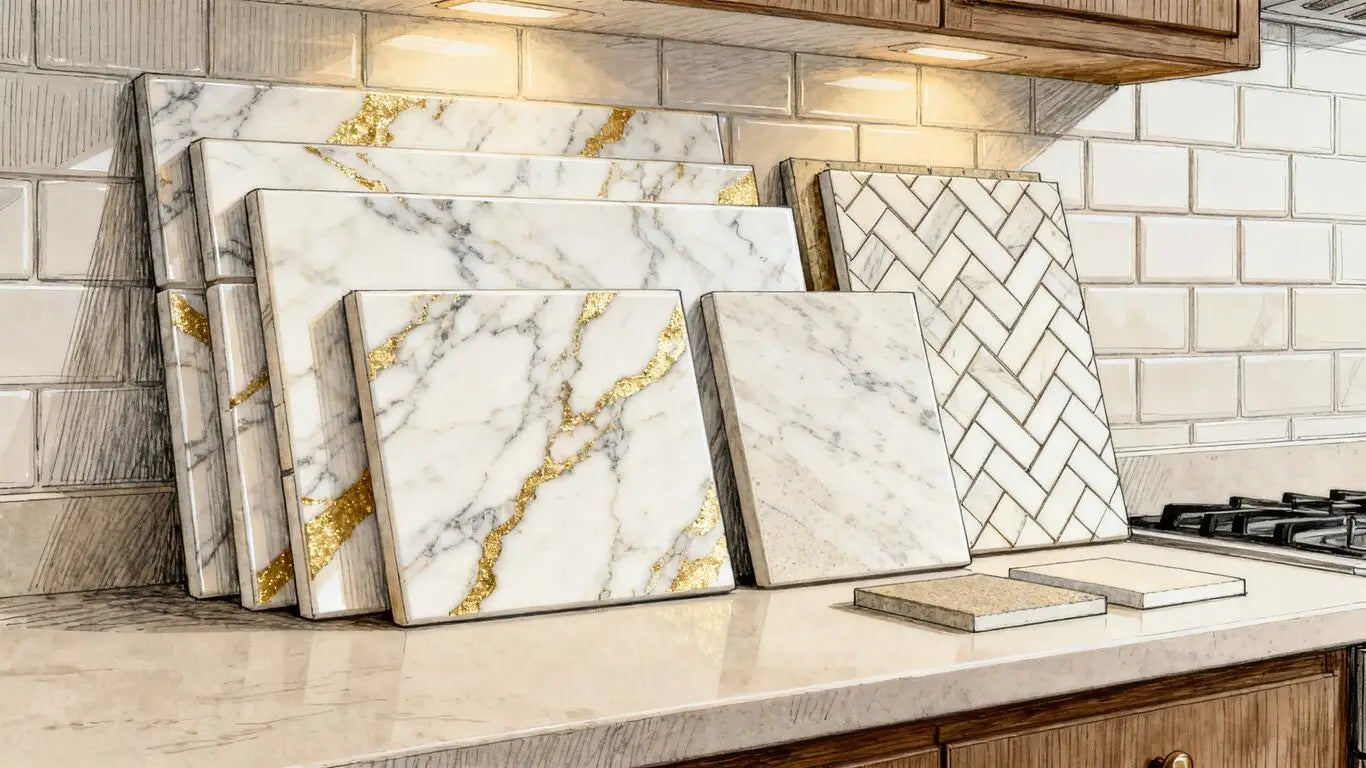
Compare polished, honed, and brushed marble finishes
Polished marble has a reflective surface that can make a backsplash feel luminous and formal. Honed marble is smoother and more softly matte, with a quieter visual effect. Brushed finishes add tactile character and a gently textured appearance; always request a sample because the same veining can read differently across finishes.
Match tile size to the scale of your kitchen
Large tile can visually simplify a broad wall, while smaller tile adapts more easily around outlets, windows, and short cabinet runs. In a compact kitchen, a modest rectangular tile may provide enough structure without making the backsplash feel busy. Account for nominal sizing and actual joint placement when sketching the layout.
Consider stacked, running bond, herringbone, and basket weave layouts
The layout should reinforce the room’s architecture. A stacked pattern feels orderly, running bond adds familiar movement, herringbone draws attention diagonally, and basket weave creates a more traditional decorative note. Before installation, dry-lay several sheets or pieces so the direction and repeat are visible at full scale.
Plan focal areas behind the range and sink
The wall behind the range is often the natural focal point, but the sink wall can also benefit from a framed detail. Use a change in pattern, a border, or a slab field to distinguish the area without creating an unrelated visual island. A measured transition is more elegant than an accent that stops abruptly at a cabinet edge.
Balance beauty with everyday performance
Marble is a practical natural stone for many kitchen wall applications, but it deserves informed care. A backsplash protects the wall from everyday splashes while also becoming a visible design surface. Good planning preserves both functions.
Understand marble’s durability in kitchen applications
Calacatta Gold is described as durable and long-lasting for residential and commercial spaces, and it is suitable for backsplashes, walls, countertops, and other applications. Even durable stone can be affected by installation quality, impact, acidic substances, and neglect. Treat the backsplash as a lasting material, not a maintenance-free one.
Protect the surface from spills, heat, and staining
Wipe spills promptly, particularly around cooking and preparation zones. Use suitable trivets or protective measures where hot cookware could contact adjacent surfaces, and avoid harsh cleaners that may dull or damage natural stone. Sealing can help, but it does not eliminate the need for sensible daily care.
Choose the right grout color and joint width
A close white or warm-neutral grout creates a quieter field and lets the marble dominate. A gray grout can pick up cooler veining and make the pattern more visible. Joint width should suit the tile edges and installation requirements; excessively narrow joints can make alignment less forgiving.
Plan for sealing and routine natural stone care
Confirm the recommended sealer and maintenance schedule with the installer and product documentation. Clean with products intended for natural stone, and test unfamiliar cleaners in an inconspicuous area first. These simple habits help preserve the finish and keep the white background looking fresh.
Plan your Calacatta backsplash installation
Installation planning is where an attractive concept becomes a workable project. Measurements, outlet locations, corners, and material quantities all affect the final cost and appearance. Allow time for inspection before setting begins, since natural variation and cuts should be understood in advance.
Measure walls and calculate tile quantities
Measure each wall separately, recording height, width, openings, and areas that will not receive tile. Add a reasonable waste allowance for cuts, breakage, pattern matching, and natural variation. For a more reliable order, calculate by wall section rather than relying on one broad room measurement.
Account for outlets, corners, windows, and cabinet transitions
Mark every outlet, switch, window trim, corner, and cabinet termination on the plan. These details determine where full pieces can remain visible and where smaller cuts will occur. A pattern that looks effortless in a showroom may need careful centering around an outlet or range hood.
Review substrate preparation and setting materials
The substrate should be clean, sound, flat, and appropriate for the selected natural stone installation. Confirm the setting material, trowel method, grout, edge treatment, and sealer with a qualified professional. Product-specific installation guidance can be helpful; for example, this mosaic installation guide discusses inspection, substrate preparation, waste calculations, and finishing steps.
Renovation projects may also involve broader scheduling and purchasing decisions. A homeowner coordinating several trades might use project follow-up strategies to keep open questions, quotes, and delivery conversations moving, while an architect managing a larger property may need a France financing guide for a separate overseas project. Those resources are not installation instructions, but organized communication still helps complex renovations stay on track.
Work with an experienced natural stone installer
A skilled installer can review the material, balance veining, make clean cuts, and plan transitions before adhesive or mortar is applied. Ask about previous natural stone work and clarify responsibility for measurements, installation, sealing, and care. The installer should also review the product’s nominal sizes and any manufacturer guidance before work begins.
Order premium Calacatta marble from Surfaces Galore
Once the design is settled, the next step is comparing actual material rather than relying only on inspiration images. Surfaces Galore is an Anaheim, California-based direct importer and nationwide supplier of premium natural stone, including marble tiles, mosaics, and moldings. Review samples, current stock, quantities, and delivery needs together so the order supports the complete installation.
View current Calacatta tile and mosaic availability
Availability can influence whether a design uses field tile, a mosaic, or a combination of formats. Browse current selections and compare white backgrounds, gold and gray movement, sizes, and finishes. For a decorative option, the Calacatta Gold black mosaic provides a darker contrast while retaining the marble’s white, gold, and gray character.
Request samples, product details, and a project quote
Samples make it easier to judge the stone beside cabinet paint, counters, flooring, and hardware. Ask for product details, nominal dimensions, finish information, and a quote based on the measured quantity and waste allowance. You can also request a project quote before finalizing the material schedule.
A useful case-study method is to assemble three small sample boards: one for a quiet everyday backsplash, one for a pattern-led focal wall, and one for a slab-inspired composition. Comparing those boards in the kitchen often resolves decisions faster than viewing isolated photographs.
Save with bulk pricing for residential and commercial projects
Larger renovations, multi-unit work, and commercial interiors may benefit from bulk pricing. Share the full quantity, preferred finish, installation schedule, and any matching trim needs when requesting pricing. Clear information allows the supplier to assess the order as one coordinated project rather than a series of disconnected purchases.
Some renovation teams also coordinate adjacent services. For example, custom outdoor kitchens may belong to a wider indoor-outdoor design plan, while RCS messaging guidance or strategic website development may support a contractor’s separate customer communications and marketing work. These are distinct projects, but the same habit applies: confirm scope, timing, and deliverables before ordering.
Arrange nationwide shipping from Anaheim, California
Surfaces Galore serves customers across the United States and can arrange nationwide shipping from Anaheim, California. Confirm lead times, packaging, insurance, delivery access, and inspection procedures before shipment. The company’s published material also reminds customers that responsibility for selection and installation outcomes rests with the customer, so retain the approved sample and order details for the job file.
Conclusion
Choosing a Calacatta backsplash is a study in proportion, movement, and practical preparation: compare the marble’s white background and veining, select a format and finish that suit the kitchen, then order carefully with installation in mind. With thoughtful sampling and a well-planned layout, premium natural stone can give the room a refined focal point that remains inviting for years.
Frequently Asked Questions
Is Calacatta marble suitable for a kitchen backsplash?
Yes. Marble is commonly used on kitchen walls and backsplashes, where it adds a durable natural-stone surface and protects the wall from everyday splashes. Proper sealing and routine care remain important.
What colors work well with a Calacatta backsplash?
White, warm neutrals, gray, natural wood, brass, and darker accents can all work well. The best pairing depends on whether the marble’s gold and gray veining should blend quietly or become the room’s main feature.
Should a Calacatta backsplash match the countertop?
It does not need to match exactly, but the two surfaces should relate in color, movement, or finish. Samples viewed together are the most reliable way to judge whether the combination feels balanced.
Is polished or honed marble better for a backsplash?
Polished marble offers more reflection and a formal appearance, while honed marble has a softer matte look. Neither is universally better; choose according to lighting, style, and the amount of visual contrast desired.
What backsplash layout works best with Calacatta marble?
Running bond and stacked layouts are versatile choices, while herringbone, basket weave, and other mosaics create more pattern. The wall’s size, cabinet arrangement, and focal areas should guide the decision.
How much extra marble should be ordered?
Order enough to cover cuts, breakage, pattern matching, and natural variation. The exact allowance depends on the room shape and layout, so the installer or supplier should confirm the quantity from detailed measurements.
How should a marble backsplash be cleaned?
Wipe spills promptly and use a cleaner made for natural stone. Avoid harsh or acidic products, follow the sealer’s care instructions, and ask a stone professional before using an unfamiliar treatment.

Leave a comment