

Emperador Marble: Style, Uses, and Installation Guide

TL;DR:
- Emperador marble is a luxurious natural brown stone primarily quarried in Spain, known for its rich chocolate to beige color and cream to gold veining. It is used for high-end kitchen and bathroom surfaces, with dark and light varieties offering distinct visual moods, and must be properly sealed and installed to maintain its beauty. Its porosity limits outdoor applications, but when correctly cared for, it provides timeless elegance and character in interior design.
Emperador marble is defined as a natural brown marble quarried primarily in Spain, prized for its deep chocolate to warm beige base color and striking cream to gold veining. It ranks among the most recognized luxury marble options for kitchen and bathroom renovations, and its dramatic veining and warm tones make it a designer’s first choice for creating focal points that balance opulence with comfort. Surfacesgalore carries authentic Emperador marble sourced directly from quarries, giving homeowners and designers access to genuine stone at competitive prices. At $10–$15 per square foot, it sits in a moderately priced luxury tier, well below Calacatta or Statuario but with comparable visual impact.
What are the key types of Emperador marble?
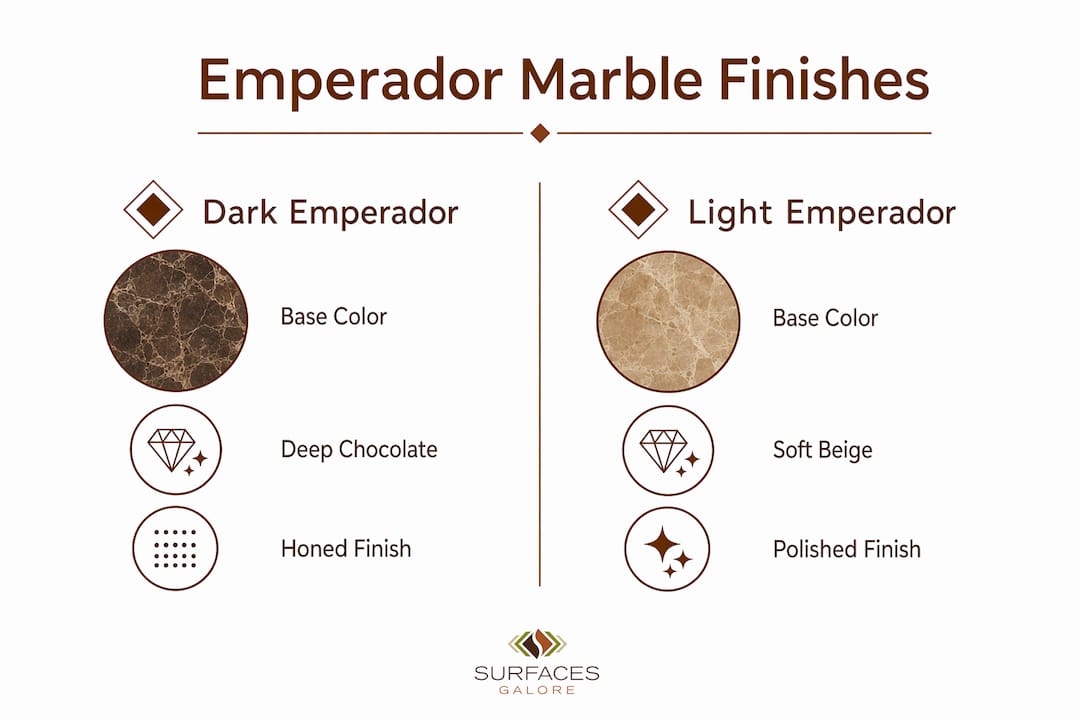
Emperador marble comes in two primary varieties, and choosing between them shapes the entire mood of a room. Dark Emperador features a deep chocolate brown base with complex cream to gold veining, while Light Emperador offers softer beige-brown tones with subtler, more restrained veining. Dark Emperador reads as bold and dramatic. Light Emperador reads as warm and approachable.
Dark Emperador
Dark Emperador is the variety most people picture when they think of brown marble. Its rich, near-espresso background makes veining pop with high contrast, which works especially well in spaces with strong natural light or white cabinetry. Designers use it to anchor a room visually, giving weight to large floor fields or statement countertops.
Light Emperador
Light Emperador suits spaces where the goal is warmth without drama. The softer base color blends more easily with wood tones, cream walls, and brushed brass or bronze fixtures. It reads as refined rather than bold, making it a strong choice for master bathrooms or powder rooms where the stone is meant to complement rather than dominate.
Finish options: polished vs. honed
Finish choice changes how Emperador reads in a space as much as color does.
- Polished: Brings out the full depth of color and makes veining appear sharp and vivid. Best for countertops and feature walls where visual impact is the goal.
- Honed: Produces a matte, velvety surface that softens the stone’s appearance. Preferred for floors where slip resistance matters and for bathrooms with a more understated aesthetic.
- Brushed or leathered: Less common but increasingly popular in 2026 kitchen design. Creates a textured surface that hides minor scratches and adds tactile interest.
Pro Tip: On floors, choose a honed or brushed finish for Emperador dark marble. Polished marble becomes slippery when wet, and the honed surface actually reads darker and richer in person than it does in photos.
| Feature | Dark Emperador | Light Emperador |
|---|---|---|
| Base color | Deep chocolate brown | Soft beige-brown |
| Veining intensity | High contrast, cream to gold | Subtle, muted tones |
| Best finish | Polished or honed | Honed or brushed |
| Ideal application | Feature walls, countertops | Bathroom floors, vanities |
| Design mood | Bold and dramatic | Warm and refined |
How can Emperador marble be used in kitchen and bathroom renovations?
Emperador marble works across nearly every surface in a kitchen or bathroom, and that versatility is one of its strongest selling points. Designers use it as a grounding stone paired with lighter marbles like Crema Marfil to add architectural weight without overwhelming a space. The contrast between dark Emperador and a pale stone creates visual rhythm on floors and walls without requiring pattern or color from other materials.
Best applications for kitchens
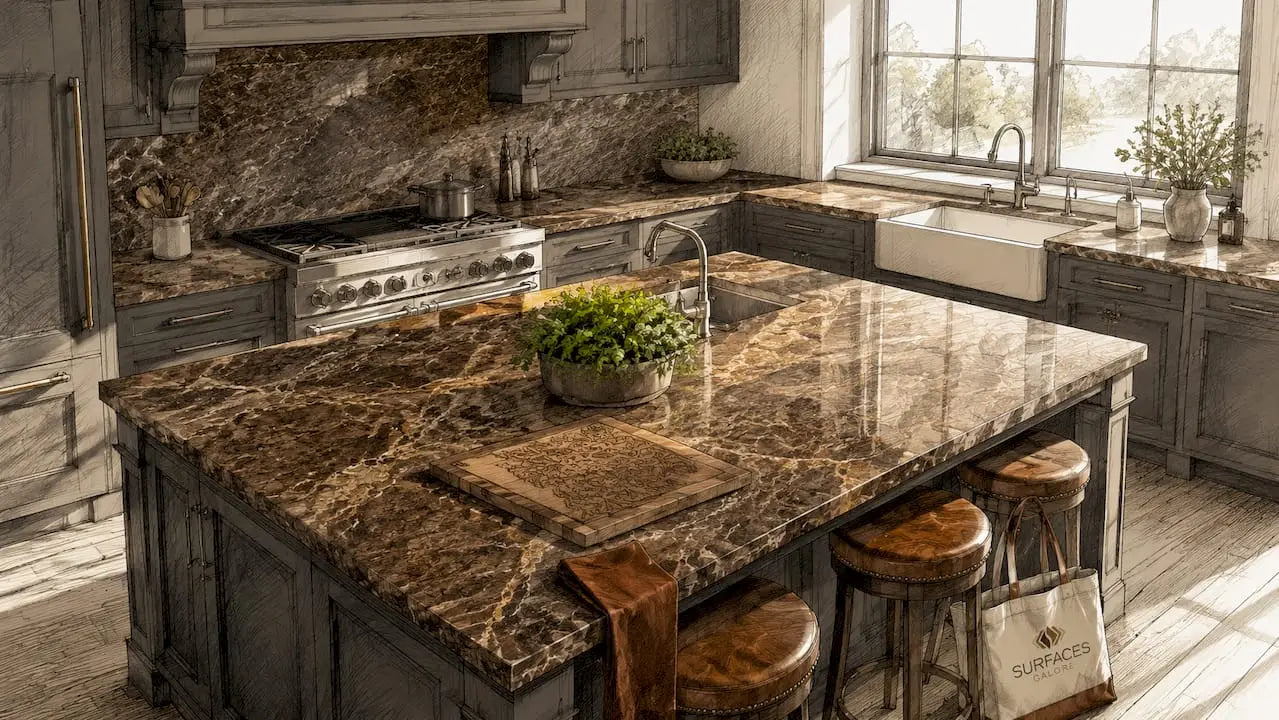
Luxury marble countertops in Emperador are a natural fit for kitchen islands where the stone becomes the room’s centerpiece. The warm brown tones work particularly well against white shaker cabinets, matte black hardware, or natural oak. Splashbacks in Emperador behind a range or sink add depth without competing with other design elements.
- Kitchen island countertops: The large slab format shows off veining at its best.
- Splashbacks: A full-height Emperador splashback behind a range creates a dramatic focal point.
- Flooring: Large format tiles in a herringbone or straight lay pattern ground an open-plan kitchen.
- Shelf and niche liners: Small applications of Emperador inside open shelving add warmth and texture.
Best applications for bathrooms
Bathroom vanities in Emperador are among the most popular uses for this stone in residential renovation. The warm brown tones complement chrome, brushed nickel, and matte black fixtures equally well. Emperador pairs beautifully with natural timber and brushed metal accents, which is why it appears so often in spa-style master bathrooms.
- Vanity tops: Durable and visually striking, especially with undermount sinks.
- Shower walls: Full-height Emperador in a shower creates a luxurious, enveloping effect.
- Feature walls: A single Emperador accent wall behind a freestanding tub is a signature move in high-end bathroom design.
- Floor tiles: Works well in both large format and mosaic formats for shower floors.
One important limitation: Dark Emperador is recommended for indoor use only. Its moisture sensitivity makes it unsuitable for outdoor flooring or exposed exterior applications. Stick to kitchens, bathrooms, and interior living spaces.
Pro Tip: When pairing Emperador with Crema Marfil or another light marble, use the lighter stone for the field and Emperador as a border or feature strip. This approach, explained in detail in Surfacesgalore’s marble tile matching guide, creates a grounded, layered look without making the room feel heavy.
What are the essential installation considerations for Emperador marble?
Proper installation determines whether Emperador marble looks stunning for decades or starts showing problems within a few years. The stone’s natural porosity and weight require specific adhesive, grout, and surface preparation choices that differ from ceramic or porcelain tile work.
Step-by-step installation guidance
- Prepare the substrate. The subfloor or wall surface must be flat, stable, and free of flex. Any movement in the substrate will crack natural stone over time. Use a cement backer board for wet areas.
- Select a high-performance adhesive. Use a white or gray polymer-modified adhesive rated for natural stone. Avoid standard tile adhesives, which can stain porous stone from below.
- Apply the adhesive with a notched trowel. Back-butter each tile as well as the substrate for full coverage. Voids beneath the stone cause cracking under load.
- Set tiles with consistent spacing. A grout width of 3–5mm is the industry-recommended range for Emperador floor tiles. This width accommodates natural size variation between tiles while keeping joints visually tight.
- Choose grout color carefully. Grout colors matching mid-tone veins in Emperador, such as dove gray or slate gray, reduce harsh contrast lines and keep the stone’s natural movement as the visual focus.
- Allow full cure before grouting. Wait at least 24 hours after setting tiles before applying grout. In wet areas, extend this to 48 hours.
- Seal before and after grouting. Apply a penetrating sealer to the stone face before grouting to prevent grout from staining the surface. Seal again after grout cures.
Pro Tip: Test a water droplet on your Emperador tiles before installation. If the stone absorbs the water within a few minutes, a high-performance sealer is required before any grouting or use. This simple test prevents irreversible staining.
| Installation factor | Recommendation |
|---|---|
| Grout joint width | 3–5mm |
| Adhesive type | Polymer-modified, white or gray |
| Substrate requirement | Flat, rigid, cement backer in wet areas |
| Grout color | Mid-tone gray matching stone veins |
| Sealing timing | Before grouting and after grout cures |
For a thorough walkthrough of marble floor installation, Surfacesgalore’s marble installation guide covers every step from substrate prep to final sealing.
How to maintain Emperador marble surfaces and preserve their beauty
Emperador marble is a metamorphic limestone variant, which means it is more porous and prone to moisture absorption than granite or quartzite. That porosity is manageable with the right maintenance routine, but ignoring it leads to staining that is difficult or impossible to reverse.
Sealing
Sealing is the single most important maintenance step for Emperador marble. Sealing protects against stains and moisture penetration, which is especially critical in kitchens and bathrooms where liquid exposure is constant. Use a penetrating impregnating sealer rather than a topical coating. Penetrating sealers soak into the stone and protect from within without altering the surface appearance.
Reseal Emperador marble every 12–24 months in high-use areas like kitchen countertops. In lower-traffic areas like a bathroom feature wall, resealing every two to three years is sufficient. The water droplet test tells you when resealing is due: if water absorbs into the stone rather than beading on the surface, the sealer has worn down.
Cleaning
- Use pH-neutral stone cleaners. Products formulated for natural stone are safe for daily use on Emperador.
- Avoid acidic cleaners. Vinegar, lemon juice, and most bathroom tile sprays etch the marble surface. Etching appears as dull spots that require professional polishing to remove.
- Avoid bleach and ammonia. These strip the sealer and can discolor the stone over time.
- Wipe spills immediately. Coffee, red wine, and cooking oils are the most common staining agents in kitchens. Blot rather than wipe to avoid spreading the stain.
- Use soft cloths or microfiber mops. Abrasive scrubbers scratch polished surfaces.
Grout and long-term care
Grout lines in Emperador installations need their own protection. Apply a grout sealer after installation and refresh it annually in wet areas. Discolored or crumbling grout should be regrouted promptly because water infiltration behind the tiles causes far more damage than surface staining.
Pro Tip: Place stone-safe trivets under hot pots on Emperador countertops. Thermal shock from direct heat contact can cause micro-fractures in marble that are invisible at first but expand over time.
Signs that professional restoration is needed include deep etching across large surface areas, persistent staining that does not respond to cleaning, or visible cracks. A stone restoration professional can re-hone or re-polish the surface and apply a fresh sealer to bring the stone back to its original condition.
Key takeaways
Emperador marble delivers luxury-grade aesthetics at a moderate price point, but its porosity demands proper sealing, grout selection, and pH-neutral cleaning to maintain its beauty long-term.
| Point | Details |
|---|---|
| Two main varieties | Dark Emperador is bold and dramatic; Light Emperador is warm and understated. |
| Finish matters | Honed finishes suit floors and wet areas; polished finishes maximize visual impact on countertops. |
| Installation precision | Use a 3–5mm grout joint and match grout color to mid-tone veins for a clean result. |
| Sealing is non-negotiable | Apply a penetrating sealer before grouting and reseal every 12–24 months in high-use areas. |
| Indoor use only | Dark Emperador is not suitable for outdoor flooring due to moisture and weather sensitivity. |
Why Emperador marble still earns its place in serious design projects
I have seen a lot of stone trends come and go over the past decade. Dramatic white marbles with bold gray veining dominated the early 2020s, and for a while it felt like every kitchen renovation featured the same pale slab. Emperador marble never disappeared during that period. It just waited.
What makes Emperador genuinely different from most brown marble options is the layering in its veining. The cream and gold lines do not run in a single direction. They branch, intersect, and shift in ways that make large format installations look almost three-dimensional. That quality is hard to replicate with engineered stone, and designers who have worked with both materials know the difference immediately.
The misconception I hear most often is that Emperador is too dark for smaller spaces. That is wrong. A honed Light Emperador on a bathroom floor in a compact space reads as warm and grounded, not heavy. The key is pairing it with reflective surfaces, pale walls, and good lighting. The stone actually makes the room feel more considered rather than smaller.
The other thing people underestimate is how well Emperador ages. Unlike white marbles that show every etch and scratch, the dark base color of Emperador absorbs minor wear into its character. A countertop that has been in daily use for ten years develops a patina that looks intentional. That is not true of every stone, and it is a real advantage for kitchen applications where the surface takes constant abuse.
For 2026 renovations, I expect Emperador to appear more frequently alongside warm metals like unlacquered brass and aged bronze, and paired with textured plaster walls rather than painted drywall. The design direction is moving toward layered warmth, and Emperador fits that direction better than almost any other natural stone. You can see how this plays out in real projects in Surfacesgalore’s 2026 marble applications guide.
— cihan
Authentic Emperador marble collections at Surfacesgalore
Surfacesgalore is a direct importer of premium natural stone based in Anaheim, California, shipping nationwide to homeowners, designers, architects, and contractors.
The Surfacesgalore collection includes both Dark and Light Emperador marble in multiple formats, from large format floor tiles to mosaic sheets and custom cut pieces for countertops and vanities. Every piece is sourced for color consistency and structural quality, so what you see in the sample matches what arrives on site. Browse the full natural stone tile collection to find the right Emperador variety for your kitchen or bathroom renovation, or reach out directly for guidance on quantities, finishes, and pairing options.
FAQ
What is Emperador marble?
Emperador marble is a natural brown marble quarried primarily in Spain, defined by its chocolate to beige base color and cream to gold veining. It is classified as a metamorphic limestone and is widely used for luxury countertops, flooring, and bathroom applications.
How much does Emperador marble cost?
Emperador marble typically costs between $10 and $15 per square foot, placing it in the moderately priced luxury stone category below Calacatta or Statuario marble.
Is Emperador marble suitable for kitchen countertops?
Yes. Emperador marble works well for luxury marble countertops when properly sealed with a penetrating impregnating sealer. Reseal every 12–24 months and wipe spills immediately to prevent staining from acidic substances.
What grout width is recommended for Emperador marble tiles?
The industry-recommended grout width for Emperador floor tiles is 3–5mm. Pair the grout with a mid-tone gray color that matches the stone’s veining to minimize harsh contrast lines.
Can Emperador marble be used outdoors?
No. Dark Emperador marble is recommended for indoor use only. Its porosity makes it sensitive to moisture and weather exposure, which causes deterioration in outdoor flooring applications.
Leave a comment