
From $150–$300 Installed: Italian Statuary Checks for Designers

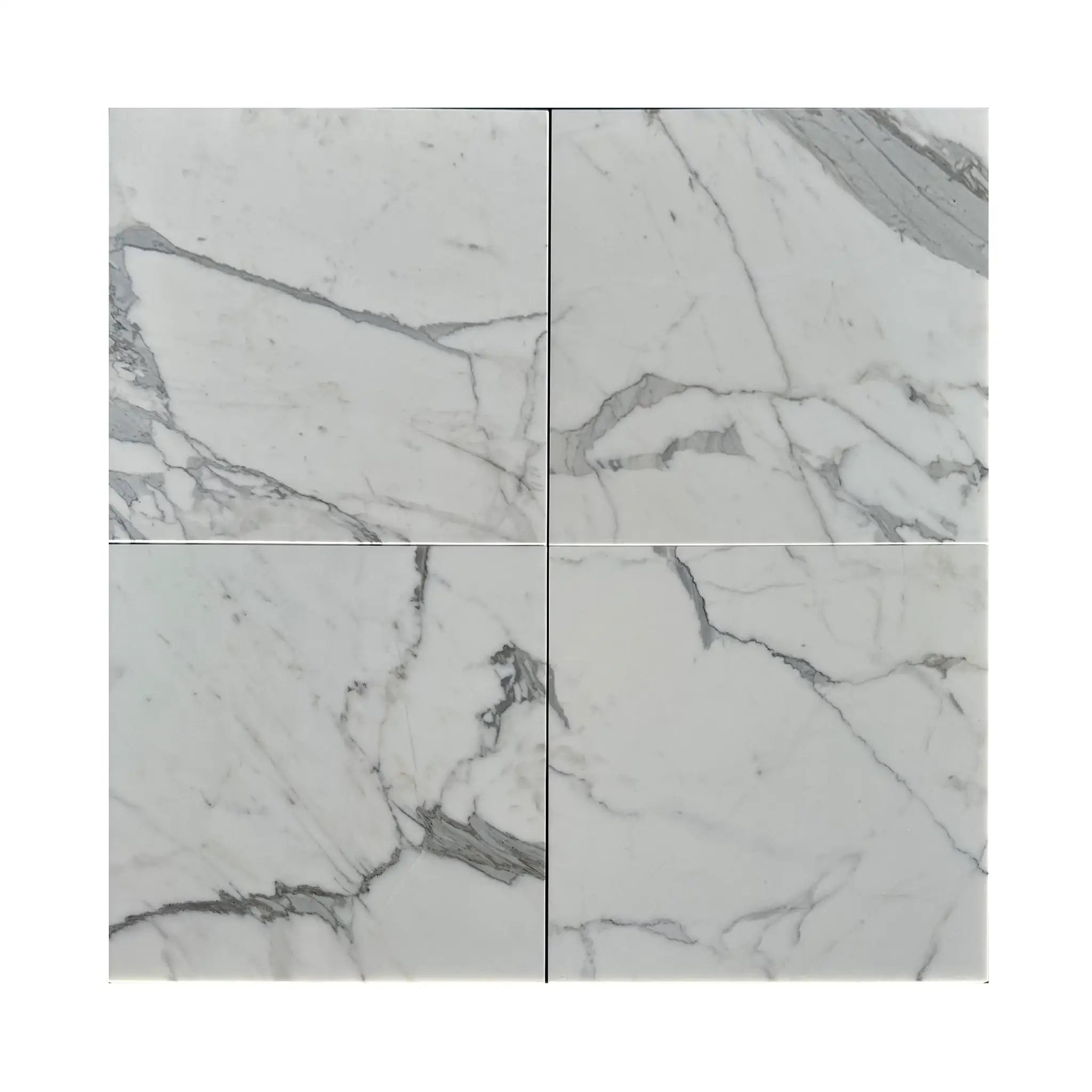
Italian statuary marble is an ice-white, high-purity marble from the Carrara region of Italy, marked by bold, dramatic grey veining. It belongs on a focal, low-traffic surface, a waterfall island, a vertical feature wall, a sculptural sink, where its pattern can be seen and its softness protected. Statuario tile is available in 12x12, 18x18, and 6x12 formats to suit various design needs.
TL;DR:
- Genuine Statuario marble is sourced from specific benches in the Apuan Alps, with strict identification confirmed by quarry documentation and slab photos.
- It features a luminous white background with bold, widely spaced grey veins, and slight translucence when backlit, indicating high quality.
- Statuario’s price is generally mid-to-premium, higher than Carrara but below Calacatta, with availability limited by regional quarrying restrictions and environmental regulations.
- Best used for feature islands, vertical walls, and low-traffic surfaces due to its delicate calcite nature and sensitivity to acids and etching.
- Suppliers should provide detailed slab provenance, prompt sample inspection, and proper sealing; higher-cost varieties command a premium for purity and pattern consistency.
Table of Contents
- What Is Statuario Marble and How Do You Identify It?
- Statuario vs Carrara vs Calacatta: Choosing the Right White Marble
- Best Applications and Design Brief Language for Statuario
- How to Specify, Order, and Inspect Statuario for a Project
- Sealing, Cleaning, and Long-Term Care for Statuario Interiors
- Sourcing, Scarcity, and Verifying Authenticity
- Common Quality Grades and Classifications Within Statuario Marble
- Comparative Durability and Technical Properties Versus Other Marbles
- Environmental and Ethical Considerations in Quarrying and Sourcing Statuario
- History and Origin of Italian Statuario Marble
- Major Quarries in Italy Producing Statuario Marble
- A Trade Perspective on Sourcing Statuario
- Surfaces Galore Statuario Tile Options and How to Order
- Sources
- FAQ
What Is Statuario Marble and How Do You Identify It?
Statuario earned its name because Renaissance carvers chose it for statuary, work that demanded a stone pure enough to hold fine detail without competing veins or gray patches. That history still shapes how the trade defines the real thing today.
True Statuario comes from specific benches in the Apuan Alps near Carrara, a mountain range that has supplied marble to Italy since antiquity. Not every white marble labeled “statuary” in a showroom actually originates there, which is why identification matters before you commit a project budget.
Look for three things on the slab itself:
- A luminous, near-white background with minimal gray or beige undertone
- Bold, well-defined charcoal or dark grey veins that run in distinct, often dramatic patterns rather than fine hairline threads
- A slight translucence in the calcite when backlit, a trait that separates high-grade Statuario from denser, more opaque white marbles
Pro Tip: Ask to see the slab in natural daylight, not just under showroom lighting. Statuario’s undertone can shift noticeably between warm interior bulbs and true daylight, and that difference matters once it’s installed next to your cabinetry or fixtures.
Genuine Statuario is quarried in limited benches, and that scarcity is baked into the price. Reputable importers document each block with a quarry and block number, along with photos of the actual slab you’re buying rather than a representative sample. Request that paperwork before approving anything. A supplier who can’t produce it is a signal to slow down, not a formality to skip.
Statuario vs Carrara vs Calacatta: Choosing the Right White Marble
The three most requested white Italian marbles look similar in a photo and behave very differently on a job site. Here’s how they split:
- Carrara: Softer gray background, fine and closely spaced veining, most affordable of the three, widely available in large quantities
- Statuario: Brighter white ground, bold and widely spaced charcoal veins, moderate to limited availability, mid-to-premium pricing
- Calacatta: Brightest white background of the group, thick and dramatic gold or grey veining, the rarest and typically the most expensive
Trade guides consistently place Statuario between Carrara and top-tier Calacatta on both price and rarity, with the exact position depending on the specific grade and quarry lot. Fabrication cost tracks the same curve. Statuario’s bold veining rewards bookmatching, cutting adjacent slabs so the pattern mirrors across a seam, but that technique demands more slab yield per finished area and drives up waste. If your project has a firm budget ceiling, Carrara or a mixed-material approach often makes more financial sense than stretching for Statuario across large square footage. Save it for the moments that need drama.
Best Applications and Design Brief Language for Statuario
Statuario performs best where it’s seen, not walked on constantly. Trade sourcing guides consistently recommend it for feature islands, vertical cladding, and sculptural sinks, applications where the visual drama stays intact and cleaning stays manageable.
- Kitchen islands and waterfall edges — the single highest-value use; a bookmatched island face becomes the room’s focal point.
- Vertical feature walls and fireplace surrounds — no foot traffic, no spills, just the veining on full display.
- Bathroom vanities and freestanding sinks — low wear, high visual payoff, and easy to seal properly since the surface isn’t handling daily abrasion.
- Accent backsplashes — a 6x12 or 12x12 format works well behind a range or in a tub surround where pattern continuity matters more than square footage.
- Avoid it for: high-traffic kitchen floors, commercial entryways, or any surface exposed to frequent acidic spills without vigilant maintenance.
A sample spec line might read: “Statuario White, polished finish, 3cm, bookmatched pair, honed alternative available for a softer sheen on vertical applications.” Polished brings out the stone’s brightness and vein contrast best; honed suits a quieter, matte look on floors or walls where glare isn’t wanted.
If the budget won’t stretch to a full room in Statuario, use it strategically. Specify it for the island and a matching backsplash, then pair it with a more durable, less expensive stone for perimeter counters and flooring. Designers can also use smaller formats like the 12x12 tile for accent bands instead of covering an entire floor, which preserves the visual impact while controlling material cost.
How to Specify, Order, and Inspect Statuario for a Project
Before you commit to a slab or tile lot, run through a short checklist with your supplier:
- Request the quarry and block number for the specific lot you’re purchasing.
- Ask for actual slab photos, not catalog stock images.
- Confirm the finish (polished or honed) and thickness (2cm or 3cm) match your fabrication plan.
- Verify edge detail options if the piece will be an island or vanity top.
- Ask about back-netting or resin reinforcement on thinner cuts.
On logistics, build in buffer time. Genuine Statuario often has longer lead times than domestic stone, and reinforced or bookmatched slabs can add 15 to 25 percent to fabrication cost due to the extra care and yield loss involved. Order a physical sample before finalizing a full order.
- Confirm crate packing and insurance coverage for transit.
- Ask your fabricator about template timing, most shops want the space fully framed before templating a bookmatched piece.
- Discuss custom fabrication needs early if you’re specifying a waterfall edge or integrated sink.
Sealing, Cleaning, and Long-Term Care for Statuario Interiors
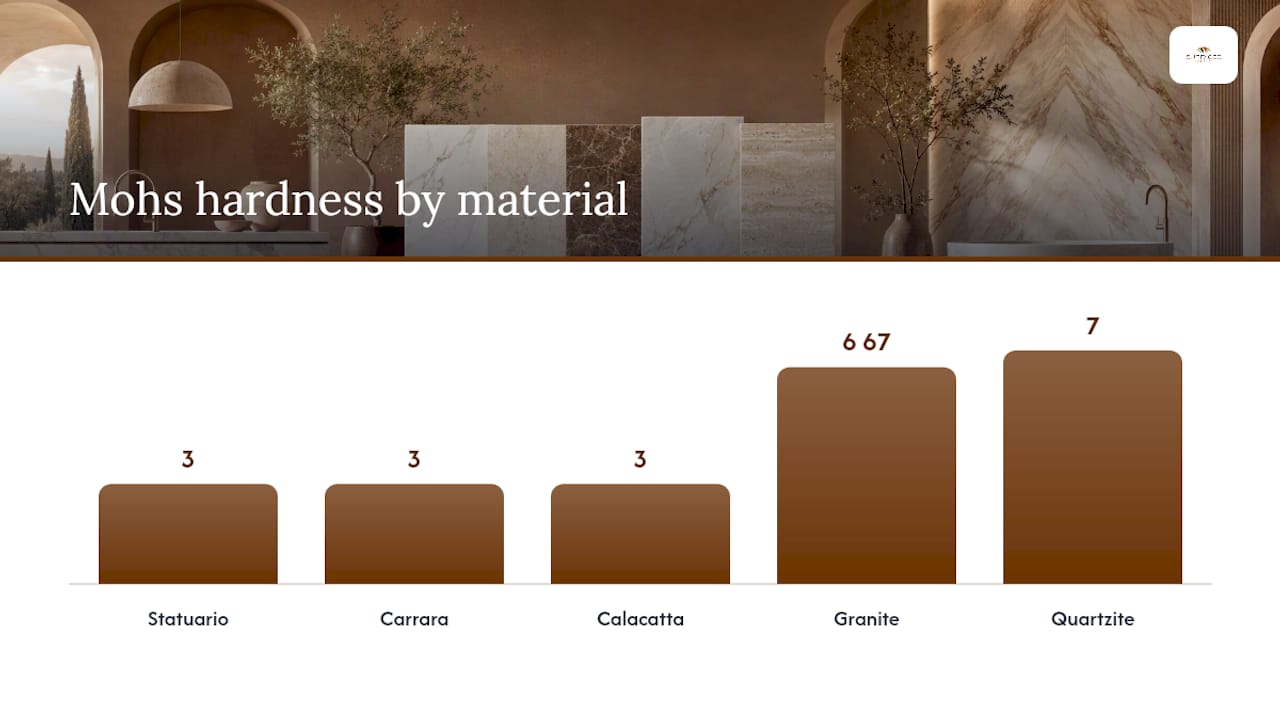
Statuario is a calcite stone with a Mohs hardness around 3, which makes it soft compared to granite or quartzite. That softness is exactly why it etches easily when it meets something acidic.
Wipe up wine, citrus, and vinegar spills immediately. A dull spot from lemon juice left overnight isn’t a stain you can scrub out; it’s the surface itself reacting chemically, and it usually needs professional honing to fix.
- Use a pH-neutral stone cleaner, never anything labeled “descaler” or “multi-surface acid clean.”
- Skip vinegar-based DIY cleaning solutions entirely, they’re one of the most common causes of etched marble countertops.
- Reapply an impregnating sealer every 12 to 18 months, more often in high-humidity kitchens or bathrooms.
Pro Tip: Keep a small sample chip of your installed Statuario in a drawer. If you ever need to test a new cleaning product or check how it reacts to a specific spill, test it on the chip first, not the countertop.
Minor dulling can often be buffed out by a professional restorer with a marble polishing compound. Deep etching, cracks, or chips need a stone restoration specialist, not a DIY fix.
Sourcing, Scarcity, and Verifying Authenticity
Genuine Statuario comes from a narrow set of quarry benches, and tightening EU permit conditions have made supply tighter in recent years, which pushes lead times out and prices up for top-grade material.
- Request block/quarry number and exporter documentation before final approval.
- Ask how the supplier crates and insures slabs for transit.
- Reserve material early if your timeline is fixed, popular veining patterns sell out of a given lot fast.
- Budget for a mixed-material approach if full-room Statuario isn’t financially realistic.
Common Quality Grades and Classifications Within Statuario Marble
Not all Statuario coming out of the same general quarry area grades the same, and understanding the tiers helps explain why two slabs can carry very different price tags.
Premium/Statuario Extra sits at the top: the whitest possible background with minimal beige or gray undertone, and veining that’s bold but still visually balanced rather than chaotic. This grade is what most designers picture when they hear the name, and it commands the highest price per square foot.
Standard Statuario still qualifies as genuine material from the correct quarry benches, but the background may carry a slightly warmer or more uneven tone, and veining can run denser or more scattered across the slab. It’s still a beautiful stone, just less uniform, and it typically costs less than the extra grade.
Statuarietto, sometimes used in the trade for a finer-veined variant, splits the difference between Statuario and standard Carrara, offering some of the brightness and vein contrast at a gentler price point.
Grading isn’t governed by a single universal industry standard the way, say, diamond clarity is. It’s largely a function of individual quarry output and how importers and fabricators sort slabs by eye. That’s precisely why requesting actual slab photos matters more than trusting a grade label alone. Two slabs both marketed as “premium Statuario” from different suppliers can look meaningfully different once they arrive on site.
Comparative Durability and Technical Properties Versus Other Marbles
Statuario sits at roughly 3 on the Mohs hardness scale, the same general range as most calcite-based marbles, including Carrara and Calacatta. That places it well below granite (6 to 7) and quartzite (7), and even below some limestones with denser mineral structures.
Porosity is the other variable that matters more day to day than hardness. Statuario’s fine, tight crystalline structure gives it relatively low porosity for a marble, which is part of why it takes a polish so well and reflects light with that signature brightness. Low porosity doesn’t mean stain-proof, though. Without a properly applied impregnating sealer, oil and pigmented liquids can still work into the surface over time.
Compared to Carrara, Statuario behaves almost identically in terms of hardness and etch sensitivity, since both come from similar calcite deposits in the same general region. The practical difference is aesthetic, not structural. Compared to denser engineered surfaces or quartzite, Statuario will always be the more delicate choice, and that’s worth stating plainly to clients who assume “natural stone” means “indestructible.” It doesn’t. What Statuario offers instead is a depth and luminosity that manufactured surfaces still haven’t fully replicated, which is exactly why designers keep specifying it for the applications where softness is an acceptable tradeoff for beauty.
Environmental and Ethical Considerations in Quarrying and Sourcing Statuario
Marble quarrying in the Apuan Alps carries real environmental weight, and it’s worth understanding before specifying material at scale. Extracting stone from mountain benches involves significant water use for cutting and cooling, generates marble dust that requires careful management, and permanently reshapes the landscape being quarried.
Local Italian authorities have tightened extraction permits and environmental oversight in the region over recent years, part of a broader push to balance the economic importance of quarrying with conservation of the Apuan Alps’ ecosystem. That regulatory tightening is one of the forces behind the supply constraints discussed earlier in this guide, fewer active permits generally means less material reaching the export market.
For designers and homeowners weighing ethical sourcing, the most practical lever available is supplier transparency. Working with an importer who can trace a slab back to a specific quarry and block number isn’t just a fraud safeguard, it’s also the clearest available signal that the material was extracted and exported through documented, regulated channels rather than an unverifiable gray-market source. Asking for that paperwork does double duty: it protects your project from mislabeled stone, and it supports quarries operating within Italy’s environmental permitting framework rather than around it.
History and Origin of Italian Statuario Marble
The Apuan Alps have supplied marble to builders and sculptors for over two thousand years, and Statuario represents the purest tier of that output. Its geological formation began roughly 200 million years ago, when limestone sediment on the seafloor underwent intense heat and pressure during the formation of the Apennine mountain range, recrystallizing into the dense, crystalline calcite structure that defines marble today.
What makes Statuario specifically different from other marble emerging from the same broader region is mineral purity. The benches that produce true Statuario contain exceptionally low levels of the iron oxides and clay impurities that give other marbles their gray, beige, or yellow undertones. That purity is why Renaissance-era sculptors sought it out specifically for figurative statuary work, hence the name, where a stone free of distracting veining or discoloration was essential for carving faces, drapery, and fine anatomical detail.
Michelangelo is widely associated with Carrara-region marble for his sculptural work, and the same general quarry district that supplied Renaissance workshops centuries ago still produces Statuario today, though from a narrower set of specific benches than the broader marble output of the area. That continuity, stone from the same mountains that shaped some of the most famous statues of ancient Rome and the Renaissance now finishing kitchen islands in American homes, is part of what gives Statuario its enduring appeal among designers and architects.
Major Quarries in Italy Producing Statuario Marble
The Carrara district isn’t a single quarry, it’s a network of extraction sites spread across several mountain basins, each with slightly different mineral characteristics that show up in the finished slab.
The Fantiscritti basin is one of the most historically significant sources, with a quarrying history that traces back to Roman times. Material from this area tends to show the classic bold, widely spaced vein pattern most designers picture when they hear “Statuario.”
The Miseglia and Colonnata basins also contribute meaningful volume to the market, each with its own subtle variation in background whiteness and vein density. Stone from these benches can range from the brightest, most uniform Statuario to slightly warmer-toned material depending on the specific bench and depth extracted.
Because these basins sit close together geographically but produce genuinely different visual results, quarry and block documentation becomes essential rather than optional. Two slabs labeled simply “Statuario, Carrara” without a specific block number could come from benches with noticeably different vein character. That’s the practical reason experienced importers track block numbers so closely, and why designers specifying a large bookmatched installation should always confirm that every slab in the order comes from the same block.
A Trade Perspective on Sourcing Statuario
The most common mistake I see in project planning isn’t budget, it’s expectation. Designers pull a photo of a dramatically veined Statuario island from a portfolio site and assume every slab in that grade will look the same. It won’t. Marble is geology, not a printed material, and even slabs from the same quarry bench show real variation from one cut to the next.
The second recurring issue is bookmatch waste. Clients rarely account for the yield loss that comes with mirroring a vein pattern across a seam, and that gap between expectation and actual usable square footage causes more budget surprises than the price per square foot ever does.
Working directly with an importer rather than through several layers of distributors tends to shrink both problems. Shorter supply chains mean better slab traceability back to a specific block, and fewer handoffs mean fewer surprises on lead time.
— John | Surfaces Galore
Surfaces Galore Statuario Tile Options and How to Order
Surfaces Galore carries Statuario as a direct importer, which means the pricing skips the extra markup layers that come with buying through multiple middlemen and means nationwide shipping is built into how we operate, not bolted on as an afterthought.
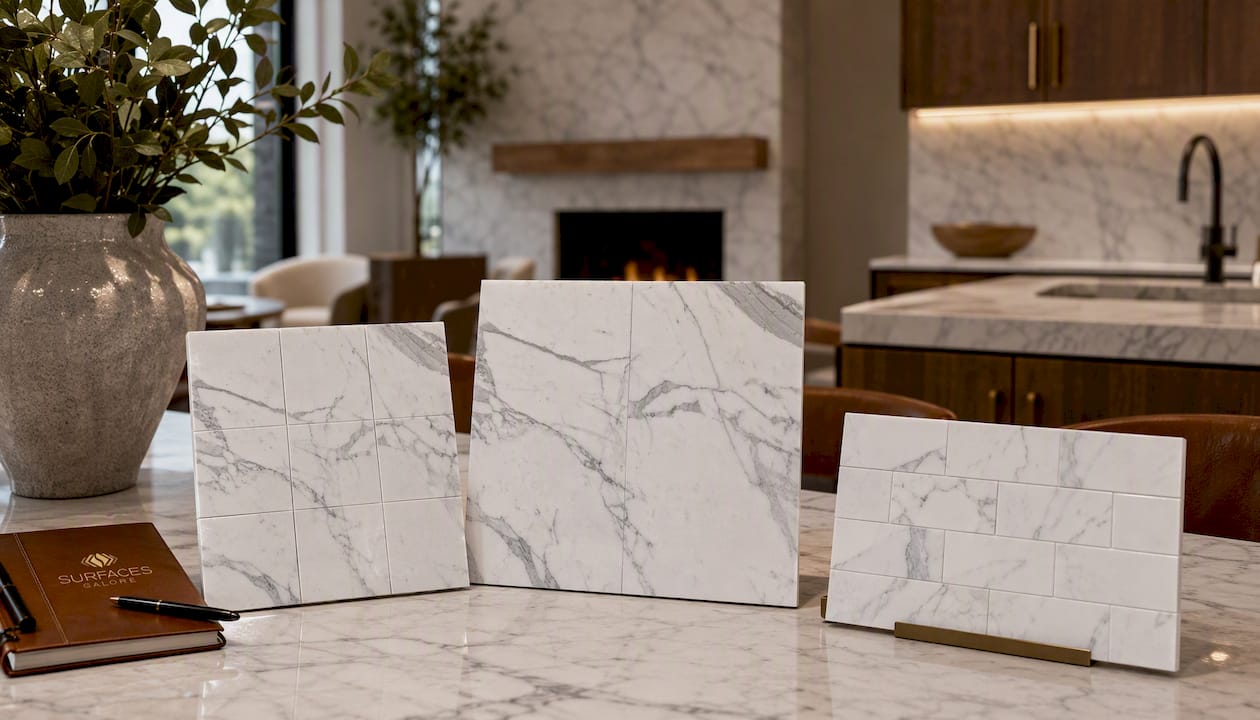
Three tile formats cover most residential and commercial specification needs. The 12x12 polished or honed Statuario tile works well for backsplashes and accent flooring where a classic proportion suits the space. The 18x18 format suits larger-format floor applications and low-traffic rooms where fewer grout lines make the veining read more continuously. The 6x12 tile fits detailed backsplash patterns, insets, and tighter accent areas where a smaller module reads better.
Trade customers get access to bulk quotes and custom order support for larger commercial jobs. Whether you’re speccing a single powder room or supplying a multi-unit residential build, you can request samples through Surfaces Galore to see actual veining and undertone before committing, ask for slab photos on larger orders, or reach out directly for a trade quote on volume pricing.
Sources
For deeper technical comparisons, see our guides on Carrara marble properties and grades and Calacatta marble. Designers researching fabrication should also review design applications for classic marble. Always request current slab photos and exporter documentation directly from your supplier before finalizing a Statuario order.
- STATUARIO | Marmi di Carrara since 1956 - The King of White Marble
- Italian Marble: Carrara, Calacatta, Statuario | SlabWise
- Is Statuario marble expensive? — Acemar
FAQ
Is Statuario Marble Expensive?
Yes, Statuario typically ranks among the higher-cost Italian marbles, with industry references citing installed price ranges often exceeding $150 to $300 per square foot depending on grade, slab size, and fabrication complexity.
What Does Statuario Marble Look Like?
Statuario has a bright, near-white background crossed by bold, widely spaced charcoal or dark grey veins, with a subtle translucence in the calcite that’s visible when backlit.
Is Italian Marble Valuable?
Genuine Italian marble, especially rare varieties like Statuario, holds strong value due to limited quarry supply, documented provenance, and centuries of proven use in high-end architecture and sculpture.
What Is the Most Famous Statue in Italy?
Michelangelo’s David is the most famous statue associated with Italian marble craftsmanship, carved from marble sourced from the Carrara region that also produces Statuario today.
How Do I Care for Statuario Countertops?
Wipe up acidic spills immediately, use only pH-neutral stone cleaners, and reapply an impregnating sealer every 12 to 18 months to protect against staining and etching.
Recommended
- Designer Guide to Travertine for Luxury Spaces
- Italian Marble Guide Types Applications and Advice
- Marble Custom Fabrication for Luxury Homes
- Stone Tile Cost Estimating Guide for U.S. Projects
This article is provided for general informational guidance only. Natural stone varies in color, veining, texture and performance. For installation, sealing, cleaning and maintenance, follow the product manufacturer’s instructions and consult a qualified installer or stone-care professional. Always test cleaning and sealing products in an inconspicuous area first. Surfaces Galore is not responsible for damage, discoloration, etching, staining, installation issues or other problems resulting from

Leave a comment