
6 Preorder Checks for White Dolomite Marble Buyers

White dolomite marble, sold under names like Bianco Dolomite and Super White, gives you the classic white, veined marble look with noticeably better everyday toughness than calcitic marbles like Calacatta or Statuario. It resists scratching and etches more slowly, but it’s still a calcareous stone that needs sealing and care around acid. For kitchen counters, floors, and bathroom walls that see real daily use, it’s one of the smarter marble-family choices on the market.
TL;DR:
- White dolomite marble offers better scratch resistance and slower etching than calcitic marbles, making it suitable for high-use areas like kitchens and bathrooms.
- Its mineral content, primarily calcium magnesium carbonate, provides a Mohs hardness of 3.5 to 4, slightly higher than traditional calcitic marbles.
- To maintain its appearance, sealing is essential, and acid testing before purchase is recommended to verify true dolomite and prevent mismatched or inferior slabs.
- Suitable finishes include polished and honed, with honed preferred for floors and shower areas to reduce slip risk and hide scratches.
- Cost ranges from $20 to $50 per square foot for entry-level, up to $120 for premium varieties, with installation costs varying based on complexity and location.
Table of Contents
- What Is White Dolomite Marble, and What Formats Come In?
- How Does Dolomite Differ From Calcitic Marble?
- Where Should You Use White Dolomite Marble?
- What Should You Check Before Buying White Dolomite Marble?
- How Do You Install and Maintain White Dolomite Marble?
- Where to Find White Dolomite Marble Tiles and Slabs
- The Case for Specifying Dolomite Over Chasing a Marble Name
- Get White Dolomite Marble Samples and Trade Pricing
- Sources
- FAQ
What Is White Dolomite Marble, and What Formats Come In?
White dolomite marble is a metamorphic stone composed largely of the mineral dolomite rather than calcite, which is what separates it from traditional white marbles. It forms the same way ordinary marble does, through the metamorphism of sedimentary rock, but starting from dolostone instead of limestone/08%3A_Metamorphic_Minerals_and_Metamorphic_Rocks/8.06%3A_Metasedimentary_Rocks/8.6.03%3A_Metamorphosed_Limestones_and_Dolostones_(Marbles)), which is why it behaves differently under a knife, a mop, or a squeeze of lemon.
Suppliers market this stone under several names, and the naming gets confusing fast. Bianco Dolomite, Bianco Dolomiti, and Super White all typically refer to dolomitic marble, though the exact mineral content and quarry origin can shift the hardness and veining pattern from one lot to the next. That’s why asking about quarry origin matters as much as asking about color when you’re comparing slabs, and it’s worth reading up on how quarry origin shapes a stone’s character before you commit to a large order.
On the format side, white dolomite shows up in a wide range of practical sizes:
- Tile formats: common sizes include 6x12, 12x24, and 18x18, with 12x24 being the go-to for floors and 18x18 popular for larger open layouts.
- Slabs: typically sold in standard thicknesses for countertops and vanity tops, cut to project dimensions by a fabricator.
- Trim pieces: pencil liners (often 1/2x12) and mosaics fill in backsplash and border details.
- Finishes: polished, honed, and leathered are all widely available, each changing the light reflection and slip resistance.
Before ordering in volume, request a physical sample and, if your yard offers it, look at installed photos. Retailers commonly emphasize sample programs precisely because color and veining photograph differently than they look in person. Lead times vary by finish and order size, so build a few extra weeks into your schedule if you need to trim pieces cut to match a specific slab lot.
How Does Dolomite Differ From Calcitic Marble?
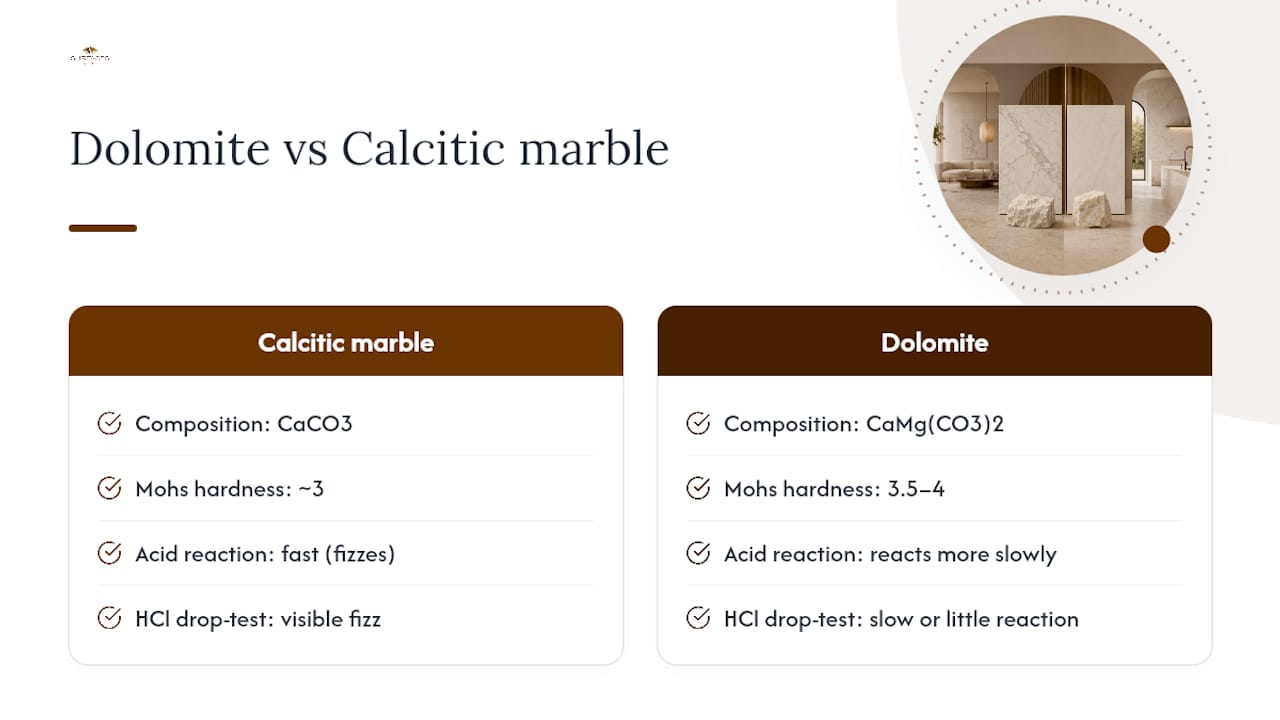
The mineral difference is the whole story here. Calcitic marbles like Carrara and Calacatta are built from calcium carbonate (CaCO3), while dolomite is calcium magnesium carbonate, CaMg(CO3)2. That extra magnesium in the crystal structure is what gives dolomite its edge in daily wear.
On the Mohs hardness scale, dolomite typically measures around 3.5 to 4, compared to roughly 3 for calcitic marble. That half-point to full-point difference sounds small, but on a kitchen island that gets pots, pans, and keys dragged across it for a decade, it adds up to visibly fewer surface scratches.
Acid resistance is where the reputation really comes from. Dolomite reacts more slowly to acidic substances than calcitic marble like wine, citrus, and vinegar, which is why it gets pitched as the “marble for people who cook.” Slower is not the same as immune, though. Left in contact with lemon juice long enough, dolomite will still etch, just less dramatically and less quickly than a Carrara countertop would under the same spill.
Field test: a simple drop of diluted hydrochloric acid tells you a lot. Calcite fizzes visibly on contact, while true dolomite reacts slowly or barely at all unless it’s been ground to powder. Any reputable stone yard should let you run this test on a sample piece.
Because dolomitic marbles range from nearly pure dolomite to blends with meaningful calcite content, the etch resistance you get can vary by quarry and even by lot. For a large commercial specification where acid resistance is a hard requirement, ask the supplier for a petrographic or XRF mineral report rather than relying on the product name alone.
Pro Tip: Bring a small bottle of white vinegar to the stone yard. Dab a drop on the back or an offcut of the exact slab you’re considering, wait 60 seconds, and check for dulling. It’s a five-minute test that can save you years of buyer’s remorse.
Porosity runs moderate to low depending on the specific stone, but every dolomitic marble needs a penetrating sealer before use. Skipping that step is the single most common installation mistake we see.
Where Should You Use White Dolomite Marble?
White dolomite earns its reputation in the rooms that take the most abuse. Kitchen countertops are the headline use case: you get the marble look with a stone that shrugs off a dropped cast-iron pan better than Carrara would. Polished finishes suit both countertops and accent walls where you want maximum light bounce and vein contrast.
Bathrooms are the other natural fit, especially shower floors and walls. Here, finish choice matters more than in a kitchen because water and soap film create slip risk on smooth stone.
- Countertops and backsplashes: polished or honed finish, either works well since spills are wiped quickly.
- Floors in living areas and hallways: honed finish reduces slip risk and hides light scratching better than polished.
- Shower floors: honed or a textured/leathered finish for grip, never a high polish underfoot.
- Accent walls and fireplace surrounds: polished finish for maximum shine and drama.
- Outdoor patios: proceed with caution. Extended acid rain exposure and freeze-thaw cycles haven’t been tested consistently across every dolomite variety, so confirm density and absorption specs with your supplier before specifying it outside in a freeze-prone climate.
Because natural stone varies lot to lot, order enough material from the same production run for a single room, and ask your supplier about book-matching if you want mirrored veining across a large island or a shower wall. A little planning here prevents the mismatched-vein headache that shows up after installation, when it’s far more expensive to fix.
What Should You Check Before Buying White Dolomite Marble?
Buying natural stone sight-unseen from a photo is how projects go wrong. Work through these checks before you commit to a full order:
- Request a sample and run the acid test. Confirm the dealer’s “dolomite” is actually dolomite and not a calcitic marble riding on the same marketing name.
- Inspect the actual slab or a current lot photo for veining, fractures, and fissures, not a stock catalog image from a different quarry run.
- Ask for lot numbers so multiple slabs or boxes of tile come from the same block and match visually.
- Confirm the finish matches the application (honed for wet floors, polished for vertical surfaces and counters).
- Ask about sealer recommendations and fabrication tolerances, especially for waterfall edges or mitered countertop corners.
- Calculate square footage with a waste factor, typically 10 to 15% extra for tile with a running-bond or diagonal layout.
On budget, expect a real range depending on grade and finish. Entry-level dolomite runs at a moderate price range per square foot for material only, while premium varieties with dramatic veining can reach $60 to $120 per square foot. Installed costs sit on top of that and swing widely based on fabrication complexity, edge profiles, and local labor rates.
| What to check | Why it matters |
|---|---|
| Acid-drop reaction | Confirms true dolomite vs. mislabeled calcitic marble |
| Lot number matching | Prevents visible color or vein shifts across one room |
| Finish vs. application | Wrong finish creates slip risk or excess maintenance |
| Waste factor in square footage | Avoids a mid-project material shortage |
| Sealer type and schedule | Protects against staining and etching long-term |
Most residential kitchen or bathroom projects run four to eight weeks from order to installed countertop, longer if you’re waiting on a custom slab match or a busy fabrication shop.
How Do You Install and Maintain White Dolomite Marble?
Installation follows standard natural stone practice with a few dolomite-specific notes. For floors, a cement-based mortar over a properly prepared substrate handles the stone’s weight and won’t compromise the finish. For countertops, fabricators typically use epoxy or polyester resin at seams, color-matched to the veining. Grout choice matters more than people expect: a sanded grout close in tone to the stone hides the grout line better than a stark contrast color, especially on 12x24 or 18x18 layouts with tighter joints.
Sealing is non-negotiable on this stone. A penetrating sealer applied at installation, then reapplied annually to every one to two years depending on traffic, keeps the surface resistant to staining. Kitchen counters that see daily use lean toward the annual end of that range; a lightly used bathroom vanity can often stretch to two years between applications.
- Clean daily with a pH-neutral stone cleaner, never generic all-purpose sprays or anything with vinegar or bleach.
- Use trivets and cutting boards religiously in the kitchen, even though dolomite resists scratching better than calcitic marble.
- Wipe up wine, coffee, and citrus spills immediately rather than letting them sit, since slower etching is not zero etching.
- For minor etch marks, a marble-specific polishing powder buffed by hand often restores the shine; deeper etches usually call for professional honing or restoration.
Pro Tip: Keep a small bottle of the same polishing powder your installer used stored under the sink. Light etches caught early take five minutes to buff out; the same mark left for a month often needs a professional visit.
For a broader maintenance routine covering sealers and cleaning products across marble types generally, our guide on protecting luxury stone surfaces walks through the full schedule.
Where to Find White Dolomite Marble Tiles and Slabs

Surfaces Galore imports and stocks white dolomite marble directly, which means the material you see in photos is the material available to order, not a catalog stand-in from a different production run. As the a direct importer and nationwide supplier, the company sources dolomitic marble at the quarry level and passes that sourcing control on to buyers who want consistent lot matching.
Three products cover most residential and light commercial needs:
- White Dolomite with Gray Light 12x24 Polished Tile, sold in 180 square foot lots, works well for flooring and larger wall applications where a polished finish suits the room.
- Bianco Dolomite Pencil Liner in the 1/2x12 trim size, available polished or honed, finishes off backsplash edges and shower niches.
- Bianco Dolomite 18x18 Marble Tile, also available polished or honed, fits larger-format floor and wall layouts.
Every listing includes finish and sample ordering options, so you can hold the actual stone before committing to a full pallet. For readers who want to go deeper on technical selection criteria, or who are pairing stone choices with other finish decisions like glass interior doors and trim work, Surfaces Galore’s team, including writer John, publishes additional technical articles and offers direct trade contact for bulk and commercial quotes.
The Case for Specifying Dolomite Over Chasing a Marble Name
Most buyers shop for white marble by chasing a name: Calacatta, Statuario, Carrara. That instinct makes sense for a slab you’ll only ever see, but it falls apart the moment that slab becomes a kitchen counter someone actually cooks on. The name tells you almost nothing about how the stone will hold up to five years of lemon zest and cast iron.
What the mineralogy tells you is far more useful. A stone that’s 90% dolomite behaves differently than one that’s 60% dolomite and 40% calcite, and two slabs sold under the same marketing name can test differently under an acid drop. That’s the gap conventional buying advice skips over: it treats “dolomite” as a fixed category when it’s really a range.
If there’s one thing worth prioritizing over vein pattern or brand name, it’s running the acid test yourself before you sign off on a slab. Lot matching comes second. Vein aesthetics, as much as they drive the purchase decision emotionally, should come last. A gorgeous slab that etches like calcite the first time someone leaves a wine glass out overnight isn’t the win it looked like in the showroom.
— John | Surfaces Galore
Get White Dolomite Marble Samples and Trade Pricing
Direct import relationships with quarries can reduce markup compared to middleman distributors, potentially bringing pricing closer to true material cost for orders ranging from residential tiles to bulk commercial renovations.

For trade professionals, custom bulk quotes and sample requests move quickly, so a design firm specifying dolomite across several units doesn’t have to wait weeks between sample approval and order confirmation. Homeowners get the same direct-import pricing on smaller orders, with samples available before you commit to a full pallet of tile or a slab for your countertop. Start by requesting a sample of the 12x24 polished white dolomite tile or reach out for a bulk quote on your specific square footage, and get the acid test and lot-matching questions answered before material ships.
Sources
- Dolomite Stone: Complete Guide for Homeowners & Fabricators – Dynamic Stone Tools
- Dolomite White Dolomite — Technical Data & Care Guide | Stone Intelligence
- Stone+ / Marble technical notes
- Dolomite vs. Marble: What’s the Difference and Which Should You Choose? | Stone Moods
FAQ
What Is White Dolomite Marble?
White dolomite marble is a natural stone formed mainly from the mineral dolomite rather than calcite, giving it a white, marble-like appearance with greater hardness and slower acid reaction than traditional calcitic marbles.
Is Dolomite Marble Expensive?
Dolomite marble typically costs $20 to $50 per square foot for entry-level material and $60 to $120 per square foot for premium varieties, with installed costs on top depending on fabrication and location.
Is White Dolomite Marble Durable?
It’s more durable than calcitic marble in two specific ways: it typically measures harder on the Mohs scale (around 3.5 to 4 versus roughly 3) and it reacts more slowly to acidic spills, though it still needs sealing and can etch with prolonged acid exposure.
What Is White Dolomite Used For?
White dolomite is commonly used for kitchen countertops, backsplashes, flooring, shower walls, and accent walls, chosen specifically for rooms where marble’s classic look is wanted alongside better day-to-day wear resistance.
Recommended
- 4 Phase Marble Design Checklist for Homeowners and Design Pros
- Elegant White Marble Examples for Luxurious Home Design
- Top Marble Selection Tips 2025 for Stylish Projects
This article is provided for general informational guidance only. Natural stone varies in color, veining, texture and performance. For installation, sealing, cleaning and maintenance, follow the product manufacturer’s instructions and consult a qualified installer or stone-care professional. Always test cleaning and sealing products in an inconspicuous area first. Surfaces Galore is not responsible for damage, discoloration, etching, staining, installation issues or other problems resulting from

Leave a comment