
From $5–$20/sq ft: Porcelain vs Direct Import Stone for Living Room Tiles

Porcelain is the best living room tile option for most homeowners because it resists stains and scratches while offering wood-look planks and large-format slabs that mimic pricier materials. Natural stone, marble, limestone, and travertine deliver a depth of character porcelain still can’t fully replicate, and they suit lower-traffic or design-forward rooms. Wood-look porcelain splits the difference: the warmth of wood, none of the upkeep.
TL;DR:
- Porcelain is ideal for high-traffic living rooms due to its stain and scratch resistance, especially if you want minimal maintenance.
- Natural stone like marble and limestone offers unique veining and character but requires regular sealing and careful handling to prevent damage.
- Large-format porcelain tiles installed with minimal grout lines create a seamless, expansive look, enhancing room size perception.
- Proper sample testing in your room’s lighting is crucial, as showroom lighting can misrepresent tile tone and veining.
- Installation costs vary from $5 to $15 per square foot for porcelain and $7 to $20 for natural stone, with structural considerations for heavier materials.
Table of Contents
- Living Room Tile Options: The Main Materials to Know
- Porcelain vs Natural Stone: Which Performs Better in a Living Room?
- A Closer Look at Marble, Limestone, Travertine, Slate, and Porcelain
- Choosing the Right Size, Format, and Finish for Your Space
- What Living Room Tile Really Costs, and What to Plan For Structurally
- How to Choose Your Living Room Tile Without Regret
- Why Trust This Guidance on Living Room Tile
- A Perspective on Choosing Tile That Ages Well
- Order Samples and Start Your Living Room Tile Project
- Sources
- FAQ
Living Room Tile Options: The Main Materials to Know
Every living room tile choice comes down to a trade-off between performance and personality. Porcelain wins on the performance side. Natural stone wins on personality. Knowing what each material actually does helps you skip the guesswork before you’re standing in a showroom staring at forty samples.
Here’s a fast rundown of what each material brings to a living room:
- Porcelain — engineered clay fired at high heat, extremely dense, resists moisture and scratches, available in wood-look planks and slab-size formats. Best for high-traffic living rooms, homes with pets or kids, and anyone who wants zero maintenance drama.
- Ceramic — a softer cousin of porcelain, easier to cut, generally lower cost, but more prone to chipping under heavy furniture. Best for budget-conscious remodels or accent walls rather than the main floor.
- Marble — classic veined stone, polished or honed, reads as formal and upscale. Best for living rooms that see light foot traffic and where the owner accepts some patina over time.
- Limestone — a softer, more matte sedimentary stone with a muted, earthy palette. Best for a warm, understated look in transitional or Mediterranean-style interiors.
- Travertine — pitted, textured stone with rustic warmth, sold filled or unfilled. Best for casual, organic-feeling living rooms and open-plan spaces that flow into outdoor patios.
- Slate — a dense, textured metamorphic stone with strong grip and rich, moody coloring. Best for rooms that want a grounded, cabin-like or industrial aesthetic.
- Wood-look porcelain — porcelain printed and textured to resemble hardwood planks. Best for anyone who wants a wood floor’s look without wood’s sensitivity to moisture and scratching.
Photos on a screen rarely tell the truth about tone or veining. Pro Tip: Order physical samples and set them on your living room floor for a few days, checking them at morning and evening light, before you commit to a full order. Showroom lighting is engineered to flatter every tile in the building, which is exactly why it misleads buyers more than any other factor.
Porcelain vs Natural Stone: Which Performs Better in a Living Room?
Porcelain and natural stone solve different problems, and the right pick depends on how hard your living room actually works.
Porcelain is manufactured to be nearly non-porous, which means it shrugs off spilled wine, dropped Legos, and dragged furniture legs far better than most stone. It’s generally more stain and scratch resistant than natural stone, a difference that matters most in households with kids, pets, or frequent entertaining. Marble, limestone, and travertine are more porous by nature. They need sealing, they can etch from acidic spills, and they show wear as a patina rather than hiding it.
Here’s how the two stack up on the factors that matter most:
- Durability and porosity: Porcelain is nearly impervious to moisture; natural stone absorbs liquids unless properly sealed.
- Aesthetic character: Porcelain looks consistent tile to tile; stone offers one-of-a-kind veining and color movement no two slabs repeat.
- Installation complexity: Porcelain is lighter and more forgiving on substrate; stone often demands more precise leveling and, in some cases, structural review.
- Cost and lifecycle: Porcelain typically costs less upfront; stone can carry a higher lifetime value if you value patina over pristine uniformity.
Installation costs bear this out directly. Porcelain installation commonly runs $5 to $15 per square foot, while natural stone tends to start higher, often $7 to $20 per square foot once you account for sealing, cutting, and site prep. Large-format porcelain also earns points for predictable slip ratings and architectural reliability, which matters if you’re matching your living room floor to an adjoining interior door replacement or hallway surface. Porcelain’s consistency also makes it the safer pick when you need continuity across connected rooms, since a natural stone slab from a new batch may never match your original order exactly.
A Closer Look at Marble, Limestone, Travertine, Slate, and Porcelain
Each material has its own quirks, and knowing them before you order saves you from a costly mismatch between expectation and reality.
Marble comes polished, honed, or brushed. Polished marble looks glamorous but scratches and etches more visibly, especially near a fireplace hearth where ash or soot can settle. Honed marble hides wear better and reads as softer and more contemporary. Either finish needs sealing roughly every 6 to 12 months in a living room, less often than a kitchen counter but not something you skip forever. Marble fits formal living rooms, entryway-adjacent spaces, and rooms where you want a showpiece floor rather than a workhorse one.
Limestone has a chalky, matte surface and a narrower color range, mostly warm creams, grays, and taupes. It’s softer than marble, so it dents and scratches more easily under heavy furniture, but that same softness gives it an aged, quarried look many designers chase intentionally. Reseal it annually if the room sees regular use. Design guidance from Salvatori notes that softer stones like limestone can develop genuinely attractive patina in formal living spaces, provided the owner is willing to maintain it.
Travertine is sold filled (holes patched with resin or grout for a smoother surface) or unfilled (raw, pitted texture left exposed). Filled travertine suits a refined, modern living room; unfilled travertine leans rustic and works beautifully in spaces that open onto a patio or courtyard. Explore the natural stone options built for living-room foundations if you want to see how these materials read at full room scale rather than as a single sample chip.
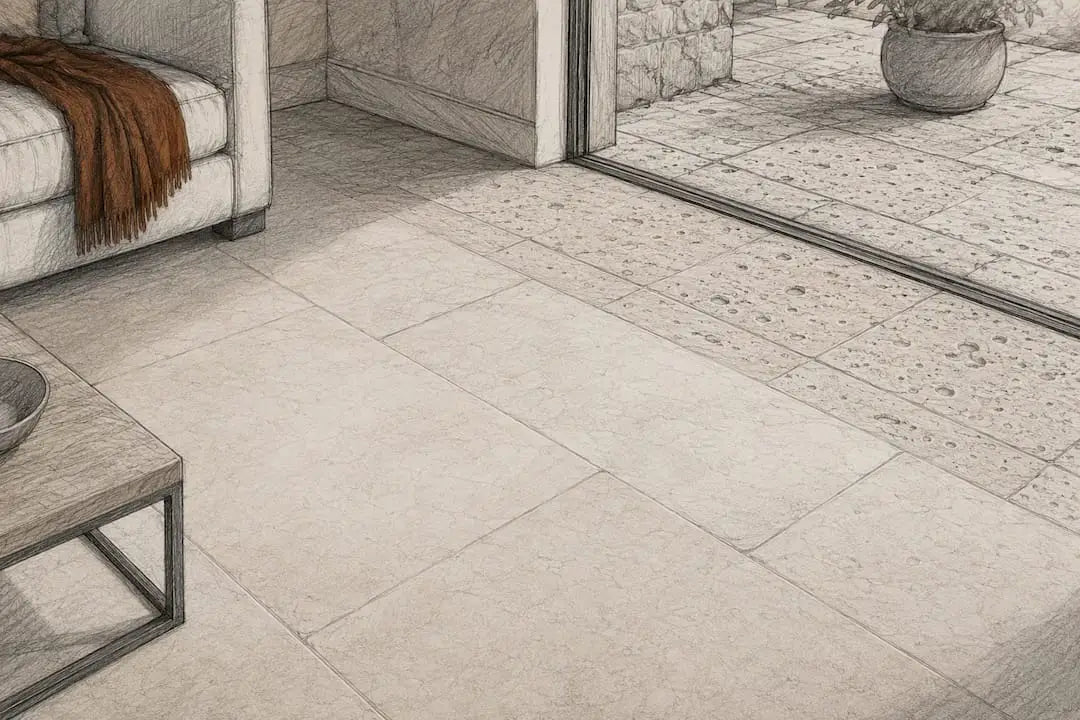
Slate brings texture and grip other stones can’t match, along with deep charcoal, green, or rust tones. It handles heavier traffic than marble or limestone, making it a solid choice for a mudroom-adjacent den or a living room with a rugged, cabin-style palette.
Porcelain now comes in plank formats, large-format slabs up to five feet long, and rectified edges that create razor-thin grout lines. Wood-look porcelain uses high-resolution printing and textured surfaces to mimic oak or walnut grain convincingly at arm’s length, without the scratching or humidity sensitivity real hardwood suffers.
Choosing the Right Size, Format, and Finish for Your Space
The tile you pick matters less than how it’s laid, sized, and finished. Two identical materials can make a room feel twice as large or half as busy depending on these choices.
- Go large format with minimal grout for visual calm. Bigger tiles and thinner grout lines make a living room floor read as one continuous surface rather than a checkerboard, which is why large formats are favored for reducing grout lines and creating continuous floors.
- Use plank formats to create directional flow. Long, narrow tiles laid parallel to your longest wall visually stretch a room, similar to hardwood strip flooring.
- Pick your finish based on how the light hits the room. Honed finishes cut glare and are often recommended for living areas where a softer look matters more than shine; polished finishes show footprints and dust more readily.
- Match grout to your intent. Grout that blends with the tile disappears and emphasizes the material; grout in a contrasting tone turns the floor into a pattern in its own right.
- Choose a layout pattern deliberately. Herringbone adds motion and works well with plank-format porcelain; staggered brick lay feels calmer; straight lay is the safest choice for large-format slabs where pattern would compete with the stone’s natural veining.
What Living Room Tile Really Costs, and What to Plan For Structurally
Budgeting for a living room tile project means accounting for more than the per-square-foot price tag on a sample.
Sealing is the recurring cost people forget. Marble and limestone typically need resealing every 6 to 12 months; travertine, depending on whether it’s filled, can go a bit longer. Skip harsh acidic cleaners like vinegar or bleach on any natural stone. They break down sealer and etch the surface. A pH-neutral stone cleaner is the only safe long-term choice.
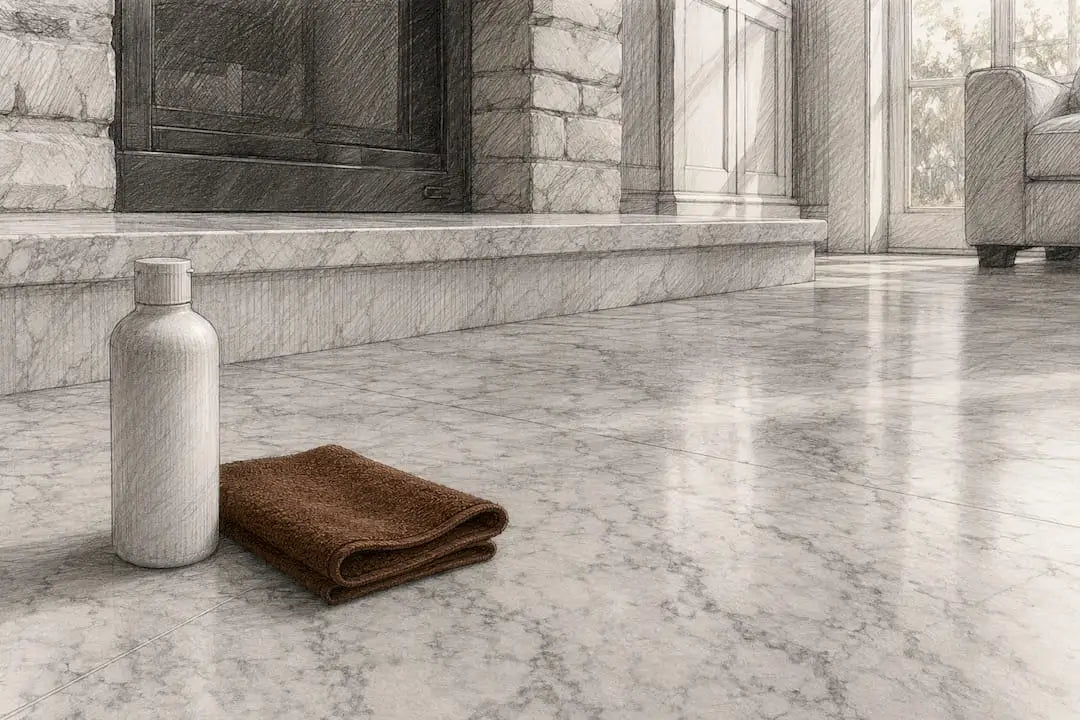
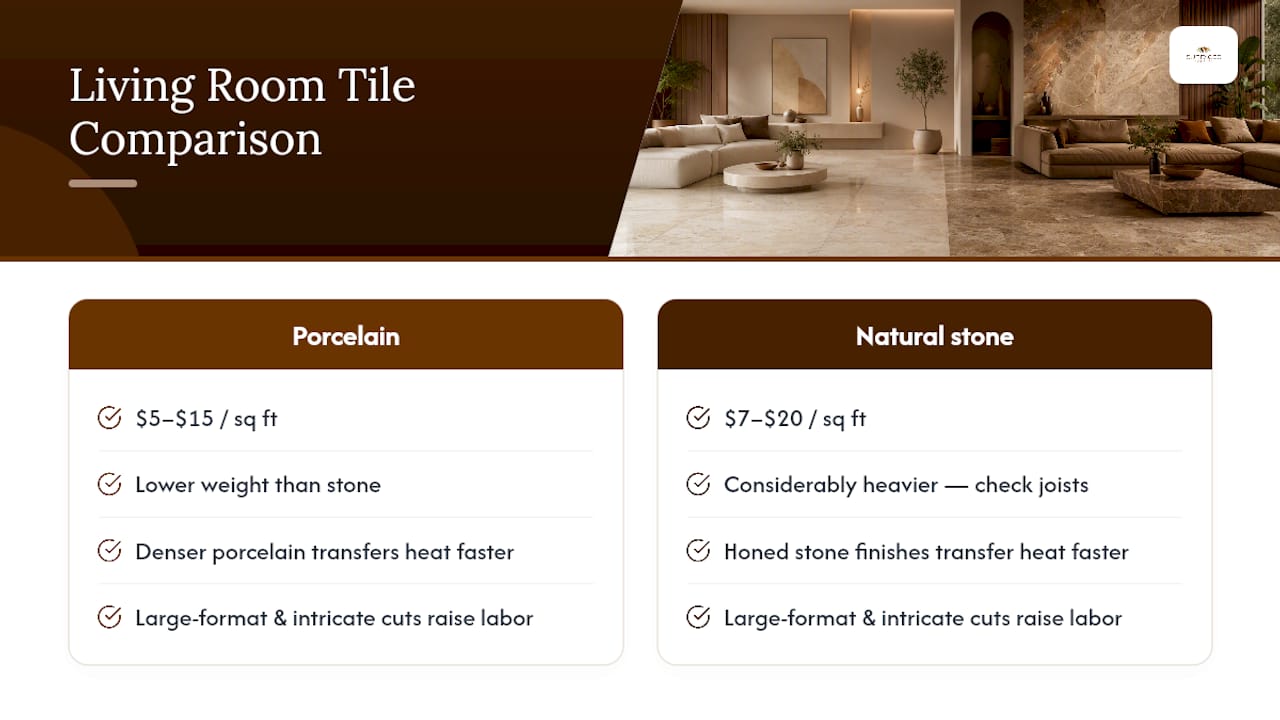
Weight is the other overlooked factor. Natural stone is considerably heavier than porcelain, and installing it on an upper floor sometimes requires checking joist load capacity before work begins. It’s worth consulting a structural professional whenever you’re unsure, especially with slab-format stone.
Underfloor heating adds another wrinkle. Both porcelain and natural stone conduct heat well, but denser porcelain and honed stone finishes transfer warmth faster than thick, textured surfaces. Confirm your installer has direct experience pairing tile with radiant systems before signing a contract; that’s a specific skill, not a given for every flooring crew.
On raw numbers: porcelain installation typically runs $5 to $15 per square foot, while natural stone often starts around $7 to $20 per square foot once sealing, cutting, and substrate prep are factored in. Large-format tiles, intricate cuts, and herringbone layouts all push labor costs higher because they demand more precise handling and more waste allowance.
For a full breakdown of what happens between demo day and the final grout line, the step-by-step tile installation workflow walks through substrate prep in more detail than most contractors will volunteer upfront.
How to Choose Your Living Room Tile Without Regret
- Define your use-case first. A living room with two dogs and three kids has different needs than a formal parlor used twice a month.
- Set a real budget, including sealing and maintenance, not just the tile price.
- Order samples and test them in your actual room lighting over several days, a step trade professionals consistently recommend before any final order.
- Confirm substrate prep with your installer, since an uneven subfloor shows through large-format tile far more than it does with smaller pieces.
- Get at least two installer quotes and ask each one directly about recommended grout, sealer, warranty terms, and expected maintenance.
Pro Tip: Treat vague answers about substrate prep as a red flag. An installer who can’t explain how they’ll level your subfloor before laying large-format tile is one who hasn’t done it enough times to know why it matters.
Watch for inconsistent tile thickness within a single batch, suppliers who won’t offer a sample, or quotes that skip substrate work entirely. Any of those should send you back to the drawing board.
Why Trust This Guidance on Living Room Tile
This guide was put together by cihan, drawing on installation-grade research and years of tracking how natural stone performs once it leaves the showroom and lands in a real living room.
Surfaces Galore backs that perspective with direct-importer access to marble, limestone, and travertine, sample ordering, and nationwide shipping to homeowners, designers, and contractors alike. A few ways that shows up in practice:
- Formal living rooms built around honed marble slabs sourced directly, skipping the markup of multiple middlemen.
- Open-plan spaces where a single limestone or travertine order maintains color consistency from the living room straight into an adjoining kitchen.
- Trade and bulk quotes for designers and contractors managing multi-room renovations on a deadline.
For deeper inspiration, browse marble tile examples for elegant, timeless spaces or the complete limestone guide for renovation-specific detail.
A Perspective on Choosing Tile That Ages Well
Pick the base material that harmonizes with your architecture, not the one trending on social media this month. A neutral limestone or a quiet honed marble in warm gray gives you decades of flexibility. Bold veining or dark slate reads better as an accent, a fireplace surround, or a feature wall, than as wall-to-wall flooring you’ll be living with for fifteen years. Design professionals tend to favor stone that supports a room’s architecture rather than competing with it, and that advice holds up. Balance your appetite for maintenance honestly against your design ambitions, and the floor will outlast every trend cycle around it.
— cihan
Order Samples and Start Your Living Room Tile Project
Surfaces Galore cuts out the markup of multiple distributors by importing marble, limestone, and travertine directly, then shipping samples and full orders nationwide to homeowners, designers, and contractors alike. That means better pricing on the same authentic stone you’d find quoted through a design showroom, plus sample ordering so you’re never guessing how a slab looks in your own living room light.

If you’re weighing marble against limestone or trying to figure out whether travertine fits your floor plan, request samples first. Trade and commercial clients managing multi-room projects can also request bulk quotes directly. When your palette is narrowed down, visit the Surfaces Galore collection to order samples, request a quote, or connect with design support before your next renovation milestone.
Sources
For deeper technical comparisons behind the guidance in this article, see Homes & Gardens’ porcelain versus stone breakdown, Stoneworld’s analysis of large-format interior tile, and FFWD Architects on natural stone versus porcelain. For Surfaces Galore’s own resources, see the floor tile selection guide.
- Porcelain vs stone tiles: Experts reveal differences, pros, cons and how to pick the right one for your DIY project or renovation | Homes and Gardens
- Interior porcelain tiles: large-format vs natural stone | Stoneworld
- Natural stone versus porcelain tiles for interiors | FFWD Architects
FAQ
Should tile be lighter or darker than the walls?
Tile is generally chosen a shade or two darker or more saturated than the walls, since a floor that’s too close in tone to the walls can flatten the room’s sense of depth. Lighter tile against darker walls tends to make a living room feel more spacious, while a darker floor grounds a room with high ceilings or lots of natural light.
Is porcelain or natural stone better for a living room?
Porcelain is the more practical choice for high-traffic living rooms because it resists stains and scratches without sealing. Natural stone, particularly marble and limestone, offers unmatched character and suits lower-traffic, design-forward spaces where patina is welcome.
How much does living room tile typically cost installed?
Porcelain installation typically runs $5 to $15 per square foot, while natural stone often starts around $7 to $20 per square foot once sealing and site prep are included.
Does natural stone work with underfloor heating?
Yes, both porcelain and natural stone conduct heat well, though denser materials and honed finishes transfer warmth faster than thick, textured stone. Confirm your installer has direct experience pairing tile with radiant heating systems before installation.
How often does natural stone tile need to be sealed?
Marble and limestone typically need resealing every 6 to 12 months in a living room setting, depending on foot traffic and sun exposure. Travertine’s sealing schedule varies depending on whether it’s filled or unfilled.

Leave a comment