
Spec Ready Crema Marfil Marble for Designers & Contractors, 3 Grades

Crema Marfil is a Spanish cream-beige marble quarried near Pinoso, Alicante, prized for its warm, consistent tone and fine veining. It performs best on interior floors, wall cladding, bathroom vanities, and mosaics, and it’s a poor fit for kitchen countertops without heavy sealing discipline. Choose it when you want a soft, uniform palette and are willing to commit to periodic sealing and pH-neutral cleaning.
TL;DR:
- Crema Marfil from the Monte Coto quarry maintains consistent color and veining, especially in the select grade, making it ideal for large, continuous surfaces.
- Polished finishes enhance the cream tone and are suitable for walls, while honed finishes offer better slip resistance for flooring in high-traffic areas.
- Proper sealing and pH-neutral cleaning are essential for maintaining its glossy appearance and durability, particularly in interior applications exposed to acids.
- Variations like pinholes, color drift, and veining concentration are natural, so inspecting tile upon delivery and ordering from the same lot are key to a uniform look.
- Authentic Crema Marfil can be distinguished by its weight, subtle mineral scent, and by testing with vinegar, which should etch the stone quickly.
Table of Contents
- Marble Crema Marfil Formats, Sizes, and Finishes
- Where Does Cream Marfil Stone Actually Come From?
- Best Uses and Design Pairings for Crema Marfil Marble
- Is Crema Marfil Marble Durable Enough for Daily Use?
- How to Specify and Order Crema Marfil for a Project
- Environmental and Sustainability Considerations
- Crema Marfil vs. Other Marble and Stone Options
- Common Defects and Natural Variations to Expect
- How to Identify Authentic Crema Marfil Marble
- The Surfaces Galore Take on Crema Marfil
- Ready to Explore Crema Marfil Options?
- Sources
- FAQ
Marble Crema Marfil Formats, Sizes, and Finishes
Crema Marfil ships in more configurations than most buyers expect. That is exactly why so many kitchen and bath projects reach for it. Field tiles run in standard sizes like 12x12 and 24x24 inches, with large-format slabs available for seamless floors or feature walls where grout lines would break up the pattern. Mosaics come in classic layouts, hex, basketweave, and arabesque, and they show up constantly in shower floors and backsplashes because the small pieces handle curves and drains better than a single slab.
Finish selection changes both the look and the performance:
- Polished — reflective, high-shine surface that saturates the cream tone; best for walls and low-traffic formal areas
- Honed — matte finish that hides etching and scratches, making it the safer pick for floors
- Tumbled — aged, slightly pitted texture suited to Mediterranean or rustic-leaning designs
- Brushed — subtle texture with better slip resistance than polished stone
Trim pieces round out the order: baseboards, thresholds, pencil liners, and pre-assembled mosaic sheets let you finish transitions without custom cutting on site.
Where Does Cream Marfil Stone Actually Come From?
Authentic Crema Marfil comes from the Monte Coto quarry region near Pinoso, in Alicante, Spain, and that origin is more than a marketing detail. Marble sold under the same name but quarried elsewhere often shows looser color consistency and less predictable veining, which is why Crema Marfil sourced from Coto tends to hold tighter specs than look-alike stone from other countries.
Suppliers typically sell three grades, and knowing the difference saves buyers from a mismatched installation:
- Select — the most uniform cream color, priced at a premium, and recommended for large continuous floors or walls
- Standard — moderate veining variation, a solid choice for mixed-pattern or accent applications
- Commercial — visible veining and color shifts, appropriate for budget projects or spaces where variation is part of the look
Ask for water absorption, density, and compressive strength data before finalizing a spec, especially on commercial jobs with engineering sign-off requirements.
Best Uses and Design Pairings for Crema Marfil Marble
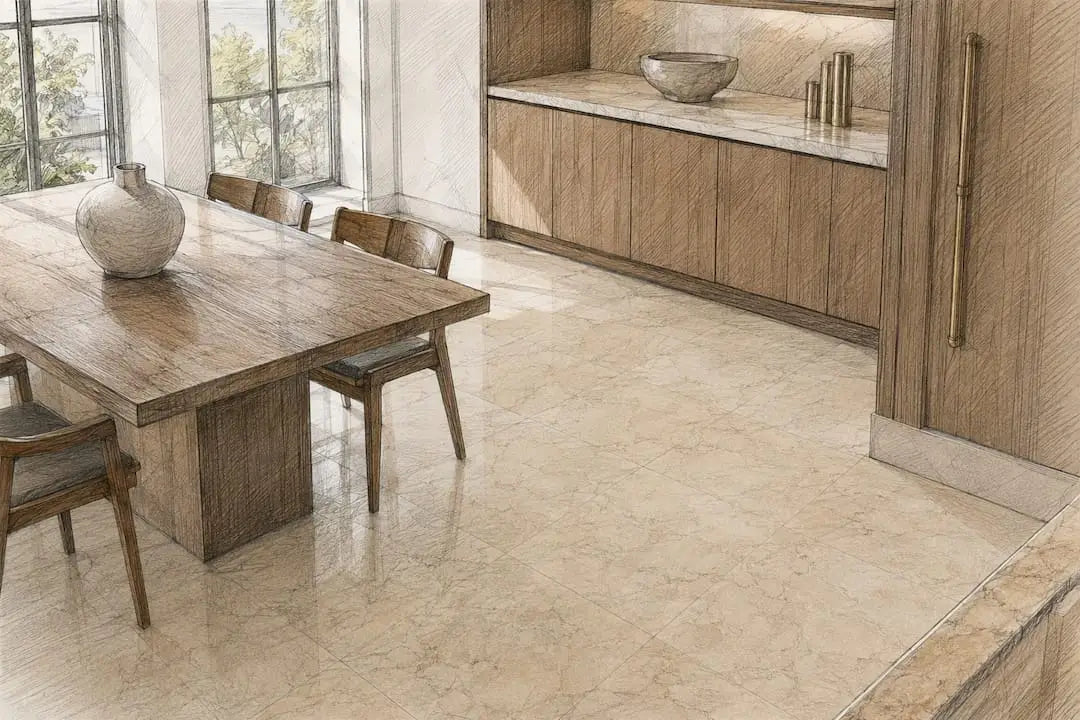
Crema Marfil earns its reputation in specific settings, not everywhere. It’s a strong choice for interior flooring, hotel lobbies, bathroom walls and vanities, stair risers, and mosaic accents, and its consistent cream tone is a big reason it shows up so often in hospitality and public interiors where designers need a material that reads the same across a large footprint.
Pairing it well comes down to temperature matching and choosing complementary fixtures like interior doors that match Crema Marfil’s warm palette. Designers typically combine Crema Marfil with:
- Warm whites and greige paint tones, never stark cool white, which exaggerates the marble’s natural yellowing
- Warm wood species like white oak or walnut
- Brass, gold, and champagne bronze fixtures rather than chrome or nickel
Finish choice should follow the use case: honed for floors and other high-traffic areas where etching is inevitable, polished for walls and formal spaces where reflectivity matters more than durability against acids.
Pro Tip: If you’re pairing Crema Marfil floors with a Crema Marfil shower surround, order both in honed finish. Mixing polished walls with honed floors in the same room can make the stone look like two different materials once light hits it.
Is Crema Marfil Marble Durable Enough for Daily Use?
Crema Marfil holds up well underfoot, but it has one real weakness: acid sensitivity. Vinegar, lemon juice, and most bathroom cleaners will etch the surface, leaving a dull spot that no amount of scrubbing fixes. A pH-neutral stone cleaner is not optional if you want the surface to stay glossy.
Follow these steps to protect the installation long term:
- Apply a penetrating sealer immediately after installation, before grout haze remover or heavy foot traffic
- Test the seal every 6 to 12 months by dripping water on the surface. If it beads, the seal is holding; if it darkens the stone, reseal
- Clean daily with a pH-neutral stone cleaner, never vinegar-based or citrus products
- Wipe up spills from wine, coffee, or acidic foods immediately rather than letting them sit
High-quality Crema Marfil from the Monte Coto quarry tests at roughly 0.2% water absorption and 2680 kg/m³ density, figures that explain why it seals well and holds a polish for years when maintained correctly. With proper sealing and pH-neutral care, expect decades of service on floors and walls. Skip it for active kitchen countertops where citrus, wine, and daily acid exposure will outpace even a diligent sealing schedule.
How to Specify and Order Crema Marfil for a Project
Ordering marble sight unseen is how mismatched floors happen. Always request physical samples first, and for anything beyond a small bathroom, order full slabs or tile lots from the same production run to avoid visible color drift between batches.
Your spec sheet should include:
- Grade: Select, Standard, or Commercial
- Finish: polished, honed, tumbled, or brushed
- Thickness: commonly 3/8 inch for wall tile, 3cm for slab countertops or heavy-traffic flooring
- Edge profile: bullnose, bevel, or eased, depending on the application
- Format: tile size or slab dimensions, plus mosaic sheet size if applicable
On cost, material for Crema Marfil field tile typically runs $7 to $25 per square foot depending on grade and size, and installation labor adds a separate line item on top of that. Get quotes from your installer before ordering material, and build in a 10 to 15% overage for cutting waste and future repairs. For large or multi-room jobs, matching slabs from a single lot is worth the extra coordination, and Surfacesgalore’s guide to matching marble slabs walks through how that process works in practice.
Environmental and Sustainability Considerations
Natural stone has a different sustainability profile than manufactured surfaces, and it’s worth understanding before you compare Crema Marfil to engineered alternatives. Quarried marble is a one-time extraction with no ongoing chemical manufacturing process, unlike quartz composites that require resins and pigments. It also carries transportation impact, since authentic Crema Marfil travels from Alicante to job sites worldwide, and that shipping footprint is a real tradeoff against sourcing a regional stone.
On the positive side, marble’s lifespan works in its favor. A properly sealed and maintained Crema Marfil floor or wall can last decades, sometimes outliving the building systems around it, which spreads its environmental cost over a much longer service life than a laminate or vinyl surface replaced every 10 to 15 years. Reclaimed marble is also increasingly available through demolition and renovation salvage, giving buyers a lower-impact option for accent pieces, thresholds, or mosaics where slight variation is acceptable.
Buyers who care about sourcing transparency should ask suppliers directly about quarry origin and any environmental certifications tied to the extraction process. Not every supplier tracks or discloses this information consistently, so a direct question during the quote process is more reliable than assuming a certification applies. Choosing a genuinely quarried, long-lifespan material and maintaining it properly remains one of the more straightforward ways to keep a natural stone project’s footprint in check.
Crema Marfil vs. Other Marble and Stone Options
Crema Marfil sits in a specific niche: warm, uniform, cream-toned stone with a formal, polished look. Compared to other popular marbles, the differences come down to color temperature and veining character. Calacatta and Carrara marbles lean cool white to gray with bolder, more dramatic veining, which suits a contemporary palette but clashes with warm wood and brass pairings. Botticino, an Italian marble, shares Crema Marfil’s beige family but tends to run slightly more golden with heavier movement in the veining.
Travertine is the most common alternative comparison, since it shares the warm cream-beige family. The key difference is texture: travertine has a naturally pitted, porous surface (often filled during manufacturing) that reads more rustic, while Crema Marfil is denser and takes a true polish. Many projects actually combine the two, using Crema Marfil for interior floors and travertine for exteriors or transitional spaces to keep a consistent warm palette while matching each material’s functional strengths outdoors versus in.
Engineered quartz is the non-stone alternative worth mentioning. It offers more color consistency and zero sealing requirements, but it can’t replicate the depth and subtle veining variation that makes natural marble feel authentic. For buyers who want a genuine stone floor or wall with warm tones and don’t mind the maintenance tradeoff, Crema Marfil remains a strong pick within the marble category, and Surfacesgalore’s natural stone collection covers it alongside limestone and travertine options, allowing side-by-side comparison.
Common Defects and Natural Variations to Expect
No batch of Crema Marfil looks perfectly identical, and buyers who expect factory-level uniformity are often surprised. Natural veining varies from tile to tile, sometimes dramatically between Select and Commercial grade material, since Commercial grade is priced lower specifically because it carries more visible movement and occasional darker mineral streaks.
Watch for a few recurring issues when inspecting a shipment:
- Pinholes and fissures — small natural voids that are typically filled with resin at the factory; a few are normal, but excessive filling on a “Select” grade order is a red flag
- Color drift between lots — tiles from different production runs can show a warmer or cooler cast even within the same stated grade, which is why ordering from a single lot matters for large installations
- Veining concentration — some tiles in a batch will show heavier veining than others; a good supplier lets you preview or reject outlier pieces before installation
- Surface scratching in transit — polished tiles can pick up light haze from shipping; a competent installer buffs this out during final polish
None of these are defects in the sense of a manufacturing flaw. They’re the nature of a quarried material, and honestly, that variation is part of what makes a marble floor look different from a printed tile. The practical takeaway is to inspect tile on delivery, before installation, and flag anything that falls outside the grade you paid for.
How to Identify Authentic Crema Marfil Marble
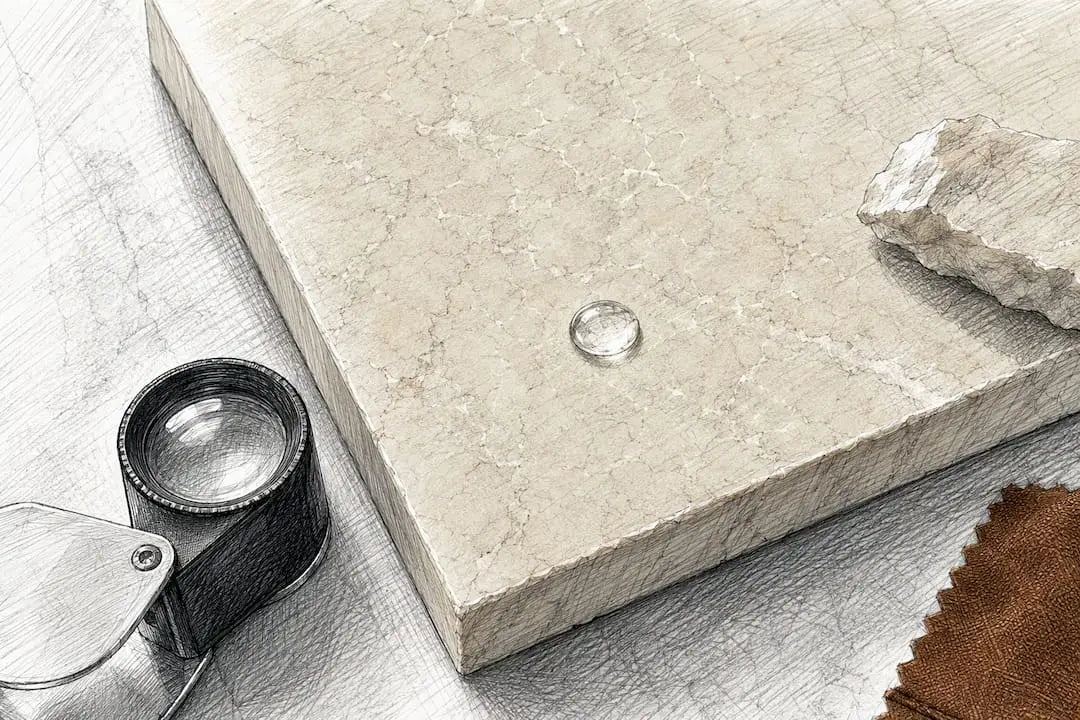
The cream marble market has no shortage of imitators, from dyed limestone to porcelain tile printed with a marble pattern. A few checks separate the real thing from a substitute.
Genuine Crema Marfil has a cool, dense feel to the touch and a certain heft, natural stone weighs noticeably more than porcelain of the same dimensions. Run your hand across the surface: real marble has subtle temperature variation and a faint mineral scent when wet, while porcelain stays uniform and odorless. A loupe or magnifying glass reveals authentic veining running through the stone’s depth rather than sitting on a printed surface layer, which is the giveaway with digitally printed porcelain “marble look” tiles.
Ask your supplier directly about quarry origin. Authentic material traces back to Monte Coto or the broader Pinoso region in Alicante, and a supplier who can’t answer that question, or who’s vague about country of origin, is worth a second look. Request a small sample and test it with a drop of white vinegar in an inconspicuous spot: real marble etches within a minute or two, while porcelain and most engineered stone won’t react at all. That single test tells you more than any product description.
The Surfaces Galore Take on Crema Marfil
Crema Marfil gets treated as a safe, generic choice in a lot of buying guides, and that undersells it. The real skill isn’t picking the stone, it’s matching grade and finish to the actual room. A Select grade slab wasted on a low-traffic accent wall is money that should have gone to a large-format floor where the uniform color actually earns its keep.
Surfacesgalore is a direct importer of premium natural stone, including marble, limestone, and travertine tiles, mosaics, and decorative pieces, and that direct-import model is what lets us speak plainly about grading instead of dressing up whatever happens to be in stock. We ship nationwide to designers, architects, contractors, and homeowners, and our Crema Marfil marble guide goes deeper into slab matching and sample ordering for anyone specifying a full room.
— Cihan
Ready to Explore Crema Marfil Options?
If you’ve narrowed your decision down to Crema Marfil, the next step is simple: request samples before you commit to a full order. Surfacesgalore ships trade quotes and sample sets to designers, architects, contractors, and homeowners nationwide, and specifying grade and finish upfront gets you a far more accurate quote than a general price inquiry.
When you reach out, be specific rather than general. A quote request that names grade, finish, and thickness gets priced faster and more accurately than “how much for Crema Marfil.” Here’s what to have ready:
| What to Specify | Why It Matters |
|---|---|
| Grade (Select, Standard, Commercial) | Determines price and color uniformity |
| Finish (polished, honed, tumbled, brushed) | Affects slip resistance and maintenance needs |
| Thickness (3/8" tile, 3cm slab) | Depends on application: wall, floor, or countertop |
Whether you’re planning a bathroom vanity, a hotel lobby floor, or a full-home flooring package, Surfacesgalore’s team can walk through grading and lead times before you place an order. Shop natural stone tiles today, or request a custom quote to get started.
Sources
- Crema Marfil Marble from Coto Quarry - Karimi Stone
- Crema Marfil Tile: The Complete Guide for Homeowners - D and G Flooring
FAQ
What Is Crema Marfil Marble?
Crema Marfil is a cream-beige marble quarried in the Pinoso region of Alicante, Spain, known for its warm, uniform color and fine veining. It’s most commonly used for interior floors, wall cladding, and bathroom vanities.
Is Crema Marfil Marble Expensive?
Material typically runs $7 to $25 per square foot depending on grade and size, with Select grade commanding the highest price for its color uniformity. Installation labor adds a separate cost on top of the material price, so get a trade quote before budgeting a full project.
What Colors Go Well With Crema Marfil?
Warm whites, greige, warm wood tones, and warm metal finishes like brass and champagne bronze pair best with Crema Marfil. Stark cool whites tend to exaggerate the marble’s natural yellowing and should be avoided.
Is Crema Marfil Marble Durable?
Yes, when properly sealed and cleaned with pH-neutral products, Crema Marfil holds up for decades on floors and walls. It’s sensitive to acidic substances like vinegar and lemon juice, which can etch the surface, so it’s not the best fit for active kitchen countertops without a strict maintenance routine.

Leave a comment