

Marble face selection: Expert tips for stunning results

TL;DR:
- Choosing the correct marble face is crucial for ensuring structural strength, vein continuity, and aesthetic quality in renovations. Experts recommend inspecting both slab sides in person, considering finish and project scale, and planning seams carefully to achieve seamless, durable results. Thoughtful face selection from the outset significantly enhances the longevity and visual harmony of marble installations.
Most homeowners walk into a stone yard and immediately fall in love with a marble slab’s color or the drama of its veining. That moment of visual connection is real, and it matters. But stopping there is where many renovation projects quietly go wrong. The face of a marble slab, meaning which portion gets placed as your visible surface, determines far more than aesthetics. It shapes how seams hold up, where cracks are most likely to develop, and whether your finished countertop or wall looks like a luxury installation or an afterthought. This article will walk you through every critical layer of marble face selection so your project turns out exactly as you imagined.
Table of Contents
- Understanding marble face selection
- Key factors influencing marble face selection
- Comparing marble finishes and their impact on face selection
- Practical tips for choosing marble faces in kitchen and bathroom projects
- Why thoughtful marble face selection is the real secret to renovation success
- Next steps: Explore your marble options with SurfacesGalore
- Frequently asked questions
Key Takeaways
| Point | Details |
|---|---|
| Face selection prevents defects | Choosing the right marble face reduces risks of visible imperfections and ensures structural durability. |
| Finish influences visibility | The surface finish determines how much scratches and etching are visible on marble faces. |
| Seam placement matters | Aligning seams with veins and avoiding weak areas delivers both beauty and strength. |
| Look beyond aesthetics | The process of face selection goes deeper than color or pattern—structural integrity also counts. |
Understanding marble face selection
Marble face selection is the process of choosing which surface area of a slab becomes the visible, installed side of your countertop, wall, or floor. It sounds simple, and that simplicity is deceptive. Every marble slab has two faces, and they are almost never identical. One side might carry the most dramatic veining. The other might show fewer fissures or have a more consistent background color. Choosing wisely between those two options, and choosing which section of the slab to cut from, is where skilled fabricators and experienced designers earn their keep.
The decision goes well beyond picking the prettier side. The right marble slab selection tips involve understanding structural integrity, seam placement, and how your finish choice will interact with the surface you pick. Marble face selection reduces fabrication risk by steering cutting and seaming away from weak planes, fractured zones, and visible defects while keeping vein continuity intact across seams.
Here is why this matters in practice:
- Beauty: The right face shows your chosen veining or pattern at its most striking angle and orientation.
- Durability: Avoiding structurally weaker zones means your slab is less likely to crack during or after fabrication.
- Seam quality: Aligning veins across seam joints creates a visually seamless result that defines truly high-end installations.
- Cost efficiency: Selecting the correct face before cutting prevents expensive errors, wasted material, and costly re-orders.
“A slab can look perfect from across the room and still harbor micro-fissures or weak planes that only reveal themselves during cutting or years later under stress. Face selection is your first line of defense.”
Understanding this foundation changes how you approach your renovation entirely. Instead of grabbing the most dramatic slab and assuming the fabricator will figure it out, you become an active participant in a process that protects both your investment and your design vision.
Key factors influencing marble face selection
Now that you understand the concept, here is what determines which side or section of a marble slab is selected. There are several interlocking factors, and none of them works in isolation.
1. Material strength and structural integrity
Every slab has zones of varying density. Natural geological processes create pressure lines, micro-fissures, and soft inclusions in marble. When a fabricator cuts through a weak zone, the slab risks cracking, especially at edges and seams. Choosing a face that keeps these weaker areas away from high-stress cut lines is essential. This is why custom marble fabrication always begins with a thorough slab inspection, not just a design sketch.
2. Vein alignment and visual continuity
The veining in marble is formed by mineral deposits that run through the stone at angles determined by millions of years of geological movement. When two slab sections meet at a seam, those veins need to flow continuously from one piece to the next. Poor vein alignment at seams is one of the most visible signs of an inexperienced installation. Matching marble slabs across seams requires careful planning of which face is selected and how the slab is oriented before cutting begins.

3. Finish compatibility
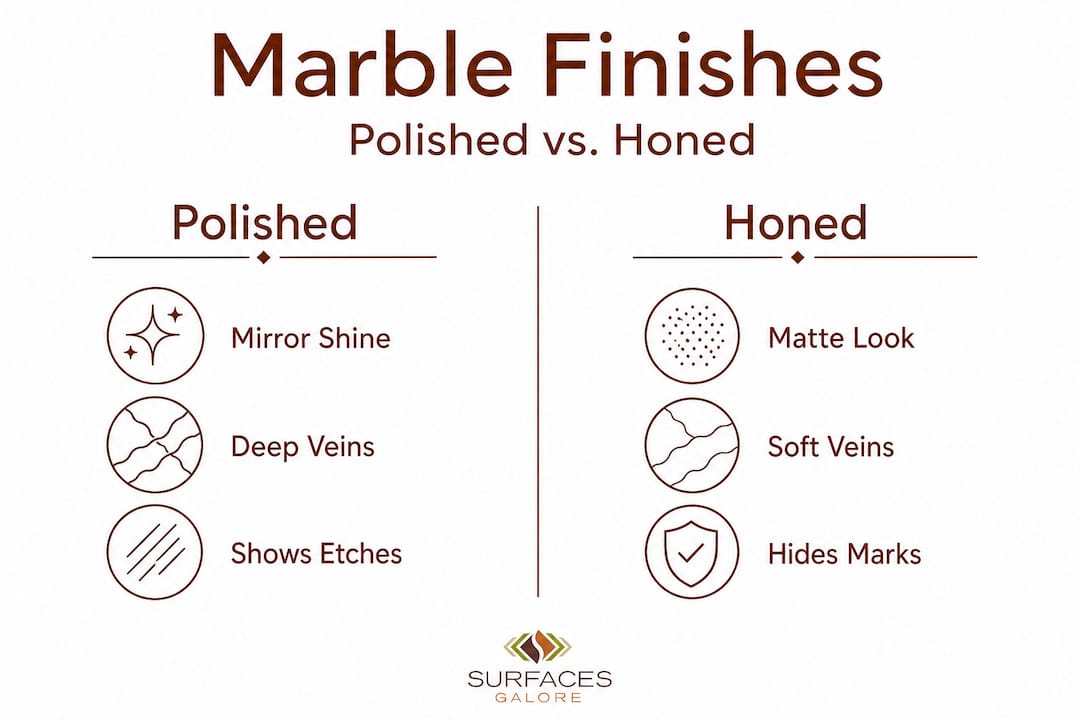
The finish you choose directly affects which face of the slab should be used. A polished finish amplifies surface reflectivity, which means any imperfection, scratch, or etch mark becomes much more visible. A honed finish diffuses light and hides minor surface variations better. Edge profiles and finish choices interact with slab face selection because certain faces or regions may have different suitability depending on the finish applied and whether weaker areas are being exposed to complex edge cuts.
4. Edge profile selection
Edge profiles add visual elegance, but more complex profiles require more material removal and place more stress on the slab edge. A waterfall edge or an ogee profile on a face with a hidden micro-fissure is a recipe for chipping or cracking during fabrication. Simpler profiles, like a straight or eased edge, are more forgiving and are often the smarter choice when the most visually appealing face has structural limitations.
5. Size and layout of the project
Large kitchen islands require bookmatched slabs or precise seam planning across wide surfaces. Bathroom vanities are smaller but often demand bold, centered veining for dramatic effect. The scale of your project determines how much of the slab face is actually used and where the most critical selection decisions fall.
| Factor | Kitchen priority | Bathroom priority |
|---|---|---|
| Structural strength | High (wide cuts, seams) | Medium (smaller cuts) |
| Vein alignment | High (long runs) | High (focal surfaces) |
| Finish choice | Medium to high | High (moisture exposure) |
| Edge complexity | Medium | Low to medium |
| Pattern centering | Medium | Very high |
Pro Tip: Always inspect both faces of a slab in person, ideally under lighting that resembles your actual installation environment. Warehouse fluorescent lighting flattens a slab’s depth and hides fissures that natural or warm light will reveal once installed.
Comparing marble finishes and their impact on face selection
Different finishes dramatically affect how the chosen face of marble responds to wear, light, and cleaning. Your finish choice is not just a style decision. It is a practical one that should inform which face you select and how you plan your seams.
Polished finish
A polished marble surface has a mirror-like sheen that reflects light beautifully. It makes colors deeper, veins more vivid, and the overall slab look incredibly luxurious. However, polished marble is also the most unforgiving in terms of showing wear. Etching from acidic substances like lemon juice, wine, or certain cleaning products leaves dull marks that contrast sharply against the reflective surface. Scratches become visible under certain lighting angles. For face selection, this means you want a face with minimal surface inconsistencies, since the polish will amplify everything.
Honed finish
Honed marble has a flat, matte appearance without the reflective shine. It feels softer and more organic, which suits contemporary and transitional design styles particularly well. The practical advantage is that polished vs honed marble comparisons consistently show honed surfaces hide everyday etching and light scratches better than polished ones. For face selection, honed finishes are more forgiving of minor surface variation, giving you slightly more flexibility in which face you choose.
Textured finishes
Textured finishes, such as brushed, leathered, or sandblasted surfaces, add tactile interest and mask imperfections very effectively. They work well in spaces where a raw, natural aesthetic is desired. The tradeoff is that they can be harder to clean in kitchen environments where oils and food residue settle into the texture. Understanding marble surface finishes explained helps you match the right finish to your specific face selection and room function.
Here is a quick breakdown of how finish interacts with face selection priorities:
- Polished: Choose the cleanest, most consistent face available. Avoid faces with fine scratches or surface inclusions.
- Honed: More flexibility in face choice. Still avoid fractured zones, but minor surface variation is less critical.
- Leathered or brushed: Best for faces with interesting natural texture. Adds character rather than fighting it.
- Sandblasted: Works well for outdoor or high-traffic areas where slip resistance matters more than visual clarity.
Finish selection impacts etching and scratch visibility significantly, which is why simpler edges are recommended for marble installations where the face may have subtle imperfections. The combination of a complex edge profile and a polished finish on a structurally marginal face is the most common reason clients end up disappointed with their installation.
It is also worth noting that marble texture options have expanded significantly in recent years, giving designers more ways to use dramatic or veined faces that might not work well under a high-polish finish. A leathered finish, for example, can transform a slab face with bold, uneven veining into a stunning feature wall without the maintenance burden that a polished version of the same face would create.
For ongoing maintenance, understanding marble polishing tips ensures that whichever face and finish you select, you can keep it looking its best for years without costly restoration work.
Practical tips for choosing marble faces in kitchen and bathroom projects
Let’s translate this knowledge into practical steps to make your project a success.
Step-by-step marble face selection workflow
-
Start with your layout drawing. Before you ever visit a stone yard, have a dimensioned layout of your countertops, walls, or floors. Know where seams will fall, where the edges will be, and which areas are most visible from entry points in the room.
-
Visit the yard in person. Photos of slabs never capture fissures, surface variation, or true color. Bring your layout drawing so you can physically place it over the slab and visualize how the veining will read in your space.
-
Inspect both faces. Ask the yard to flip the slab or show you the back. One face is almost always superior for structural or aesthetic reasons. This step alone prevents a large percentage of fabrication issues.
-
Mark your preferred face and orientation. Use chalk or a tag to indicate which face should be up and which direction the veining should run. Your fabricator needs this information before any cutting begins.
-
Discuss seam placement with your fabricator. Face selection reduces risk when seams are steered away from weak planes and aligned to follow natural vein flow. This conversation should happen before the template is made, not after.
-
Request a dry layout. Ask your fabricator to lay the cut pieces out dry before installation so you can approve the seam alignment and overall visual result. This is standard practice in quality shops.
-
Review under your actual lighting. If you can bring a sample home or hold pieces near a window or under a light fixture that matches your space, do it. Black marble design ideas and other dramatic stone selections look entirely different under warm vs. cool lighting conditions.
Common pitfalls to avoid
Many renovation projects stumble at predictable points. Ignoring slab weaknesses is the most costly because it leads to cracking either during fabrication or during the first year of use. Overlooking edge and finish compatibility is the second most common mistake, especially when clients fall in love with a complex ogee edge on a face that has surface fragility.
A third pitfall is choosing a marble face based on the slab lying horizontally in a yard when it will actually be installed vertically, as in a shower surround or a backsplash. Veining reads completely differently when the orientation changes. Always ask your supplier or fabricator to mock up the slab in the intended orientation before finalizing your selection. The marble selection tips that experienced designers use almost always include this step.
Kitchen-specific considerations
Kitchens demand the most attention to seam placement because countertops often run long distances and see heavy daily use. Place seams away from the cook zone, where constant thermal movement and impact stress are greatest. Around sinks and dishwashers, moisture exposure is elevated, so the face selected for those areas should have minimal surface openings or vein pockets that can trap water over time. When choosing marble slabs for kitchen islands, prioritize structural strength over dramatic veining if you have to choose between the two.
Bathroom-specific considerations
Bathrooms offer more creative freedom because surface areas are smaller and traffic stress is lower. This is where bold, dramatic veining really shines. A full-height shower surround with bookmatched marble panels can become an extraordinary focal point. The key is ensuring that the bookmatched faces are mirror images of each other, which requires careful selection of adjacent slabs from the same block. Moisture resistance is also worth considering. For shower floors and steam environments, a honed or textured face handles wet conditions better than a polished one.
Pro Tip: When previewing slabs for a bathroom installation, photograph the slab under different lighting conditions and compare it against your tile, fixtures, and cabinetry samples before committing. Small-space installations are more sensitive to color tone mismatches than large kitchen surfaces because every element is closer together.
For countertop installation tips that cover the broader installation process, including waterproofing, substrate preparation, and sealing, it helps to have a full picture before finalizing your face selection, since some substrate conditions can influence which face orientation is most stable.
Why thoughtful marble face selection is the real secret to renovation success
After years of working with homeowners, designers, and architects on natural stone projects, we have noticed a consistent pattern. The clients who are happiest with their finished renovations are not necessarily the ones who spent the most money. They are the ones who treated face selection as a serious, deliberate decision rather than an afterthought.
Most design guides focus on color palettes, grout choices, and finish trends. Very few explain that seam alignment is the single biggest differentiator between a countertop that looks custom-fabricated and one that looks assembled from leftover pieces. It is not a detail only professionals need to care about. Homeowners who understand vein alignment can have a genuinely productive conversation with their fabricator and get a result that reflects their vision rather than a fabricator’s convenience.
There is also an uncomfortable truth about slab shopping: the face that looks best in the yard is not always the right one for your project. We have seen clients fight to use a specific face because of its dramatic veining, only to end up with a seam that interrupts the pattern awkwardly or an edge that chips because the most visually exciting zone of the slab happened to sit over a structural weakness. Trusting your fabricator’s guidance on which face is structurally sound is just as important as trusting your designer’s eye for beauty.
The editorial truth we return to, time and again, is this: a beautiful countertop starts with the face you do not see, chosen for strength as much as style. That hidden decision, made in a stone yard or a fabrication shop before a single cut happens, is what separates renovations that age gracefully from ones that require repairs within a few years.
For inspiration on how seamless marble matching elevates the visual quality of an installation, it is worth studying examples where bookmatched slabs or carefully aligned seams create the illusion of a continuous stone surface. Compare that to projects where seam placement was treated as a purely logistical decision. The difference is immediately apparent, even to untrained eyes.
If you are exploring bold, dramatic options, grey marble inspiration offers a range of looks from soft, cloudy patterns to sharp, graphic veining that demonstrates how the same stone can look entirely different depending on which face is selected and how it is oriented.
Next steps: Explore your marble options with SurfacesGalore
If you’re ready to select the perfect marble face for your project, here’s how SurfacesGalore can help.
At Surfaces Galore, we work directly with homeowners and designers every day to navigate exactly the decisions this article covers. From choosing the right slab face to pairing your finish with your space’s lighting and layout, our team brings hands-on fabrication knowledge and a wide inventory of premium natural stone to every conversation.
Visit our marble selection tools at SurfacesGalore.com to browse our full range of marble slabs, mosaics, and decorative pieces imported directly from quarry sources. Whether you are designing a sleek kitchen in Los Angeles or a spa-inspired bathroom in Chicago, we ship nationwide and offer personalized guidance to help you find the right slab, the right face, and the right finish for a result that lasts a lifetime.
Frequently asked questions
What exactly is marble face selection?
Marble face selection means choosing which area of a marble slab becomes the visible surface, with careful consideration of aesthetics, structural integrity, and how seams will align. Face selection also reduces fabrication risk by keeping cuts and seams away from weaker slab zones and fractured planes.
Why does finish choice matter for marble face selection?
The finish determines how visible surface imperfections, etching, and scratches will be once the marble is installed and in daily use. Finish selection impacts etching visibility significantly, which is why the face you choose should match the demands of the finish being applied.
How should seams be planned for marble countertops?
Seams should be positioned where the natural vein pattern allows for visual continuity and away from structurally weaker regions of the slab. Seam alignment and fabrication risk are both directly influenced by where and how the face selection is made before cutting begins.
Can I preview marble faces before installation?
Yes, you absolutely should preview slab faces in person and under lighting that closely matches your intended installation environment. Face and finish suitability vary across different regions of a slab, and seeing both sides in real light helps you identify imperfections and choose the most appropriate surface before any cutting starts.
Leave a comment