

Meet DCOF 0.42: Modern Bathroom Floor Tile Ideas From Quarry to Finish

Large-format porcelain, honed natural stone, and small-format mosaics dominate modern bathroom floors right now, and the reason isn’t just looks. Durability and slip resistance decide which of these actually holds up, which is why any tile you shortlist should meet a DCOF of 0.42 or higher for wet areas. Reserve mosaics and penny-round tile for showers and tight, curved spaces where drainage and grip matter most, and lean on porcelain or honed stone everywhere else for that clean, low-grout modern look. Surfaces Galore carries the natural stone side of that equation directly from the quarry.
TL;DR:
- Large-format porcelain tiles with minimal grout lines are favored for their modern, seamless look and ease of maintenance, but require a flat substrate with a maximum of 1/8 inch unevenness.
- Honed marble, especially hexagon or large slabs, provides a luxurious feel but necessitates regular sealing and should be honed rather than polished to prevent slipperiness and scratches.
- Small-format mosaics like penny-rounds and hexagons excel in showers and curved spaces for traction, as their dense grout enhances slip resistance, especially if the DCOF is 0.42 or higher.
- Natural stone offers unmatched depth and character but requires ongoing care, sealing, and cautious material selection, like honed finishes, to ensure durability and safety in modern bathrooms.
- Sustainability considerations include choosing recycled-content porcelain and locally sourced natural stone, which reduce environmental impact while maintaining style and longevity.
Table of Contents
- Modern Bathroom Floor Tile Ideas Worth Copying
- Porcelain vs. Natural Stone vs. Resilient Flooring: What Actually Performs
- Choosing Tile Size and Layout for a Modern Look
- A Decision Checklist Before You Buy Tile
- What Maintenance and Cost Actually Look Like
- Why Authentic Natural Stone Still Belongs in a Modern Bathroom
- How Tile Finish Changes Under Bathroom Lighting
- Matching Floor Tile to Your Wall Tile and Overall Design
- Sustainable and Eco-Friendly Tile Options Gaining Ground
- A Short Note From Our Perspective
- Explore Natural Stone Collections at Surfaces Galore
- Sources
- FAQ
Modern Bathroom Floor Tile Ideas Worth Copying
Every one of these directions shows up in current renovation projects for a reason: each solves a specific problem, whether that’s grout fatigue, slippery showers, or a floor that just looks dated the day it’s installed. Here’s what actually works and where to use it.
-
Large-format porcelain, stone-look, matte or honed. This is the default modern floor right now. Slabs in the 24x24 inch to 32x32 inch range (and larger) cut grout lines dramatically, which lines up with the NKBA’s 2026 Bath Trends Report finding that 89% of designers report client demand for minimal or no visible grout. A matte or honed finish also hides water spots better than gloss.
-
Honed marble hexagon or large-format slabs. For homeowners chasing a genuinely luxurious modern floor, honed marble delivers a softness porcelain can’t quite fake. Stick with honed rather than polished on floors. Polished marble looks stunning on a wall but turns dangerously slick underfoot when wet, and it scratches faster in high-traffic zones.
-
Porcelain hexagon and penny-round mosaics. These earn their place in showers and small powder rooms specifically because of drainage and grip. Small-format tile means more grout lines, and more grout lines mean more traction points. That higher grout density is part of why practitioners consistently steer shower floors toward 1x1 inch to 4x4 inch formats rather than large slabs.
-
Wood-look porcelain planks in chevron or herringbone. You get the warmth of a wood floor without the water damage risk. Herringbone in particular reads as intentional and custom, even at a mid-range price point.
-
Terrazzo and encaustic-style cement tile. Both work best as accent floors, a powder room statement, or a defined runner rather than covering an entire primary bath. The pattern density gets visually loud fast in a large room.
-
Slate and textured natural stone. For a rustic-modern pairing, textured stone finishes bring grip and character together, though you’ll want to confirm the specific slip rating before committing a full floor to it.
-
Restrained pattern moves. A checkerboard in two close neutral tones, a subtle geometric border along the tub, or a single tile runner down a narrow galley bath all read as current without overwhelming the room. The NKBA’s 2026 report also found that 96% of designers picked neutral color groups as the leading palette this year, which is exactly why these pattern ideas work best in tone-on-tone neutrals rather than high contrast.
Pro Tip: If you’re torn between a bold pattern and a plain floor, order samples of both and lay them in the actual bathroom under your real lighting for a day before deciding. Showroom lighting flatters almost everything.
Porcelain vs. Natural Stone vs. Resilient Flooring: What Actually Performs
The material you choose determines how much upkeep your modern floor demands for the next twenty years, not just how it photographs on day one.
- Porcelain has low porosity and high durability, and large-format porcelain in particular tends to deliver the best long-term value per year of ownership, though it needs a properly prepped, flat substrate to install correctly.
- Natural stone (marble, travertine, limestone) offers visual depth no manufactured tile fully replicates, but it needs periodic sealing and pH-neutral cleaners. Honed or tumbled finishes are the better choice for floors because they hide etching and wear far more gracefully than polished stone.
- LVP and other resilient flooring can be a practical alternative in secondary bathrooms or for budget-conscious renovations, though it won’t match the resale value or heat retention of tile.
Industry guidance sets a Dynamic Coefficient of Friction (DCOF) of 0.42 or higher as the recommended minimum for level interior wet surfaces. Ask for this number before you buy any bathroom floor tile, glossy or matte, stone or porcelain.
Choosing Tile Size and Layout for a Modern Look
Scale is doing more design work in a modern bathroom than color or material. A few rules keep the proportions right:
- Large-format tiles suit primary bathrooms and open floor plans; they minimize grout and read as calm and seamless.
- Medium and small formats belong in showers, curved niches, and any area needing slope-to-drain, where large slabs simply can’t bend to the geometry.
- Herringbone and chevron add movement to a narrow room; hexagon and basketweave suit powder rooms where you want a focal moment; checkerboard works best restrained to two similar tones rather than stark black and white.
- Running tile lengthwise down a narrow bathroom visually stretches the space, while a runner insert can define a walkway to the shower.
- Large-format tile only looks flawless on a substrate flat to within 1/8 inch over 10 feet. Skip that prep and you’ll see lippage at every edge.
A Decision Checklist Before You Buy Tile
Bring this list to your next showroom visit or installer consultation so the inspiration you’ve gathered actually survives contact with your bathroom’s real conditions.
- Confirm how wet the zone gets: shower floor, tub surround, and open floor each demand different DCOF ratings.
- Ask for the tile’s specific DCOF rating; anything under 0.42 in a wet zone is a hazard, not just a style choice.
- Choose a matte or honed finish over gloss for any floor tile, regardless of material.
- Check tile size against room dimensions. Oversized tile in a tiny powder room can look as awkward as tiny tile in a sprawling primary bath.
- Pick a grout color close to the tile itself for the low-grout modern look, or a contrasting grout deliberately, as a design choice rather than an accident.
- Confirm compatibility with underfloor heating if you’re installing it, since specs vary by product and manufacturer.
- Get a written cost estimate that separates material, labor, and substrate prep.
Ask your installer directly about substrate flatness tolerance, the grout joint width they recommend for your tile size, and which sealer they’ll use on natural stone. Pro Tip: Walk away from any installer who can’t tell you the DCOF rating of the floor tile they’re selling you, or who waves off sealing requirements on natural stone as unnecessary.
What Maintenance and Cost Actually Look Like
Porcelain asks the least of you day to day: regular sweeping and an occasional pH-neutral mop is usually enough. Natural stone needs periodic resealing and cleaners formulated for stone, since standard bathroom cleaners can etch marble and limestone over time.
- Porcelain: low maintenance, high durability, strong long-term value.
- Natural stone: moderate maintenance, needs sealing on a schedule and stone-safe cleaners, but delivers a depth of pattern porcelain can’t fully copy.
- Large-format installations generally cost more upfront because of the substrate prep and skilled labor required, but that investment often pays back in fewer grout lines to clean and a longer visual shelf life.
- For honed stone specifically, reseal on the schedule your supplier recommends rather than waiting until water stops beading.
Why Authentic Natural Stone Still Belongs in a Modern Bathroom
Modern doesn’t have to mean cold or manufactured. As a direct importer based in Anaheim, California, Surfacesgalore ships marble, travertine, and limestone nationwide to homeowners, designers, and contractors who want the real material, not a printed imitation of it. That tactile quality is exactly what’s drawing designers back toward natural surfaces for baths built around slower, ritual-like routines.
A few practical habits make natural stone work in a modern floor plan:
- Choose honed rather than polished finishes for any floor application, for grip and long-term wear.
- Order physical samples before committing. Stone veining varies by slab, and photos rarely capture it accurately.
- Build a sealing schedule into your maintenance routine from day one, not after the first stain appears.
- Read up on travertine’s specific design applications or browse current bathroom floor tile trends for more material-specific guidance.
How Tile Finish Changes Under Bathroom Lighting
The finish you choose reads completely differently depending on your light source, and this trips up more renovations than people expect. Glossy tile bounces light hard, which can make a small windowless bathroom feel brighter, but it also throws back every fixture reflection and magnifies water spots the second someone steps out of the shower.
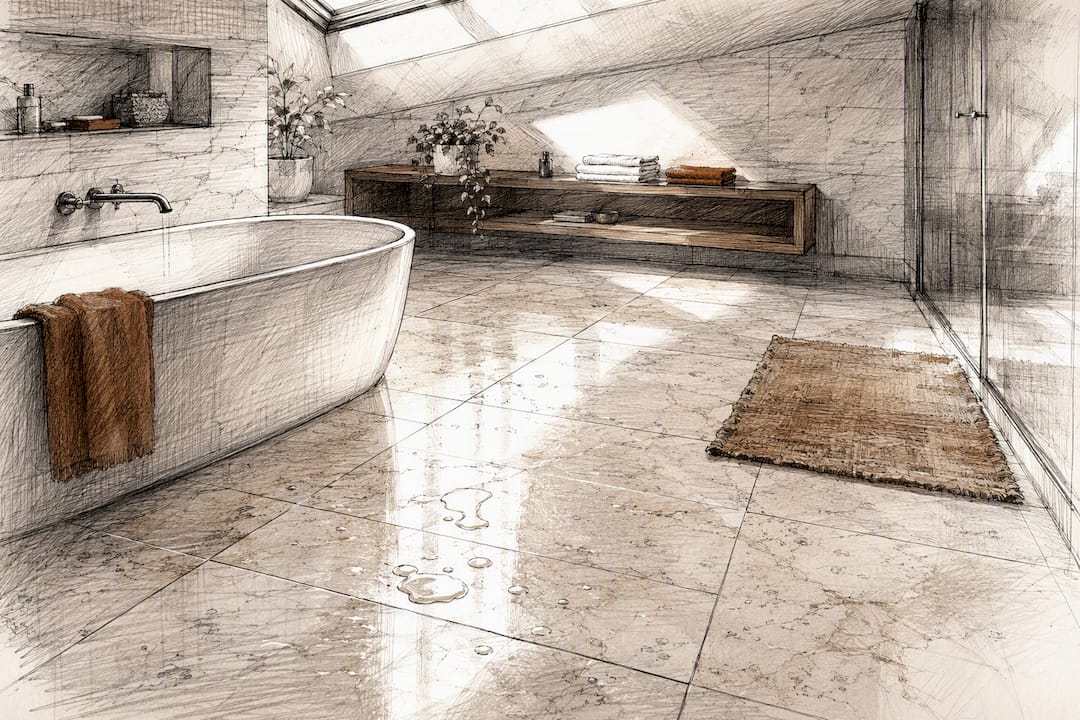
Matte and honed finishes scatter light instead of bouncing it, producing a softer, more even look that hides minor imperfections and daily grime far better. That’s a major reason matte and honed surfaces have become the default in modern bathroom renovations, alongside their safety advantage underfoot.
Natural light matters too. A bathroom with a window facing north gets cooler, flatter daylight, which tends to favor warmer stone tones like travertine or beige marble to keep the room from feeling sterile. South-facing bathrooms with strong direct light can carry cooler grays and whites without looking clinical.
Under artificial light, pay attention to color temperature. Warm bulbs (around 2700K) flatter beige and cream stone tones, while cooler bulbs (4000K and above) suit gray porcelain and crisp white schemes. If you’re installing a textured or tumbled stone finish, angled vanity lighting or a well-placed recessed fixture will emphasize that texture in a way flat overhead lighting won’t. Bring your tile sample into the actual bathroom and check it against your planned fixtures before finalizing anything, since showroom lighting almost always misrepresents how a finish will look at home.
Matching Floor Tile to Your Wall Tile and Overall Design
The floor and walls need to work as one composition, not two separate decisions made months apart. A common modern approach uses a large-format neutral floor as the quiet base, then lets the wall tile or shower surround carry more pattern, texture, or a bolder stone veining. That contrast in scale (large plain floor, more detailed wall) reads as deliberate rather than busy.
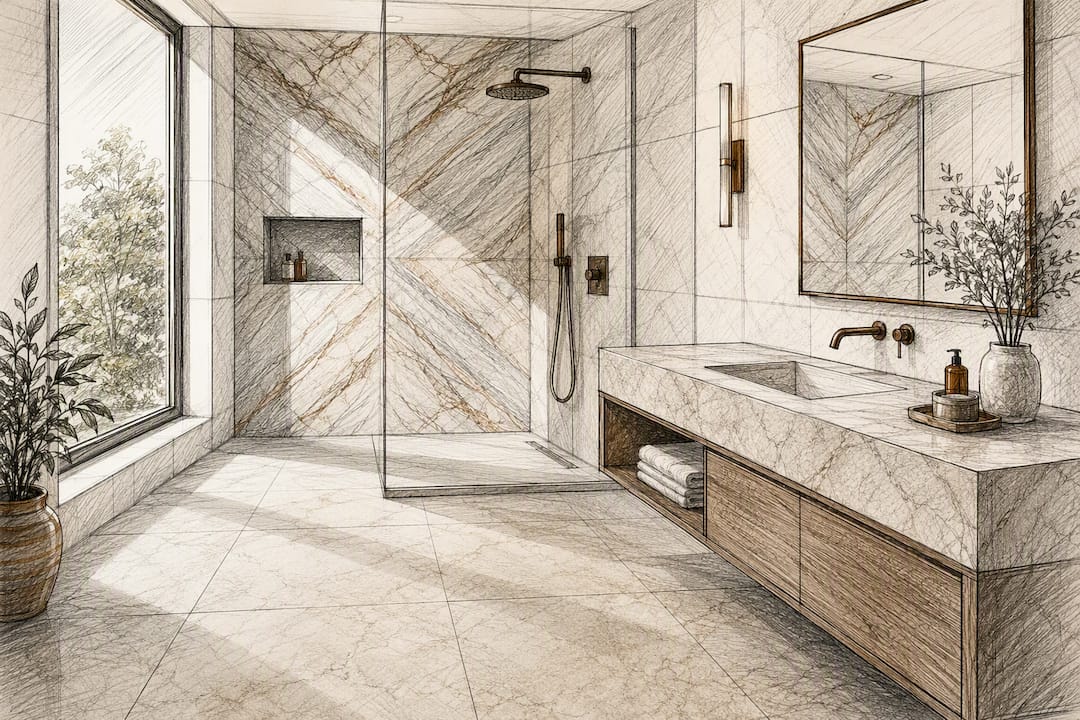
Color continuity across floor and wall doesn’t mean matching tiles exactly. It usually means staying within the same undertone family, whether that’s warm beige and taupe or cool gray and white, so the transition at the tub or shower curb doesn’t feel jarring. Coordinating a floor tile with a backsplash or vanity-area tile choice elsewhere in the house also helps a renovation feel intentional rather than piecemeal.
Grout color plays a bigger role in this integration than most people plan for. Matching grout to tile on both floor and walls reinforces that seamless, low-grout modern look designers are leaning into. A contrasting grout on the wall but not the floor (or vice versa) can make two surfaces that are otherwise similar in tone look disconnected. If you’re planning wall tile as part of the same renovation, reviewing a full bathroom wall tile installation workflow alongside your floor choice helps you sequence decisions instead of picking each surface in isolation.
Sustainable and Eco-Friendly Tile Options Gaining Ground
Sustainability is showing up in bathroom renovations less as a single trendy material and more as a set of practical choices homeowners are layering into decisions they’d make anyway. Porcelain and natural stone both hold up here: a floor that lasts fifteen to twenty-five years without replacement is inherently lower-impact than one that needs redoing every five years because of cheap materials or poor installation.
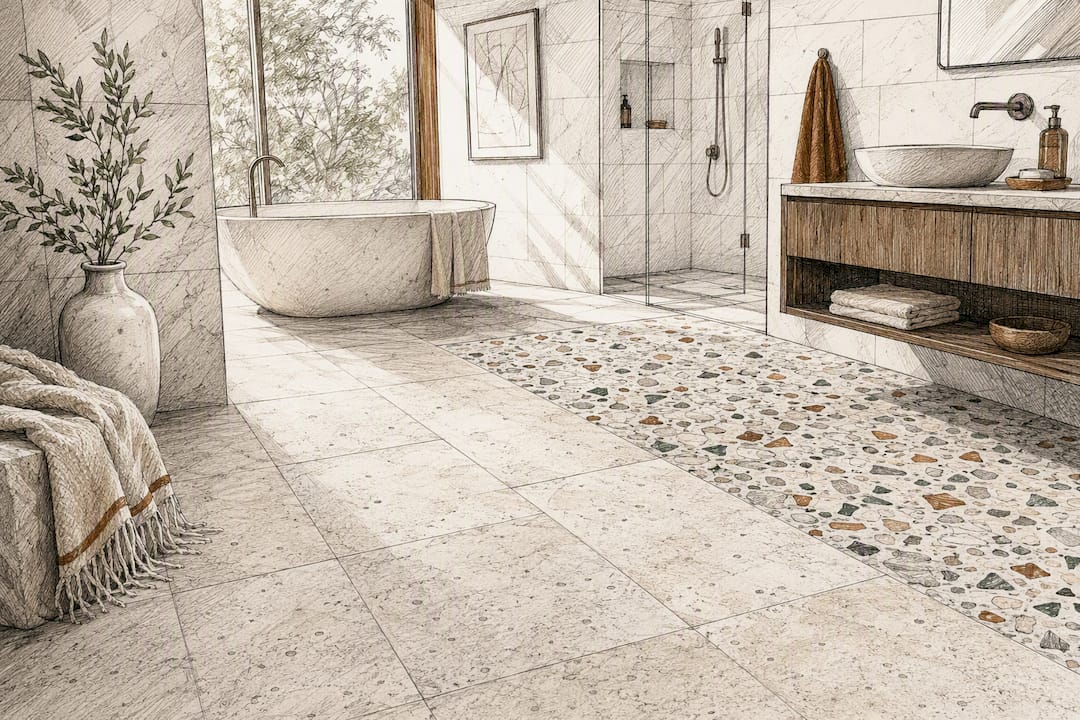
Recycled-content tile, including porcelain bodies made with reclaimed material and terrazzo blended with recycled glass or stone aggregate, has become easier to find at mainstream price points rather than only through specialty suppliers. Terrazzo in particular fits naturally into the accent-floor and statement-area role already popular in modern bathrooms, so choosing a recycled-aggregate version doesn’t require compromising on the look.
Natural stone carries its own sustainability argument, even without a recycled-content label. Quarried stone requires no synthetic manufacturing process, and a well-sealed honed marble or travertine floor can genuinely outlast several generations of manufactured flooring trends. Buying direct from an importer rather than through multiple distribution layers also tends to reduce the overall footprint of getting stone from quarry to bathroom.
Local sourcing matters more than people assume, too. Stone and porcelain shipped shorter distances, or ordered in the quantity actually needed rather than over-purchased “just in case,” cuts down on both waste and transportation impact. If sustainability is a priority in your renovation, ask your supplier directly about where materials are quarried or manufactured. That single question often reveals more than any marketing label on the box.
A Short Note From Our Perspective
The best modern bathrooms rarely go all-in on one texture. Pair a calm, large-format neutral floor with one honed stone accent, whether that’s a hex inlay or a stone threshold, and order samples before anything else. That one habit prevents more renovation regret than any style choice.
— cihan
Explore Natural Stone Collections at Surfaces Galore
If you’ve been comparing large-format porcelain against honed marble and travertine, Surfaces Galore gives you a direct line to the real stone, cut from the quarry to your project without the markup layered on by multiple distributors. As a direct importer based in Anaheim, California, shipping nationwide, Surfaces Galore offers sample options so you can test veining, tone, and finish in your own bathroom lighting before committing to a full order.
Whether you’re outfitting a single powder room floor or sourcing bulk marble and travertine for a full remodel, the collections are built for exactly this kind of decision. Discover marble collections and travertine selections, request samples for the finishes you’re considering, and shop natural stone tiles today at Surfacesgalore.
Sources
- NKBA | KBIS 2026 Bath Trends Report – NKBA
- Performance & style guide to bathroom materials and finish options
- Bathroom tile cost: porcelain vs ceramic vs stone
FAQ
What is the current trend in bathroom tile?
Large-format porcelain and honed natural stone with minimal grout lines are leading, with 89% of designers reporting client demand for that seamless, low-grout look, paired with neutral color palettes.
What is the best flooring for a modern bathroom?
Large-format porcelain is generally the best all-around choice for durability and low maintenance, while honed marble or travertine from a direct source like Surfaces Galore suits homeowners prioritizing natural texture and long-term character.
What bathroom tile never goes out of style?
Honed natural stone, classic hexagon mosaics, and simple large-format neutral porcelain have all held their design relevance for decades because they favor proportion and material quality over trend-driven pattern.
Should the bathroom floor be lighter or darker than the walls?
Either works, but keeping the floor as the quieter, more neutral surface while letting walls or a shower surround carry more pattern or depth tends to read as more intentional and current.
What DCOF rating should I look for in bathroom floor tile?
Choose tile rated at a Dynamic Coefficient of Friction of 0.42 or higher for any wet or level interior surface to reduce slip risk.
Leave a comment