
Stone Mosaic Custom Pool Applications: A Complete Guide

Natural stone mosaics turn a pool from a functional rectangle into something worth looking at twice. Whether you’re specifying a waterline border for a Scottsdale resort or planning a floor medallion for a residential backyard in Florida, stone mosaic custom pool applications sit at the intersection of artistry and structural engineering. Get the material selection right, and you have a surface that lasts decades. Get it wrong, and you’re regrouting within three years.
Here’s what you need to know before specifying or installing:
- Common stones used: marble, travertine, limestone, granite, and slate
- Key performance factors: water resistance, porosity, slip resistance, and chemical compatibility
- Installation essentials: mosaic sheets, 100% thin-set coverage, epoxy grout, and sealants
- Typical applications: pool waterlines, submerged floors, spa surrounds, and accent walls
- Maintenance demands: periodic resealing and pH-balanced cleaning products
- Where to source: Surfacesgalore carries authentic marble, travertine, and limestone mosaics shipped nationwide
Table of Contents
- Which natural stone types work best in pool environments?
- How should you install stone mosaics in a pool?
- What finish keeps pool stone surfaces safe underfoot?
- How do stone mosaics enhance pool design aesthetics?
- What is the environmental impact of sourcing natural stone?
- Are stone mosaics compatible with pool chemicals and water treatment?
- Surfacesgalore: premium natural stone mosaics for your pool project
- Key Takeaways
- FAQ
Which natural stone types work best in pool environments?
Not every beautiful stone belongs underwater. The pool environment is chemically aggressive, thermally variable, and constantly wet. Material selection is where most projects succeed or fail before a single tile is set.
- Marble mosaics are dense with distinctive veining and perform well when finished with a honed, sandblasted, or brushed surface. Polished marble is a slip hazard when wet and should be avoided on horizontal pool surfaces.
- Travertine mosaics have natural surface texture and open pores that provide traction and dissipate heat underfoot, making them a top choice for warm-climate pool decks and spa surrounds. Quality travertine has crystalline, evenly distributed cavities; stones with clay-filled or sandy spots degrade rapidly in pool water.
- Limestone mosaics are softer and more porous than marble or travertine. They require thorough sealing and careful pH management, since acidic pool water accelerates surface erosion.
- Granite and slate mosaics offer low porosity and high durability, with a rugged aesthetic that suits contemporary and naturalistic pool designs.
- Porosity matters more than appearance. A stone that looks solid may still absorb water and pool chemicals if it contains clay impurities or soft spots. Always verify cavity structure before specifying.
- Finish selection is non-negotiable for safety. Honed, brushed, sandblasted, and naturally tumbled finishes all provide the grip that polished surfaces lack.
Surfacesgalore specializes in marble, travertine, and limestone mosaics sourced directly from quarries, with product lines vetted for density and finish consistency. Their travertine selection guide covers porosity grading and heat dissipation properties in detail.
How should you install stone mosaics in a pool?
Installation is where most stone mosaic failures originate. Submerged environments are unforgiving: any void behind a tile becomes a water pocket, and water pockets cause freeze-thaw cracking, delamination, and salt attack.
- 100% thin-set coverage is mandatory. Expert installers eliminate all voids behind mosaic sheets to prevent water ingress and freeze-thaw damage. Back-buttering each sheet in addition to applying adhesive to the substrate is standard practice.
- Epoxy grout outperforms cement-based grout in pool environments. It resists water penetration, staining, and chemical damage at a level cement grout cannot match. For pool stone mosaic installations, epoxy grout is the professional standard.
- Use flexible, high-polymer adhesives. Pools expand and contract with temperature changes. A rigid adhesive bond will crack; a flexible one moves with the structure.
- Six-sided sealing before installation means sealing all faces of each stone piece, including the back, before setting. This dramatically reduces moisture absorption through the substrate bond.
- Plan movement joints. Expansion joints at regular intervals accommodate thermal cycling and prevent the grout lines from cracking under pressure.
- Secondary waterproofing membranes applied to the substrate before tiling add a critical layer of protection, especially at corners and penetrations.
- Professional installation systems that integrate adhesive, grout, and membrane from a single manufacturer reduce compatibility risk and simplify warranty coverage.
Pro Tip: Never skip back-buttering on mosaic sheets in submerged zones. Even a small void behind a 1-inch stone piece can trap enough water to pop the tile off the substrate within a single freeze cycle.
For grout selection guidance specific to stone mosaics, Surfacesgalore’s resource on mosaic grout options covers water resistance ratings and compatibility with natural stone.
What finish keeps pool stone surfaces safe underfoot?
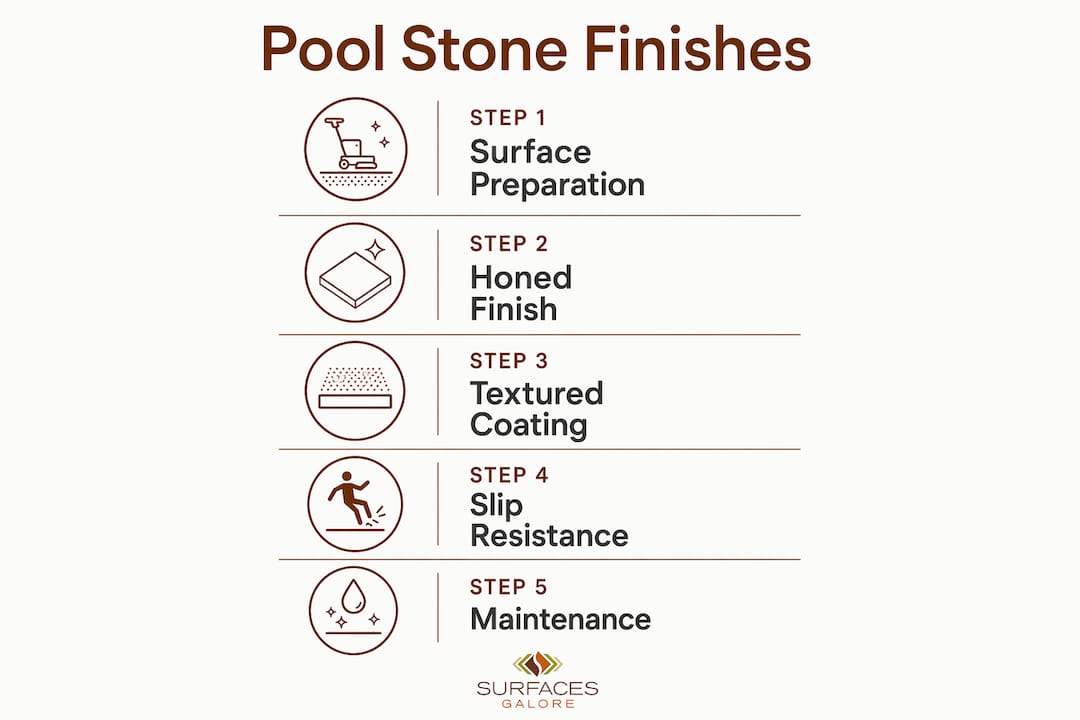
Slip resistance is a design decision, not an afterthought. A polished marble surface that looks stunning in a showroom becomes a liability the moment a wet foot steps on it.
- Polished finishes are inappropriate for any horizontal pool surface. The reflective sheen comes from a surface so smooth it offers almost no friction when wet.
- Honed, brushed, sandblasted, and tumbled finishes are the safe choices. Each creates micro-texture that grips wet feet without sacrificing the stone’s natural character. Stone surface finish directly determines slip resistance in pool areas.
- Travertine’s natural porosity functions as a built-in safety feature. Dense, crystalline travertine provides traction when wet and stays cooler underfoot than denser stones, which is a real advantage on sun-exposed pool decks in the South and Southwest.
- Marble can be made safe with sandblasting or honing, but the finish must be specified explicitly. Never assume a marble mosaic arrives in a pool-safe finish.
- Resealing maintains safety. As sealant wears, stone becomes more porous and can develop a slick biofilm. Regular maintenance keeps the surface texture performing as intended.
- Surface texture affects comfort, not just safety. A brushed travertine feels pleasant underfoot; a heavily sandblasted granite can feel abrasive. Test samples before committing to a large installation.
Surfacesgalore’s article on marble shower floor slip resistance applies directly to pool environments and covers finish selection in practical terms.
How do stone mosaics enhance pool design aesthetics?
The design range for custom stone pool mosaics is wider than most homeowners realize. A single-color travertine waterline border is the entry point; a hand-cut marble medallion on a pool floor is the ceiling.
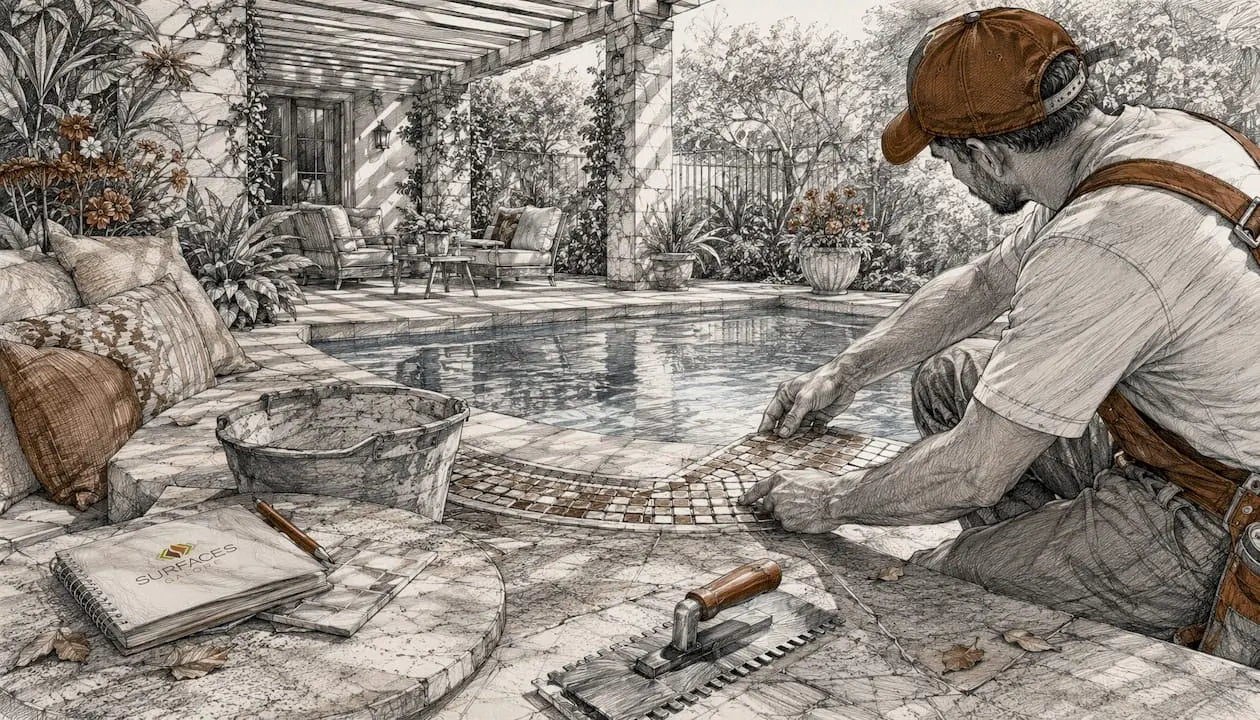
- Waterline borders are the most common application. A band of contrasting mosaic at the waterline defines the pool’s geometry and protects the most chemically exposed zone with a durable, sealed surface.
- Floor medallions in submerged areas create a focal point visible from above and from the pool deck. These require precise custom cutting and full epoxy grout coverage.
- Wall murals and accent panels in spa surrounds or feature walls add depth and visual interest without the structural demands of a submerged floor.
- Spa surrounds benefit from travertine’s heat dissipation and slip resistance, making it both a practical and aesthetic choice.
- Coordination with coping and decking matters. A mosaic that fights with the pool coping stone reads as disjointed; one that echoes it reads as intentional design. Early collaboration among designers, architects, and installers is what separates a cohesive result from a patchwork one.
- Budget scales with complexity. A simple border mosaic costs a fraction of a custom pictorial medallion. Natural stone commands a premium over ceramic or glass, but the longevity and resale value typically justify it for luxury residential and commercial projects.
- Environmental sourcing is increasingly a client priority. Natural stone is a finite resource, and responsible sourcing from quarries with documented extraction practices matters to many designers and their clients.
What is the environmental impact of sourcing natural stone?
Natural stone is one of the most durable building materials available, which is itself an environmental argument. A travertine pool deck installed correctly can outlast multiple generations of synthetic alternatives, reducing the lifecycle waste of replacement materials.
That said, quarrying has real impacts: land disturbance, water use, and the carbon cost of transportation from quarry to job site. Specifying stone from suppliers who document their sourcing practices, prioritize shorter supply chains, and minimize waste in fabrication reduces that footprint. Surfacesgalore imports directly from quarries, which cuts out intermediary handling and the associated logistics emissions.
Reclaimed and salvaged stone is another option for designers with sustainability mandates, though matching existing pool tile with reclaimed material requires careful color and thickness verification.
Are stone mosaics compatible with pool chemicals and water treatment?
Chemical compatibility is the technical question most homeowners skip until something goes wrong. Pool water is not neutral: chlorinated systems run at pH 7.2–7.8, and salt-chlorinated systems add a corrosive chloride load on top of that.
Salt-chlorinated pool water is particularly aggressive toward porous materials. Dense stones like granite and quartzite handle it better than limestone or lower-grade travertine. For any natural stone in a salt pool, thorough sealing and annual resealing are non-negotiable.
Marble and travertine are calcium-based, which means acidic water below pH 7.0 will etch them over time. Maintaining proper water chemistry protects the stone as much as it protects the pool equipment. Comprehensive sealing before installation and periodic maintenance are the primary defenses against staining and chemical damage from pool water.
Glass and porcelain mosaics offer lower porosity and higher chemical resistance than natural stone, but they cannot replicate the warmth and texture that makes stone mosaics worth the additional care.
Surfacesgalore: premium natural stone mosaics for your pool project

Surfacesgalore is a direct importer of authentic marble, travertine, and limestone mosaics, shipping nationwide to homeowners, designers, and contractors across the United States. Because they import directly, the pricing reflects what the material actually costs, not what three layers of distribution add to it.
Their catalog covers the full range of custom stone pool designs, from simple waterline borders to complex floor patterns, with expert guidance on finish selection, grout compatibility, and installation sequencing. Whether you’re sourcing for a single residential pool or specifying materials across a commercial hospitality project, Surfacesgalore provides the product depth and technical support to get the specification right the first time.
Browse their natural stone mosaic collections to find the right marble, travertine, or limestone for your pool project, and reach out to their team for design consultation and project support.
Key Takeaways
Natural stone mosaics in pool environments require the right stone, the right finish, and the right installation system to perform for decades without failure.
| Point | Details |
|---|---|
| Stone selection drives performance | Dense stones like granite and quality travertine resist chemical damage better than porous limestone in pool environments. |
| Epoxy grout is the professional standard | Epoxy grout outperforms cement-based grout in water penetration, staining, and chemical resistance for pool mosaics. |
| Finish determines safety | Honed, brushed, sandblasted, or tumbled finishes provide the slip resistance that polished surfaces cannot offer when wet. |
| Chemical compatibility requires maintenance | Salt-chlorinated pools demand dense stone, thorough sealing, and annual resealing to prevent surface degradation. |
| Surfacesgalore for sourcing | Surfacesgalore imports authentic marble, travertine, and limestone mosaics directly, with nationwide shipping and expert project support. |
FAQ
What stones work best for submerged pool mosaic applications?
Dense stones like granite, quartzite, and high-quality travertine perform best in submerged zones. Marble works well with proper sealing and epoxy grout; limestone requires the most maintenance due to its higher porosity.
Why is epoxy grout recommended over cement grout for pool mosaics?
Epoxy grout resists water penetration, staining, and chemical damage at a level cement-based grout cannot match, making it the professional standard for pool stone mosaic installations.
How often should natural stone pool mosaics be resealed?
Most natural stone pool mosaics benefit from periodic resealing to maintain chemical and stain resistance, with some needing more frequent attention in high-traffic or salt-pool installations.
Can polished marble be used in a pool?
Polished marble is not recommended for horizontal pool surfaces because it becomes dangerously slippery when wet. Honed, sandblasted, or brushed finishes provide the necessary grip for safe pool use.
Where can I source premium natural stone mosaics for a pool project in the US?
Surfacesgalore is a direct importer of marble, travertine, and limestone mosaics based in Anaheim, California, with nationwide shipping for residential and commercial pool projects.

Leave a comment