
Trade Ready Thassos Marble: Build 10–15% Overage, Seal Before Grout

Thassos is a pure-white marble quarried on the Greek island of the same name, valued for a brightness and crystalline shine that few other natural stones match. It works best on floors, walls, countertops, shower surrounds, and mosaic accents where you want a clean, light-filled backdrop rather than heavy veining. The tradeoff comes down to finish: polished Thassos delivers maximum sparkle but shows etching and foot traffic fast, while honed Thassos trades some shine for durability and slip resistance, and either finish needs a quality sealer to stay stain-free.
TL;DR:
- Thassos marble’s bright white appearance results from its pure limestone origin and crystalline structure that scatters light, making finish choice crucial for its look and longevity.
- Polished Thassos offers maximum shine but requires diligent sealing and is less suitable for high-traffic or wet areas, whereas honed or textured finishes prioritize durability and slip resistance.
- Sealing is essential before grouting and periodically thereafter; a water-drop test helps determine when resealing is necessary to prevent stains and etching.
- Proper substrate flatness, edge profiling, and grout color choices significantly affect the visual consistency and longevity of installed Thassos surfaces.
- Sourcing directly from importers with slab photos and sample approvals minimizes project surprises, ensures consistency, and offers cost advantages over reseller channels.
Table of Contents
- What Makes Thassos Marble Look So Bright?
- How Do You Specify Thassos Formats and Sizes?
- What’s the Right Way to Install and Maintain Thassos?
- Where Does Thassos Fit in 2026 Interior Design?
- Where Does Thassos Marble Come From?
- Thassos vs. Carrara vs. Calacatta: What’s the Real Difference?
- Is Thassos Marble Quarrying Environmentally Sustainable?
- Why Does Thassos Need More Upkeep Than Some Other Marbles?
- What Does Thassos Marble Typically Cost?
- Why Has Thassos Marble Mattered to Architecture for So Long?
- The Trade Perspective on Specifying Thassos
- Ready to See Thassos in Your Own Project?
- Sources
- FAQ
What Makes Thassos Marble Look So Bright?
Thassos earns its reputation from two things working together: an unusually pure white body and a fine, sugar-like crystalline structure that scatters light instead of absorbing it. Most marbles carry mineral streaks that read as gray or beige veining. Thassos has almost none of that, which is why designers reach for it when the goal is a calm, uniform white field rather than a dramatic pattern.
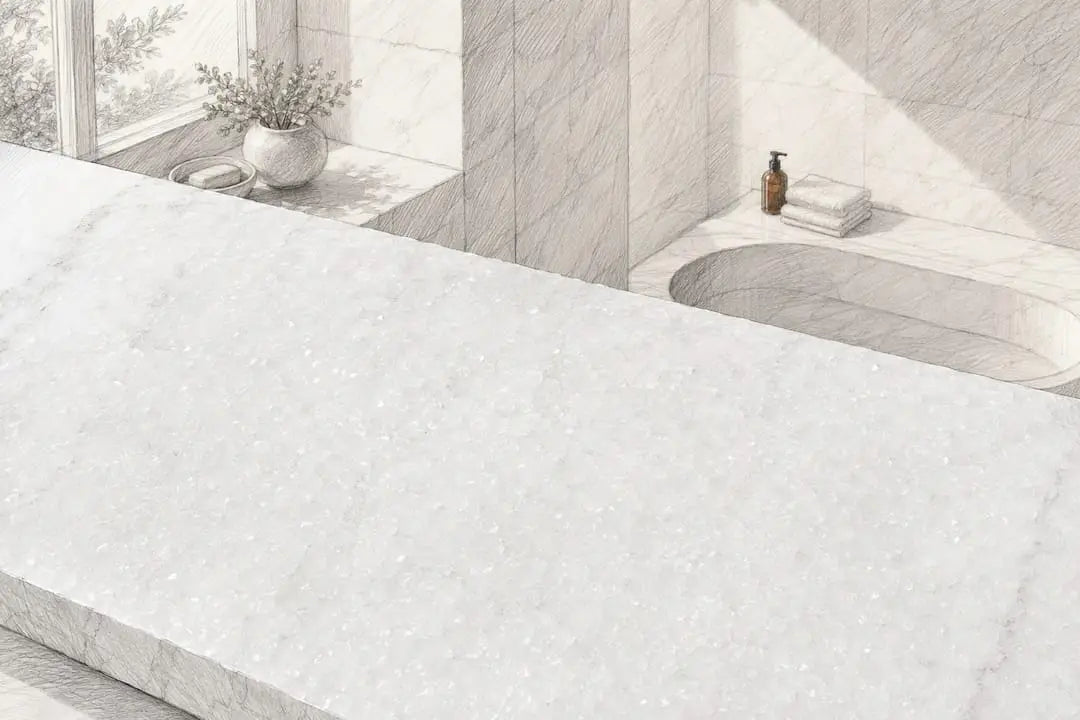
That crystalline structure is also what makes finish selection so consequential. A polished surface acts almost like a mirror, amplifying the stone’s natural brightness and making small rooms feel larger. A honed finish mutes the shine into a soft, matte glow, and a textured or brushed finish goes further still, trading reflectivity for grip.
Here’s how the three main finishes stack up in practice:
- Polished: Maximum luminosity and the classic “wet look,” but it shows etching and footprints more readily than honed surfaces, so it suits low-traffic walls, backsplashes, and accent pieces better than busy floors.
- Honed: A softer, matte surface that hides minor scratching and etching, making it the better call for kitchen floors, entryways, and other high-traffic zones.
- Textured or tumbled: Adds real slip resistance for wet feet, which is why it shows up most often on shower floors and pool surrounds.
Porosity is the other variable you can’t skip. Thassos isn’t as absorbent as some limestones, but it’s still porous enough that oil, wine, and citrus can etch or stain an unsealed surface within minutes. STONETECH’s own sealing and care guidance recommends sealing the stone before grout ever touches it, which keeps grout haze and staining from working into the surface during installation.
Pro Tip: Ask your supplier for a small offcut and test a lemon slice on it for two minutes before you commit to a finish. If it etches visibly, budget for a honed surface and a stricter sealing schedule in kitchens.
How Do You Specify Thassos Formats and Sizes?
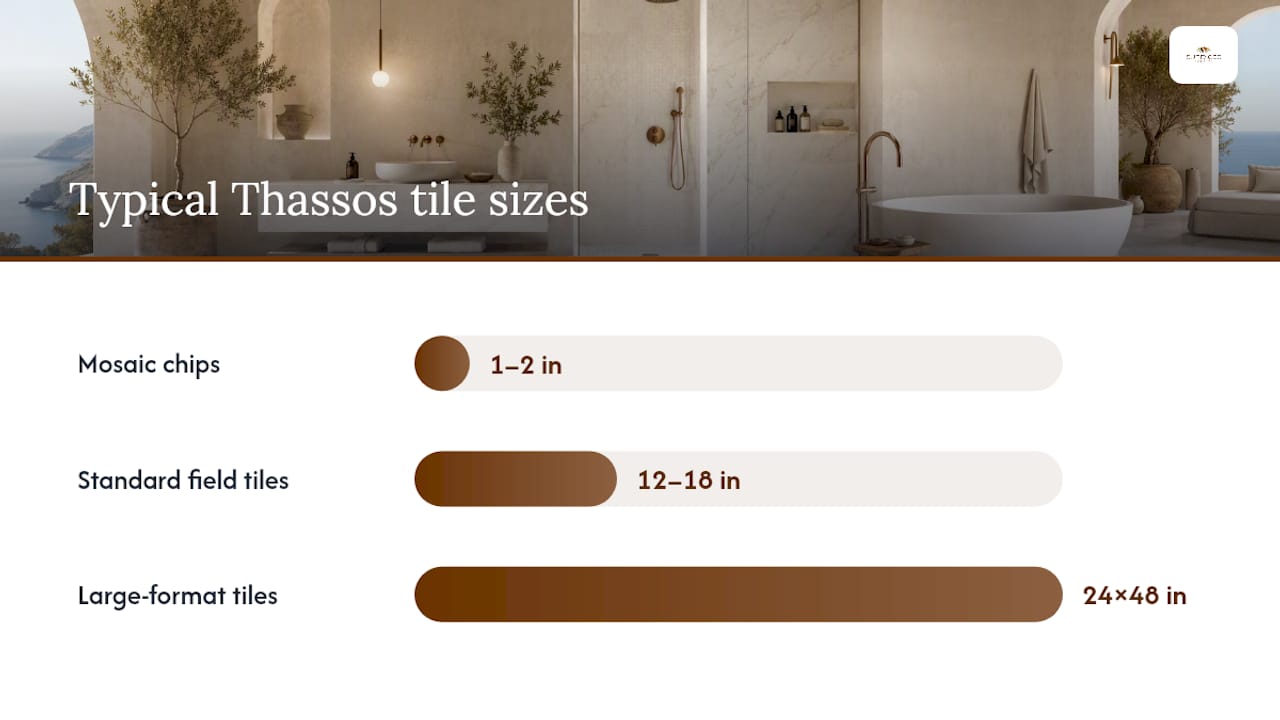
Thassos comes in a wide range of formats, and the right one depends on where it’s going and how the finished surface needs to read. Small mosaics (typically 1x1 inch to 2x2 inch chips) work well on shower floors and accent bands, where drainage slope and grip matter more than an unbroken visual field. Standard field tiles run from 12x12 inches up to 18x18 inches for walls and moderate-traffic floors, while large-format tiles, often 24x48 inches, minimize grout lines and give the stone room to show off its brightness across an open floor plan. Slabs for countertops and feature walls typically run 3/4 inch to 1 1/4 inches thick, depending on the fabrication and support requirements.
Getting the order right the first time comes down to a short checklist:
- Confirm the finish per surface. Don’t assume one finish works everywhere; a project might specify polished for a vanity top and honed for the surrounding floor.
- Request slab photos or physical samples for approval. For bookmatched pairs or large runs, ask for slabs to be set aside for visual matching before fabrication begins, since natural variation between lots is real even within a “pure white” stone.
- Specify edge profiles early. Eased, bullnose, and ogee edges each change how light catches the stone’s edge, and switching profiles mid-project can delay fabrication.
- Confirm thickness against substrate and support. Thin-set applications need different substrate prep than thick slab countertops.
- Get quantities with 10 to 15 percent overage built in to cover cuts, breakage, and future repairs from the same lot.
Digital imaging has made slab matching far less of a guessing game than it was even a few years ago, letting designers approve veining and tone from photos before a slab ever ships.
What’s the Right Way to Install and Maintain Thassos?
Installation choices made on day one determine how Thassos performs for the next twenty years. Substrate flatness matters more with a bright white, high-polish stone than with a busy pattern, because any subfloor imperfection telegraphs through as a visible shadow. Use a modified thin-set rated for natural stone, and match your trowel notch to the tile format, larger tiles need a bigger notch for full coverage. For grout, choose a color close to the stone itself; a stark contrast grout line will visually fragment the clean white field that’s the whole reason someone chose Thassos in the first place.
Wet areas need extra thought. Honed or lightly textured finishes belong on shower floors, where slip resistance matters more than shine, and a topical sealer becomes non-negotiable given constant water exposure. If you’re planning a full shower surround, review shower installation workflow guidance before tiling begins.
On sealing schedule: STONETECH’s guidance recommends sealing marble before grouting, which reduces the chance of grout haze bonding into the stone’s surface pores. After installation, a simple water-drop test tells you when it’s time to reseal.
Pro Tip: Place a few drops of water on the stone. If it beads up for 15 to 20 minutes, the seal is holding. If it darkens the stone within a few minutes, it’s time to reseal.
Routine care is straightforward when you follow it:
- Clean with a pH-neutral stone cleaner, never vinegar, bleach, or generic all-purpose sprays.
- Wipe up citrus, wine, and oil spills immediately to prevent etching.
- Use coasters and trivets on countertops in daily use.
- Reseal on a schedule based on traffic, kitchens and bathrooms need more frequent attention than accent walls.
Etch marks (dull spots where acid has touched the polish) can often be buffed out by a stone restoration specialist using marble polishing powder. Deep scratches or cracked tiles usually call for professional intervention rather than a DIY fix. For a broader troubleshooting reference, avoiding marble damage covers the most common homeowner mistakes.
Where Does Thassos Fit in 2026 Interior Design?
Thassos remains one of the go-to stones for kitchens, primary bathrooms, and entryways where the goal is a bright, gallery-like feel rather than a busy, patterned surface. It shows up as full-slab countertops, shower wall panels, floor fields, and small-format mosaic accents on backsplashes and niche walls. Because its veining is so minimal, it also reads beautifully on furniture tops and side tables, where a busier marble would compete with other design elements in the room.
A handful of trends are shaping how it gets used going into 2026:
- Large-format runs with minimal grout lines to emphasize the stone’s uninterrupted brightness across open floor plans.
- Warm-wood pairings, oak, walnut, and rattan, that soften the coolness of pure white stone and keep a room from feeling clinical.
- Matte black or brushed brass fixtures as a contrast finish, which reads as more current than polished chrome against bright white marble.
- Restrained veining strategies, choosing the cleanest lots available rather than seeking out dramatic movement, since the appeal of Thassos is precisely its calm uniformity.
Grout choice deserves a second mention here: a bright white or matched-tone grout keeps the surface reading as one continuous plane, while a gray or charcoal grout on a Thassos floor creates a grid pattern that can undercut the minimalist effect. For more on pairing stone with current interior direction, see advantages of marble tiles for 2026.
Where Does Thassos Marble Come From?
Thassos marble is quarried on Thassos island in the northern Aegean Sea, part of a metamorphic belt where limestone deposits were transformed under intense heat and pressure over millions of years. That process, called metamorphism, recrystallizes the original limestone into dense, interlocking calcite crystals, and it’s the uniformity of that recrystallization on Thassos specifically that produces such a clean white body with so little mineral impurity.
Most marbles get their color and veining from trace minerals, iron for warm tones, graphite or clay for gray streaking, that were present in the original sediment. Thassos formed from an unusually pure limestone source with minimal mineral contamination, which is why it comes out of the ground closer to true white than most quarries can produce. The fine, tight crystal grain is what gives the stone its particular light-scattering quality rather than a glassy, uniform reflection.
Quarrying on the island has continued for thousands of years, and the same geological formation that produced ancient building stone is still being extracted today. Modern quarrying uses diamond wire saws instead of hand tools, but the stone being cut is geologically the same material that’s made Thassos a reference point for pure white marble across architectural history.
Thassos vs. Carrara vs. Calacatta: What’s the Real Difference?
If you’re choosing between the major white marbles, the decision usually comes down to how much veining you want. Thassos sits at one extreme: nearly pure white with minimal to no visible veining, which makes it the choice when the goal is a flat, calm field of color. Carrara, quarried in Italy, runs gray-white with soft, feathery gray veining that gives it a more traditional, textured look. Calacatta, also Italian, tends toward a brighter white background than Carrara but with bolder, more dramatic veining, often gold or gray, that reads as a statement piece rather than a backdrop.
Price and use case follow from that visual difference. Designers reach for Thassos when they want the stone to disappear into a clean, minimal composition, letting cabinetry, fixtures, or architecture carry the visual interest. Carrara suits a more classic, softer aesthetic where some movement is welcome. Calacatta gets specified when the stone itself is meant to be the focal point of a room, often on a single feature wall or island rather than throughout an entire space.
None of the three is objectively “better.” They solve different design problems. A kitchen island that needs to make a statement calls for Calacatta’s bold veining; a spa-style bathroom built around calm and light calls for Thassos; a traditional kitchen with painted cabinetry often looks right with Carrara’s gentle movement. Matching the stone to the intended mood matters more than chasing whichever one is trending.
Is Thassos Marble Quarrying Environmentally Sustainable?
Marble quarrying, including on Thassos, is a resource-intensive process. Extracting stone from a mountainside involves diesel-powered cutting equipment, water use for dust suppression and blade cooling, and permanent alteration of the quarry landscape. These impacts are real and worth acknowledging honestly rather than glossing over with vague sustainability language.
That said, natural stone has genuine advantages over many manufactured alternatives when you look at the full lifecycle. Thassos marble doesn’t require petroleum-based resins or synthetic binders the way engineered quartz does, and a well-maintained marble floor or countertop can last generations rather than being replaced every 10 to 15 years like some manufactured surfaces. Longevity is itself a sustainability factor: a material that never needs replacing has a smaller lifetime footprint than one that gets torn out and landfilled on a shorter cycle.
Sourcing matters too. Buying from an established, direct-importer supply chain rather than an unclear chain of resellers gives you more visibility into quarry practices and reduces the number of intermediate handling and shipping steps. If sustainability is a priority for a project, ask your supplier directly about quarry practices, water reclamation, and shipping logistics rather than relying on marketing claims. Those are fair questions for any natural stone purchase, and a transparent supplier should be able to answer them.
Why Does Thassos Need More Upkeep Than Some Other Marbles?
Thassos looks pristine when it’s new, and that’s exactly why maintenance lapses show up faster on this stone than on darker or more heavily veined marbles. A gray-veined Carrara can hide a light etch mark or a faint water spot within its existing pattern. On a uniform white Thassos surface, the same mark stands out immediately because there’s no visual noise to camouflage it.
Over time, the maintenance issues that trip people up tend to be the same few. Etching from acidic foods and cleaners is the most common, since even a properly sealed surface can dull under prolonged contact with citrus, wine, or vinegar-based cleaners. Grout haze and staining around Thassos tiles is another recurring issue, which is exactly why sealing before grouting makes such a measurable difference in how the finished installation ages. Traffic patterns on polished floors show up as dulled paths in high-use areas well before the rest of the floor loses its shine, which is the main reason honed finishes get recommended for anything busier than a powder room.
The fix isn’t complicated, it’s consistency. A pH-neutral cleaner, prompt spill cleanup, and a sealing schedule matched to how hard the surface works will keep Thassos looking close to day one for years. Skipping that routine for a few years and then trying to catch up is where most owners run into trouble, since built-up etching and staining take professional restoration to reverse rather than a weekend of elbow grease.
What Does Thassos Marble Typically Cost?
Thassos generally sits in the premium tier of natural stone pricing, reflecting both its scarcity and the labor involved in quarrying a stone with such demanding purity standards. Several factors move the price within that tier. Finish is one: polished and honed typically price similarly, but specialty finishes like tumbled or brushed can add a premium. Format matters too, large-format tiles and slabs cost more per square foot than small mosaic chips, partly due to yield loss during cutting and the difficulty of extracting flaw-free large pieces from the quarry.
Grade and variety shift price further. Standard Snow White commands a baseline price, while Vein Cut or Golden Radix varieties, which show more movement or warmer tones, often carry a premium because they’re less common and more selectively cut. Book-matched slab pairs, used for dramatic wall features or waterfall countertop edges, cost more than standard slabs because the fabricator has to carefully select and cut adjacent sections from the same block.
Beyond the stone itself, budget for fabrication (cutting, edge profiling, and polishing), installation labor, substrate prep if your existing subfloor isn’t flat enough, and sealing products. Getting a written quote that itemizes material, fabrication, and installation separately makes it far easier to compare bids and spot where costs are coming from. Custom cuts and bulk orders for larger commercial or trade projects typically get better per-square-foot pricing than small retail orders, which is worth raising directly with your supplier before finalizing a design.
Why Has Thassos Marble Mattered to Architecture for So Long?
Thassos marble has a documented history stretching back to antiquity, when the island’s quarries supplied stone for temples, sculptures, and public buildings across the ancient Mediterranean world. Its purity made it especially prized for statuary, where sculptors wanted a stone that wouldn’t compete with the subtlety of carved detail through visible veining or color variation.
That reputation as a “sculptor’s marble” carried forward for centuries, and the same qualities that made it valuable to ancient carvers, brightness, fine grain, minimal flaws, are what make it valuable to architects and designers today. The stone connects a modern kitchen island or bathroom wall to a material tradition that predates almost every other building material still in common use. Few natural stones carry that kind of continuous architectural pedigree from ancient quarrying to contemporary residential design.
For today’s designers, that history isn’t just trivia, it’s part of the pitch to clients who want a material with genuine substance behind it, not just a trending look. Specifying Thassos connects a project to that same lineage, whether the application is a full bathroom renovation or a single accent wall.
The Trade Perspective on Specifying Thassos
Most of the friction around Thassos projects has nothing to do with the stone itself and everything to do with how it gets sourced. Buyers who go through a long chain of resellers often lose the ability to get slab-specific photos, confirm lot consistency, or get a straight answer about lead times, and that’s when projects run into surprises at install. Surfaces Galore works as a direct importer precisely to close that gap, shipping nationwide with the ability to support custom cuts, slab selection, and sample approval for large or book-matched runs.
The opinion worth stating plainly: too many specifiers treat Thassos as interchangeable with any generic white marble, then get blindsided when a polished floor shows wear within a year or grout haze creeps in because nobody sealed before grouting. That’s not a flaw in the stone. It’s a mismatch between finish, application, and maintenance expectations set at the very start of a project. The fix isn’t avoiding Thassos, it’s specifying it deliberately: honed for floors, polished for low-traffic vertical surfaces, and a sealing plan built into the project timeline rather than an afterthought.
Where a direct-importer model earns its keep is in the details that prevent those mismatches: getting real slab photos before fabrication, having someone on the other end who can answer a porosity question without forwarding it to three other companies first, and pricing bulk or trade orders without the markup layers that come from multiple middlemen.
— cihan
Ready to See Thassos in Your Own Project?
Nothing replaces holding a physical piece of Thassos in your hand next to your cabinetry, flooring, or fixture finishes. Surfaces Galore ships samples nationwide so you can test color, veining, and finish under your own project’s lighting before committing to a full order.
Direct importers cut out reseller layers that slow down slab approval and inflate pricing on premium stone. This allows faster access to slab photography for book-matched runs, straightforward trade quotes for contractors and designers managing multiple units, and custom cuts sized to project needs rather than distributor stock. Whether specifying a single bathroom vanity or sourcing stone for a multi-unit commercial build, direct-import pricing and support are beneficial.
Start by requesting samples or a bulk quote through the Surfaces Galore marble collection to get slab photos and lead times specific to your project before you finalize your design.
Sources
FAQ
Is Thassos Marble Durable Enough for Kitchen Floors?
Yes, with the right finish. Honed Thassos resists visible wear and etching better than polished on high-traffic kitchen floors, and a proper sealing schedule keeps stains from setting in.
What’s the Difference Between Polished and Honed Thassos?
Polished Thassos has a reflective, glossy surface that maximizes brightness but shows etching and footprints more easily, while honed Thassos has a matte finish that hides minor wear and offers better slip resistance.
How Often Does Thassos Marble Need to Be Sealed?
Resealing frequency depends on traffic and exposure, but a simple water-drop test tells you when it’s due: if water no longer beads on the surface within 15 to 20 minutes, it’s time to reseal.
Can Thassos Marble Be Used in Showers?
Yes, honed or textured Thassos is commonly used on shower walls and floors, since the added texture improves slip resistance in wet conditions compared to a polished finish.
How Is Thassos Different From Carrara or Calacatta Marble?
Thassos is nearly pure white with minimal veining, Carrara has soft gray veining on a grayer background, and Calacatta features bolder, more dramatic veining on a brighter white field.
Does Surfaces Galore Offer Samples Before Ordering Thassos in Bulk?
Sample requests and slab approval for large or book-matched runs are often supported, helping designers and contractors confirm color and veining before fabrication begins.

Leave a comment