

Understanding Marble Translucency for High-End Design

TL;DR:
- Marble’s translucency depends on mineral structure, crystal size, and impurities, not just thickness.
- Typical light transmission for 12-15mm white marble slabs is around 10%, suitable for subtle backlit effects.
- Marble offers a durable, versatile option for luminous architectural features compared to more translucent stones like onyx and alabaster.
Marble is not a monolithic material. Designers who specify it as if every slab performs identically with light are leaving serious creative potential on the table. A thin panel of White Sivec behind a LED source glows with an almost organic warmth, while a thick Nero Marquina slab absorbs light entirely, creating a completely different spatial experience. The difference is translucency, and it is one of the least understood properties in premium stone specification. This article walks through what marble translucency actually is, how it is measured, how it compares to onyx and alabaster, and how to put it to work in architectural features that clients will remember for decades.
Table of Contents
- What is marble translucency?
- How is marble translucency measured?
- Marble vs. other translucent stones: What sets it apart?
- Designing with marble translucency: Applications and best practices
- A designer’s perspective: The translucency trade-off few discuss
- Explore premium marble solutions with SurfacesGalore
- Frequently asked questions
Key Takeaways
| Point | Details |
|---|---|
| Not all marble is equally translucent | Variations in composition and thickness significantly impact how much light marble transmits. |
| Measurement depends on thickness | A 12-15 mm marble slab transmits about 10 percent of incident light, but thinner slabs need reinforcement. |
| Compared to onyx and alabaster | Marble transmits less light than onyx or alabaster but offers a unique visual effect in premium settings. |
| Design and install thoughtfully | Proper slab choice, lighting, and support are essential for safe and stunning translucent marble features. |
What is marble translucency?
Translucency describes a material’s ability to allow light to pass through it without producing a clear image on the other side. This is a critical distinction. A transparent material, like glass, lets you see through it with full clarity. An opaque material blocks light entirely. Marble falls between these two states, transmitting diffused light that softens, scatters, and glows rather than projecting a sharp image.
For designers and architects, this means marble can function as a luminous surface rather than just a reflective one. That functional difference changes everything about how you use it. A backlit marble panel does not just glow; it reveals the veining, the mineral crystals, and the internal geometry of the stone in a way that no amount of surface polishing can replicate.
Marble translucency is not simply about how thin a slab is. It is the result of crystalline structure, mineral composition, and natural impurities working together to scatter, absorb, or transmit photons.
The fundamental reason marble transmits any light at all is the calcite and dolomite crystals that make up its structure. These crystals are semitransparent at the microscopic level. When they recrystallize under heat and pressure during metamorphism, the resulting stone retains some light-transmitting capacity. The size of those crystals, the uniformity of the matrix, and the presence or absence of iron oxides, clays, and other mineral inclusions all determine how much light ultimately passes through.
Here is what directly controls translucency in marble:
- Crystal size: Larger, more uniform calcite crystals produce higher translucency. Fine-grained marbles scatter and absorb more light.
- Color and tone: Lighter marbles, especially those with white or cream base tones, transmit significantly more light than dark varieties like black or deep green marble.
- Impurity content: Iron oxides create warm amber and orange tones but reduce transmission. Graphite inclusions, responsible for gray veining, absorb light and reduce overall luminosity.
- Veining density: Heavily veined slabs transmit light unevenly, creating dramatic but often inconsistent backlit effects.
- Slab thickness: At standard 12 to 15 mm thickness, marble transmits roughly 10% of incident light, though this number shifts meaningfully as thickness changes.
That 10% benchmark is worth internalizing. It is not enough to make marble a window replacement, but it is absolutely enough to create dramatic luminous effects in architectural applications when the light source is strong and properly positioned. Clients who expect onyx-level glow from a marble slab will be disappointed. Clients who understand marble’s subtle, diffuse luminosity tend to be the most enthusiastic once they see it installed correctly.
Understanding thickness is inseparable from understanding translucency. Our marble thickness guide covers the structural and aesthetic implications of slab thickness in detail, which is essential reading before specifying marble for any lit application.
The most translucent marbles in commercial use today include White Sivec, Afyon White, and Calacatta Michelangelo. These varieties share large, relatively pure calcite crystal structures with minimal dark inclusions. On the opposite end, marbles like Emperador Dark, Verde Alpi, and Nero Marquina are near-opaque and are rarely used in backlit applications except for contrast elements.

How is marble translucency measured?
Quantifying marble translucency requires laboratory conditions that most fabricators do not have on-site. The standard approach uses spectrophotometry or photometry, directing a calibrated light source at one face of a stone slab and measuring how much light exits the opposite face. The result is expressed as a percentage of total incident light transmitted, and it varies with wavelength since stone does not transmit all colors of light equally.
The correlation between thickness and light transmission is predictable but not linear. Decreasing thickness from 20 mm to 10 mm does not simply double transmission because absorption and scattering interact in complex ways within the stone matrix. What is consistent is the directional relationship: thinner slabs transmit more light, and every millimeter removed increases that effect.
Here is a practical reference table for how common translucent stones perform across different thicknesses:
| Stone type | Thickness | Light transmission |
|---|---|---|
| Marble (white varieties) | 15 mm | ~10% |
| Marble (white varieties) | 10 mm | ~15 to 18% |
| Marble (white varieties) | 6 mm | ~22 to 28% |
| Onyx | 15 mm | ~15 to 20% |
| Onyx | 10 mm | ~20 to 25% |
| Alabaster | 12 mm | ~25 to 30% |
| Alabaster | 8 mm | ~30 to 40% |
As transmission data confirms, marble at 12 to 15 mm typically sits around 10% transmission, while thinner slabs increase that figure but bring real structural risks into play.
The structural concern is not trivial. Below 10 mm, marble becomes fragile enough that installation vibration, thermal cycling, and point loads from fixtures can cause cracking. For vertical applications like feature walls, this is manageable with fiberglass mesh backing or honeycomb aluminum panels bonded to the stone’s rear face. For countertops or floor applications, going below 12 mm without full-surface substrate bonding is a liability risk no project budget can justify.
Here is the practical process for specifying and measuring marble translucency on a real project:
- Identify candidate slabs early: Request translucency testing from your fabricator or importer before a slab is committed to a project. Many premium importers can provide light-box demonstrations on request.
- Standardize the thickness decision: Agree on target thickness with your structural engineer before ordering. Going back to reduce thickness after fabrication is expensive and sometimes impossible.
- Test with your actual light source: LED temperature and output wattage dramatically affect the apparent glow. A 3000K warm white LED and a 6500K cool white LED produce completely different visual results through the same marble panel.
- Document transmission rates in specifications: Treat marble translucency like any other performance specification. Include the expected transmission range, slab thickness, and lighting specification in your project documentation.
- Account for sealer impact: Penetrating sealers have minimal effect on translucency, but topical coatings can reduce transmission noticeably. Specify accordingly.
Pro Tip: Bond a fiberglass mesh backing to any marble slab thinner than 12 mm before installation. This adds structural integrity without measurably reducing light transmission and is standard practice for backlit panels in high-traffic hospitality environments.
For guidance on ongoing care after installation, review the details on maintaining translucent marble to understand how cleaning products and polishing methods interact with thin stone.
Marble vs. other translucent stones: What sets it apart?
When a client wants a glowing stone surface, the conversation almost always involves three materials: marble, onyx, and alabaster. These three share the quality of light transmission but differ enormously in practical terms. Understanding where each excels, and where it fails, is the kind of knowledge that separates informed specification from expensive mistakes.
Here is a direct comparison across the key variables:
| Property | Marble | Onyx | Alabaster |
|---|---|---|---|
| Light transmission (standard) | ~10% | 10 to 25% | up to 30% |
| Hardness (Mohs scale) | 3 to 4 | 6 to 7 | 1.5 to 2 |
| Durability | High | Moderate | Very low |
| Cost range | Moderate to high | High | High to very high |
| Slab size availability | Large | Moderate | Small |
| Ideal application | Feature walls, countertops | Backlit panels, bar fronts | Luxury accent lighting |
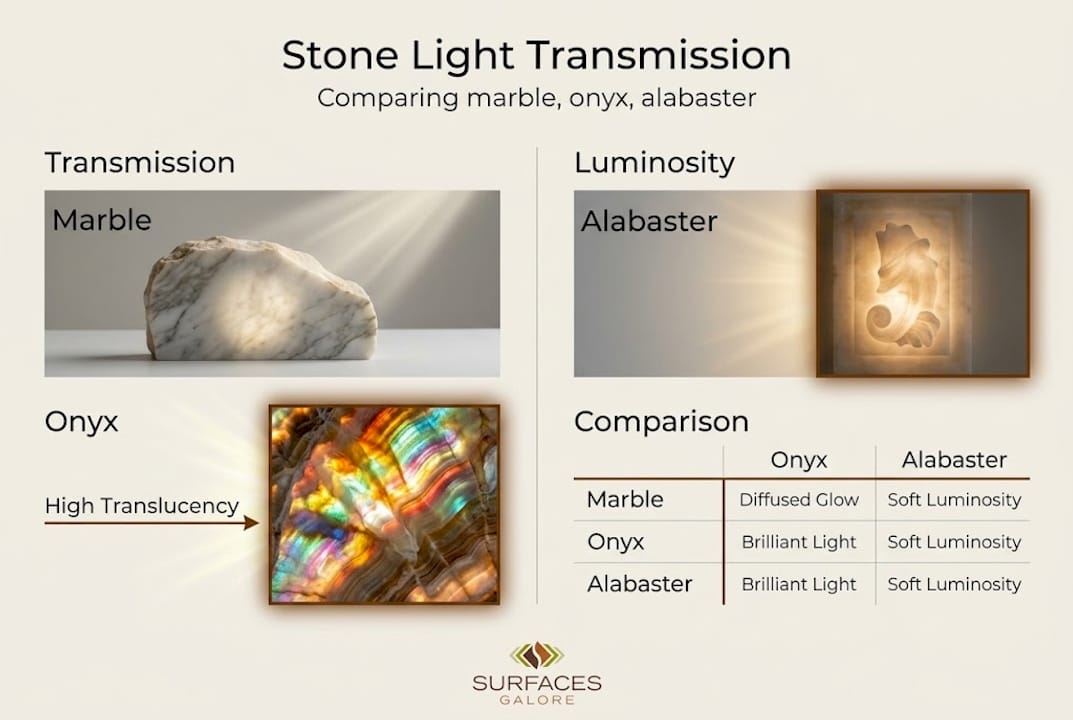
The differences matter enormously in practice. Onyx transmits significantly more light than marble at comparable thicknesses, which is why it dominates high-end backlit bar fronts and reception desks in luxury hotels. Its higher Mohs hardness also means it resists scratching better than alabaster. However, onyx is rarely available in large slab formats, it is significantly more expensive per square foot, and its banding pattern can look overwhelming at large scale without careful layout planning.
Alabaster is in a class of its own for sheer luminosity. The material glows almost like frosted glass at 8 to 12 mm and has been used in ecclesiastical architecture for centuries to create soft, diffuse interior light without windows. The problem is equally clear: alabaster is extremely soft, prone to moisture damage, and almost impossible to source in large panels. It belongs in intimate, protected environments where it will not be touched or exposed to water.
Marble occupies the practical middle ground. Its moderate translucency is sufficient for dramatic effects with the right lighting. Its superior size availability in premium varieties means fewer seams in large installations. Its hardness and familiarity among fabricators means reliable installation and finishing. And its cost, while high, is generally more accessible than comparable-quality onyx.
The real design decision is about what effect you are creating:
- Soft, ambient luminescence: Marble’s ~10% transmission is ideal. Think spa walls, luxury elevator surrounds, and residential master bath accent panels where glow should be subtle and sophisticated.
- High-drama backlit glow: Onyx delivers this at 20 to 25% transmission. Use it for focal features where the stone IS the statement.
- Delicate, artistic translucency: Alabaster in protected applications. Decorative ceiling panels, art installations, and specialty lighting elements where it will not be disturbed.
- Backlit bar fronts: Either marble or onyx works, depending on the budget and desired intensity. Marble offers a more understated luxury; onyx commands more attention.
For guidance on selecting the right marble varieties and color palettes for specific project types, the resource on choosing marble colors provides useful direction on matching stone character to design intent.
The most important insight here is that marble does not need to compete with onyx or alabaster on transmission percentage. It wins on versatility, durability, and scale. Used correctly, its nuanced luminosity often reads as more refined than the more aggressive glow of higher-transmission stones.
Designing with marble translucency: Applications and best practices
Knowing how marble behaves with light is only useful if you can translate that knowledge into well-executed installations. The applications for translucent marble are broader than most designers initially consider, and the technical requirements are manageable once you understand the fundamentals.
The most common and highest-impact applications include:
- Backlit feature walls: Full-height panels in hotel lobbies, residential great rooms, and corporate reception areas. These create immediate visual impact and serve as a signature design element. Use white or cream marble varieties at 10 to 15 mm with LED panels mounted 50 to 100 mm behind the stone surface for even light distribution.
- Illuminated countertops: Less common but increasingly popular in hospitality and high-end residential kitchens and bars. The stone sits above a light source integrated into the cabinetry. Requires full-surface substrate support and careful sealing to protect from moisture and heat.
- Elevator surrounds and cabs: One of the best environments for translucent marble because the enclosed space amplifies the glow effect and the stone is protected from heavy traffic or impact. Honeycomb-backed panels at 6 to 10 mm perform well here.
- Accent ceiling panels: Used in spa treatment rooms, private dining rooms, and master bathroom ceilings where ambient light can be controlled for mood. Structural requirements are critical here.
- Stair risers with integrated lighting: A subtle but effective technique where LED strips are embedded at tread level to backlight marble risers, creating a floating effect on staircases.
As reinforcement requirements confirm, thinner slabs increase transmission but require structural support that should be engineered, not improvised on-site. The details of marble installation matter even more when the stone is thinner than standard and the lighting is integrated.
Several installation and maintenance considerations are unique to translucent marble applications:
- Substrate visibility: Any imperfection in the surface behind the marble, including adhesive ridges, backing seams, or substrate discoloration, will be visible when the light is active. Flawless substrate preparation is non-negotiable.
- Grout joint planning: Grout lines interrupt the glow effect. Minimize joint width and use epoxy-based grout for a tighter, more seamless appearance that transmits less visual interruption.
- Sealing protocol: Thin marble is more porous per unit area at the edge faces. Follow a careful marble maintenance strategy that includes edge sealing, not just face sealing.
- LED heat management: LED sources generate heat that can cause thermal stress in stone over time. Maintain adequate air gap between light source and stone panel, and specify LEDs with proper thermal management ratings.
Pro Tip: Specify LED lighting at 2700K to 3000K color temperature for white and cream marbles. This warm range enhances the stone’s natural calcite warmth and produces a richer, more organic glow than cooler temperature LEDs, which can make the stone look flat or clinical.
A designer’s perspective: The translucency trade-off few discuss
There is a tendency in high-end design to treat greater translucency as a proxy for greater quality. More glow means better stone, better design, more premium result. We think this is wrong, and not just marginally.
The most sophisticated translucent marble installations we have seen do not use the most translucent stone available. They use carefully selected marble with moderate, controlled transmission that integrates with the broader lighting design of the space rather than competing with it. A backlit panel that glows at 25% transmission in a dark room is extraordinary. In a daylit space with multiple competing light sources, it reads as chaotic.
Marble’s ~10% transmission is often exactly right because it creates luminosity that reads as warmth rather than spectacle. Clients who push for maximum glow sometimes find that the result feels more like a shopping mall feature than a refined residential interior. The restraint of marble’s natural translucency is a feature, not a limitation.
There is also the durability conversation that gets skipped when the pursuit of luminosity takes over. Thinner slabs that transmit more light also carry more risk of cracking, staining through the back face, and requiring costly maintenance cycles. Understanding the crystallization risks associated with certain finishing and maintenance approaches is part of making a responsible specification for a client who will live with this surface for twenty years.
Setting client expectations early is where the best designers distinguish themselves. A well-briefed client understands that marble’s translucency will shift with ambient light conditions, that it requires specific maintenance products, and that the effect in a finished room will look different from a sample held up to a showroom light. Managing that expectation protects the relationship and ensures the client loves the result rather than questioning it.
Explore premium marble solutions with SurfacesGalore
Translucent marble applications require sourcing partners who understand stone at the material level, not just the catalog level.
At Surfaces Galore, we work directly with quarries and importers to bring premium white and cream marble varieties to designers and architects across the United States. Our team can help you identify slabs with the translucency characteristics your project requires, discuss thickness options relative to your structural and aesthetic goals, and connect you with the technical resources to specify marble tile protection correctly. Whether you are designing a backlit hotel lobby feature wall or a luminous residential accent panel, the SurfacesGalore marble experts are here to support you from initial selection through project completion.
Frequently asked questions
Why does some marble appear more translucent than others?
Marble’s translucency depends on its mineral composition, crystal size, and concentration of impurities. Varieties with large, pure calcite crystals and minimal dark inclusions, confirmed by empirical transmission data, transmit the most light and are preferred for backlit applications.
How thick should marble be for a strong yet translucent feature?
The standard specification is 12 to 15 mm, which balances durability with the approximately 10% light transmission that benchmarks confirm for white marble varieties. Slabs below 10 mm require fiberglass mesh or honeycomb backing for structural integrity.
Can marble transmit as much light as onyx or alabaster?
No. Marble generally achieves around 10% light transmission at standard thickness, while onyx reaches 10 to 25% and alabaster up to 30%, though marble compensates with superior durability, size, and versatility.
Do you need special lighting for translucent marble features?
Yes, the color temperature and positioning of your LED source significantly shape the final effect. Warm white LEDs in the 2700K to 3000K range typically produce the most flattering results for white and cream marble panels.
Leave a comment