
What Is Marble Fleuri Cut? Characteristics and Uses

TL;DR:
- Fleuri cut marble is a cross-sectional, non-directional style that reveals organic cloud-like patterns and fossils. It differs from vein cut marble, which exposes linear veins by slicing parallel to bedding planes, creating bold directional designs. Fleuri cut enhances spaces with organic character and simplifies large-scale installation while showcasing geological history.
Marble fleuri cut is defined as slicing a stone block perpendicular to its natural bedding planes, at a 90-degree angle to the sedimentary layers, which reveals organic, cloud-like patterns hidden within the stone’s inner core. This technique produces soft, non-directional surfaces that contrast sharply with the bold linear striations of vein cut marble. Fleuri cut is also called cross cut in the stone industry, and both terms describe the same method. The result is a surface that reads like a geological painting: swirling clouds, mottled tones, and often visible fossils embedded in the stone. For homeowners, designers, and contractors sourcing natural stone, understanding this distinction is the difference between choosing a surface that commands attention and one that quietly anchors a room. Surfacesgalore carries a curated selection of natural stone products, including marble varieties that showcase both cutting methods.
What is marble fleuri cut and how does it differ from vein cut?
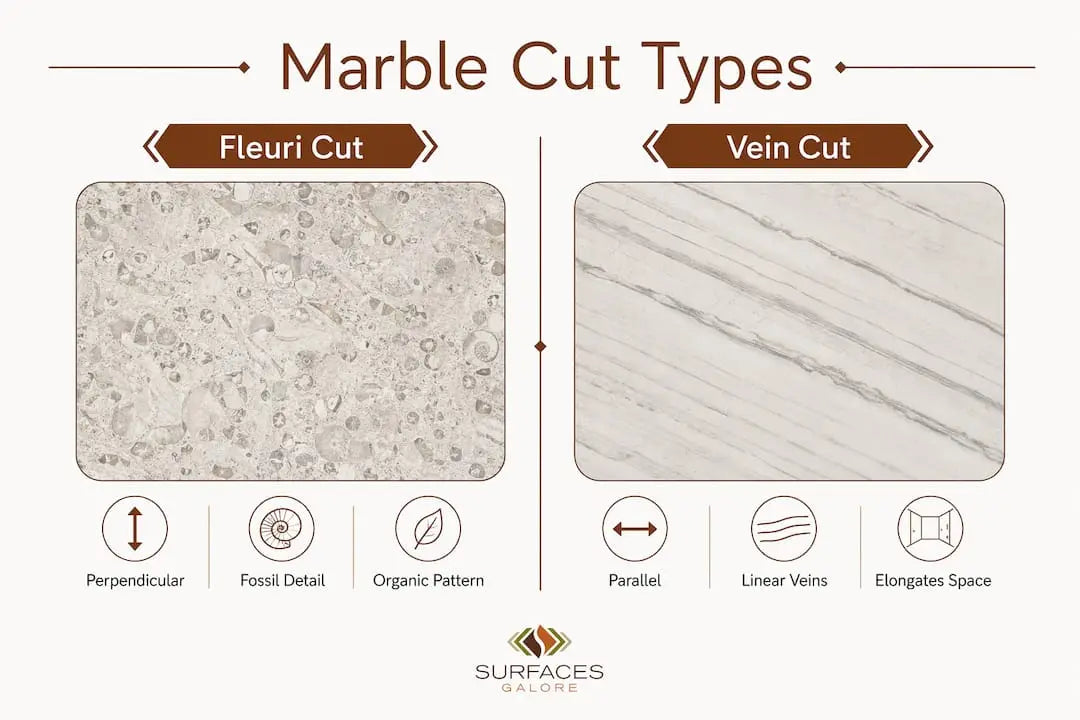
The two dominant marble cutting techniques are fleuri cut (cross cut) and vein cut, and they produce dramatically different results from the same block of stone. Fleuri and vein cut slabs often originate from the identical quarry block. The only variable is the direction of the saw blade relative to the stone’s natural veining.
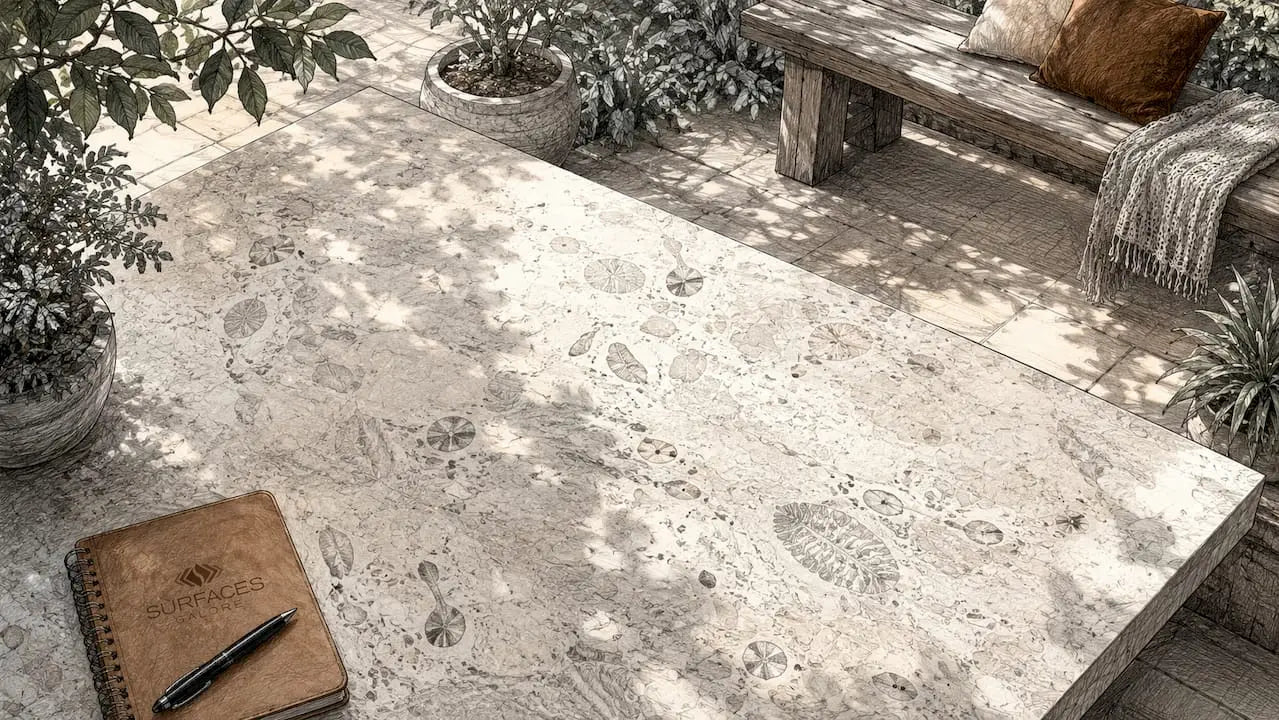
Vein cut slices the block parallel to its natural bedding planes, which exposes the long, linear veins running through the marble. The result is a surface with strong directional movement: bold stripes, dramatic lines, and a sense of visual flow. Fleuri cut does the opposite. By cutting perpendicular to those same planes, it exposes the cross-section of the veins, producing circular, elliptical, and cloud-like shapes instead of lines. You can read more about the visual drama of vein cut marble to understand how the two approaches diverge in practice.
The spatial effects of each cut are equally distinct. Vein cut tends to elongate spaces and guide the eye in a single direction, which makes it a common choice for feature walls and corridors where architectural drama is the goal. Fleuri cut breaks up that directionality, creating a visually balanced, textured surface that softens a room rather than stretching it. This makes fleuri cut particularly effective in square rooms, intimate bathrooms, and large floor fields where a single directional pattern would feel overwhelming.
One of the most striking characteristics of fleuri cut is its capacity to reveal fossil content. Phenix Marble, quarried in Missouri and used extensively in 19th and 20th century American architecture, is a well-known example. Its fleuri cut slabs prominently feature fossils such as brachiopods and starfish, details that are largely invisible in vein cut slabs of the same stone. This fossil-rich aesthetic was a signature of historic public buildings and courthouses across the Midwest.
The table below summarizes the core differences between the two cutting methods.
| Characteristic | Fleuri cut (cross cut) | Vein cut |
|---|---|---|
| Cut direction | Perpendicular to bedding planes | Parallel to bedding planes |
| Pattern appearance | Cloud-like, organic, non-directional | Linear, striped, directional |
| Fossil visibility | High, brachiopods and starfish often visible | Low, fossils remain hidden |
| Spatial effect | Balances and softens spaces | Elongates and directs the eye |
| Installation complexity | More forgiving, easier alignment | Requires precise pattern matching |
| Best applications | Flooring, bathrooms, large wall fields | Feature walls, corridors, accent panels |
What are the key characteristics and benefits of fleuri marble?
Fleuri cut marble delivers a set of aesthetic and practical advantages that make it the preferred choice for a wide range of interior projects. Its defining characteristic is the non-directional visual field it creates. Because the pattern has no single axis of movement, it reads consistently from any viewing angle, which is a significant advantage in large-format flooring and expansive wall cladding.
The organic quality of fleuri cut surfaces comes from the cross-sectional exposure of mineral deposits, crystal formations, and fossilized material within the stone. These elements appear as soft clouds, rings, and mottled patches rather than hard lines. Fleuri cut marble is especially popular for interiors where softness and organic detail are desired over architectural drama, including bathrooms, living spaces, and areas where subtle aesthetic variation is valued.
The benefits of choosing fleuri cut marble for a project include:
- Non-directional patterning that works equally well in square, rectangular, or irregular floor plans without creating visual tension.
- Fossil visibility that adds geological character and uniqueness to each slab, making every installation one of a kind.
- Easier installation alignment because the pattern does not require precise book-matching or directional continuity between tiles.
- Visual softening of spaces, which makes fleuri cut a strong counterbalance to rooms with strong geometric architecture, sharp angles, or heavy structural elements.
- Versatility across scales, from small bathroom floors to large commercial lobbies, without losing visual coherence.
The fossil content deserves special attention. Paleontological details are signature aspects of fleuri cut marble, and the visibility of brachiopods, crinoids, and starfish depends entirely on the quarry’s geological history and the clarity of the stone’s stratification. Not every marble variety produces equally dramatic fossil patterns, which is why slab selection matters so much.
Pro Tip: Always request full slab images or visit the supplier’s yard before purchasing fleuri cut marble. The cloud-like pattern varies significantly from slab to slab, and what looks uniform in a small sample tile can appear dramatically different across a full floor installation.
Durability is consistent with other marble finishing options. Fleuri cut does not compromise the structural integrity of the stone. The cut direction affects aesthetics only, not hardness or density. Standard marble maintenance practices apply: sealing every one to two years, prompt cleanup of acidic spills, and dry mopping for daily care.
What practical applications and design considerations suit fleuri cut marble?
Fleuri cut marble performs best in applications where pattern continuity is less critical than overall visual texture. Its non-directional nature makes it one of the most versatile marble cutting techniques available to designers and homeowners. Here is how to think about where and how to use it effectively.
-
Large-format flooring. Fleuri cut is the preferred choice for expansive floor fields in residential great rooms, hotel lobbies, and commercial reception areas. Installing fleuri cut marble is often easier because the pattern is more forgiving than vein cut, which requires precise alignment. This reduces installation time, minimizes tile waste from pattern-matching cuts, and lowers overall labor costs on large projects.
-
Bathroom walls and floors. Fleuri cut marble is a natural fit for bathrooms because its soft, organic patterns complement the curved forms of fixtures, freestanding tubs, and rounded niches. The non-directional surface works well around obstacles like drains, shower curbs, and plumbing penetrations where a directional vein cut pattern would be interrupted. For detailed guidance on wet area applications, the marble shower installation workflow from Surfacesgalore covers the process thoroughly.
-
Accent walls and feature panels. While vein cut dominates dramatic feature wall applications, fleuri cut works well as a background surface behind shelving, cabinetry, or art installations where a quieter, textured backdrop is more appropriate than a bold linear statement.
-
Complex floor layouts. Herringbone, basketweave, and medallion patterns benefit from fleuri cut because the non-directional field does not fight the geometry of the layout. A vein cut tile in a herringbone pattern creates competing directional forces. A fleuri cut tile in the same layout lets the geometric pattern read clearly without visual interference.
-
Smaller, intimate spaces. Fleuri cut is used to balance design, breaking rigid geometric proportions especially in smaller spaces. A powder room with strong architectural moldings and a coffered ceiling benefits from a fleuri cut floor that grounds the room without adding another layer of directional complexity.
Lighting plays a meaningful role in how fleuri cut patterns read. Raking light from low-angle fixtures or natural side light emphasizes the texture and depth of the cloud-like patterns. Overhead lighting flattens the surface and reduces the visual interest of the fossil and mineral content. If the installation space relies primarily on overhead lighting, choose a fleuri cut marble with strong tonal contrast between its cloud formations to maintain visual depth. You can explore marble pattern ideas for additional design direction on pairing cut types with lighting and layout.
How to select fleuri cut marble for your project
Choosing the right fleuri cut marble requires more than picking a color. The quality of the cloud-like pattern, the visibility of fossil content, and the consistency across slabs all vary based on quarry origin and geological conditions. Here is what to evaluate before committing to a purchase.
-
Request full slab photographs or view slabs in person. Not all stones yield attractive cloud-like patterns; slab selection is critical. A small sample tile rarely represents the full range of variation across a slab. Ask your supplier for images of the actual slabs allocated to your project.
-
Understand the quarry’s geological history. Fleuri cut marble from limestone-rich sedimentary deposits tends to produce the most dramatic fossil content. Marble from metamorphic-dominant quarries may show less fossil detail but stronger mineral cloud formations. The aesthetic outcome is directly tied to the stone’s origin.
-
Evaluate stratification clarity. Clear, well-defined stratification in the stone produces the most recognizable cloud-like fleuri pattern. Poorly stratified stone can result in a muddy, indistinct surface that lacks the organic character that makes fleuri cut desirable. Slab selection for fleuri cut requires evaluating stratification clarity and fossil visibility before purchase.
-
Match your project scale to slab availability. Large floor installations require consistent pattern character across many slabs. Confirm that your supplier can source enough material from the same quarry run to maintain visual consistency throughout the project. For guidance on this process, the matching marble slabs guide from Surfacesgalore explains industry practices for maintaining slab continuity.
-
Consider the finish. Fleuri cut marble is available in polished, honed, and brushed finishes. Polished finishes amplify the depth and luster of the cloud patterns and fossil content. Honed finishes produce a matte surface that reads softer and is more slip-resistant for floor applications. Brushed finishes add tactile texture and work well in rustic or transitional interiors.
-
Work with a supplier who stocks natural stone directly. Importers with direct quarry relationships can provide more accurate information about stone origin, batch consistency, and available quantities than distributors working from secondary sources.
Pro Tip: When ordering fleuri cut marble for a floor, add 10 to 15 percent overage to your calculated square footage. This accounts for cuts around obstacles, potential breakage during installation, and future repairs. The non-directional pattern makes it easier to blend replacement tiles, but having material from the same quarry run is still the safest approach.
Key takeaways
Fleuri cut marble is the superior choice for large-scale, pattern-flexible installations where organic texture, fossil visibility, and installation ease outweigh the need for directional drama.
| Point | Details |
|---|---|
| Fleuri cut definition | Stone is sliced perpendicular to bedding planes, revealing cloud-like, non-directional patterns. |
| Fossil visibility | Fleuri cut exposes brachiopods, starfish, and crinoids that vein cut leaves hidden. |
| Installation advantage | Non-directional patterns reduce alignment demands and tile waste on large floor projects. |
| Design application | Best suited for flooring, bathrooms, complex layouts, and spaces needing visual balance. |
| Slab selection matters | Stratification clarity and quarry origin determine pattern quality; always review full slabs before purchase. |
Why fleuri cut deserves more attention than it gets
Most clients who walk into a stone yard gravitate toward vein cut marble first. The bold, linear movement is immediately legible. It looks dramatic in a showroom. It photographs well. I understand the appeal, and I have specified vein cut marble in dozens of projects where it was exactly the right call.
But I have also watched designers make the mistake of defaulting to vein cut in spaces where it actively works against the design. A small bathroom with a vein cut floor and a vein cut accent wall creates competing directional forces that make the room feel restless rather than refined. The same space with a fleuri cut floor and a vein cut accent wall achieves something much harder to pull off: visual tension that resolves itself. The organic pattern grounds the room while the linear wall panel provides the drama.
What I find most underappreciated about fleuri cut is its geological honesty. A well-selected fleuri cut slab is a cross-section of hundreds of millions of years of sedimentary history. The fossils are not decorative additions. They are the actual record of ancient marine life, preserved in stone and exposed by the saw blade. That is a genuinely remarkable thing to install in a bathroom floor, and most people walk across it without knowing what they are looking at.
My advice to anyone selecting marble for a project: consider the cut direction as seriously as you consider the color. The same stone, cut two different ways, produces two completely different interior experiences. Fleuri cut marble, used with intention, creates spaces that feel grounded, organic, and quietly extraordinary. That is a harder effect to achieve than drama, and it is worth pursuing.
— cihan
Explore fleuri cut marble and natural stone at Surfacesgalore
Surfacesgalore is a direct importer of premium natural stone based in Anaheim, California, shipping nationwide to designers, architects, contractors, and homeowners. The collection includes marble tiles, mosaics, and decorative pieces that showcase both fleuri cut and vein cut characteristics, giving you the ability to compare options side by side before committing to a purchase. If you are planning a flooring project, a bathroom renovation, or a large-scale commercial installation, the team at Surfacesgalore can help you identify the right stone, cut, and finish for your specific application. Browse the full natural stone collection and discover marble that brings genuine geological character to your next project.
FAQ
What does fleuri cut mean in marble?
Fleuri cut, also called cross cut, means the marble block is sliced perpendicular to its natural bedding planes. This produces organic, cloud-like patterns and often exposes fossilized material embedded in the stone.
How is fleuri cut different from vein cut marble?
Vein cut slices parallel to the stone’s natural layers, producing bold linear striations. Fleuri cut slices perpendicular to those layers, producing soft, non-directional cloud patterns from the same block of stone.
What are the best uses for fleuri cut marble?
Fleuri cut marble works best in large-format flooring, bathroom walls and floors, complex geometric tile layouts, and any space where a non-directional, visually balanced surface is preferred over strong linear movement.
Does fleuri cut marble show fossils?
Yes. Fleuri cut is specifically effective at revealing fossilized content such as brachiopods, starfish, and crinoids that remain hidden in vein cut slabs of the same stone. The visibility depends on the quarry’s geological history.
Is fleuri cut marble harder to install than vein cut?
Fleuri cut marble is generally easier to install because its non-directional pattern does not require precise alignment between tiles. This reduces installation time and material waste, particularly on large floor projects.

Leave a comment