
What Is Natural Stone Absorption? A Pro Guide

TL;DR:
- Understanding natural stone absorption, which measures how liquids penetrate stone pores, is crucial for successful installation and maintenance. Testing with simple water drop methods helps determine sealing needs, especially for high-absorption stones like limestone and travertine, which require more frequent resealing. Selecting low-absorption stones such as granite for wet areas and outdoor use minimizes staining risk and prolongs durability.
If you’ve ever watched water bead on a granite countertop and assumed all natural stone behaves the same way, you’re not alone. Understanding what is natural stone absorption is the single most important factor that separates successful stone installations from costly failures. Absorption affects everything: stain susceptibility, freeze resistance, sealing schedules, and how long your stone actually lasts. Whether you’re specifying travertine for a hotel bathroom or laying limestone pavers in a backyard, this guide walks you through how absorption works, how to test it, and how to use that knowledge on your next project.
Table of Contents
- Key takeaways
- What natural stone absorption is
- How to test stone absorption
- How absorption rates shape sealing and maintenance
- Choosing stone based on absorption properties
- 2026 design trends and absorption-smart stone choices
- My take on absorption misconceptions in the field
- Explore Surfacesgalore’s natural stone collections
- FAQ
Key takeaways
| Point | Details |
|---|---|
| Absorption drives maintenance | Stone’s pore structure determines how quickly it absorbs liquids and how often it needs sealing. |
| Stone types vary widely | Granite absorbs near 0.4% by weight while limestone can reach 10-12%, demanding very different care approaches. |
| Testing is straightforward | A simple water drop test or lab soak test reveals absorption rates before you commit to sealing or installation. |
| Sealers slow, not stop, absorption | Penetrating sealers buy time for spill cleanup but do not make stone waterproof. |
| Match stone to moisture exposure | Choosing low-absorption stone for wet areas prevents long-term damage and reduces maintenance burden. |
What natural stone absorption is
Natural stone absorption refers to the capacity of stone to take in liquid through its internal pore network. When water or any liquid contacts stone, it doesn’t just sit on the surface. It moves into the microscopic spaces between mineral grains and crystals. Stone’s porous network functions much like capillaries in the human body, pulling liquid inward through surface tension and pressure.
Understanding stone porosity explained properly means separating two closely related but distinct concepts: porosity and permeability. Porosity is the total volume of void space inside the stone, expressed as a percentage. Permeability describes how connected those voids are and how easily fluid can travel between them. A stone can have high porosity but low permeability if its pores are isolated and discontinuous. That matters because pore connectivity is the key factor for staining susceptibility, not total void volume alone. Two stones with identical porosity readings can behave very differently in a spill scenario depending on their permeability.
How absorption affects real-world stone behavior
In practical terms, a high-absorption stone soaks up coffee, wine, oil, and cleaning chemicals faster than the eye can track. Staining becomes a real risk within seconds rather than minutes. In outdoor settings, the problem compounds because absorbed water expands when it freezes. High absorption rates increase the risk of frost damage, as freezing water in pores generates enough pressure to crack stone from the inside out.
The difference between stone types and absorption is substantial enough to change your specification decision entirely:
- Granite: Typically below 0.4% absorption by weight. Dense, crystalline structure with low permeability makes it the most resistant common stone.
- Marble: Generally ranges from 0.1% to 2%, depending on origin and finish. Honed marble absorbs more than polished marble because the finish opens pores.
- Travertine: Falls between 3% and 6% for most commercial grades. Its characteristic voids and sedimentary formation make it notably porous.
- Limestone: The widest range of any common building stone. Sedimentary rocks like limestone can reach absorption rates of 10-12% by weight, placing them firmly in the high-maintenance category.
| Stone Type | Typical Absorption Rate | Relative Stain Risk |
|---|---|---|
| Granite | Below 0.4% | Very low |
| Marble | 0.1% to 2% | Low to moderate |
| Travertine | 3% to 6% | Moderate to high |
| Limestone | Up to 10-12% | High |
These absorption rates of natural stone are not just numbers on a data sheet. They translate directly into how you seal, maintain, and specify stone across different project types.
How to test stone absorption
Knowing the absorption number on a spec sheet is useful, but testing the actual stone in your hands is more reliable. Slabs from the same quarry and even different areas of the same slab can behave differently. Varying mineral density within a single slab means you should always test multiple spots before making sealing decisions.
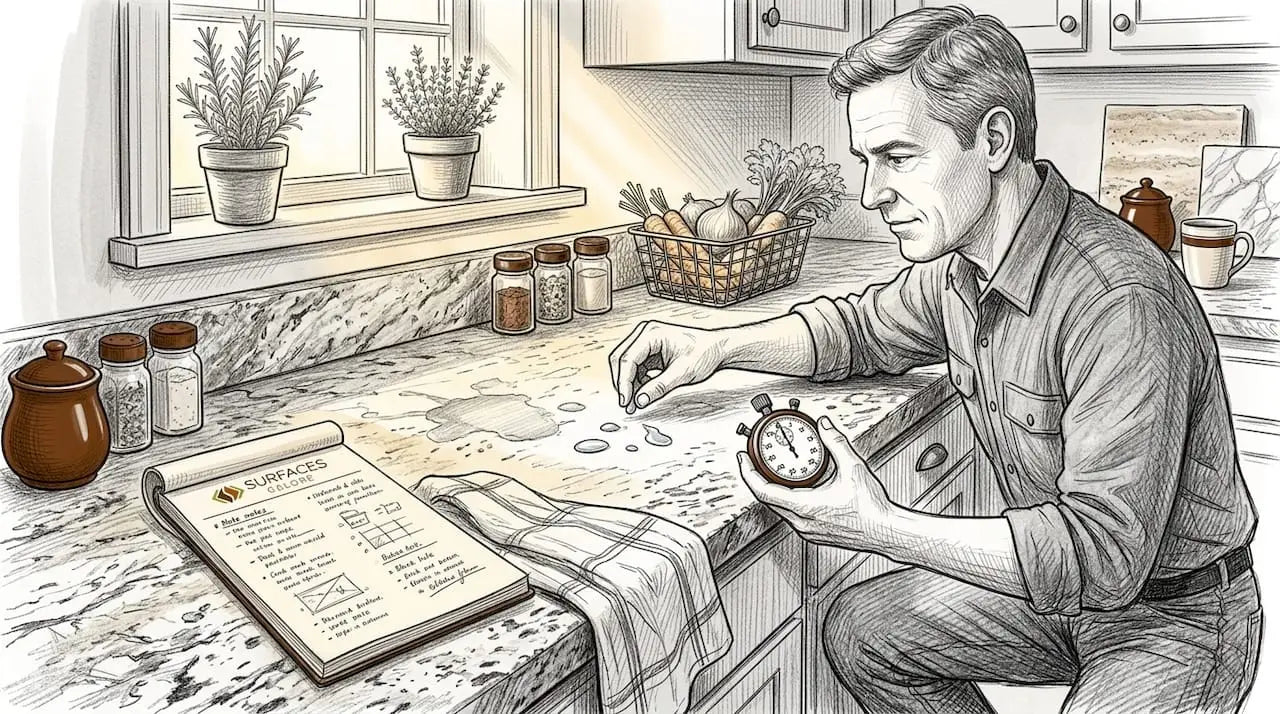
The water drop field test
This is the quickest way to get a real-world read on how to test stone absorption without any lab equipment:
- Make sure the stone surface is clean, dry, and at room temperature. Any residual moisture or sealer will skew your results.
- Place 3-4 drops of plain water on the stone surface in different spots, spacing them at least 6 inches apart.
- Start a timer the moment the drops land.
- Watch the drops. Note whether they bead, slowly spread, or quickly darken the stone beneath them.
- If the water absorbs in under 3 minutes, the stone is highly porous and needs 2-3 coats of sealer right away.
- If the water sits for 10-30 minutes before any absorption occurs, the stone has moderate porosity and standard sealing protocols apply.
- If the water still beads clearly after 30 minutes, porosity is low. Annual re-testing is typically sufficient.
- Wipe the surface dry after each test. Repeat on at least three different areas of the slab or tile.
Pro Tip: Test on an unsealed area whenever possible. If you’re testing stone already installed, clean it thoroughly and let it dry for 24 hours before running the water drop test. Sealer residue will give you a false low-absorption reading.
Lab-grade soaking test
For more precise results, especially when specifying stone for high-traffic commercial applications, a soaking test gives you a measurable percentage. You’ll need a kitchen scale accurate to 0.1 grams, a container large enough to submerge the sample, and about 48 hours of patience.
The absorption rate formula is: Absorption (%) = ((Wet weight minus Dry weight) / Dry weight) x 100.
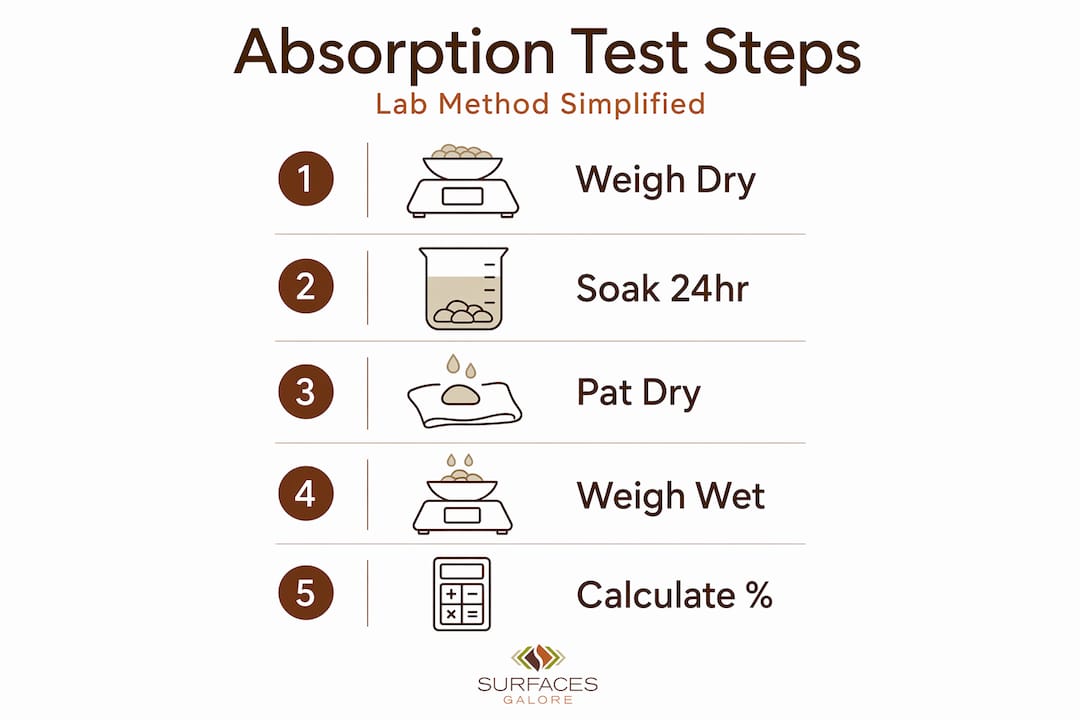
Weigh the dry sample, submerge it in clean water for 24 hours, pull it out, pat the surface dry, and weigh it again immediately. A 500-gram sample that gains 25 grams after soaking has a 5% absorption rate. That number tells you exactly where it falls on the spectrum and what sealing approach to use.
Testing this way across multiple samples from a batch gives you the confidence to spec stone correctly, particularly for outdoor applications where freeze-thaw cycles are a real concern.
How absorption rates shape sealing and maintenance
Once you understand your stone’s absorption rate, sealing decisions become straightforward rather than guesswork. The relationship between absorption and sealing is direct: the more a stone absorbs, the more sealer it needs and the more often it needs reapplication.
Penetrating vs. topical sealers
There are two broad categories of stone sealer, and choosing the wrong one based on your stone’s absorption profile is a common mistake:
- Penetrating impregnators soak into the pore walls and line them with hydrophobic material. They slow absorption without blocking breathability, allowing vapor to escape while repelling liquid. These are the right choice for most natural stone.
- Topical sealers form a film on the stone surface. They can trap moisture inside and may alter the stone’s appearance. They are better suited to certain engineered surfaces than to natural stone.
Think of an impregnating sealer as a rain jacket, not a waterproof shell. It slows the absorption rate and buys you time to wipe up a spill, but it does not make the stone immune. Speed of cleanup still matters, especially on calcium carbonate stones like marble and limestone that can etch from acidic liquids before the liquid even penetrates.
Sealing natural stone is not a one-time task. Sealers break down over time from cleaning products, UV exposure, and temperature cycling. Without periodic reapplication guided by water bead tests, your stone is progressively losing its protection without any visible warning sign.
How absorption time guides sealing frequency
The water drop test result you gathered earlier directly informs your sealing schedule:
- Absorption under 3 minutes: Apply 2-3 coats of penetrating sealer at 15-20 minute intervals. Retest after each coat. Return to test annually.
- Absorption between 3 and 10 minutes: One to two coats of sealer. Retest every 12-18 months.
- Absorption over 30 minutes: Single coat may suffice. Annual testing confirms whether reapplication is needed.
Travertine often requires three or more coats for effective protection, with a bead test performed after each coat to confirm saturation before adding the next. This step-by-step approach is standard practice among stone care professionals and is worth adopting on any project where durability matters.
Pro Tip: Never skip the post-sealing bead test. Apply water drops to the freshly sealed surface after the curing time specified on the product label. If water still darkens the stone, apply another coat. If it beads cleanly, the sealer has done its job.
Learning more about sealing benefits for kitchens and baths gives you a practical framework for building a maintenance plan around your specific installation.
Choosing stone based on absorption properties
The most expensive mistake in stone specification is choosing a material based on appearance alone and discovering too late that its absorption rate makes it wrong for the application. Absorption should be a non-negotiable filter in your selection process, applied before aesthetics.
Wet area applications
Bathrooms, shower floors, pool surrounds, and kitchen backsplashes involve constant or frequent moisture exposure. In these spaces, lower absorption is always preferable:
- Shower floors and walls: Marble with a polished finish performs well due to its relatively low absorption and the closed surface a polish creates. Avoid honed finishes in showers unless you are committed to aggressive sealing schedules.
- Kitchen countertops: Granite is a reliable choice precisely because of its sub-0.4% absorption rate. Oil, wine, and acidic liquids have far less opportunity to penetrate before you can wipe them up.
- Pool surrounds and wet decks: Travertine is popular for its aesthetic, but its 3-6% absorption rate demands thorough sealing and annual maintenance in wet outdoor environments.
Outdoor and climate-sensitive applications
Outdoor stone faces the harshest test of absorption properties. Freeze-thaw cycles create cracking when moisture trapped in pores expands on freezing. In climates with hard winters, any stone with absorption above 3% requires careful evaluation before outdoor use.
| Application | Recommended Stone | Max Acceptable Absorption |
|---|---|---|
| Shower floor | Polished marble, dense granite | Below 2% |
| Kitchen countertop | Granite | Below 0.5% |
| Outdoor patio (mild climate) | Travertine, dense limestone | Below 5% |
| Outdoor paving (freeze risk) | Granite, low-absorption limestone | Below 1.5% |
| Interior flooring | Marble, travertine, limestone | Below 6% |
Budget and aesthetics are real factors in any project, but they should be weighed against absorption data rather than replacing it. A beautiful limestone floor at a great price becomes expensive very quickly if it requires quarterly sealing and still stains easily. Viewing the natural stone terminology guide at Surfacesgalore can help you decode spec sheets and absorption data with confidence.
2026 design trends and absorption-smart stone choices
The 2026 trend toward warmer, more textural interiors is driving strong demand for limestone, travertine, and veined marble in kitchens and bathrooms. Understanding absorption makes it possible to pursue these looks without the maintenance surprises that catch unprepared homeowners and contractors off guard.
Key trends and what absorption means for each:
- Limewash and aged limestone walls: The soft, organic look is popular, but limestone’s high absorption rate means proper sealing is mandatory before installation in any wet or high-humidity zone.
- Travertine tile in large-format bathrooms: This look is all over design media right now. Filling travertine voids before installation and sealing thoroughly afterward is not optional. It is the only way to protect the investment long term. Surfacesgalore’s travertine sealing guide walks through exactly what that process looks like.
- Honed marble countertops and vanities: Honed finishes are trending for their understated elegance, but the open surface absorbs faster than polished marble. Commit to a sealing routine before specifying this finish for heavy-use areas.
- Sustainable natural stone interiors: The push toward sustainable design with natural stone aligns well with choosing durable, low-absorption stone that lasts decades without replacement. Longevity is sustainability.
The common thread across every 2026 trend involving natural stone is that the stones generating the most interest are not the most forgiving from an absorption standpoint. Knowing the absorption profile of your chosen stone before installation puts you in control of the look and the outcome.
My take on absorption misconceptions in the field
I’ve watched contractors seal a slab once during installation and genuinely believe that stone is protected for life. That single misconception causes more stone failures than any other. Sealers break down from cleaning agents, UV exposure, and temperature changes, often within a year in high-use areas. The stone doesn’t announce it. The sealer just quietly stops working.
What I find most underappreciated is the variability within a single slab. I’ve tested travertine pieces from the same batch where one end absorbed in 90 seconds and the other held water for nearly 8 minutes. That’s not unusual. It’s the nature of sedimentary stone formed over millions of years with inconsistent mineral density throughout. Testing only the center of a slab before sealing means you may be under-sealing the more porous edges where most staining actually happens.
The water drop test is genuinely underused by DIYers who assume their stone is fine because it looks fine. Absorption damage is invisible until it isn’t. By the time a stain or crack appears, the protection window has long passed. Run the test before you install, after you seal, and once a year afterward. It takes five minutes and costs nothing.
My honest advice: source your stone from suppliers who understand absorption data and can speak to the specific characteristics of the stone they’re selling. Surfacesgalore operates that way. Their team can point you toward spec data and help you match stone to application rather than just selling you whatever looks good in the showroom.
— cihan
Explore Surfacesgalore’s natural stone collections
At Surfacesgalore, absorption knowledge doesn’t stay theoretical. The team works directly with designers, contractors, and homeowners to match premium marble, limestone, and travertine to the specific demands of each project, whether that’s a low-maintenance granite kitchen or a travertine bathroom that needs a detailed sealing plan from day one.
Every product in the Surfacesgalore catalog comes with the material background to help you make the right call on sealing, maintenance, and application suitability. From marble tile protection guidance to browsing the full range of natural stone available for nationwide shipping, the resources are built for people who take stone seriously. If you’re ready to shop natural stone tiles today or want to discover marble collections that balance beauty with real-world durability, start at Surfacesgalore.
FAQ
What is natural stone absorption?
Natural stone absorption is the capacity of stone to take in liquid through its internal pore network. It is measured as a percentage of the stone’s dry weight and directly affects stain susceptibility, sealing requirements, and durability in wet environments.
How do I test stone absorption at home?
Place 3-4 drops of water on a clean, dry stone surface and time how long it takes to absorb. If absorption occurs in under 3 minutes, the stone is highly porous and needs multiple sealer coats immediately. If water beads for 30 or more minutes, porosity is low.
Which natural stone has the lowest absorption rate?
Granite typically has the lowest absorption rate among common building stones, generally below 0.4% by weight. Its dense crystalline structure gives it the highest natural resistance to liquid penetration with minimal sealing required.
Does sealing make natural stone waterproof?
No. Penetrating sealers line pore walls with hydrophobic material to slow absorption, but they do not seal stone completely. They give you time to wipe up spills before staining occurs. Cleanup speed still matters, particularly on marble and limestone.
How often should I reseal natural stone?
Resealing frequency depends on the stone’s absorption rate and the conditions it faces. High-absorption stones in wet areas may need annual resealing. Low-absorption stones like granite may only need resealing every three to five years. Annual water drop testing is the most reliable guide.

Leave a comment