
Buying Guide for Granite and Marble Fabrication and Installation

If you’re sourcing stone for a renovation or build, the short answer is this: choose marble for luxury focal surfaces, travertine for warm, textured floors and walls, and granite where durability under daily use matters most, like kitchen counters. Marble ranks 3 to 4 on the Mohs scale, which explains why it needs more frequent sealing than granite. Surfacesgalore, a direct importer of premium natural stone, ships full-slab photos and samples nationwide before you commit to an order.
Before you place a granite and marble fabrication and installation order, work through this checklist:
- Request full-slab photos and, for bookmatched projects, a dry-lay sequence.
- Confirm finish (polished, honed, tumbled, brushed) and thickness against your application.
- Order a physical sample and get a custom or bulk quote in writing.
- Confirm lead time before you lock in an installer’s schedule.
Two things separate a smooth order from a stressful one: buying from a direct importer with an active sample program, and building a sealing schedule into your budget from day one.
Key Takeaways
Choosing the right stone comes down to matching porosity and finish to the room, then locking in slab photos and sealing schedules before fabrication starts.
| Point | Details |
|---|---|
| Match material to use | Marble for focal surfaces, travertine for warm textured floors, granite for high-traffic counters. |
| Confirm slab photos first | Review full-slab or dry-lay photos before production to avoid vein mismatch. |
| Build a sealing schedule | Granite every 3 to 5 years, marble once or twice yearly in kitchens, travertine annually. |
| Itemize your quotes | Ask suppliers to separate material, finish, edge work, and shipping costs. |
| Order from a direct importer | Surfacesgalore provides sample programs, full-slab photos, and trade support for custom and bulk orders. |
Where to Learn More
Table of Contents
- Materials Compared: Marble, Limestone, Travertine, and a Note on Granite
- Which Finish and Product Type Fit Each Room?
- How Durable Is Natural Stone, and How Often Does It Need Sealing?
- How Do You Order Samples, Slabs, and Custom Cuts?
- What Drives the Price of Natural Stone?
- What Natural Stone Trends Should You Watch in 2026?
- Sources
- FAQ
Materials Compared: Marble, Limestone, Travertine, and a Note on Granite
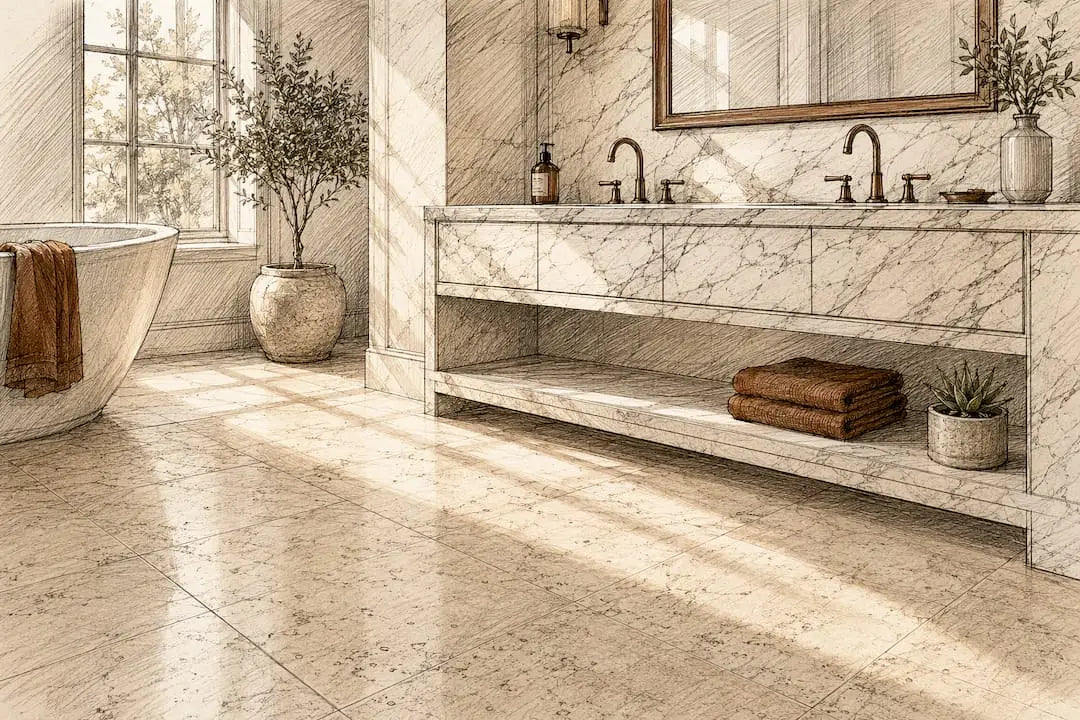
Every natural stone project starts with the same question: which material actually fits the room? Marble is calcium carbonate based, and its veining and light-reflective surface make it the default choice for vanities, feature walls, and statement countertops where looks carry the room. Travertine and limestone read differently. Both are quieter, more textured, and tend to blend into a space rather than dominate it, which is exactly why designers reach for travertine in spa-style bathrooms and limestone in understated, durable flooring.
| Material | Best for | Porosity / maintenance | Visual character | Finish options | Cost factors | Lead time / sample options |
|---|---|---|---|---|---|---|
| Marble | Feature walls, vanities, statement counters | Moderate porosity, needs regular sealing | Bold veining, high visual variation | Polished, honed | Grade, veining rarity, bookmatching | Sample plus custom slab quote available |
| Limestone | Flooring, understated wall cladding | Low to moderate, moderate sealing needs | Muted tone, consistent texture | Honed, brushed | Thickness, finish, order volume | Bulk order pricing typically available |
| Travertine | Warm floors, showers, backsplashes | Highest porosity of the three, needs filling | Pitted texture, warm earth tones | Filled/polished, unfilled/tumbled | Filling process, finish, thickness | Sample and custom cut options |
| Granite | High-traffic counters, outdoor surfaces | Low porosity, long resealing intervals | Speckled, uniform pattern | Polished, honed, leathered | Slab rarity, edge profiles | Depends on block sourcing |
The tradeoff is straightforward. Marble buys you drama but demands more upkeep. Travertine’s natural pores and voids mean it almost always ships filled with epoxy or resin before it’s honed or polished for flooring. Granite gives up some visual range for a stone that shrugs off daily abuse.
- Reserve dramatic, high-veining marble for a focal wall or island, not an entire busy kitchen.
- If book-matching matters to your design, request it and sequential slab numbering at the quote stage, not after fabrication starts.
- Ask for a marble slab selection walkthrough if you’re unsure which lot best matches your space.
Which Finish and Product Type Fit Each Room?
The right stone in the wrong finish still causes problems. Slip risk, wear patterns, and how deep the veining reads all shift with finish choice, so match the two together before you order.
- Countertops: polished granite or marble slabs for standout kitchen islands; honed marble where you want a softer, matte look.
- Floors: honed or tumbled travertine and limestone tile for warmth underfoot, especially in transitional spaces.
- Showers: filled, polished travertine or marble mosaics; marble shower installation requires careful attention to grout lines and slip resistance.
- Backsplashes: marble mosaics or small-format tile bring detail without the cost of full slabs. See marble backsplash ideas for layout inspiration.
- Accent walls and trims: bookmatched marble slabs or decorative moldings for a single dramatic gesture.
Polished finishes deepen color and veining but show scratches faster; honed and leathered finishes hide wear and add texture at the cost of some shine.
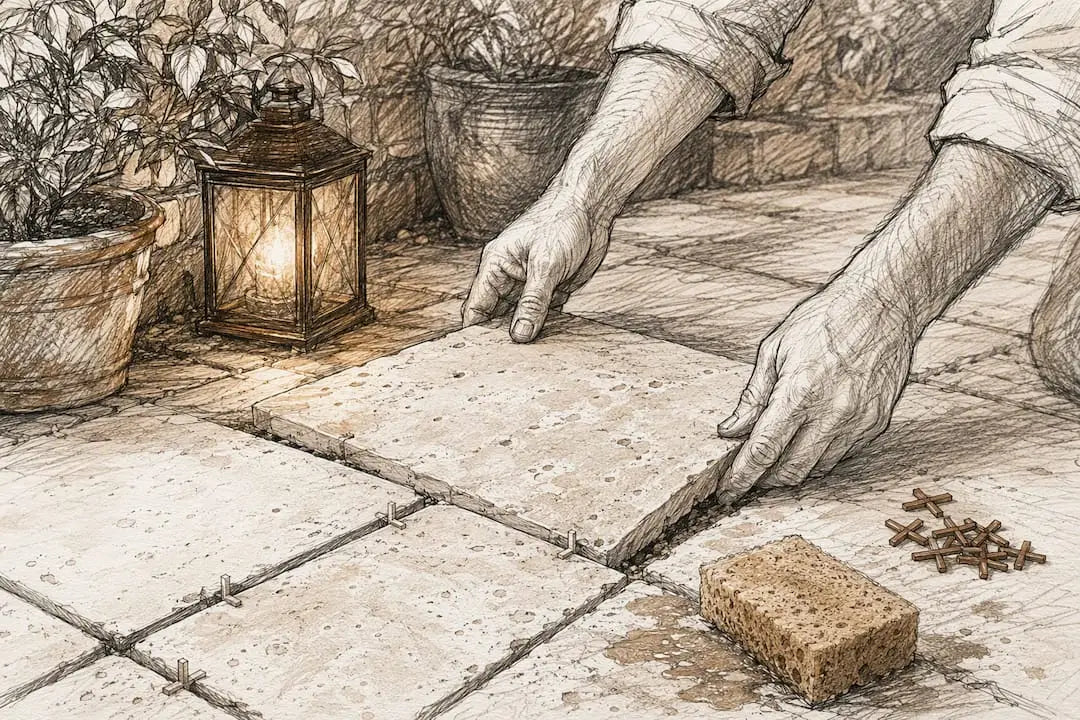
Pro Tip: Specify filled travertine for any wet or high-traffic floor. Unfilled, tumbled travertine looks rustic but collects grime in its pits and needs more frequent sealing to stay clean.
How Durable Is Natural Stone, and How Often Does It Need Sealing?
Porosity is the number that actually predicts your maintenance workload, more than hardness does. A denser stone resists both staining and etching, while a porous one absorbs liquids before you can wipe them up.
Build a simple care routine around three habits: use a penetrating sealer rated for natural stone, clean with pH-neutral products instead of anything acidic, and reseal on a fixed schedule rather than waiting for visible staining.
Sealing cadence: denser granites often go 3 to 5 years between resealing, marble in an active kitchen frequently needs sealing once or twice a year, and travertine, given its porosity, is usually sealed annually.
Skipping this schedule doesn’t just risk stains. Most fabricator and installer warranties assume you followed a documented maintenance plan, and neglecting sealing is one of the fastest ways to void coverage. Keep your receipts and resealing dates on file.
How Do You Order Samples, Slabs, and Custom Cuts?
Ordering stone is not like ordering paint. You’re buying a natural material with variation baked in, so the process needs more checkpoints.
- Submit project drawings and elevations so the fabricator understands cutouts and edge profiles.
- Review full-slab or lot photos before production, not after.
- Confirm thickness and finish in writing.
- Specify edge profiles and cutout locations (sinks, cooktops, outlets).
- For bookmatched or large-format work, request dry-lay photos and slab sequencing to confirm vein continuity before shipping.
- Confirm packing and crating method for long-distance shipment.
Locking in application area, finish, thickness, drawings, and inspection photos before fabrication starts is what keeps a project on schedule. Lead times stretch when you’re sourcing exotic blocks, requesting bookmatching, or ordering custom resin filling on travertine, so build in buffer time for anything outside a standard cut. Your supplier should hand off slab photos, labels, and inspection records; your installer confirms substrate readiness and final measurements on-site before the stone arrives.
What Drives the Price of Natural Stone?
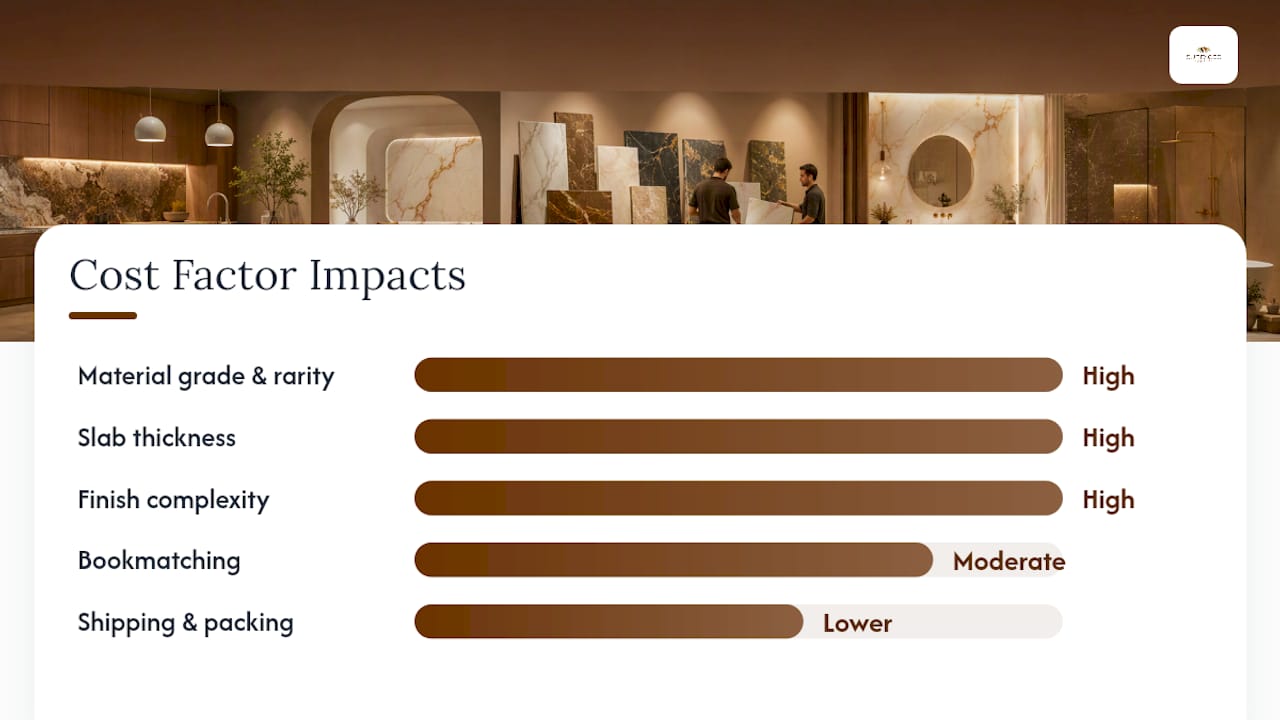
Grade and rarity set the floor, but slab yield, thickness, and finish move the number just as much. A rare bookmatched marble lot costs more per square foot partly because you’re paying for matched veining across multiple slabs, not just the material itself. Custom edge profiles, resin filling on travertine, and expedited fabrication all add line items that a basic quote might not show upfront.
| Cost factor | Typical impact |
|---|---|
| Material grade and rarity | Higher-grade, rare veining commands premium pricing |
| Slab thickness | Thicker slabs cost more and reduce yield per block |
| Finish complexity | Leathered and brushed finishes add labor time |
| Bookmatching | Requires matched sequential slabs, raising per-unit cost |
| Shipping and packing | Combined shipments reduce per-project freight cost |
When you request quotes from multiple suppliers, ask each one to itemize material, finish, edge work, and shipping separately. Bulk orders and trade pricing are the two most reliable places to negotiate, and combining shipments across a project’s tile, slab, and mosaic needs usually beats separate freight runs.
What Natural Stone Trends Should You Watch in 2026?
Expect warm, earthy palettes to keep gaining ground over stark white marble, especially in travertine and honed limestone. Large-format slabs and full bookmatched feature walls remain the strongest way to make a small space feel considered rather than crowded.
- Warm neutral tones across travertine and limestone flooring.
- Large-format slabs to minimize grout lines and visual breaks.
- Bookmatched marble reserved for single statement walls or islands.
- Leathered and brushed finishes for tactile, low-glare surfaces.
- Backlit onyx accents in select high-end bathroom and bar applications.
Keep dramatic, trend-forward choices contained to one focal area. Large-format and bookmatched slabs also change how you order: fewer seams means fewer, larger slabs, which affects both cost and lead time planning.
A Direct Importer’s View on Sourcing Stone Right
At Surfacesgalore, we work directly with quarries and control sourcing from block to slab, which is why our sample program and full-slab photo library exist. Designers and contractors lean on this to confirm veining and lot consistency before fabrication begins, not after installation.
Get Samples and a Quote from Surfacesgalore
There’s a real cost to ordering stone blind: mismatched veining, wrong thickness, or a finish that doesn’t suit the room. As a direct importer, Surfacesgalore controls sourcing from quarry to slab, which means you see full-slab photos and get a physical sample before you commit a dollar to fabrication.
Whether you’re specifying marble for a client’s kitchen island or sourcing travertine for a hotel lobby floor, our team handles custom cuts and bulk quotes with nationwide shipping. Browse our marble collections to compare grades and veining, or request a sample and custom quote directly through Surfacesgalore to get your lead time and pricing locked in before your installer’s schedule opens up.
Sources
- Natural Stone Buying Guide 2026
- A 2026 Buyer’s Guide from HC Stone Materials: Sourcing Premium Natural Stone for Global Luxury Architecture Projects — 7 Expert Criteria - XIAMEN HC WORLD STONE
- Natural Stone Project Procurement Guide: From Material Selection To Export-Ready Delivery - FOR U STONE
- Limestone vs Marble vs Travertine - WillyHomes
FAQ
What’s the Difference Between Marble and Granite for Countertops?
Marble is calcium carbonate based and prized for its veining, while granite is an igneous stone valued for hardness and heat resistance, making granite the more common choice for daily-use kitchen counters.
How Often Does Natural Stone Need Sealing?
Granite typically needs resealing every 3 to 5 years, marble in active kitchens often needs it once or twice a year, and travertine usually needs annual sealing due to its higher porosity.
Should I Order a Sample Before Buying Slabs?
Yes. Requesting a physical sample and full-slab photos before production, which Surfacesgalore offers as a direct importer, helps confirm color and veining match your design intent.
Is Travertine a Good Choice for Bathroom Floors?
Filled and honed or polished travertine works well in bathrooms, but unfilled, tumbled travertine needs more frequent sealing since its natural voids collect moisture and grime.
What Should I Include in a Stone Order Request?
Include project drawings, full-slab or lot photos, finish and thickness confirmation, edge and cutout specifications, and packing details before fabrication begins.

Leave a comment