

Natural stone in sustainable design: key benefits

TL;DR:
- Natural stone has a low lifecycle CO₂ footprint, averaging 12.5 kg CO₂ eq/m².
- Proper sourcing and certification can enhance its sustainability benefits and support LEED credits.
- Durability and local sourcing make natural stone a cost-effective, long-lasting, eco-friendly choice.
Most designers assume natural stone is an environmental liability. The quarrying, the transport, the weight, it all sounds like a carbon nightmare. But lifecycle assessments show that natural stone averages just 12.5 kg CO₂ eq/m², a figure that puts it well below many synthetic alternatives. The real story is one of longevity, low processing energy, and material transparency that few other flooring or cladding options can match. If you’re specifying materials for sustainable projects, understanding what the data actually says about natural stone could reshape how you approach your next specification.
Table of Contents
- Why natural stone stands out in sustainable design
- Life cycle, durability, and the long-term cost advantage
- Environmental impacts of quarrying and best mitigation practices
- Design strategies: Choosing and specifying natural stone for sustainability
- A fresh perspective: Sustainability is more than material choice
- Start your next sustainable project with expert stone guidance
- Frequently asked questions
Key Takeaways
| Point | Details |
|---|---|
| Low carbon footprint | Natural stone’s embodied carbon and energy are significantly lower than most alternatives. |
| Superior long-term value | Despite higher upfront costs, stone’s durability lowers lifetime expense and waste. |
| Mitigated quarry impacts | Modern quarrying and certification can dramatically reduce environmental impact. |
| Design flexibility | Natural stone’s aesthetics and performance can be tailored to both luxury and practical projects. |
Why natural stone stands out in sustainable design
Natural stone forms over millions of years through geological processes that require zero industrial input. By the time it reaches your project, the most energy-intensive step is extraction and transport, not manufacturing. Compare that to ceramic, quartz, or porcelain, which require kilns, resins, and binders that drive up embodied energy significantly. Understanding what natural stone is at a material level helps clarify why its environmental profile looks so different from engineered alternatives.
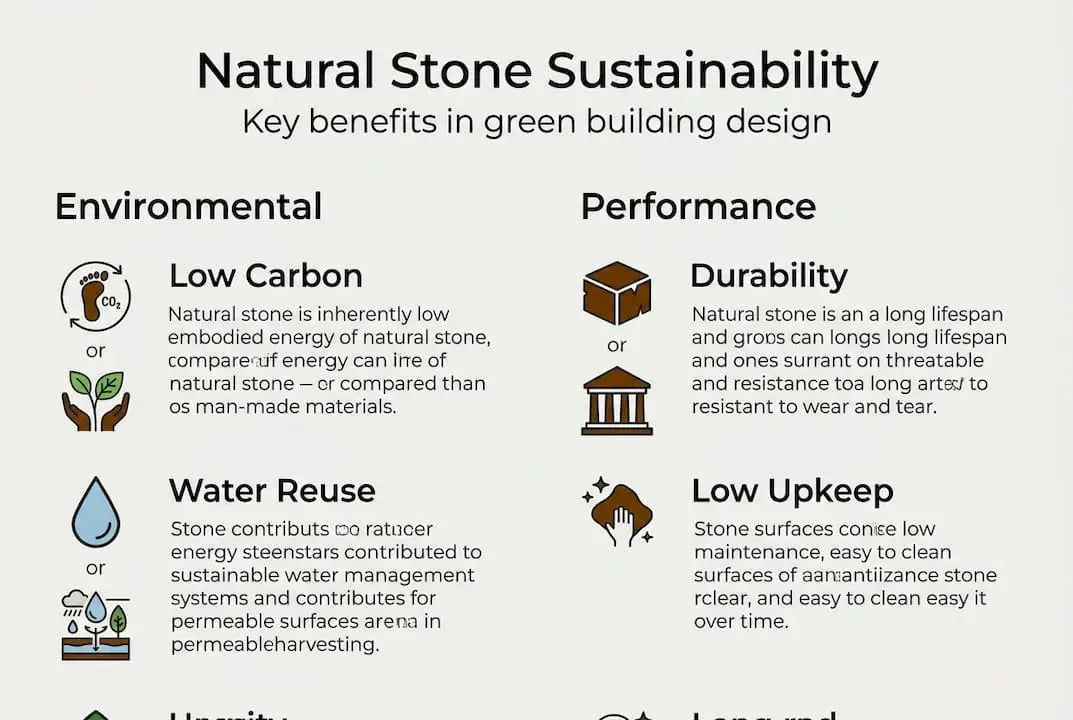
The numbers back this up. International LCA data averaging 12.5 kg CO₂ eq/m² places natural stone among the lower-impact flooring materials available. Sandstone aggregate comes in even lower at 2.30 kg CO₂ eq/ton. These figures reflect the minimal transformation the material undergoes between quarry and installation.
“For architects, NSC 373-certified stone with EPDs supports LEED credits across Materials and Resources, Energy and Atmosphere, and Indoor Environmental Quality categories, while thermal mass properties make it ideal for passive design in climates with significant temperature swings.”
NSC 373 is the Natural Stone Council’s sustainability certification. EPDs, or Environmental Product Declarations, are third-party verified documents that quantify a material’s environmental impact across its full lifecycle. Both are increasingly required by project owners pursuing LEED v4 certification, and natural stone suppliers who provide them give your team a real documentation advantage.
Key sustainability attributes that set natural stone apart:
- Lower global warming potential (GWP) compared to ceramic, quartz, and porcelain tile
- High thermal mass that reduces HVAC load in passive design strategies
- NSC 373 certification available for verified sustainable sourcing
- EPD documentation that supports LEED credit submissions
- Local sourcing options that reduce transport-related emissions
- No synthetic binders or resins that off-gas volatile organic compounds (VOCs)
Local sourcing deserves extra attention. When stone is quarried and processed domestically or regionally, transport emissions drop sharply. Paired with EPD documentation, this creates a material specification that holds up to the most rigorous project sustainability reviews.
Life cycle, durability, and the long-term cost advantage
Sustainability isn’t just about energy and emissions. Cost and longevity matter, too. A material that lasts 100 years and never needs replacing is almost always more sustainable than one that needs to be ripped out and reinstalled every 15 to 20 years. Natural stone sits firmly in the first category.
Life Cycle Cost (LCC) analysis shows that natural stone is more cost-effective over a 30-year period than ceramic tile, with a total LCC of USD 92.50/m² compared to lower upfront costs for tile that accumulate through replacement, maintenance, and disposal. That’s a critical insight for designers who need to justify premium material selections to clients focused on budget.
| Material | Upfront cost | Lifespan | Replacement cycles (30 yr) | Total LCC |
|---|---|---|---|---|
| Natural stone | Higher | 75 to 100+ years | 0 | Lower overall |
| Ceramic tile | Lower | 15 to 20 years | 1 to 2 | Higher overall |
| Porcelain tile | Moderate | 20 to 30 years | 1 | Moderate |
Beyond cost, natural stone adds measurable value to a building. Properties featuring authentic stone finishes consistently command higher valuations and stronger client satisfaction scores. When you’re working with clients who plan to hold or sell an asset, that’s a tangible return on specification.
For a detailed breakdown of how these figures compare in real renovation scenarios, the marble vs ceramic cost comparison and tile renovation cost savings resources offer project-specific context.
Pro Tip: When building a specification for a long-term project, request the supplier’s LCC documentation alongside their EPD. Having both in your project file gives you a complete sustainability and financial argument that’s hard to challenge during value engineering reviews.
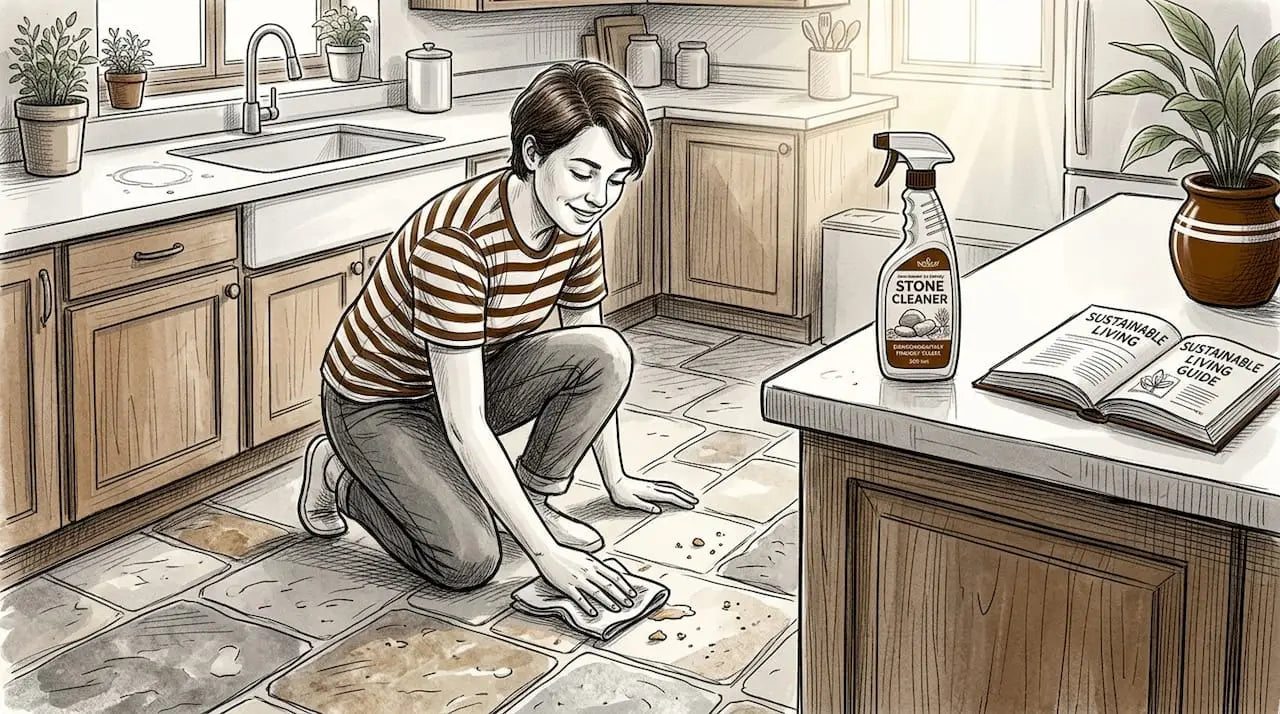
The durability of natural stone also reduces maintenance burdens. Properly sealed stone requires minimal intervention for decades. That means fewer cleaning products, less water use, and no adhesive or grout replacement cycles that add to a building’s operational footprint over time.
Environmental impacts of quarrying and best mitigation practices
While the lifecycle and benefits are impressive, quarrying can still raise concerns. Here’s how the industry and your choices make a difference.
Quarrying is the most environmentally intensive phase of natural stone’s lifecycle. Key impact hotspots include dust generation, blasting vibration, land disruption, and water consumption. Harder rock types require more explosive use, which increases both noise and particulate impact. These are real concerns, and responsible sourcing decisions directly affect how significant they are for your project.
The good news is that the industry has made substantial progress. Modern quarry operations now achieve up to 98% water recycling, dramatically reducing freshwater consumption. Renewable energy adoption at quarry sites is growing, and land reclamation programs restore excavated areas after use. These advances don’t happen automatically, though. They require vendors who prioritize them.
| Mitigation feature | Leading suppliers | Standard suppliers |
|---|---|---|
| Water recycling rate | Up to 98% | 40 to 60% |
| Renewable energy use | Yes | Rarely |
| Land reclamation program | Documented | Inconsistent |
| NSC 373 certification | Yes | Sometimes |
| EPD availability | Full documentation | Limited |
For more on how to evaluate these metrics during sourcing, natural stone sustainability metrics provides a practical framework.
Best practices for responsible stone sourcing:
- Request NSC 373 certification from every stone supplier you consider
- Ask for EPDs that cover the full extraction-to-delivery lifecycle
- Prioritize domestic or regional quarries to reduce transport emissions
- Verify water recycling commitments in writing before finalizing supplier selection
- Confirm land reclamation policies are active, not just planned
- Avoid suppliers who cannot document their environmental practices
The vendors who can answer these questions clearly are the ones worth working with. Opacity around quarrying practices is a red flag, not a minor concern.
Design strategies: Choosing and specifying natural stone for sustainability
Now that you understand the why and the how, let’s look at practical ways to integrate stone into your next sustainable project.
Not all stone performs the same way in every environment. The first distinction to understand is between calcareous and siliceous stone. Calcareous stones like marble are acid-sensitive, meaning they can etch when exposed to citric acid, vinegar, or cleaning products with low pH. Siliceous stones like granite are chemically resistant and better suited to high-use or food-adjacent environments. Specifying the wrong type without a sealer plan creates maintenance problems that undermine a project’s long-term sustainability case.
A practical decision framework for sustainable stone selection:
- Confirm sourcing origin and verify NSC 373 certification before shortlisting
- Request EPDs and confirm they cover extraction, processing, and transport
- Match stone chemistry to environment (calcareous vs. siliceous based on exposure)
- Specify sealers for calcareous stones in kitchens, bathrooms, or exterior applications
- Consider permeability in water-heavy zones where runoff management matters
- Select finish based on use (honed for slip resistance, polished for interior aesthetics)
- Engage your supplier early to confirm documentation timelines and custom sizing
In high-water areas, permeable stone types like sandstone can actively support water management by allowing controlled drainage rather than forcing runoff. This is a performance benefit that goes beyond aesthetics and contributes directly to site sustainability goals.
For a full overview of stone types and how they perform across project types, types of natural stone is a useful reference. For finish selection guidance, stone finishes for durability covers the performance trade-offs in detail. And if you’re still in the early selection phase, selecting natural stone for elegance walks through the aesthetic and functional criteria together.
Pro Tip: Engage your stone supplier at the schematic design phase, not during construction documents. Early involvement means they can flag lead times, confirm certification availability, and help you avoid substitutions that compromise your sustainability documentation later.
A fresh perspective: Sustainability is more than material choice
Here’s something the standard sustainability conversation misses: specifying natural stone is not, by itself, a sustainable act. The material has the potential to be one of the most responsible choices in your palette, but that potential is only realized through how you select, detail, and maintain it.
We’ve seen projects where certified stone was installed without proper sealer specification, leading to premature degradation and early replacement. That’s not sustainable, regardless of the EPD on file. The designers and architects who achieve the best outcomes are the ones who treat stone as a long-term system, not a one-time material decision.
Engaging suppliers who provide full documentation, working with natural stone design experience behind them, and building maintenance protocols into your project handoff are what separate good intentions from real results. The material is only as sustainable as the decisions surrounding it.
Start your next sustainable project with expert stone guidance
For professionals seeking to move from principles to projects, support matters. Sourcing the right stone with the right documentation takes more than a catalog search.
At Surfaces Galore, we work directly with designers and architects across the country to match projects with the right stone, the right certifications, and the right support. Our team ships premium marble, travertine, and specialty stone nationwide from our Anaheim base, and we can help you navigate EPD documentation, sustainable sourcing questions, and custom specifications. Visit Surfaces Galore to connect with our team and explore our curated range of natural stone built for projects that demand both beauty and accountability.
Frequently asked questions
How does natural stone compare to porcelain or quartz for sustainability?
Natural stone has lower embodied energy than quartz or porcelain, which require resin binding and high-heat manufacturing, making it a stronger long-term sustainability choice despite higher initial quarrying impacts.
Can natural stone help projects achieve LEED certification?
Yes. NSC 373-certified stone with EPDs can contribute to LEED v4 credits across Materials and Resources, Indoor Environmental Quality, and Energy and Atmosphere categories.
What quarrying impacts should I consider when selecting stone?
Dust, land disruption, and water consumption are the main concerns. Selecting vendors with up to 98% water recycling, renewable energy programs, and documented land reclamation significantly reduces these impacts.
Are certain types of stone better for sustainable water management?
Yes. Permeable stone types like sandstone allow controlled drainage in high-water environments, making them a functional choice for sites where runoff management is a design priority.
Leave a comment