
Understanding Natural Stone Authenticity for Renovations

Imitation stones are increasingly convincing, leaving many homeowners unsure about what they’re really getting when they invest in renovation materials. Authentic natural stone brings proven value through beauty, durability, and long-term return on investment, but distinguishing real from fake requires knowledge most buyers don’t have. This guide clears up what authenticity means, how to recognize it, why it matters for your project, and practical steps to secure genuine materials for every renovation.
Table of Contents
- Why authenticity in natural stone matters
- Defining natural stone authenticity
- How professionals test and verify authenticity
- Natural stone vs. engineered stone: What’s the difference?
- How to ensure authenticity in your stone renovation
- Elevate your project with authentic natural stone
- Frequently asked questions
Key Takeaways
| Point | Details |
|---|---|
| Seek certified suppliers | Work only with suppliers who provide clear documentation and adhere to recognized stone standards. |
| Test and verify | Employ simple tests and insist on lab or certification results to confirm authenticity before buying. |
| Natural stone advantage | Authentic stone offers unmatched aesthetics, durability, patina, and long-term value for your renovation. |
| Understand the differences | Natural and engineered stones have very different properties, so choose based on your project’s practical and aesthetic needs. |
Why authenticity in natural stone matters
Authentic natural stone offers unique aesthetics, patina, and durability for centuries, setting it apart from engineered alternatives in fundamental ways. Understanding these differences helps you make renovation choices that deliver lasting value.
Natural stone differs from engineered stone in composition, performance, and longevity. Real stone forms over millions of years through geological processes, creating unique mineral patterns and variations. Engineered stone combines crushed minerals with resins, producing uniform appearance but different structural properties.
Key benefits of authentic stone include:
- Lasts for generations with proper care, often outliving the buildings they adorn
- Develops a desirable patina over time, adding character and depth
- Resists heat and wear better than most synthetic alternatives
- Maintains value and enhances property resale potential
- Offers irreplaceable natural variation that makes each installation unique
The aesthetic and resale value implications are substantial. Authentic stone signals quality and permanence to potential buyers, while synthetic materials may raise questions about cost-cutting. Real stone’s unique veining and color variations create visual interest that engineered products struggle to replicate convincingly.
Risks of fake or misrepresented stone include compromised performance, unexpected repairs, and lost investment. Synthetic materials marketed as natural stone may crack under heat, stain unexpectedly, or deteriorate faster than anticipated.
“Authentic natural stone breathes, ages gracefully, and develops character over decades. This living quality, combined with superior heat resistance and structural integrity, makes it irreplaceable for projects demanding both beauty and performance.”
Understanding durability in real stone helps you appreciate why authenticity matters beyond aesthetics. Third-party verified authenticity provides assurance that your investment delivers the performance you expect.
Defining natural stone authenticity
Authenticity in natural stone means verifiable natural origin, unique mineralogical composition, and documented geological provenance. These three elements distinguish genuine stone from convincing imitations.
Authentic natural stone is characterized by unique mineral composition, natural variation, and provenance documentation, providing a foundation for verification. Real stone carries a geological fingerprint that reveals its formation history and source location.
Visual and tactile cues that indicate authenticity include:
- Variation in veining patterns, with no two sections identical
- Small natural fissures or mineral deposits that add character
- Irregular textures and color gradations throughout the material
- Cool touch temperature that warms slowly under hand contact
- Weight and density that feels substantial compared to composites
Documentation forms the backbone of authenticity verification. Quarry data identifies the specific extraction site and geological formation. Third-party certifications from independent labs confirm mineral composition and performance characteristics. Supplier transparency about sourcing and processing builds confidence in material origins.
Exploring types of authentic stone reveals the diversity of natural materials available. Understanding stone authenticity terms helps you communicate effectively with suppliers and contractors.
Pro Tip: Always ask for provenance documentation and lab results for any major project. Reputable suppliers provide this information readily, while reluctance to share documentation raises red flags about material authenticity.
Working with certified suppliers ensures access to verified materials and expert guidance throughout your renovation.
How professionals test and verify authenticity
Professionals use both simple field tests and advanced laboratory methods to verify natural stone authenticity. Understanding these approaches helps you make informed decisions.
Reflectance spectroscopy, petrographic analysis, and ASTM/ANSI standards verify authenticity through rigorous scientific methods. These techniques reveal mineral composition and structural properties that confirm natural origin.
Steps for verifying authenticity:
- Conduct water drop tests to observe absorption patterns and porosity
- Perform touch tests to assess temperature retention and surface texture
- Request spectroscopy analysis to identify mineral composition
- Review petrographic reports that detail geological formation
- Verify ASTM and ANSI/NSC-373 certifications from independent labs
- Compare physical samples against documented quarry characteristics
- Inspect for natural variation patterns that synthetic materials cannot replicate
Water drop tests reveal porosity differences. Natural stone absorbs water at varying rates depending on mineral composition, while many synthetic materials show uniform absorption or complete resistance. Touch tests leverage thermal properties, as authentic stone feels cool and warms gradually under sustained contact.
Lab-based spectroscopy analyzes light reflection patterns to identify mineral content. Petrographic analysis examines thin stone sections under microscopy, revealing crystal structures and formation patterns unique to natural materials.

ASTM standards establish performance benchmarks for strength, durability, and safety. ANSI/NSC-373 certification verifies sustainability practices and authentic sourcing. These certifications matter because they provide independent confirmation of material properties and origin claims.
| Stone Type | Compressive Strength (PSI) | Density (lb/ft³) | Porosity (%) |
|---|---|---|---|
| Marble | 10,000-25,000 | 160-180 | 0.2-2.0 |
| Travertine | 5,000-15,000 | 140-160 | 2.0-8.0 |
| Granite | 20,000-50,000 | 165-185 | 0.2-1.5 |
| Limestone | 4,000-20,000 | 135-170 | 1.0-15.0 |
These benchmarks help identify authentic materials. Significant deviations from expected ranges suggest synthetic composition or misidentified stone types.
Pro Tip: Never rely solely on appearance when verifying authenticity. Demand supplier certifications and independent lab reports before committing to large purchases or installations.
Learning about selecting genuine stone and quality sourcing practices strengthens your ability to identify authentic materials. Understanding ASTM durability standards provides context for performance expectations.
Natural stone vs. engineered stone: What’s the difference?
Understanding the distinctions between natural and engineered stone helps you choose materials that align with your renovation goals and performance expectations.
Engineered stone is uniform, non-porous, lower maintenance but less authentic and heat resistant; natural stone is durable, unique, requires care, creating clear trade-offs for different applications.
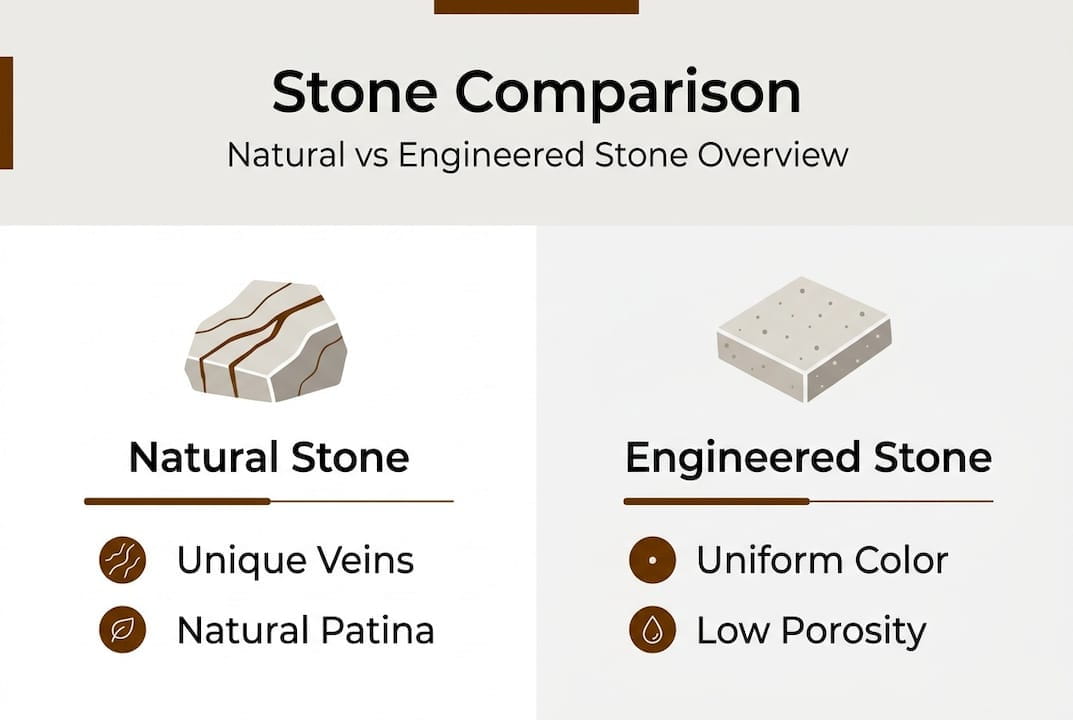
| Feature | Natural Stone | Engineered Stone |
|---|---|---|
| Performance | Varies by type, proven centuries of durability | Consistent, predictable performance |
| Heat Resistance | Excellent, withstands high temperatures | Limited, can crack or discolor from heat |
| Lifespan | Generations with proper care | 10-25 years typical |
| Maintenance | Requires periodic sealing, careful cleaning | Minimal maintenance, stain resistant |
| Aesthetic | Unique variations, natural character | Uniform appearance, limited variation |
| Cost | Higher initial investment, better long-term value | Lower upfront cost, replacement needed sooner |
Natural stone advantages:
- Irreplaceable uniqueness in every slab
- Superior heat resistance for kitchen applications
- Develops attractive patina over time
- Higher resale value and perceived quality
- Environmentally sustainable when properly sourced
Natural stone considerations:
- Requires regular sealing to prevent staining
- More susceptible to etching from acidic substances
- Higher initial material and installation costs
- Variation may complicate matching for repairs
Engineered stone advantages:
- Consistent color and pattern throughout
- Non-porous surface resists staining
- Lower maintenance requirements
- More affordable initial investment
- Easier to match for repairs or additions
Engineered stone considerations:
- Limited heat resistance, hot pots cause damage
- Lacks natural character and uniqueness
- Shorter lifespan before replacement needed
- Lower resale value perception
- Environmental concerns with resin content
“Authentic natural stone delivers unmatched long-term return on investment through superior heat resistance, timeless beauty, and multi-generational durability. While engineered alternatives offer convenience, they cannot replicate the living quality and lasting value of genuine geological materials.”
Exploring backsplash use cases and marble selection tips reveals how authentic stone performs in real-world applications.
How to ensure authenticity in your stone renovation
Securing authentic natural stone requires systematic verification, careful supplier selection, and thorough documentation. These steps protect your investment and ensure material quality.
Always test specific slabs, check certifications, request quarry documentation, and confirm standards compliance to verify authenticity throughout the sourcing process.
Steps for ensuring authenticity:
- Research suppliers with established reputations and verifiable track records
- Request complete documentation including quarry location and extraction dates
- Verify third-party certifications from independent testing laboratories
- Inspect physical samples for natural variation and characteristic features
- Conduct simple field tests including water absorption and temperature assessment
- Review installation portfolios showing completed projects with similar materials
- Confirm warranty coverage and performance guarantees in writing
- Document your specific slabs with photographs before fabrication begins
Choosing authentic suppliers starts with verification of business credentials and industry affiliations. Established importers maintain relationships with specific quarries and provide detailed provenance information. Ask how long they’ve operated, which quarries they work with, and what verification processes they follow.
Documentation to request includes quarry certificates of origin, ASTM test results, mineral composition analysis, and sustainability certifications. Legitimate suppliers provide this information promptly and completely. Incomplete or vague documentation suggests potential authenticity issues.
On-site tests you can perform include the water drop test, temperature assessment, and visual inspection for natural variation. Place water drops on the surface and observe absorption patterns. Touch the stone to assess thermal properties. Examine veining and color distribution for natural irregularity.
Red flags to avoid:
- Suppliers who refuse to provide quarry documentation
- Resistance to independent testing or slab inspection
- Samples showing unnaturally uniform patterns or colors
- Prices significantly below market rates for claimed stone types
- Vague or inconsistent answers about material origins
- Pressure tactics or limited-time offers on premium materials
Pro Tip: Visit supplier yards when possible to inspect inventory directly, or request high-resolution photographs of your specific slabs from multiple angles. This documentation helps verify authenticity and ensures you receive the exact materials you selected.
Understanding the stone ordering process streamlines procurement and reduces verification challenges. Following industry certification steps ensures compliance with recognized standards.
Elevate your project with authentic natural stone
Applying what you’ve learned about natural stone authenticity positions you to make confident renovation decisions that deliver lasting value. The difference between authentic and imitation materials becomes clear when you know what to look for and which questions to ask.
Consulting with proven, certified suppliers transforms knowledge into action. At Surfaces Galore, we specialize in direct importation of premium marble and travertine, maintaining transparent relationships with quarries and providing complete documentation for every slab. Our commitment to authenticity means you receive genuine natural stone backed by certifications and performance guarantees.
Explore authentic stone options that bring timeless beauty to your renovation. Our nationwide shipping connects designers, architects, contractors, and homeowners across the U.S. with materials that deliver both aesthetic appeal and proven durability. Discover how to select natural stone for timeless spaces that reflect your vision and stand the test of time.
Frequently asked questions
How can I spot fake natural stone in a showroom?
Look for uniform colors, printed patterns, and lack of natural veining, and ensure the supplier provides origin certificates. Authentic stone shows irregular variation that synthetic materials cannot replicate convincingly.
Which certifications confirm natural stone authenticity?
ASTM and ANSI/NSC-373 are benchmarks for authentic stone verification, establishing performance standards and confirming proven stone origin. These independent certifications provide reliable authenticity confirmation.
Why is authentic stone better than engineered stone for renovations?
Natural stone provides long-term ROI and distinctive characteristics including unique beauty, superior longevity, natural patina development, and higher heat resistance compared to engineered options.
Is real natural stone harder to maintain than engineered stone?
Natural stone requires more care but offers greater durability. Yes, authentic stone typically requires sealing and careful cleaning, but its longevity and character often outweigh the added maintenance effort.
Should I test each slab before installation?
Yes, because stone varies by quarry and slab. Always test for density and require supplier documentation before final selection to ensure your specific materials meet performance expectations.

Leave a comment