
Crema Marfil tiles: A complete guide to choosing, designing, and ordering natural stone

Key Takeaways
Crema Marfil is a warm, adaptable natural marble that suits both quiet interiors and more decorative schemes.
- Warm beige color and subtle veining create a timeless foundation.
- Tile size and finish should match the room, traffic, and maintenance plan.
- Natural variation is part of the character, so samples and lot review matter.
- Mosaics, borders, and contrasting stones can give the installation a custom feel.
- Careful preparation, sealing, and professional installation protect the finished surface.
What makes Crema Marfil tiles a timeless design choice
Crema Marfil has remained popular because it brings warmth without overwhelming a room. Its soft palette works across many periods and finishes. As a natural marble, every piece has its own movement, which keeps a large installation from feeling flat or overly uniform.
Warm beige tones and subtle natural veining
The defining character of Crema Marfil is its warm beige background and subtle natural veining. Some pieces read softly and evenly, while others show more visible movement or tonal depth. That variation gives floors and walls a calm, layered appearance rather than a manufactured repeat.
The color is particularly useful when a room needs warmth but not a strong accent color. It can sit comfortably beside painted cabinetry, wood, brushed metal, and softly colored textiles. For a broader view of the stone’s palette and pairing possibilities, explore this Crema Marfil tile collection.
How Crema Marfil complements classic and contemporary interiors
In a traditional setting, Crema Marfil can support molding, furniture with curved profiles, and detailed borders. In a contemporary room, larger formats and restrained grout lines allow the stone to feel clean and architectural. The same beige foundation can therefore move from a formal foyer to a simple, light-filled bathroom.
A polished surface adds brightness and refinement, while a honed surface feels quieter and more tactile. The design direction comes less from the marble alone than from its scale, surrounding materials, and layout.
Authentic natural marble versus manufactured surface materials
Authentic marble has mineral variation, depth, and a cool, smooth feel that develops its own visual rhythm across an installation. No two tiles are perfectly identical. Manufactured surface materials may offer more predictable repetition, but natural marble is chosen precisely for its geological character.
When assessing a natural stone order, inspect samples for background tone, veining, edge quality, and finish. A sample cannot show every possible variation, but it provides a useful starting point for setting expectations.
Why natural stone can add long-term design value
A well-chosen marble installation can remain visually relevant through multiple renovation cycles. Its appeal comes from a classic material rather than a short-lived printed pattern. Crema Marfil is also documented as suitable for residential and commercial spaces, with applications including floors, walls, countertops, and more.
That does not make stone maintenance-free. It does mean that thoughtful selection and care can preserve an elegant foundation for years. Natural variation is a design asset when the project is planned around it.
How to choose the right Crema Marfil tile
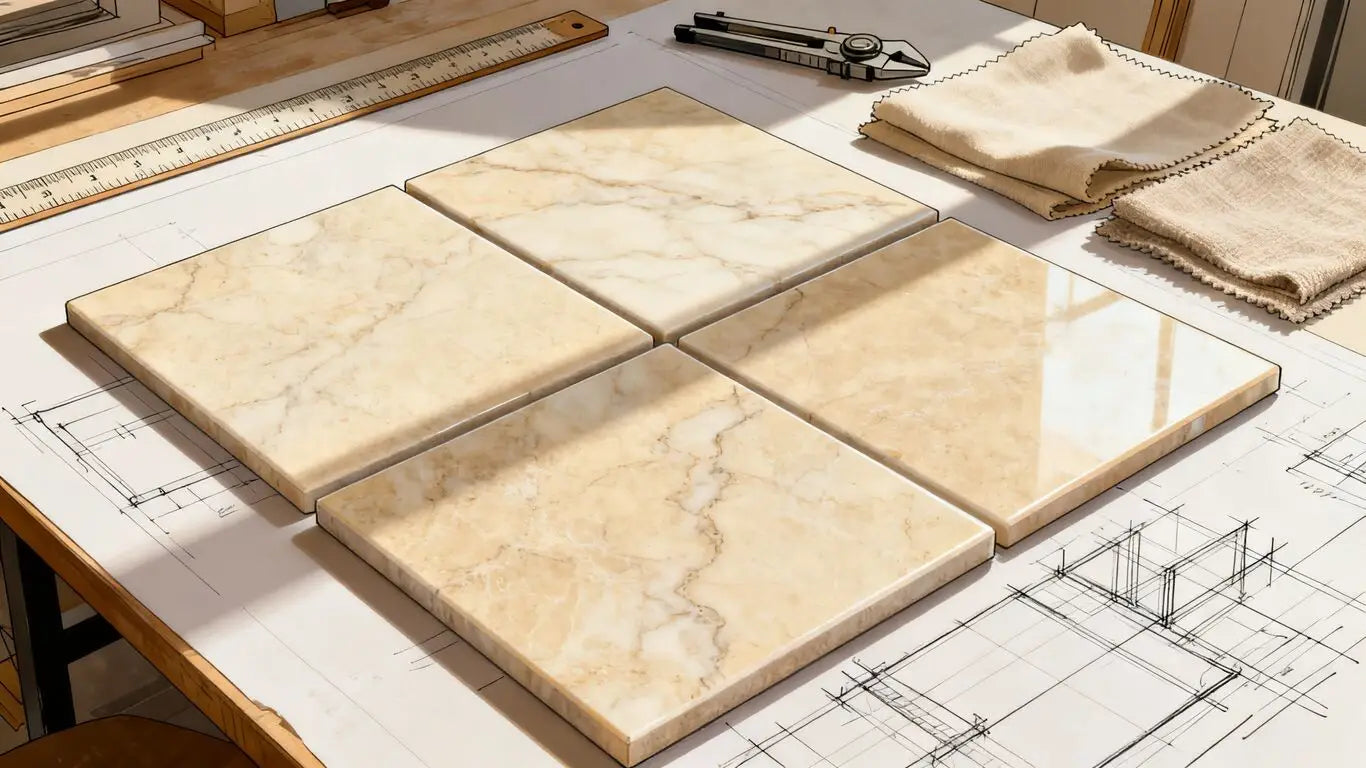
Choosing among crema marfil tiles involves more than selecting a color from a screen. Room dimensions, traffic, lighting, finish, and installation method all affect the final impression. Begin with the intended use, then compare actual samples under the lighting in the space.
Selecting tile sizes for floors, walls, and backsplashes
Large tiles can make an open floor feel calmer by reducing grout lines, while smaller formats are useful around corners, niches, and compact rooms. Medium formats often provide a practical balance for bathrooms and kitchens. On a backsplash, a smaller tile or mosaic can introduce pattern without competing with cabinetry.
Check nominal dimensions, coverage, thickness, and edge details before ordering. A floor layout also deserves a dry fit so cuts and focal points are understood before mortar is applied.
Comparing polished, honed, and tumbled finishes
Polished marble reflects light and gives the surface a formal sheen. Honed marble has a softer, low-sheen appearance that can feel more relaxed and may disguise small surface marks more easily. Tumbled marble has softened edges and a gently aged character that suits rustic or traditional layouts.
Finish should follow both the visual brief and the location. In areas where slip resistance matters, review the specific stone and installation conditions with a qualified professional rather than assuming that one finish suits every application.
Coordinating Crema Marfil with other marble and travertine
Crema Marfil pairs naturally with beige, ivory, gray, and darker stones. A related warm travertine can create a quiet tonal composition, while a darker marble can frame the beige field and sharpen its veining. Keep one material dominant and use the second as a border, inset, or accent.
For a more decorative direction, a Spanish Mix marble mosaic combines Crema Marfil with Emperador Light and Emperador Dark marbles. It can add controlled contrast to a backsplash, bathroom, or feature area without abandoning the warm palette.
Reviewing shade, veining, thickness, and lot variation
Natural stone should be reviewed as a lot, not only as a single tile. Compare several pieces side by side and check the thickness, surface finish, corners, and tonal range. Mark especially attractive pieces for focal positions, and plan less prominent cuts near walls or under fixtures.
Before purchase, confirm the measured area, waste allowance, and whether future replacement pieces may be needed. These small checks make the ordering stage much less stressful.
| Decision | What to compare | Where it matters most |
|---|---|---|
| Size | Coverage, cuts, and grout lines | Floors and open walls |
| Finish | Sheen, texture, and traction needs | Bathrooms and entries |
| Color | Beige depth and surrounding materials | Whole-room coordination |
| Lot | Veining, shade, and thickness | Larger installations |
The table is a useful starting filter, not a substitute for viewing samples. A carefully chosen combination of size, finish, and lot will usually look more intentional than a rushed color-only decision.
Where to use Crema Marfil marble tiles
Crema Marfil marble tiles are versatile enough for many interior applications. The warm base can connect separate rooms, or it can be limited to one carefully framed area. Consider the stone’s exposure to water, grit, spills, and traffic before finalizing the specification.

Entryways, foyers, hallways, and living spaces
A Crema Marfil entryway creates a welcoming first impression and gives adjacent rooms a warm visual link. In hallways, a consistent field can make the circulation path feel longer and more composed. Living spaces benefit from larger formats, restrained borders, or a simple area rug that lets the veining remain visible.
Because entry floors collect grit, use suitable mats and a cleaning routine designed for marble. The stone’s durability supports busy settings, but surface protection still depends on proper installation and care.
Kitchen backsplashes and decorative wall applications
A backsplash is a good place to use Crema Marfil for warmth without covering every surface in pattern. Rectangles, mosaics, and trim can be arranged around a range, sink, or open shelf. The stone also works as a decorative wall field where its subtle movement can be seen at eye level.
For kitchens, confirm that the selected finish and sealer suit the expected exposure to splashes and food-related staining. A sample board viewed beside the countertop and cabinet color can prevent costly mismatches.
Bathroom floors, shower walls, and accent areas
In bathrooms, Crema Marfil can move from floor to shower wall, niche, or accent band for a cohesive look. Mosaics are especially useful on smaller surfaces and shower floors because their scale follows changes in plane. A softly honed finish often gives a quieter atmosphere than a highly reflective surface.
Drainage, waterproofing, slope, and grout joints require careful planning. For inspiration centered on kitchen and bath applications, see these Crema Marfil marble tiles.
Commercial interiors, hospitality spaces, and architectural projects
The stone’s warm neutrality can suit reception areas, corridors, restaurants, guest bathrooms, and other architectural interiors. In a commercial project, the design should account for traffic, cleaning practices, replacement material, and consistent lot planning. A repeating layout can establish order, while a border or mosaic can identify a transition zone.
For projects with demanding schedules, approve samples and shop drawings early. The visual goal is only one part of a successful specification; coordination with the installer and other trades matters just as much.
Design ideas for Crema Marfil tile installations
A good Crema Marfil installation is rarely just a field of beige tiles. Proportion, rhythm, and contrast can give the material a stronger architectural presence. The most successful schemes usually repeat one or two design cues rather than layering every available pattern.
Creating elegant borders, trim details, and transition areas
A narrow border can define a foyer, frame a bathroom floor, or separate two finishes without making the room feel busy. Marble trim can also finish the edge of a backsplash or create a visual stop beneath cabinetry. Keep the border aligned with doors, walls, or major fixtures so it feels built into the architecture.
Use test pieces to check how the border meets corners and thresholds. Small alignment decisions become highly visible when a pattern runs through a long hallway.
Pairing Crema Marfil with checkerboard and geometric layouts
A checkerboard layout can give Crema Marfil a classic, confident character. Pairing the beige marble with a dark stone creates a stronger graphic effect, while two close warm tones produce a more restrained pattern. Rotate or scale the layout only after checking how it meets room boundaries.
Geometric designs are especially effective in foyers, dining areas, bathrooms, and hospitality interiors. For additional pattern inspiration, consider these marble checkerboard layouts, then adapt the scale to the project rather than copying it exactly.
Using mosaics to add texture and visual interest
Mosaics introduce smaller points of movement and can make a modest accent area feel considered. They work well in shower niches, backsplash bands, shower floors, and decorative wall panels. A polished mosaic feels more luminous; a tumbled option tends to appear softer and more established.
Before installation, lay sheets out dry and inspect the joins between them. The pattern should flow naturally, with no obvious sheet edges or abrupt changes in direction.
Combining beige marble with dark, gray, or white natural stone
Dark marble provides drama and outlines the warmth of Crema Marfil. Gray stone brings a cooler, more contemporary balance, while white marble keeps the room bright and understated. Use the strongest contrast at a focal point, then repeat a small amount elsewhere for continuity.
Accessories can complete the composition. For example, stylish table decorations can echo the warm undertones in a dining room without adding another permanent stone pattern. In a separate project, modern wedding cake ideas may offer useful inspiration for architectural shapes and restrained color palettes, even outside event design.
Installation and care considerations for Crema Marfil
Natural stone rewards patience during installation. The substrate, layout, mortar, grout, sealer, and cleaning products all influence the finished appearance. Treat the material as a coordinated system rather than a series of isolated decisions.

Preparing the substrate and planning the layout
The substrate should be clean, sound, flat, and appropriate for the intended installation. Dry-lay tiles before setting them to review shade variation, directional veining, cuts, and transitions. Keep the layout centered where possible, and avoid leaving very narrow slivers at visible edges.
Measure carefully and include a sensible waste allowance for cuts and natural variation. A useful mosaic installation guide can help organize inspection, dry-fitting, mortar application, grouting, sealing, and waste planning.
Choosing grout colors and controlling visual contrast
A grout close to the marble’s background creates a continuous field and lets the veining lead. A contrasting grout makes each tile more distinct and can strengthen a geometric layout. Test the grout against a sample before committing, because the wet installation color may differ from the dry appearance.
Keep joints consistent and remove residue promptly. Grout haze can distract from subtle veining, especially on polished surfaces.
Sealing marble before and after installation
Marble is porous, so sealing is commonly part of a responsible care plan. The appropriate product and timing depend on the stone, finish, location, and manufacturer directions. Sealers do not make marble stain-proof, but they can help reduce absorption when correctly selected and applied.
Confirm that the surface is clean and fully dry before sealing. After installation, follow the sealer instructions and allow the recommended curing time before regular use.
Cleaning routines and protecting the stone from etching
Use a soft cloth or mop and a cleaner intended for natural stone. Wipe spills promptly, particularly acidic substances that may etch marble. Avoid abrasive pads and unapproved acidic cleaners, and use mats or felt protection where grit and furniture movement could mark the surface.
A simple routine is easier to maintain than occasional aggressive cleaning:
- Dust or sweep loose grit regularly.
- Blot spills instead of spreading them.
- Clean with a pH-appropriate stone product.
- Refresh protective measures as the surface requires.
These habits preserve the finish and make subtle changes easier to spot. If a mark or dull area appears, seek advice before trying a strong household product.
Why professional installation is important for natural stone
Professional installation helps address substrate preparation, layout balance, cutting, lippage, grout, and sealing. Experienced installers also know when a tile needs to be set aside because its variation or thickness is unsuitable for a particular position.
Natural stone work still requires homeowner review and informed product selection. Confirm the installer’s method, inspect the material before setting, and keep documentation for the chosen products and care routine.
How to order Crema Marfil tiles from Surfaces Galore
Ordering natural stone is easiest when design decisions and project quantities are handled together. Start with the room, area, size, finish, and desired shade range. Then confirm availability, samples, freight timing, and the amount of material needed before placing the order.
Reviewing current inventory, sizes, finishes, and product availability
Surfaces Galore offers Crema Marfil tiles in various sizes and finishes, along with related marble products such as slabs and mosaics. Review current stock rather than relying on a past listing, and ask which lots match the approved sample. This is particularly helpful when a project needs several cartons or multiple formats.
The company is an Anaheim, California-based direct importer and nationwide supplier of premium natural stone. Its broader assortment includes marble and travertine tiles, mosaics, and moldings.
Requesting samples and confirming project quantities
Samples allow you to compare the marble with paint, cabinetry, flooring, lighting, and hardware. Once the design is approved, calculate the field area, cuts, pattern requirements, and waste allowance. Confirm nominal dimensions and thickness before finalizing quantities.
A clear order record should include the selected size, finish, color range, quantity, delivery information, and any approved sample reference. That simple checklist reduces confusion between design intent and shipment.
Planning shipping from Anaheim across the United States
Shipping should be planned around the installation schedule, site access, and inspection time. Surfaces Galore serves customers across the United States and can ship materials cross-country, making delivery coordination an important part of the order conversation. Inspect cartons promptly on arrival and document any concerns before installation.
The company’s source material also notes insured orders and same-day shipping availability, subject to the order and current fulfillment conditions. Confirm timing directly rather than treating an announcement as a project guarantee.
Exploring bulk pricing for residential and commercial projects
Larger renovations, multi-room orders, and commercial specifications may qualify for bulk pricing. Ask for pricing based on the complete quantity, selected finish, and delivery requirements. Comparing the full order rather than a single-tile price gives a more useful view of project cost.
Designers and architects should also confirm whether the available lot can support the full installation. A visually consistent order is often worth prioritizing over a small saving on a partial quantity.
Requesting a quote from Surfaces Galore’s natural stone specialists
When requesting a quote, provide the room dimensions, preferred format, finish, delivery ZIP code, target schedule, and photographs if the project is a renovation. Surfaces Galore’s natural stone specialists can then discuss current availability and help organize the next selection step. A detailed request usually produces a more useful response than a general inquiry.
For readers searching to buy marble tiles online USA, the practical path is to compare samples, verify stock, confirm quantities, and request a project-specific quote. This quote request can begin that conversation.
Call for Your Stone Quote
Bring your room measurements and design direction to Surfaces Galore, then request current Crema Marfil availability, samples, shipping details, and project pricing for your residential or commercial order.
Conclusion
Crema Marfil offers a warm, enduring foundation for floors, walls, backsplashes, bathrooms, and decorative installations. With careful attention to size, finish, variation, layout, installation, and care, these natural marble tiles can give a project both immediate elegance and lasting character.
Frequently Asked Questions
What are Crema Marfil tiles?
Crema Marfil tiles are natural marble tiles recognized for a warm beige background and subtle veining. They are used across floors, walls, backsplashes, bathrooms, and decorative applications.
Are Crema Marfil tiles suitable for floors?
They can be suitable for residential and commercial floors when the selected finish, substrate, installation method, and maintenance plan match the location. High-traffic areas require careful cleaning and grit control.
Which finish is best for Crema Marfil marble?
Polished, honed, and tumbled finishes create different appearances. Polished surfaces are reflective, honed surfaces are softer, and tumbled surfaces have softened edges with an aged character.
Can Crema Marfil be used in a shower?
Crema Marfil can be used for shower walls, accent areas, and suitable shower-floor applications when waterproofing, slope, drainage, grout, and finish selection are handled correctly.
What colors pair well with Crema Marfil?
White, ivory, gray, dark brown, charcoal, natural wood, and other warm neutrals can complement its beige undertones. Samples should be viewed together under the project’s lighting.
Does natural marble vary from tile to tile?
Yes. Shade, veining, mineral markings, and thickness can vary. Reviewing multiple pieces from the intended lot helps establish a realistic expectation for the completed installation.
How should Crema Marfil marble be cleaned?
Sweep or dust regularly, blot spills promptly, and use a cleaner made for natural stone. Avoid abrasive materials and acidic products that may scratch or etch the surface.

Leave a comment