

What Is Slip Resistance? A Flooring Safety Guide

TL;DR:
- Slip resistance measures a floor’s ability to prevent slipping, based on friction coefficients. Many standards, such as ANSI A326.3, BS 7976, and DIN 51130, set minimum thresholds to ensure safety in wet and high-traffic areas. Proper testing, maintenance, and finish selection are essential for maintaining slip resistance in real-world conditions.
Slip resistance is defined as the measure of friction between two surfaces that prevents sliding, expressed as a coefficient of friction (COF). Slips and trips cause 40% of major workplace injuries in the UK, and the numbers are similarly alarming across the United States. That single statistic explains why building codes, flooring standards, and safety inspectors treat slip resistance as a non-negotiable specification. For anyone selecting flooring for a bathroom, kitchen, commercial lobby, or outdoor terrace, understanding this concept is the difference between a beautiful space and a liability. Surfacesgalore works with natural stone materials where surface finish directly determines how safe a floor performs underfoot.
What is slip resistance, and how is it measured?
Slip resistance is the technical term for a surface’s ability to resist sliding contact between a shoe sole and the floor. The industry quantifies this ability using the coefficient of friction, which comes in two forms: static COF and dynamic COF. Static COF measures the force needed to start movement. Dynamic COF (DCOF) measures friction during active sliding, which is the more relevant value for walking surfaces.
Key standards and their thresholds
Three major standards govern slip resistance testing across different regions and industries.
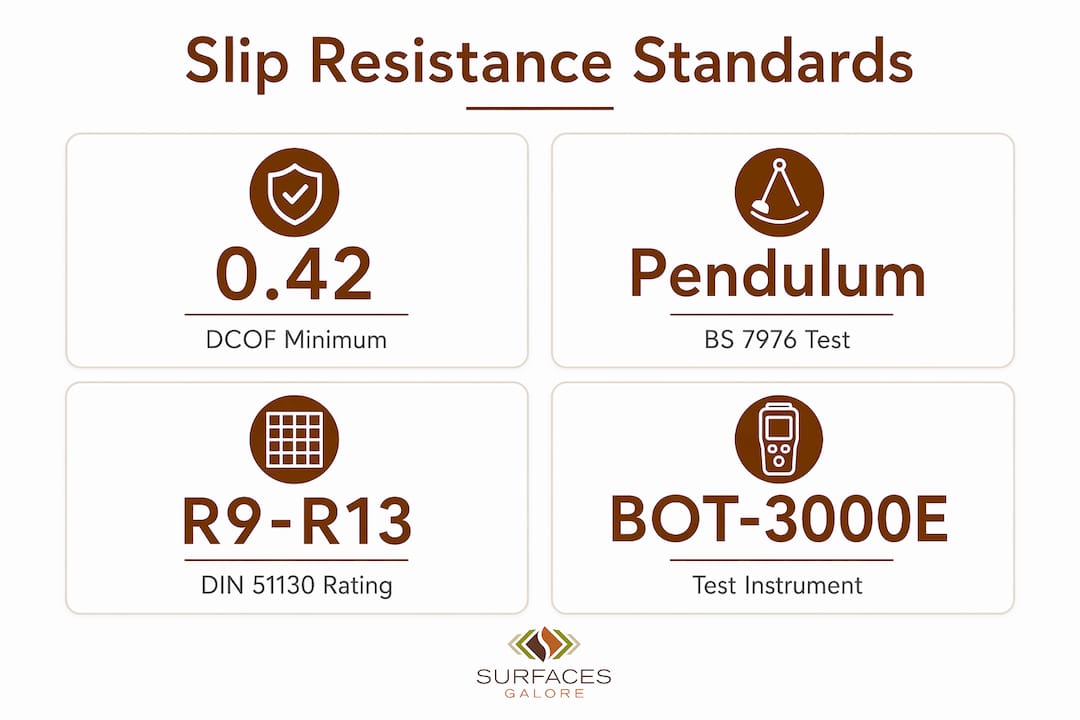
ANSI A326.3 is the primary American standard for interior wet floors. ANSI A326.3 requires a minimum DCOF of 0.42 for level interior surfaces exposed to water. Any tile or stone floor in a bathroom, commercial kitchen, or pool surround must meet or exceed this threshold to be considered safe for typical use.
BS 7976 (Pendulum Test) is the dominant method in the United Kingdom and many international markets. It produces a Pendulum Test Value (PTV). The UK’s Health and Safety Executive benchmarks low slip potential at PTV 36 or higher for wet surfaces. The pendulum test carries over 50 years of research behind it, making it the most widely trusted global method for slip assessment.
DIN 51130 (Ramp Test) is a German standard that rates surfaces from R9 through R13. DIN 51130 produces R-ratings based on the angle at which a person slips on an oiled surface while walking on a tilted ramp. R9 is the minimum for general use; R13 is required for industrial kitchens and areas with heavy grease exposure.
| Metric | Standard | Minimum Safe Value | Typical Use |
|---|---|---|---|
| DCOF | ANSI A326.3 | 0.42 | US wet interior floors |
| PTV | BS 7976 | 36 | UK and international wet surfaces |
| R-Rating | DIN 51130 | R9 | General commercial and residential |
| COF (footwear) | ISO 13287 | 0.30 (flat sole) | Shoe sole testing |
Testing instruments
The BOT-3000E tribometer is the only approved device under ANSI A326.3. That exclusivity matters because different instruments produce different readings on identical surfaces. A floor that passes one device may fail another. Specifying which instrument was used is as important as reporting the number itself.
Pro Tip: Always request the test report, not just the rating. The report should name the standard used, the instrument, and whether the surface was tested wet or dry. A bare number without context is nearly meaningless.
What affects slip resistance in real-world conditions?
A tile’s rated COF is measured under controlled lab conditions. Real floors face water, cooking oil, cleaning products, and foot traffic. Surface condition and contaminants can override a material’s intrinsic slip rating, turning a compliant floor into a hazard.
Surface texture and microtexture
Surface texture is the first line of defense. Floors with visible texture, such as brushed travertine or tumbled limestone, create mechanical grip by increasing the contact area between shoe soles and the stone. Microtexture refers to the microscopic roughness that remains effective even when a surface looks smooth. Honed marble has more microtexture than polished marble, which is why honed finishes perform better in wet areas. Understanding tile finishes and their surface properties is a practical first step before committing to any stone for a floor.
Contaminants and their impact
The following contaminants are the most common causes of slip accidents on otherwise compliant floors:
- Water. Even a thin film of water reduces friction significantly on smooth stone. Polished marble in a shower or pool area becomes genuinely dangerous without textured inserts or anti-slip treatments.
- Oil and grease. Kitchen floors face the highest contamination risk. Oil reduces COF more aggressively than water, which is why commercial kitchens require R11 or higher under DIN 51130.
- Soap and cleaning residue. Certain cleaning products leave a film that lowers friction. Using the wrong cleaner on travertine or limestone can degrade both the surface and its grip.
- Dust and fine particles. Dry environments are not automatically safe. Fine dust on a polished stone floor acts as a lubricant.
Maintenance and natural stone
Proper drainage, cleaning, and avoiding contaminants are critical to maintaining slip resistance over time, especially for natural stone. Marble and travertine are porous materials that absorb liquids if left unsealed. A sealed surface sheds water faster and retains its friction properties longer. Sealing is not optional for wet areas. It is a safety measure as much as a preservation measure.
Pro Tip: Retest slip resistance after any major cleaning protocol change or resurfacing work. Slip resistance can deteriorate with wear, and what passed at installation may not pass two years later without proper upkeep.
What are the most common misconceptions about slip resistance?
Slip resistance terminology is widely misused, and the confusion creates real safety gaps. Three distinctions matter most for anyone specifying or purchasing flooring.
Slip resistance vs. traction
Traction is static friction, which prevents a slip from starting. Slip resistance is dynamic friction, which resists motion once a slip has begun. A floor with high traction but low slip resistance may prevent most slips but cause serious injury when a slip does occur, because the foot decelerates abruptly. Both properties matter, and they are not interchangeable terms.
“Anti-slip” vs. “non-slip”
These two terms sound equivalent. They are not. “Anti-slip” refers to a certified, tested property. A product labeled anti-slip has been evaluated against a recognized standard and meets a defined threshold. “Non-slip” is frequently a marketing label with no standardized performance requirement behind it. Buyers who rely on “non-slip” labeling without requesting test data are accepting an unverified claim.
The following points summarize the most common misconceptions worth correcting before any flooring purchase:
- A high COF rating does not guarantee safety. No single friction value can guarantee safety because user behavior, stride length, footwear, and contamination all alter actual risk.
- Dry ratings do not predict wet performance. A tile rated for dry conditions may perform very differently when wet.
- Rougher is not always safer. Extremely rough surfaces trap contaminants and become harder to clean, which can increase slip risk over time.
- One test method is not enough. Different standards measure different things. A floor that passes DIN 51130 R10 may still fail the BS 7976 pendulum test at PTV 36 under specific conditions.
- Application context changes everything. A threshold safe for a hotel corridor may be inadequate for a commercial kitchen or a pool deck.
How do you choose slip-resistant flooring for your space?
Selecting the right floor requires matching the material’s tested performance to the specific demands of the environment. The process is more structured than most buyers realize.
Step-by-step evaluation approach
- Identify the environment. Wet areas like bathrooms, showers, and pool surrounds require higher slip resistance than dry hallways. Commercial kitchens face oil and grease. Outdoor terraces face rain and temperature changes.
- Determine the applicable standard. In the United States, ANSI A326.3 applies to most interior wet floors. Projects with international specifications may reference BS 7976 or DIN 51130. Know which standard governs your project before evaluating products.
- Request certified test data. Ask suppliers for the actual test report, not just a rating label. The report should specify the instrument, the standard, and the test conditions (wet or dry).
- Match the finish to the function. Honed, brushed, and textured stone finishes outperform polished finishes in wet areas. For marble shower floors, a honed or brushed finish is the standard recommendation for both safety and durability.
- Plan for maintenance. A floor that requires daily mopping with a specific pH-neutral cleaner is a different commitment than one that tolerates standard cleaning. Factor maintenance into the selection, not just the initial rating.
- Consult a professional for commercial projects. High-traffic commercial spaces carry liability exposure. An independent slip test after installation is standard practice in hospitality and healthcare construction.
Matching stone type to environment
| Environment | Recommended finish | Minimum standard |
|---|---|---|
| Residential bathroom | Honed or brushed marble | ANSI A326.3 DCOF 0.42 |
| Residential kitchen | Honed limestone or travertine | ANSI A326.3 DCOF 0.42 |
| Commercial lobby (dry) | Polished or honed marble | DCOF 0.42 dry |
| Commercial kitchen | Textured stone or anti-slip treated | DIN 51130 R11 minimum |
| Pool surround / outdoor | Brushed or tumbled travertine | PTV 36+ or R11 |
Natural stone offers genuine advantages in this context. Travertine and limestone with brushed or tumbled finishes achieve strong slip resistance ratings without sacrificing the visual warmth that makes them popular in residential design. The key is selecting the right finish and verifying the data. Surfacesgalore carries natural stone collections where finish options are clearly defined, making it straightforward to pick the right floor tile for kitchens and bathrooms without guessing.
Key takeaways
Slip resistance is the single most important safety specification for any floor in a wet or high-traffic area, and no label replaces verified test data from a recognized standard.
| Point | Details |
|---|---|
| COF is the core metric | DCOF of 0.42 or higher is the US minimum for wet interior floors under ANSI A326.3. |
| Standards vary by region | ANSI A326.3, BS 7976, and DIN 51130 each measure slip resistance differently and apply to different contexts. |
| Contaminants override ratings | Water, oil, and soap residue can make a compliant floor hazardous without proper maintenance and sealing. |
| “Non-slip” is not certified | Only “anti-slip” backed by test data from a recognized standard carries a verifiable safety guarantee. |
| Finish determines performance | Honed, brushed, and tumbled stone finishes outperform polished finishes in wet residential and commercial areas. |
Why I think most buyers underestimate slip resistance until it’s too late
Working closely with natural stone selection, I’ve seen the same pattern repeat: buyers spend weeks choosing between marble varieties, grout colors, and tile sizes, then spend about five minutes on slip resistance. The safety question gets treated as a checkbox rather than a design parameter.
The uncomfortable truth is that a polished Calacatta marble floor looks extraordinary and performs poorly in a wet shower. The same stone in a honed finish looks nearly as good and meets ANSI A326.3 without any additional treatment. The trade-off is minimal. The safety difference is significant.
What I’ve also noticed is that maintenance gets ignored entirely at the point of purchase. A floor that passes its initial slip test can deteriorate within a year if cleaned with the wrong products or left unsealed. Regular testing after installation is not paranoia. It is the only way to know whether the floor you specified still performs the way it did on day one.
My advice is to treat slip resistance the same way you treat load-bearing capacity or waterproofing. It is a structural safety requirement, not a style preference. Work with suppliers who can provide actual test reports, not just product descriptions. Surfacesgalore is one of the few natural stone importers that takes finish specification seriously enough to guide buyers through the safety implications of each surface option. That kind of transparency is worth more than a glossy catalog.
— cihan
Natural stone flooring with verified slip resistance at Surfacesgalore
Surfacesgalore imports premium marble, limestone, and travertine directly, with finish options that address both design goals and safety requirements.
The collections include honed and brushed stone finishes suited for bathrooms, kitchens, and commercial spaces where slip resistance is a specification, not an afterthought. Each product line covers the surface options most relevant to wet and high-traffic environments, from tumbled travertine for pool surrounds to honed limestone for residential kitchens. Browse the full range at Surfacesgalore to find natural stone that meets your project’s safety and design standards, and reach out for guidance on finish selection and compliance.
FAQ
What is slip resistance in flooring?
Slip resistance is the measure of friction between a floor surface and a shoe sole, expressed as a coefficient of friction. Higher values indicate greater resistance to sliding and lower slip risk.
What DCOF value is considered safe for wet floors?
ANSI A326.3 sets the minimum Dynamic Coefficient of Friction at 0.42 for level interior wet floors in the United States. Floors below this threshold are not considered safe for typical foot traffic in wet conditions.
Is polished marble slip resistant?
Polished marble has low surface texture and typically does not meet the ANSI A326.3 minimum DCOF of 0.42 when wet. Honed or brushed marble finishes perform significantly better in wet areas like bathrooms and showers.
What is the difference between anti-slip and non-slip?
“Anti-slip” refers to a certified property verified through standardized testing. “Non-slip” is frequently a marketing label without a defined performance standard behind it. Always request test data when evaluating either claim.
How often should slip resistance be tested?
Slip resistance should be tested at installation and retested after any resurfacing, major cleaning protocol change, or significant wear. Slip resistance deteriorates over time, and periodic testing is the only reliable way to confirm ongoing compliance.
Leave a comment