

White Bathroom Tile Ideas That Actually Work

From classic subway to Thassos marble, the best white bathroom tile ideas pair a clear design goal with the right material, grout, and layout. Here are the highest-impact directions, each suited to a specific situation:
- Classic subway tile (3x6 running bond or stacked): Best for budget-conscious remodels and DIY installs. Low cost, widely available, easy to replace. Can read institutional without the right grout or trim detail.
- Marble and natural stone (Thassos white marble, Bianco Dolomite): Best for luxury ensuites and spa-style showers. Unmatched visual depth. Requires sealing and careful finish selection for wet zones.
- Mosaics, hexagon, and penny rounds: Best for shower floors, niche backs, and accent borders. Built-in slip resistance from extra grout lines. Adds texture without breaking the white palette.
- Large-format rectified tile (24x24 and up): Best for making a small bathroom feel larger. Fewer grout lines, cleaner look. Demands a flat substrate and usually professional installation.
- Patterned and encaustic-look floors: Best for powder rooms and statement floors. Keeps the room light while adding personality. Porcelain printed versions cost far less than true encaustic cement tile.
Before you order anything, pull physical samples and hold them against your actual lighting, fixtures, and vanity. A tile that looks crisp white in a showroom can read yellow or gray under warm incandescent bulbs.
Key Takeaways
White tile bathrooms work best when material, finish, grout, and at least one warm accent are chosen together rather than separately.
| Point | Details |
|---|---|
| Match material to use zone | Use honed or textured tile on wet floors; reserve polished stone for walls and low-traffic features. |
| Grout color is a design decision | Warm sand or putty grout adds depth and hides grime better than bright white in most installations. |
| Natural stone requires sealing | Marble and Bianco Dolomite need a penetrating sealer before install and annual resealing in wet showers. |
| Large-format tiles need a flat substrate | Any lippage or flex in the subfloor telegraphs through rectified large-format tiles; professional installation reduces risk. |
| Surfacesgalore for authentic stone | Surfacesgalore is a direct importer of Thassos, Bianco Dolomite, travertine, and limestone with nationwide shipping and sample ordering. |
Table of Contents
- 1. Classic subway tile layouts still earn their place
- 2. Marble and natural stone bring depth no porcelain can replicate
- 3. Mosaics, hexagons, and penny rounds add texture without noise
- 4. Large-format white tiles make a small bathroom feel bigger
- 5. Patterned and encaustic-look floors keep white rooms from feeling flat
- 6. Shower and floor tile: what safety and installation actually require
- 7. Grout, finish, and color choices that prevent a sterile result
- 8. How to choose the right white tile for your bathroom
- 9. Keeping white tile bright: material-specific maintenance
- 10. Sourcing authentic white natural stone: what to check before you buy
- 11. The one design mistake worth avoiding
- Natural stone collections worth seeing at Surfacesgalore
- Sources
- FAQ
1. Classic subway tile layouts still earn their place
The 3x6 subway tile has been a bathroom staple for over a century, and it earns that longevity by being genuinely versatile. The layout you choose, though, changes the entire mood of the room.
Running bond (staggered): The classic offset pattern softens a wall visually. It reads traditional and approachable, and the slight irregularity hides minor installation imperfections, which matters for DIYers.
Stacked (grid): Aligning tiles in a straight grid reads sharper and more contemporary. Pair it with a matte black grout and you have a look that feels current without a single expensive material.
Elongated subway (2x8 or 3x12): These proportions feel more architectural. Laid horizontally, they stretch a narrow wall; laid vertically, they add height to a low-ceilinged bathroom.
Handmade subway: Slightly irregular edges and a wavy surface catch light differently across the wall. The texture alone moves the room away from the sterile, institutional feel that plain machine-made subway can produce. According to 2026 tile trend analysis, handcrafted textures are rising sharply in premium remodels as homeowners move away from flat, uniform surfaces.
Grout choice matters as much as layout. White grout on white subway creates a seamless, airy look but shows soap scum fast. A warm gray or greige grout adds definition, makes the pattern readable, and hides grime between cleanings. Bright white epoxy grout is the most stain-resistant option if you want to keep the monochromatic look.
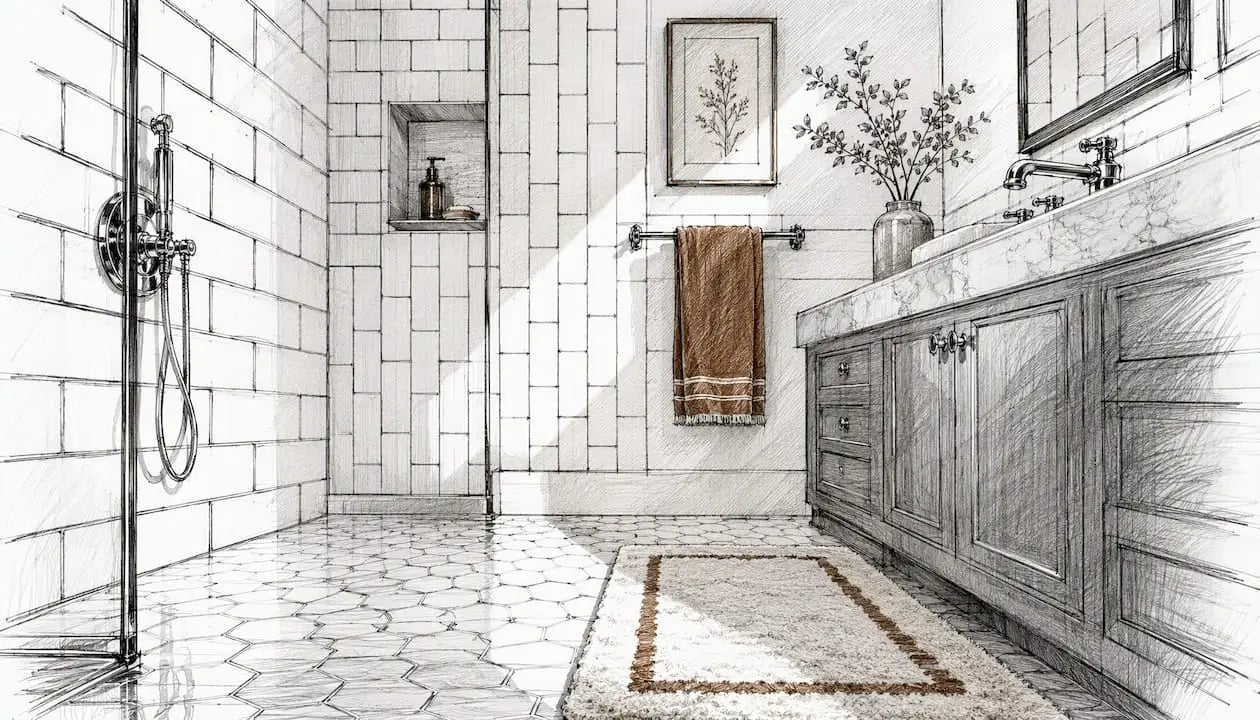
Pro Tip: To update a dated white subway shower without re-tiling, swap the existing trim pieces for a contrasting pencil liner or Schluter edge strip in matte black or brushed brass, then retile just the niche back in a contrasting material like a small-format mosaic or a stone slab cut-down. The cost is a fraction of a full re-tile, and the visual impact is immediate. Houzz community discussions consistently point to niche detailing as the single highest-return upgrade in a subway shower.
2. Marble and natural stone bring depth no porcelain can replicate
Real white marble and natural stone do something printed porcelain cannot: they catch light differently at every angle, and no two slabs are identical. That variation is the point.
Thassos white marble
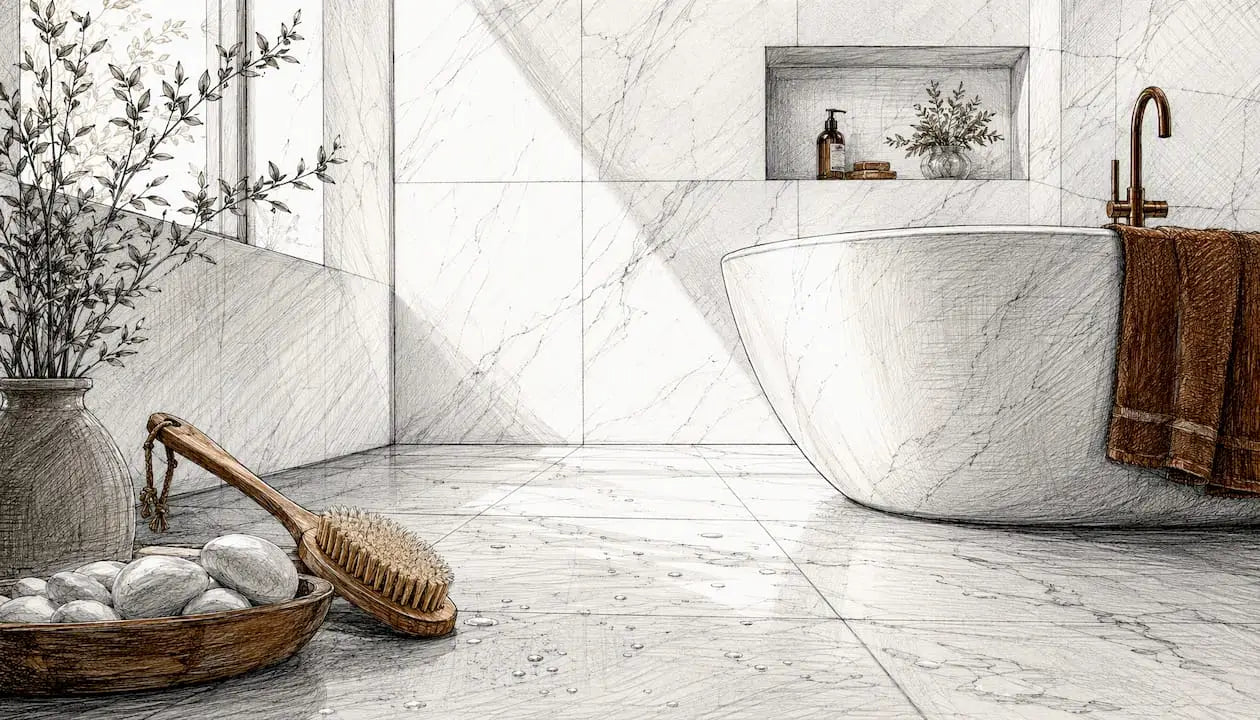
Thassos is quarried in Greece and is one of the purest white marbles available. Under bathroom lighting, it reads almost luminous, with minimal veining and a crystalline surface that reflects light rather than absorbing it. It works exceptionally well in small bathrooms precisely because it adds brightness without pattern complexity. In polished form, it amplifies light; in honed form, it softens to a matte, spa-like finish that hides watermarks better.
Bianco Dolomite marble
Bianco Dolomite carries subtle gray veining on a white ground, giving it more visual movement than Thassos. It reads elegant without being busy, and it pairs naturally with warm wood vanities and matte brass fixtures. The veining also means small scratches and minor etching are far less visible than on a flat white surface.
Key trade-offs for both stones:
- Porosity: Both require sealing before installation and periodic resealing (typically once a year in a wet shower environment, less often on dry walls).
- Finish for wet zones: Honed finishes provide better slip resistance on floors than polished. Reserve polished marble for walls and low-traffic features. Natural stone guidance consistently recommends honed or textured finishes for any surface that gets wet underfoot.
- Acidic cleaners: Vinegar, citrus-based sprays, and most commercial bathroom cleaners etch marble. Use a pH-neutral stone cleaner only.
- Slab vs. tile format: For a shower surround, large-format tiles (12x24 or larger) minimize grout lines and create a more continuous look. Full slabs are the premium option for bookmatched feature walls, but they require professional templating and installation.
Surfacesgalore carries authentic Thassos and Bianco Dolomite as a direct importer, with nationwide shipping and sample ordering available for homeowners who want to test the stone under their own lighting before committing.
Pro Tip: Order at least two samples from the same lot and place them side by side in your bathroom at different times of day. Marble reads differently under morning natural light versus evening artificial light, and the difference can be significant enough to change your decision on finish.
3. Mosaics, hexagons, and penny rounds add texture without noise
Small-format white tiles are one of the most practical tools in a bathroom renovation. They add tactile interest, break up a flat white expanse, and solve a real safety problem on wet floors.
Best placements:
- Shower floors, where the higher grout-line density improves grip
- Niche backs, where a contrasting small-format tile frames the recess without requiring a border tile
- Splashbacks behind freestanding tubs
- Floor inserts and medallions within a larger-format tile field
- Accent borders between wall tile zones
The slip-resistance advantage of small-format tiles is practical, not just aesthetic. More grout lines mean more surface texture, which translates to better traction when the floor is wet. Material comparisons for bathroom floors confirm that small-format mosaics and penny rounds are among the most reliable choices for wet-zone floors precisely because of this grout-line density.
For finish, matte or honed surfaces outperform polished on any mosaic floor. Polished glass mosaics are beautiful on walls but become dangerously slick underfoot.
Pairing ideas that work:
- White 1-inch hex mosaics on the shower floor with a warm walnut vanity and matte black fixtures
- White penny rounds on the floor with a charcoal grout for a graphic, vintage-inspired look
- White basketweave mosaics in a niche back against a large-format white wall tile for subtle texture contrast
4. Large-format white tiles make a small bathroom feel bigger
A 24x24 or 12x24 white tile on the floor of a small bathroom does something measurable: it reduces the number of grout lines the eye has to cross, which makes the floor read as a single continuous plane. The room feels larger without any structural change.
Rectified tiles, which are cut to precise dimensions after firing, allow grout joints as narrow as 1/16 inch. That near-seamless look is what gives large-format installations their clean, contemporary character. Stone and tile guides note that running the same large-format material through the shower and onto the main floor, with a consistent grout tone, creates the spa-like continuity that defines high-end bathroom design.
Installation realities to know before you start:
- The substrate must be flat to within 1/8 inch over 10 feet. Any flex or unevenness telegraphs through large tiles as lippage (one tile edge sitting higher than the next).
- Large-format floor tiles in a shower need a pre-sloped mortar bed or a pre-sloped foam system to direct water toward the drain. You cannot slope a large tile itself.
- For most homeowners, large-format rectified tile installation is a job for a professional. The margin for error is small and the cost of a cracked 24x24 slab is significant.
Design pairings to avoid a sterile result: Warm wood floating vanities, matte brass or unlacquered brass hardware, fluted limestone or travertine side panels, and linen or cotton textiles all add warmth to a large-format white tile bathroom. Without at least one warm material, the room can feel more like a hospital corridor than a spa.
5. Patterned and encaustic-look floors keep white rooms from feeling flat
A white bathroom with a patterned floor is one of the most effective ways to add personality without committing to a bold color. The floor becomes the focal point; the white walls and fixtures recede.
True encaustic cement tile vs. encaustic-look porcelain:
True encaustic tiles are made from pigmented cement, not fired clay. They are porous, require sealing, and are not recommended for wet shower floors or high-traffic areas without careful maintenance. Their handmade variation and matte depth are genuinely beautiful in a powder room or low-traffic bathroom floor.
Porcelain printed to mimic encaustic patterns costs significantly less, handles moisture without sealing, and is far more durable underfoot. For most homeowners, the printed porcelain version is the practical choice for any floor that sees regular water exposure.
Design approaches that work:
- A bold black-and-white geometric pattern in a small powder room, with plain white walls and a single statement mirror
- A subtle all-over diamond or quatrefoil pattern in a larger bathroom, where the pattern reads as texture rather than statement
- A patterned tile border framing a plain white field, which adds detail without overwhelming a larger space
Budget alternatives for homeowners who want the encaustic look without the tile cost: peel-and-stick vinyl floor tiles in encaustic patterns have improved significantly in quality, and a well-chosen bath mat or runner can achieve a similar visual effect in a rental or temporary situation.
6. Shower and floor tile: what safety and installation actually require
Slip resistance comes first
The coefficient of friction (COF) rating is the standard measure for slip resistance. The Americans with Disabilities Act recommends a minimum COF of 0.6 for wet areas. Small-format tiles, textured porcelain, and honed natural stone all tend to meet or exceed this threshold. Polished marble and large-format polished porcelain often fall below it when wet.
For shower floors specifically:
- Choose a tile no larger than 4x4 inches, or use a mosaic sheet. The grout lines provide the texture that prevents slipping.
- Specify a honed or textured finish for any natural stone on the floor.
- Avoid glass tile on shower floors entirely. It is beautiful on walls but has poor wet-surface traction.
Waterproofing and slope
- A shower floor must slope a minimum of 1/4 inch per foot toward the drain. This is not optional and cannot be corrected after tile is set.
- A waterproof membrane (sheet membrane or liquid-applied) goes under the tile on all shower walls and floors. Cement board alone is not waterproof.
- Curbless (zero-threshold) showers require a linear drain and a carefully sloped floor across the entire wet zone. They look clean and are ADA-accessible, but the installation tolerance is tighter than a standard curbed shower.
Material recommendations by zone
- Shower walls: Polished marble, large-format porcelain, or honed stone all work well. The wall does not need slip resistance.
- Shower floor: Honed stone, textured porcelain, or small-format mosaic. Never polished stone or smooth large-format tile.
- Bathroom floor outside the shower: More flexibility, but honed or matte finishes are still safer and more practical than polished.
For guidance on floor tile selection by finish and slip rating, Surfacesgalore’s blog covers the key decision points for both natural stone and porcelain.
7. Grout, finish, and color choices that prevent a sterile result
The single most common mistake in an all-white bathroom is choosing bright white grout with white tile and then wondering why the room feels cold and clinical. Grout color is a design decision, not an afterthought.
When to match vs. contrast:
- Matching grout (white on white) creates a seamless, airy look. It works best with large-format tiles where grout lines are minimal. It shows soap scum and mildew faster than any other combination.
- Contrasting grout (warm gray, greige, or charcoal on white tile) defines the tile pattern, adds visual depth, and hides grime between cleanings. It reads more graphic and intentional.
- Warm sand or putty grout is the current sweet spot: it adds warmth without the high-contrast drama of dark grout, and it ages gracefully.
Grout type matters as much as color:
Epoxy grout is stain-resistant, does not require sealing, and holds its color in wet environments. It is harder to work with during installation and costs more, but for shower floors and walls, it is worth the premium. Cement-based grout is easier to install but must be sealed and resealed regularly to resist staining.
Finish guidance by room function:
- Polished: walls, feature panels, low-traffic areas. Amplifies light. Shows watermarks and scratches.
- Honed: floors, shower walls, high-use surfaces. Matte, forgiving, spa-like. Slightly more porous than polished on natural stone.
- Textured/structured: shower floors, any wet-zone floor. Maximum grip. Harder to clean in deeply textured versions.
Pro Tip: Before ordering tile, build a real-size mockup. Tape a 12x12 or 18x18 section of your chosen tile to the wall, apply a strip of your chosen grout color (use a grout color card or a sample), and photograph it under your bathroom’s actual lighting at morning, midday, and evening. The combination that looks right in all three conditions is the one to order.
8. How to choose the right white tile for your bathroom
Decision checklist
Work through these questions before you visit a showroom or place an order:
- What is the primary use zone? Shower floor, shower wall, main bathroom floor, or accent wall each have different finish and slip requirements.
- What is the traffic level? A guest bathroom used twice a week tolerates polished marble. A family bathroom used daily by children needs a more forgiving surface.
- What is your maintenance tolerance? Natural stone requires sealing and pH-neutral cleaners. Porcelain requires almost nothing.
- What is your budget? See the tier guide below.
- Do you need professional installation? Large-format tiles, slab work, bookmatching, heated floors, and complex waterproofing all benefit from a licensed tile setter.
Budget tiers
| Tier | Material | Typical Use | Trade-offs |
|---|---|---|---|
| Entry-level | Ceramic or standard porcelain subway | Walls, low-traffic floors | Lowest cost, DIY-friendly, limited visual depth |
| Mid-range | Large-format porcelain, honed quartzite | Floors, shower walls | Better visual impact, requires flatter substrate |
| Premium | Thassos marble, Bianco Dolomite, bookmatched slabs | Feature walls, luxury ensuites | Highest visual impact, requires sealing and pro install |
For detailed cost guidance on natural stone projects, Surfacesgalore’s stone tile cost estimating guide breaks down material and installation costs by project type.
When to call a professional
- Substrate is uneven or has flex (floating floors, older subfloors)
- Full slab installation or bookmatched feature walls
- Heated floor systems under tile
- Curbless shower with linear drain
- Any project where the waterproofing system is unclear
9. Keeping white tile bright: material-specific maintenance
White tile shows what other colors hide. A consistent cleaning routine is the difference between a bathroom that looks fresh for decades and one that looks tired within a year.
Natural stone (marble, travertine, Bianco Dolomite)
Seal before installation and reseal annually in a wet shower environment, or every two to three years on dry walls and floors. Use a penetrating impregnating sealer, not a topical coating. For daily cleaning, a pH-neutral stone cleaner is the only safe option. Vinegar, bleach, and most commercial bathroom sprays etch the surface and break down the sealer.
Polished marble shows watermarks almost immediately in a shower. A squeegee after each use is the most effective prevention. Honed finishes are more forgiving but still need the same chemical care. Marble wall maintenance guidance from stone fabrication specialists recommends avoiding steam cleaners on polished marble, as repeated heat and moisture cycles can open the stone’s pores over time.
Porcelain and ceramic
These materials are essentially maintenance-free by comparison. A weekly wipe with a mild all-purpose cleaner keeps them bright. The grout, not the tile, is where porcelain bathrooms fail: cement grout must be sealed annually and cleaned with a grout brush to prevent mildew from taking hold in the joint.
Small stain remediation
For marble: a poultice made from baking soda and hydrogen peroxide, applied to the stain and covered with plastic wrap for 24 hours, draws out most organic stains (coffee, wine, rust). For grout: a diluted oxygen bleach solution (not chlorine bleach) applied with a stiff brush handles most mildew without damaging the grout or adjacent stone.
10. Sourcing authentic white natural stone: what to check before you buy
Buying natural stone online or through a distributor without the right questions leads to batch mismatches, finish surprises, and installation problems. A short sourcing checklist prevents most of them.
What to confirm before ordering:
- Finish and rectification: Is the tile honed, polished, or brushed? Are the edges rectified (machine-cut to precise dimensions) or natural? Rectified edges allow tighter grout joints; natural edges need wider joints.
- Lot and batch matching: For any visible installation, all tiles should come from the same quarry lot. Veining, background color, and tone can shift between lots, even within the same stone name.
- Sample policy: Order physical samples before committing to a full order. Photographs do not capture the depth, translucency, or surface texture of natural stone accurately.
- Shipping and return policy: Natural stone ships heavy. Confirm freight costs, delivery timeline, and the process for damaged or mismatched pieces before ordering.
- Slab vs. tile format: For Thassos and Bianco Dolomite, large-format tiles (12x24 or larger) create a more continuous look with fewer grout interruptions. Full slabs are the premium option for feature walls but require professional templating.
Surfacesgalore operates as a direct importer of marble, travertine, and limestone, which means the stone moves from quarry to customer without an additional wholesale layer. That structure typically results in better pricing and more consistent lot availability than buying through a retail tile chain. Nationwide shipping makes it accessible for homeowners outside major metro areas.
Pro Tip: When evaluating Bianco Dolomite samples, look at the veining pattern across at least four tiles from the same lot. Heavy veining variation between tiles is normal and beautiful in a bookmatched feature wall but can look chaotic in a standard running-bond installation. Decide which effect you want before you see the tiles in person.
For a deeper look at luxury stone choices for bathrooms, Surfacesgalore’s blog profiles Thassos, Bianco Dolomite, and other premium stones with finish and application guidance.
11. The one design mistake worth avoiding
White tile bathrooms fail most often not because of the tile itself, but because of what surrounds it. A room tiled entirely in white, with white grout, white fixtures, and cool overhead lighting, does not read as clean and minimal. It reads as unfinished, like a space waiting for its real design to arrive.
The fix is not complicated. One warm material, introduced deliberately, changes the entire reading of the room. A floating walnut vanity, a rattan mirror frame, a linen window shade, or a single travertine shelf breaks the monochrome and gives the eye somewhere to land. BHG’s white bathroom design research consistently shows that the most successful white bathrooms pair white tile with at least one warm wood tone or natural material.
The second pitfall is bright white grout with heavily veined stone. Thassos is forgiving because it has minimal veining. Bianco Dolomite, with its gray veining, reads beautifully against a warm putty or sand grout. Bright white grout next to gray veining creates a fractured, busy look that fights the stone’s natural pattern rather than supporting it. Choose a grout tone that is close to the stone’s background color, not its veining color.
Natural stone collections worth seeing at Surfacesgalore
If you have worked through the ideas above and you know you want authentic natural stone, the next step is getting samples in your hands.
Surfacesgalore is a direct importer of marble, travertine, and limestone, based in Anaheim, California, and shipping nationwide. The collections include Thassos white marble, Bianco Dolomite, travertine tiles and mosaics, limestone field tiles, and decorative pieces including moldings and custom mosaics. Sample ordering is available so you can test the stone under your own lighting before committing to a full order. For homeowners working with a designer or contractor, Surfacesgalore also supplies trade accounts with consistent lot availability and freight-friendly pricing. Browse the natural stone tile collections and request samples to start your project with the right material in hand.
Sources
The following resources were used in building this article and are worth bookmarking for deeper inspiration and technical reference:
- 21 White Bathroom Ideas for a Sparkling Space
- Bathroom Tile Trends 2026 | Zellige, Microcement & Stone Guide | Bay Area
- Natural Stone for Bathrooms | Luxury Wall Cladding & Floor Tile Ideas
FAQ
What is the best white tile for a small bathroom?
Large-format white porcelain or Thassos marble in a honed finish works best in a small bathroom. Fewer grout lines and a light-reflective surface make the room read larger.
How often does white marble tile need to be sealed?
In a wet shower environment, seal marble and Bianco Dolomite annually. On dry walls or low-traffic floors, resealing every two to three years is typically sufficient.
Can you use polished white marble on a shower floor?
Polished marble is not recommended for shower floors because it becomes slippery when wet. Use a honed or textured finish on any wet-zone floor, and reserve polished stone for walls.
What grout color works best with white tile?
Warm sand or putty grout adds depth and ages better than bright white. Charcoal or dark gray grout creates a graphic contrast. Bright white grout looks clean initially but shows soap scum and mildew faster than any other option.
Where can I order Thassos white marble and Bianco Dolomite in the U.S.?
Surfacesgalore is a direct importer of both stones, based in Anaheim, California, with nationwide shipping and sample ordering available at Surfacesgalore.
Leave a comment