

Why Natural Stone Works Best for Wellness Spaces

TL;DR:
- Natural stone stimulates the nervous system and provides thermal mass, creating a calming, comfortable environment. It lasts for generations, supports healthier air quality, and enhances wellness spaces through sensory and physiological benefits. Choosing the right finish and placement maximizes its restorative qualities, making it a superior material for authentic, sustainable relaxation environments.
Most people choosing materials for a wellness space focus on color and cost. They treat marble, tile, and engineered stone as interchangeable backdrops. That assumption is exactly why so many meditation rooms, spa bathrooms, and relaxation areas feel pleasant but not genuinely restorative. Understanding why natural stone for wellness spaces produces results that synthetic surfaces simply cannot requires looking at how materials interact with the human body at a sensory and physiological level. This article breaks down the science, the design strategy, and the practical choices that make natural stone the most effective foundation for any wellness environment.
Table of Contents
- Key Takeaways
- Why natural stone for wellness spaces works at a sensory level
- Research-backed wellness benefits of stone
- Stone vs. synthetic surfaces: an honest comparison
- How to select and place stone in wellness spaces
- My honest take on stone in wellness design
- Discover natural stone for your wellness project
- FAQ
Key Takeaways
| Point | Details |
|---|---|
| Stone affects your nervous system | Organic textures and natural imperfections in stone trigger a calming neurological response that uniform synthetics cannot replicate. |
| Thermal mass promotes physical ease | Stone’s ability to hold and release temperature gradually creates physiological comfort that supports relaxation. |
| Natural stone outperforms synthetics long term | Properly installed stone lasts for generations without off-gassing, making it a sound wellness investment. |
| Finish selection changes the experience | Honed and brushed finishes create softer tactile and visual qualities ideal for restorative spaces. |
| Material authenticity matters in 2026 | Leading designers now prioritize natural materials to support genuine wellbeing over engineered aesthetics. |
Why natural stone for wellness spaces works at a sensory level
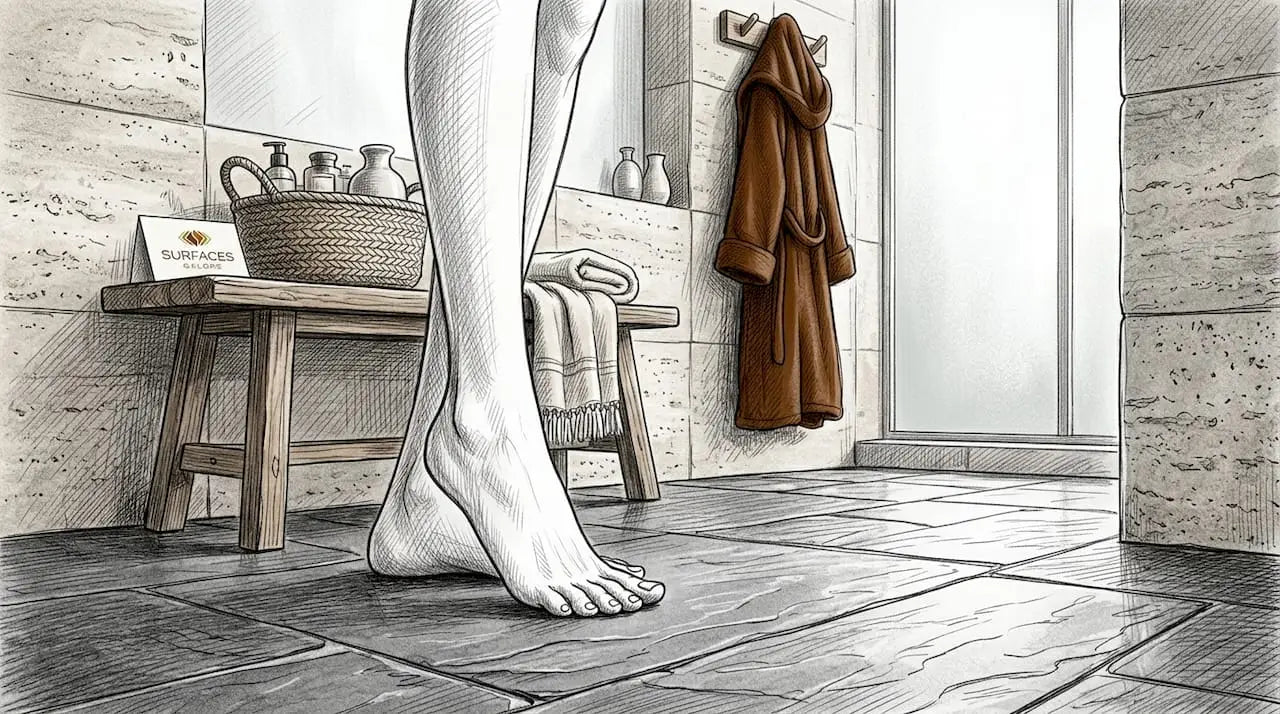
Walk barefoot across a honed travertine floor and you notice something specific. The surface has slight variations in temperature across its face. The texture shifts subtly from tile to tile. No two veins match perfectly. That sensory complexity is not a flaw. It is one of the strongest arguments for natural stone for relaxation environments.
Human nervous systems respond to organic imperfections with recognition rather than resistance. Uniform synthetic surfaces, by contrast, provide no variation for the brain to gently process. They register as neutral at best, and subtly unsettling at worst because nothing in the natural world is that perfectly consistent. Stone’s irregularities give the mind something to rest on without demanding focus. That distinction matters enormously in wellness design.
Thermal mass and physiological comfort
Natural stone absorbs heat slowly and releases it gradually. In a bathroom or spa setting, this means the floor warms under radiant heat and stays comfortable for extended periods without temperature spikes. Synthetics like vinyl or laminate heat unevenly and cool quickly. Stone’s thermal mass stabilizes temperature and moderates sound, which together reduce the low-level physiological stress that disrupts true relaxation.
Acoustic qualities worth understanding
Hard synthetic surfaces reflect sound sharply. Stone reflects sound differently. Its density and natural surface variation scatter audio frequencies rather than bouncing them back in a single harsh wave. In a shower room or meditation space, that difference produces a softer acoustic environment that supports the nervous system rather than stimulating it. Combine stone walls with a wooden ceiling or soft textiles and the result is a room that genuinely feels quiet.
Here is what natural stone delivers on a sensory level that synthetic materials cannot match:
- Textural variation that engages the nervous system gently without overstimulation
- Thermal stability that promotes physical ease over extended relaxation sessions
- Natural acoustic scattering that softens sound without eliminating it entirely
- Visual depth and pattern complexity that holds attention without demanding it
Pro Tip: Pair a honed limestone floor with matte plaster walls to get the maximum calming effect. Both surfaces absorb rather than reflect light and sound, creating a room that feels genuinely quiet even without acoustic panels.
Research-backed wellness benefits of stone
The sensory experience of natural stone is not just subjective preference. Incorporating natural stone reduces occupant stress and heart rates, creating measurably restorative environments. That finding aligns with biophilic design principles, which recognize that the human nervous system responds to natural materials, patterns, and forms with lower arousal and greater emotional ease.
Biophilic design has moved from theory to mainstream practice. 80% of interior designers now prioritize natural, unpainted materials in wellness-focused projects, a figure that reflects a genuine shift in how the design industry understands occupant health. The trend is not aesthetic nostalgia. It is a response to research showing that authenticity in material choice translates directly into how people feel in a space.
“Natural stone connects occupants to the earth in a way no manufactured product can simulate. That connection is measurable, not just poetic.”
One underappreciated advantage of stone is its chemical profile. Natural stone emits fewer VOCs and supports better indoor air quality than many engineered alternatives. Luxury vinyl tile, synthetic stone composites, and resin-based surfaces all off-gas to varying degrees. In a wellness space, where the entire point is reducing physiological burden, choosing a material that does not introduce airborne chemicals is a foundational decision, not a secondary one.
The relationship between natural materials and wellbeing is also showing up in commercial wellness design. Spas, yoga studios, and corporate wellness centers are specifying marble, travertine, and limestone at increasing rates because clients and employees respond to those spaces differently. The advantages of stone in wellness settings translate directly into occupant satisfaction and space performance.
Stone vs. synthetic surfaces: an honest comparison
Understanding how stone stacks up against engineered alternatives requires looking at the full picture: sensory experience, durability, sustainability, and maintenance demands over time.
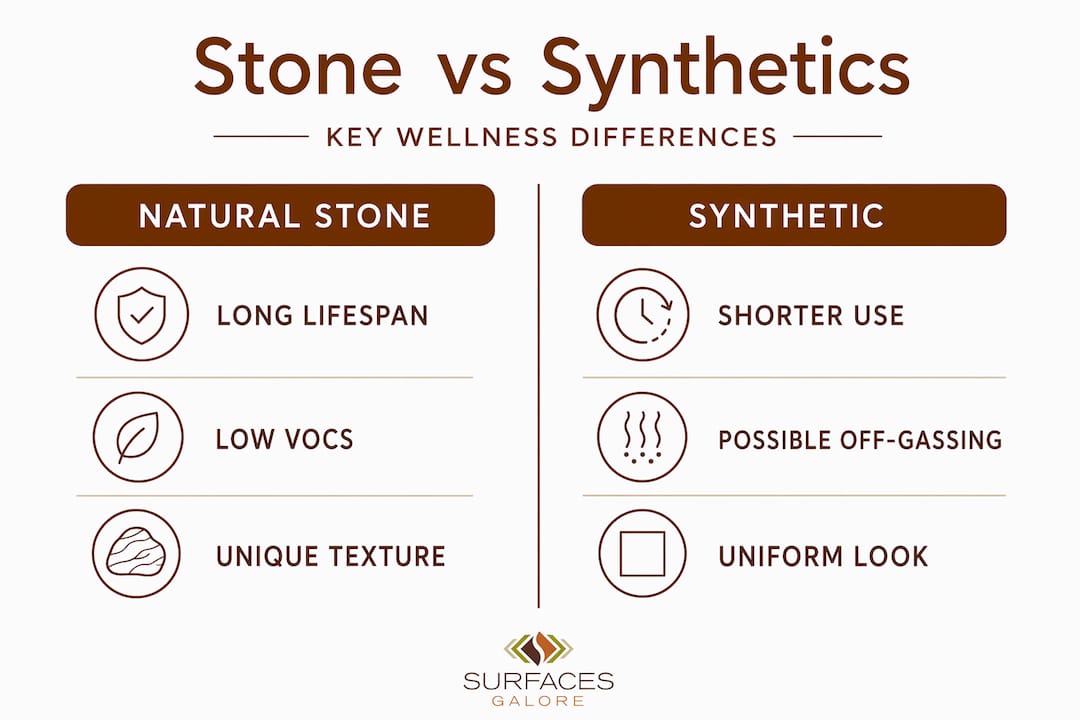
| Category | Natural stone | Synthetic alternatives |
|---|---|---|
| Lifespan | Centuries with proper care | 10 to 25 years before replacement |
| VOC emissions | Negligible to none | Variable; many emit off-gases |
| Sensory experience | Organic variation, thermal mass | Uniform, no thermal complexity |
| Sustainability | Recyclable, low processing | High processing, difficult to recycle |
| Visual authenticity | No two pieces identical | Repeated patterns visible at scale |
| Maintenance | Periodic sealing, pH-neutral cleaners | Low maintenance but shorter lifespan |
Properly installed natural stone can last centuries while maintaining its wellness qualities without any off-gassing. Synthetic surfaces, regardless of how well they mimic stone visually, degrade in ways that matter in wellness settings. Repeated patterns become obvious at scale. Surfaces scratch and dull. Replacement cycles mean ongoing chemical exposure from adhesives and new materials.
The sustainability comparison also matters to today’s wellness-minded buyer. Stone is quarried and cut with relatively minimal processing compared to the chemical manufacturing involved in engineered surfaces. At end of life, stone can be reclaimed, repurposed, or broken down without generating synthetic waste. For any project that takes long-term environmental wellbeing seriously, the choice of natural materials over manufactured ones reflects genuine values, not just marketing.
Maintenance differences are real but manageable. Natural stone requires periodic sealing and pH-neutral cleaning products. What it does not require is replacement every decade. The long-term cost of ownership, when calculated honestly, favors stone significantly over synthetic alternatives for wellness spaces designed to last.
How to select and place stone in wellness spaces
Knowing why natural stone enhances wellness spaces is only useful if you know how to apply that knowledge. Stone selection, finish choice, and placement strategy all shape the outcome significantly.
The three most widely used natural stones in wellness design are marble, limestone, and travertine. Each brings a distinct character.
- Marble delivers strong visual movement and a sense of luxury. White Carrara marble creates a clean, spa-like atmosphere. Softer gray varieties like Bardiglio read as grounding and calm.
- Limestone has a more restrained visual texture with subtle fossilized patterns. It reads as earthy and quiet, making it ideal for meditation rooms and yoga studios where visual drama would compete with the room’s purpose.
- Travertine carries warm tones and a porous surface that feels distinctly organic. Its filled and honed versions work beautifully in shower floors and spa wet areas.
Finish selection is one of the most consequential decisions in a wellness application. Polished stone reflects light sharply and reads as formal. In a relaxation context, that can feel stimulating rather than soothing. Honed and brushed finishes create a matte surface that scatters light softly, reduces glare, and feels warmer underfoot. For almost every wellness application, honed is the right starting point.
Pro Tip: When specifying travertine for a spa floor, choose a filled and honed version rather than an unfilled tumbled option. You get the warm, organic character without the maintenance challenges of open pores in a wet environment.
Placement strategy shapes how stone enhances wellness spaces at the experiential level:
| Application | Best stone choice | Recommended finish |
|---|---|---|
| Shower walls | Marble, limestone | Honed |
| Spa flooring | Travertine, limestone | Filled and honed |
| Meditation room feature wall | Limestone, marble | Brushed or honed |
| Backsplash in wellness kitchen | Marble, travertine | Honed |
| Salt therapy room accents | Himalayan salt blocks | Natural/raw |
One design technique that significantly increases the meditative quality of a space is book-matching. Book-matched stone slabs create Rorschach-like symmetry that functions as a visual anchor, drawing the eye gently and sustaining a restful state. Used on a feature wall behind a soaking tub or at the head of a meditation room, the effect is genuinely powerful.
For specialized applications, Himalayan salt blocks introduce both negative ion emission and ambient lighting into salt therapy rooms, providing functional air purification alongside sensory warmth. This is one area where the wellness benefits of stone move beyond aesthetics into measurable air quality improvement.
Lighting interplay with stone deserves more attention than it typically gets. Raking light from a low-angle fixture across a honed limestone wall brings out texture and movement that flat overhead lighting completely suppresses. For a wellness space, that subtle animation in the surface creates visual interest without stimulation. It also changes throughout the day, which keeps the space from ever feeling static.
For deeper guidance on selecting the right stone for your specific application, the natural stone selection guide at Surfacesgalore covers material properties, finish options, and placement strategies in detail.
My honest take on stone in wellness design
I’ve worked with enough wellness spaces to say this plainly: the material choice is the most underestimated decision in the entire project. Clients spend considerable thought on color palettes, fixtures, and furniture. They treat the flooring and wall material as a background decision. Then they walk into a space finished in natural stone and something visibly shifts in how they carry themselves.
What surprises people is not just the look. It’s the temperature underfoot. The way sound behaves differently. The sense that the room has a physical presence they were not expecting from a surface. That response is consistent. I’ve seen it in private spa bathrooms and in commercial yoga studios. The stone changes how people move and how long they stay.
The biggest mistake I see in wellness projects is specifying polished stone because it photographs well. Polished marble in a meditation room looks stunning in a shoot and overstimulates the senses in practice. The right finish for a wellness environment almost never photographs as dramatically as a polished alternative. That is a tension worth understanding before making a specification.
I also want to be honest about challenges. Stone requires thoughtful maintenance. It needs sealing on a schedule. It needs cleaning products chosen carefully. Those are real considerations. But they are manageable realities, not reasons to settle for an engineered alternative that will degrade in ten years and never deliver the sensory qualities stone provides from day one.
The lasting value of natural stone in wellness design is not about prestige. It is about creating a space that genuinely supports the human body and mind at a material level. That is a standard worth designing to.
— cihan
Discover natural stone for your wellness project
At Surfacesgalore, the focus is on authentic natural stone sourced directly from the finest quarries, with no intermediaries and no compromises on quality. Whether you are designing a private spa bathroom, a commercial wellness studio, or a meditation room at home, the right stone makes every element of the space perform better. Surfacesgalore’s collections include premium marble, limestone, and travertine tiles, mosaics, and custom pieces shipped nationwide from Anaheim, California. Explore the full range of wellness-ready stone tiles or browse the marble and limestone collections to find the material that fits your vision. The team at Surfacesgalore is ready to support designers, contractors, and homeowners at every stage of the selection process.
FAQ
Why does natural stone feel calming compared to other materials?
Natural stone’s organic texture variation and thermal mass engage the nervous system in a way that promotes relaxation. Human nervous systems respond positively to organic imperfections, making stone surfaces feel authentic and grounding rather than sterile.
What is the best natural stone for a home spa or bathroom?
Travertine and limestone are excellent choices for spa bathrooms because of their warm tones and soft surface character. Marble works beautifully in showers and feature walls, particularly in honed finishes that reduce glare and feel softer underfoot.
Does natural stone improve air quality in wellness spaces?
Yes. Natural stone emits negligible VOCs compared to many synthetic alternatives, contributing to cleaner indoor air. Himalayan salt blocks used in salt therapy rooms go further by releasing negative ions that actively purify the air.
How does honed finish differ from polished for wellness applications?
Honed stone has a matte surface that scatters light rather than reflecting it sharply. In a wellness space, this reduces visual stimulation and creates a softer, warmer environment. Polished finishes are better suited to formal or high-traffic areas where durability and drama are priorities.
How long does natural stone last in a wellness space?
With proper sealing and maintenance, natural stone lasts generations. Many historic stone installations are centuries old and still functionally sound, which makes stone a far longer-lasting investment than any synthetic surface alternative.
Leave a comment