
Advantages of Marble Tiles: A 2026 Homeowner's Guide

TL;DR:
- Marble tiles are natural stone surfaces known for their unique veining, durability, and long lifespan exceeding 50 years with proper care. They support high-load applications, are restorable, and add value to properties, especially in high-visibility areas, but require precise installation and regular sealing. Their natural beauty, variety, and compatibility with radiant heating make marble an enduring choice for modern and classic interiors.
Marble tiles are natural stone surfaces formed from recrystallized limestone, prized for their distinctive veining, color variation, and structural density. The advantages of marble tiles go well beyond aesthetics: they deliver a lifespan that can exceed 100 years, a compressive strength of 70–120 MPa, and a resale appeal that synthetic flooring simply cannot replicate. A 2024 interior design survey found that 63% of homeowners prefer marble for high-visibility areas like bathrooms and entryways. Surfacesgalore, based in Anaheim, California, imports premium natural marble tiles, limestone, and travertine directly, giving homeowners and designers access to authentic stone at accessible prices.
1. What makes marble tiles so durable?
Natural marble earns its reputation for durability through measurable physical properties. Its compressive strength of 70–120 MPa means it resists heavy static loads, furniture weight, and foot traffic without cracking under normal conditions. That strength is why marble appears in centuries-old cathedrals and public buildings that still see daily use today.
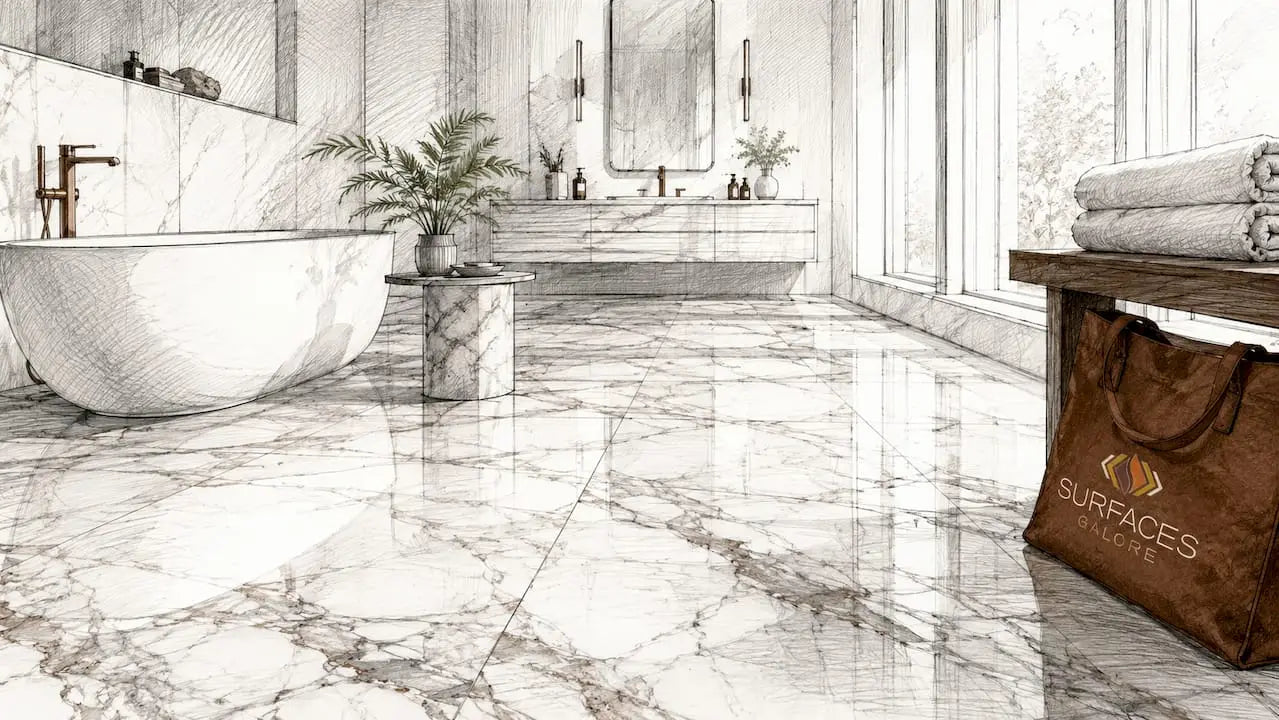
The functional lifespan of properly maintained marble flooring exceeds 50 to 100 years. Few flooring materials come close to that figure. Ceramic and porcelain tiles typically last 20–30 years before grout failure and surface wear require replacement. Luxury vinyl and laminate products rarely survive 15–20 years in high-traffic conditions.
One of marble’s most underappreciated qualities is its restorability. When polished marble develops scratches or dullness over time, a professional honing and repolishing service returns it to near-original condition. No synthetic flooring offers that option. You replace vinyl; you restore marble.
Substrate support matters as much as the stone itself. Marble requires a rigid, level subfloor, typically a concrete slab or cement board, to prevent flex that causes cracking. A properly prepared substrate is the single biggest factor in whether marble tiles last decades or develop problems within years.
| Material | Compressive strength | Typical lifespan | Restorable? |
|---|---|---|---|
| Natural marble | 70–120 MPa | 50–100+ years | Yes |
| Ceramic tile | 20–40 MPa | 20–30 years | No |
| Porcelain tile | 35–60 MPa | 25–35 years | Limited |
| Luxury vinyl plank | N/A | 15–20 years | No |
| Laminate | N/A | 10–15 years | No |
Pro Tip: Have your subfloor assessed for deflection before installation. A floor that flexes more than L/360 (a standard structural benchmark) will crack marble tiles regardless of adhesive quality.
2. How natural beauty and uniqueness enhance design
Every marble tile is geologically unique. The veining, color shifts, and crystalline patterns form over millions of years and cannot be replicated by any manufactured process. That individuality is exactly what makes marble the material of choice for luxury residential and commercial interiors.
Finish selection is the most critical technical decision affecting marble’s appearance, safety, and long-term durability. A polished finish delivers a mirror-like surface that amplifies light and creates a sense of depth. A honed finish produces a matte surface that hides minor scratches and provides better traction in wet areas. Both finishes work beautifully; the right choice depends on the space and how it is used.
Marble also adds measurable value to a property. Real estate professionals consistently cite natural stone flooring as a feature that supports higher asking prices and faster sales. Buyers recognize the material on sight, and its presence signals quality construction throughout the home.
Surfacesgalore carries a range of marble varieties, each with distinct visual character:
- Calacatta marble: Bold, dramatic veining in gold and gray on a bright white background. Best for statement floors and feature walls.
- Carrara marble: Softer gray veining on a white or blue-gray base. The most widely used marble in residential design.
- Emperador marble: Rich brown tones with cream and white veining. Adds warmth to bathrooms and living spaces.
- Crema Marfil marble: Warm beige with subtle veining. Pairs well with both contemporary and traditional interiors.
- Black Marquina marble: Deep black with white veining. Creates high-contrast, dramatic effects in modern spaces.
Marble’s natural sourcing also carries an environmental advantage over synthetic flooring. It requires no petroleum-based manufacturing, and its long lifespan means fewer replacement cycles and less material waste over the life of a building.
Pro Tip: When selecting marble for a large floor area, request tiles from the same quarry batch. Batch consistency keeps color and veining variation within a predictable range, which is something Surfacesgalore prioritizes for every order.
3. Practical installation and maintenance considerations
Professional installation is the standard recommendation for marble tiles. The material is heavy, brittle at the edges, and unforgiving of measurement errors. Homeowners and designers should factor in a 10–15% wastage allowance when ordering, covering precision cuts, broken tiles, and veining selection. Ordering short and running out mid-project is a costly mistake because matching a specific batch later is rarely possible.
The dry-lay method is a professional technique that every quality installation uses. Dry-laying 100% of the tiles before applying any adhesive lets you blend veining patterns across the floor and catch any tiles with unacceptable color variation. It adds time to the job, but the visual result is worth every minute.
Adhesive choice directly affects the finished appearance of marble. White S2 flexible adhesive is the correct product for marble installation. Gray adhesive bleeds through translucent stone and creates a permanent darkening effect that no cleaning or sealing can fix. This is a mistake that cannot be undone after the tiles are set.
Grouting and sealing require equal care. The maintenance checklist below covers the most important do’s and don’ts:
Maintenance do’s:
- Seal marble before grouting and again after grouting is complete
- Use unsanded grout applied with a rubber float to protect polished surfaces
- Clean spills immediately with a pH-neutral cleaner
- Reseal marble floors every 1–2 years depending on traffic level
- Use felt pads under furniture legs to prevent surface scratching
Maintenance don’ts:
- Never use sanded grout on marble, as sand particles scratch polished surfaces
- Avoid acidic cleaners like vinegar, lemon juice, or bleach, which etch the stone surface
- Do not use steam mops, as excessive heat and moisture penetrate the stone
- Never drag heavy furniture across marble without protection
- Avoid wax-based polishes, which build up and dull the natural finish over time
For a detailed walkthrough of the full process, Surfacesgalore’s marble installation guide covers measuring, cutting, and ordering with professional precision. For ongoing care, the marble cleaning guide outlines the exact products and techniques that preserve the stone’s finish year after year.
Pro Tip: Apply a penetrating sealer, not a topical coating, to marble floors. Penetrating sealers protect from within the stone without changing its appearance or creating a surface film that peels over time.
4. How marble tiles perform across different spaces
Marble’s performance varies by finish, sealing, and application. Understanding those variables lets you place the right marble in the right space rather than treating all marble as interchangeable.
Bathrooms
Marble is a natural fit for bathrooms, but finish matters. Polished marble is slippery when wet, making it a poor choice for shower floors and wet room surfaces. Honed marble provides a matte, slightly textured surface that improves traction without sacrificing elegance. For bathroom walls, polished marble works beautifully because the surface stays dry. Sealing is non-negotiable in bathrooms; unsealed marble absorbs moisture and develops staining over time.
Kitchens
Kitchen floors take heavy daily use, and marble handles it well when properly sealed. The main risk in kitchens is acidic spills: citrus juice, tomato sauce, and vinegar etch marble surfaces quickly if left to sit. A penetrating sealer slows absorption, but prompt cleanup remains the most effective protection. Honed marble is the preferred finish for kitchen floors because it hides minor scratches from dropped utensils and chair movement.
High-traffic areas and entryways
Entryways and hallways benefit from marble’s durability and visual impact. The 63% homeowner preference rate for marble in high-visibility areas reflects exactly this use case. Marble’s natural coolness also makes it comfortable underfoot in warm climates, a practical benefit that carpet and vinyl cannot offer.
Outdoor applications
Outdoor marble requires careful selection and consistent maintenance. Properly sealed marble maintains color integrity and slip resistance for up to 10 years in outdoor applications. Choose a marble variety rated for exterior use and apply a weather-resistant penetrating sealer annually in freeze-thaw climates.
Radiant heating systems
Marble’s high thermal mass makes it an excellent partner for radiant floor heating. Architects favor marble for radiant systems because it absorbs heat efficiently and distributes it evenly across the floor surface. The result is consistent warmth with lower energy consumption compared to flooring materials that resist heat transfer.
| Finish | Best use | Slip risk | Maintenance level |
|---|---|---|---|
| Polished | Walls, dry floors, feature areas | Higher when wet | Moderate |
| Honed | Bathrooms, kitchens, high-traffic floors | Lower | Moderate |
| Brushed | Outdoor, rustic interiors | Low | Low to moderate |
| Tumbled | Casual interiors, pool surrounds | Low | Low |
For a deeper look at how each finish performs in specific spaces, Surfacesgalore’s guide on marble surface finishes breaks down the options with real design examples.
Key takeaways
Marble tiles deliver a combination of structural strength, natural beauty, and long-term value that no synthetic flooring material matches when installed and maintained correctly.
| Point | Details |
|---|---|
| Durability is measurable | Marble’s 70–120 MPa compressive strength supports heavy loads and a 50–100+ year lifespan. |
| Finish determines function | Choose honed for wet and high-traffic areas; polished for dry, decorative surfaces. |
| Installation precision matters | Dry-lay tiles first, use white S2 adhesive, and order with a 10–15% wastage buffer. |
| Maintenance is straightforward | Seal before and after grouting, use pH-neutral cleaners, and reseal every 1–2 years. |
| Radiant heating compatibility | Marble’s thermal mass distributes heat evenly, improving energy efficiency in heated floors. |
Why marble still earns its place in modern interiors
I have worked with natural stone long enough to know that marble generates more hesitation than almost any other material. Homeowners worry about maintenance. Designers worry about clients who will not follow care instructions. Those concerns are real, but they are also manageable, and the payoff is a material that genuinely improves with age when treated correctly.
What I find most interesting is how marble handles design trends. Trends cycle every five to seven years. Marble does not. A Calacatta floor installed in 2010 looks as current today as it did then, and it will look current in 2035. That kind of staying power is genuinely rare in interior design. Engineered alternatives try to replicate it, but the printed surface layer gives them away under close inspection.
The maintenance concern also shrinks considerably once homeowners understand what marble actually needs. It is not fragile. It is reactive to acids and abrasives, which is a specific and manageable risk. Seal it properly, clean it with the right products, and marble asks very little of you. I have seen marble floors in family homes with children and pets that look excellent after 20 years of daily use. The owners simply learned the rules early.
My honest recommendation: do not let the maintenance conversation talk you out of marble if the design case is strong. Get educated on the care requirements, source from a supplier like Surfacesgalore that provides batch-consistent stone, and invest in professional installation. Those three decisions eliminate most of the risk that makes people hesitate.
— cihan
Premium marble tiles, direct from Surfacesgalore
Surfacesgalore imports natural marble tiles directly from quarry sources, which means you get authentic stone with verified batch consistency, not warehouse leftovers with mismatched veining.
The collection covers Calacatta, Carrara, Emperador, Crema Marfil, and more, available in polished, honed, brushed, and tumbled finishes. Every order ships nationwide from Anaheim, California, with support from a team that works with homeowners, designers, and contractors daily. If you are planning a bathroom renovation, kitchen floor, or a full-scale commercial project, browse the marble tile collection at Surfacesgalore and find the stone that fits your space and budget. Expert guidance on finish selection, batch ordering, and installation materials is available for every project.
FAQ
What are the main advantages of marble tiles?
Marble tiles offer natural beauty, a compressive strength of 70–120 MPa, and a lifespan exceeding 100 years with proper maintenance. They also add measurable property value and are compatible with radiant heating systems.
Are marble tiles suitable for bathroom floors?
Yes, but choose a honed finish rather than polished for bathroom floors, since honed marble provides better traction when wet. Seal the tiles before and after grouting to prevent moisture absorption and staining.
How do I maintain marble tiles long-term?
Seal marble every 1–2 years using a penetrating sealer, clean with a pH-neutral product, and avoid acidic cleaners like vinegar or bleach. Prompt spill cleanup is the single most effective daily maintenance habit.
How much extra marble should I order for installation?
Order 10–15% more than your measured square footage to account for precision cuts, natural veining selection, and any breakage during installation.
Can marble tiles be used outdoors?
Yes, with the right marble variety and consistent sealing. Properly sealed marble maintains color integrity and slip resistance for up to 10 years in outdoor applications, though annual resealing is recommended in freeze-thaw climates.

Leave a comment