
Every Type of Marble Explained: Colors, Names, and Origins

Marble sorts into two useful buckets: color families and named varieties tied to specific quarries. The eight major color groups (white, cream/beige, grey, black, brown, green, red, blue, and yellow) tell you what a stone will look like in a room. The named varieties, like Carrara, Calacatta, Statuario, Nero Marquina, Crema Marfil, Emperador, Makrana, and Yule, tell you where it came from and why designers request it by name.
Understanding all types of marble means learning both systems at once, because a supplier invoice might say “Calacatta” while a spec sheet says “white marble, premium grade.” They’re describing the same stone from two angles.
This guide covers:
- Color-by-color visual traits, finishes, and design uses
- Origin stories behind the marbles designers ask for most
- The difference between geological and commercial marble classification
- How to choose grades, finishes, and layouts without overpaying
- Maintenance realities and how marble stacks up against granite and quartzite
Key Takeaways
Marble is classified by color family and by named quarry variety, and matching grade and finish to a surface’s visibility controls both cost and long-term appearance.
| Point | Details |
|---|---|
| Color groups guide selection | White, cream, grey, black, brown, and rarer green, red, blue, and yellow marbles each suit different design roles. |
| Named varieties signal origin | Carrara, Calacatta, and Statuario share the Apuan Alps; Nero Marquina comes from Spain’s Basque Country. |
| Grading isn’t standardized | Premium, Commercial, and Economy labels vary by supplier, so request slab photos before ordering. |
| Finish changes maintenance | Honed and leathered finishes hide etching and scratches better than polished surfaces. |
| Surfacesgalore ships nationwide | This direct importer offers samples and bulk quotes for marble, limestone, and travertine projects. |
Table of Contents
- Understanding All Types of Marble by Color
- Notable Named Marbles and Their Quarry Origins
- Scientific Marble vs. Commercial Marble: What Suppliers Mean
- How to Choose the Right Marble for Your Project
- Maintenance and Durability: What to Expect Over Time
- Physical and Chemical Properties That Affect Every Marble Type
- How Marble Forms: The Geological Story Behind the Stone
- Marble vs. Granite and Quartzite: Which Stone Fits Which Job
- Environmental and Ethical Considerations in Marble Sourcing
- Care and Restoration Techniques by Marble Type
- Surfacesgalore’s Take: Matching Marble to the Project, Not Just the Trend
- Browse Marble Collections and Request Samples From Surfacesgalore
- Sources
- FAQ
Understanding All Types of Marble by Color
Color is the fastest way to narrow down options, and it’s how most marble showrooms organize their inventory. Here’s what each group actually looks like on a wall or floor, and where it earns its keep.
White marbles dominate high-end kitchens and bathrooms because they reflect light and read as timeless. Carrara shows soft, feathery grey veining on a slightly grey-white base. It’s the workhorse white marble: available, relatively affordable, and forgiving in busy kitchens. Calacatta ups the drama with bold, thick veins running across a brighter white field, often in gold or grey tones. Statuario sits between the two, with a purer white background and more defined veining than Carrara, but not quite as bold as Calacatta. Save Calacatta and Statuario for focal surfaces like an island or a fireplace surround; Carrara handles floors and shower walls without breaking the budget.
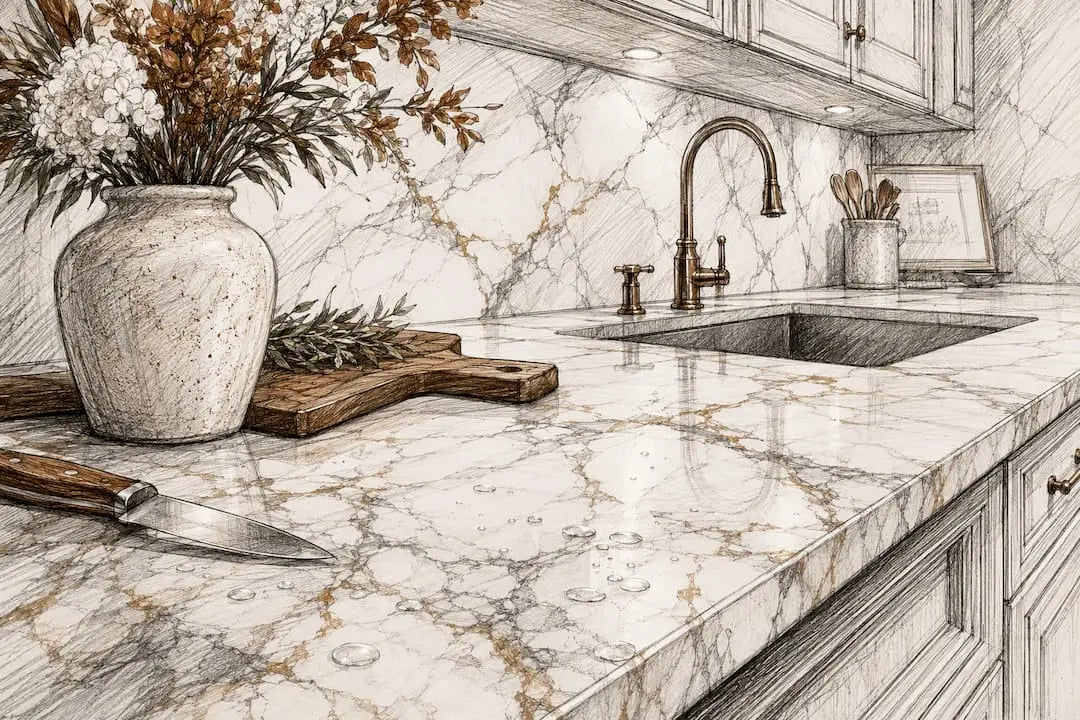
Cream and beige marbles, led by Crema Marfil, bring warmth instead of contrast. This Spanish stone has a soft, uniform beige tone with subtle veining, which makes it a favorite for traditional and transitional floors where you want texture without visual noise.
Grey marbles like Volakas and Bianco Dolomiti fit modern, minimalist schemes. Volakas has a whiter base with fine grey veining; Bianco Dolomiti leans cooler and more uniform. Both work well as a quieter alternative to Calacatta when a client wants texture but not a showpiece.
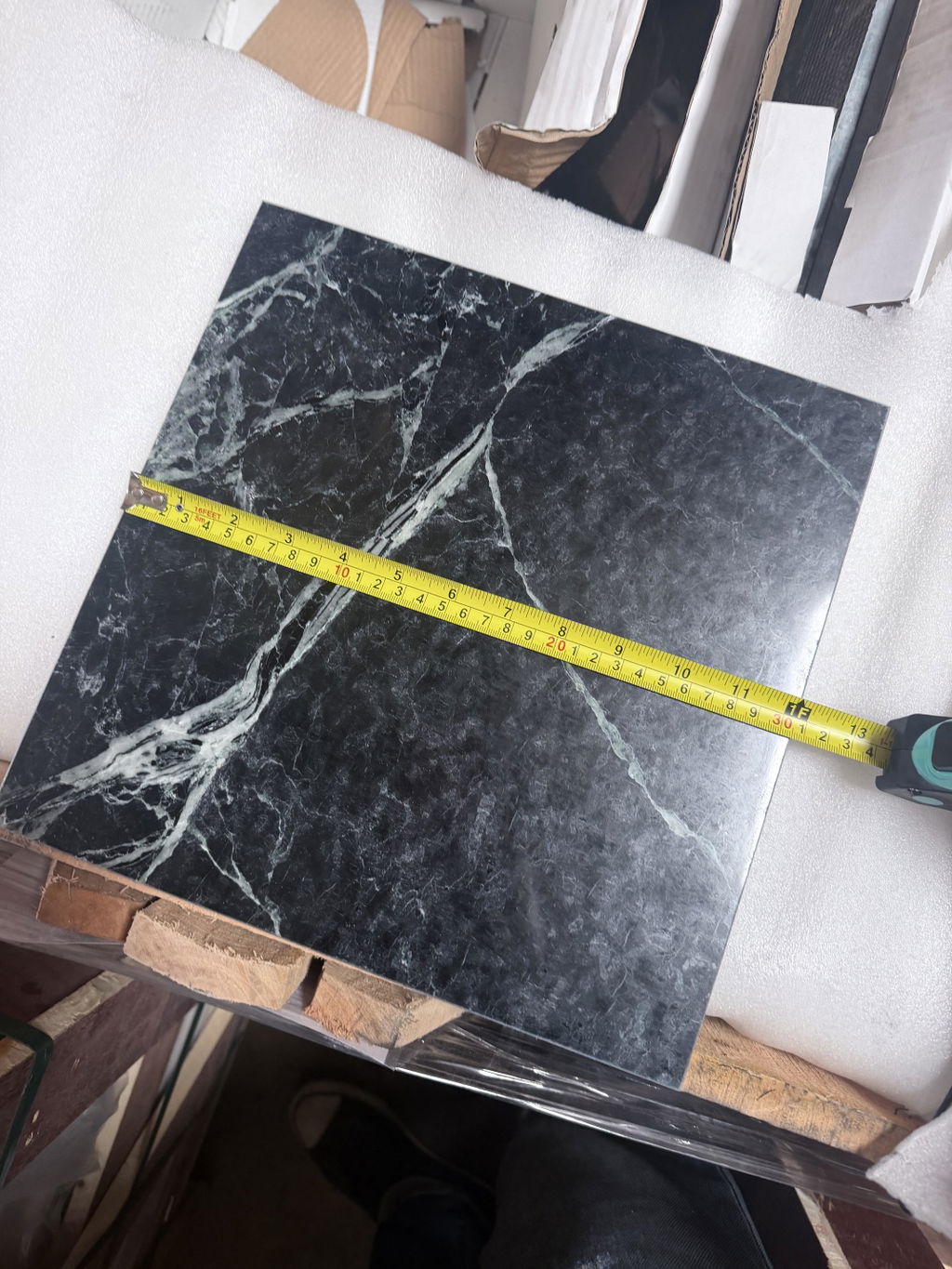
Black marble, and Nero Marquina specifically, is the one stone that reads as pure drama. Its jet black background with crisp white veining makes it a natural choice for accent walls, powder room vanities, or bookmatched panels where the pattern needs to mirror across a seam.
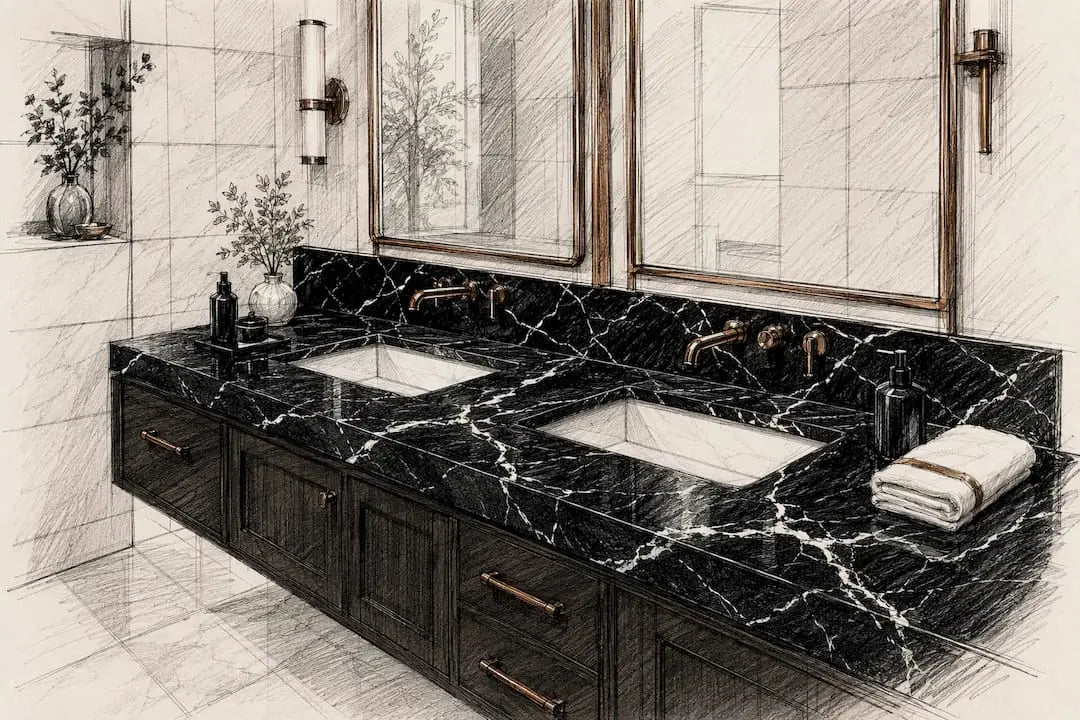
Brown marble, mainly Emperador in its light and dark variants, gives you a classic, richer alternative to beige. Dark Emperador with its network of fine veins photographs beautifully honed, especially on floors where a matte finish softens foot traffic wear.
Green, red, blue, and yellow marbles are rarer and mostly reserved for accent moments: a mosaic medallion, a fireplace surround, a bar top. Green marbles (often serpentine-rich stones traded as marble) and red marbles carry strong mineral coloring that clashes with too many other materials in a room, so pair them with neutral cabinetry and simple stone trim rather than competing patterns.
Pro Tip: If you’re mixing two marble colors in one space, keep one of them Carrara or Crema Marfil. Their neutral backgrounds act as a visual buffer so bolder stones like Nero Marquina or Calacatta don’t fight each other.
Notable Named Marbles and Their Quarry Origins
Color tells you what a marble looks like. The name tells you where it’s from, and that history often explains the price tag.
- Carrara, Calacatta, and Statuario all come from the Apuan Alps in Tuscany, Italy, but from different veins within the same mountain range. That geographic closeness is exactly why they look related but not identical.
- Nero Marquina originates in the Basque Country of Spain, where the calcite deposits formed with unusually high carbon content, producing that near-black background.
- Crema Marfil is quarried in the Alicante region of Spain and remains one of the most widely used marbles for flooring worldwide, thanks to its consistent tone.
- Makrana, from Rajasthan, India, is the marble the Taj Mahal was built from, and it’s still prized for its durability and fine white grain.
- Pentelic and Parian marbles are Greek, tied to ancient sculpture and architecture; Pentelic comes from Mount Penteli near Athens, Parian from the island of Paros. Both appear in historically famous sculpting and building stone references and occasionally in restoration projects today.
- Yule marble, from Colorado, is the source of the Lincoln Memorial and the Tomb of the Unknown Soldier, and it remains a domestic option for buyers who want provenance without importing.
These names carry weight partly because certain varieties are frequently requested for their unique veining and historical associations, and partly because supply from a specific quarry is finite.
Scientific Marble vs. Commercial Marble: What Suppliers Mean
Geologists define marble narrowly: a metamorphic rock formed when limestone recrystallizes under heat and pressure, made mostly of calcite or dolomite. The stone trade doesn’t always follow that definition. Some limestones and other polishable stones get sold as “marble” simply because they perform and polish the same way true marble does, even though they never went through metamorphism.
That gap matters when you’re comparing quotes, because grading language like Premium, Commercial, and Economy isn’t standardized across suppliers. One importer’s “Premium” might be another’s “Select.” Grading labels generally describe visual consistency and how suitable a slab is for a focal surface versus a hidden one, not a universal quality scale.
Grading exists as an expectations tool, not a certification. Premium slabs promise consistency; Commercial grades intentionally allow more vein and color variation; Economy grades lean rustic on purpose.
There’s no global standardized grading body for natural stone, so the most reliable control for a large order is requesting slab-run photos or attending a slab selection in person. Ordering extra material also protects against inconsistency across shipments, since dye lots and quarry runs shift over time. Surfacesgalore, as a direct importer based in Anaheim, California shipping nationwide, works through exactly this kind of batch verification with designers and contractors before material leaves the warehouse. For a deeper look at how grading terminology maps to real slabs, see this breakdown of marble classifications for architects.
How to Choose the Right Marble for Your Project
Picking a marble isn’t just about color. Finish, layout, and budget decide whether the material performs the way you expect once it’s installed.
- Match the finish to the wear. Polished marble shows the deepest color and sharpest veining but reveals etch marks fastest. Honed marble has a matte surface that hides light scratching and etching, making it the safer bet for kitchen floors and countertops. Leathered finishes add texture and camouflage fingerprints, which works well on islands in busy households.
- Reserve Premium grade for focal surfaces. An island, a shower feature wall, or a fireplace surround deserves the most consistent slab you can afford. Designers commonly assign premium or select slabs to highly visible surfaces and commercial-grade material to less visible ones, which stretches a budget without sacrificing the areas guests actually notice.
- Plan bookmatching before you order. Large focal areas benefit from slabs cut and mirrored from the same block, so the veining flows across a seam instead of clashing. Ask for full-slab photos before fabrication starts, not after.
- Expect price to track scarcity, not just beauty. Calacatta, Statuario, and Nero Marquina rank among the world’s costliest marbles largely because of rarity and dramatic veining, not because they’re harder to quarry. If budget is tight, Carrara or Crema Marfil deliver comparable elegance at a lower yield cost.
Pro Tip: Specify your finish choice at the design stage, not at installation. A polished slab and a honed slab from the same quarry can look like two different stones once light hits them.
For application-specific guidance, from kitchen islands to shower niches, the 2026 design guide to marble applications walks through room-by-room recommendations, and choosing marble slabs for high-end impact covers layout planning in more depth.
Maintenance and Durability: What to Expect Over Time
Marble is calcite, which means it reacts to acid. Lemon juice, vinegar, and most bathroom cleaners will etch the surface, leaving a dull mark that shows up faster on polished stone than on honed or leathered finishes. That’s a chemistry fact, not a manufacturing flaw, and it applies to every color and named variety covered above.
- Seal marble on a regular schedule (roughly once or twice a year for countertops, less often for floors) to slow staining.
- Clean with pH-neutral stone cleaners rather than anything acidic or abrasive.
- Wipe up wine, citrus, and coffee spills quickly on kitchen surfaces; they’re the most common source of etch marks.
- Minor chips can be filled by a stone technician; deep etching or scratching usually needs professional resurfacing and repolishing.
- Floors tolerate more wear than countertops, and honed finishes hide daily use better than polished ones in wet areas like showers.
Physical and Chemical Properties That Affect Every Marble Type
Every marble variety shares the same basic mineral chemistry, even when the color and price vary wildly. Marble sits at 3 to 4 on the Mohs hardness scale, softer than granite or quartzite, which is why it scratches more easily under grit, sand, or heavy furniture legs. That softness is also what makes marble easier to carve and polish to a deep shine, which is exactly why sculptors have favored it for centuries.
Porosity is the other defining trait. Marble’s crystalline structure includes microscopic pores that absorb liquids, oils, and pigments if the surface isn’t sealed. Darker marbles like Nero Marquina sometimes hide staining better visually, while pale stones like Statuario or Crema Marfil show it faster. Porosity also varies slab to slab within the same quarry, which is another reason grading exists.
Chemical sensitivity comes down to calcium carbonate content. Because marble is mostly calcite or dolomite, any acidic liquid triggers a reaction that dissolves a microscopic layer of the surface, leaving the dull etch mark mentioned earlier. This isn’t a defect you can engineer away with a better finish; it’s the same chemistry that let ancient builders carve marble with relatively simple tools. Sealers slow moisture and oil absorption but don’t block the acid reaction entirely, which is why quick cleanup still matters more than any sealer on the market.
How Marble Forms: The Geological Story Behind the Stone
Marble starts as limestone, a sedimentary rock built from compressed shells, coral, and marine sediment over millions of years. Heat and pressure inside the earth’s crust, typically from tectonic collisions or proximity to molten rock, recrystallize that limestone’s calcite grains into the interlocking crystal structure that defines true marble.
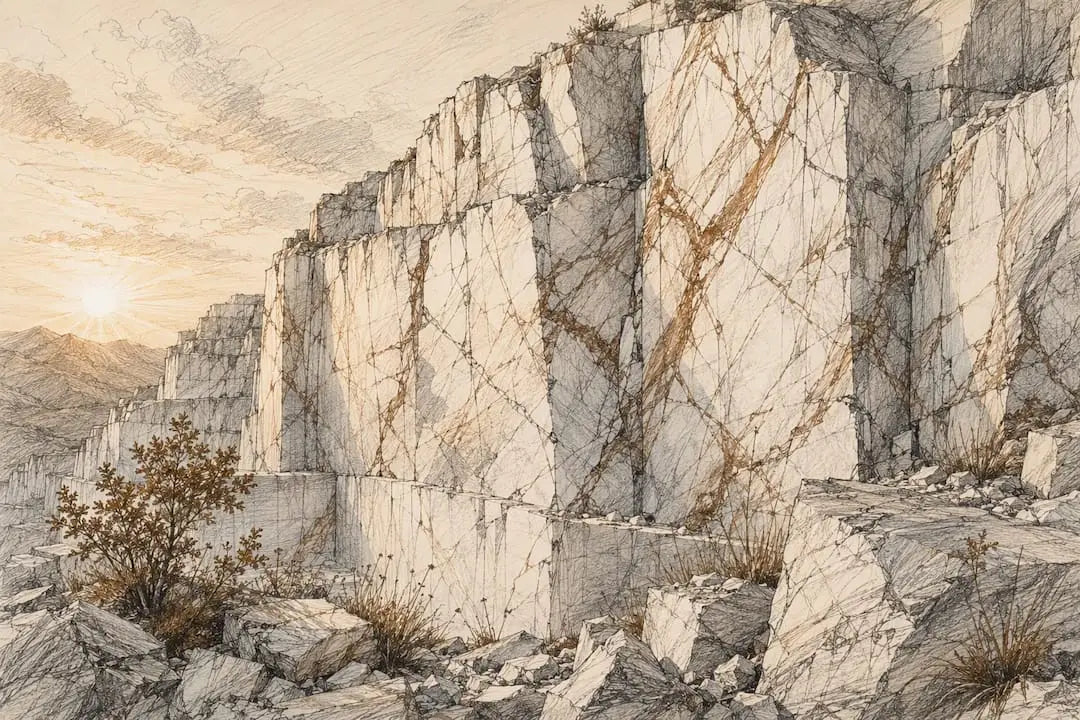
That recrystallization is what erases the original sedimentary layering and fossils, replacing them with the swirling veins buyers recognize. The veins themselves come from mineral impurities present during metamorphism: iron oxides create warm gold and red tones, graphite and carbon produce grey and black streaks, and serpentine minerals introduce green.
Geographic conditions shaped which regions became famous marble sources. Tuscany’s Apuan Alps formed through Mediterranean tectonic activity that metamorphosed ancient marine limestone into the Carrara, Calacatta, and Statuario beds still quarried today. India’s Makrana deposits and Colorado’s Yule quarry formed through separate but geologically similar processes, each shaped by regional heat and pressure over a different span of geologic time.
This formation process is also why marble supply is genuinely finite in a way manufactured surfaces aren’t. A quarry vein that produces a specific pattern, like Calacatta’s bold gold veining, can’t be replicated once it’s exhausted, which is part of why rarer varieties command higher prices.
Marble vs. Granite and Quartzite: Which Stone Fits Which Job
Marble, granite, and quartzite get grouped together in showrooms, but they behave differently once installed. Granite is an igneous rock formed from cooled magma, which makes it harder than marble and far less reactive to acid. That’s why granite remains a common choice for kitchen countertops in households worried about lemon juice and wine stains.
Quartzite sits between the two in some ways but actually outperforms both in hardness. It’s a metamorphic rock like marble, but it forms from sandstone rich in quartz rather than limestone rich in calcite, which gives it much higher scratch and acid resistance while still offering some of marble’s veined, organic look.
Marble wins on one front none of the alternatives touch: nobody mistakes true Calacatta or Statuario for anything else. The depth of veining and the way light plays across polished calcite has no synthetic or alternative-stone equivalent, and it’s the reason marble remains the default for museum lobbies, historic restorations, and any interior meant to read as genuinely luxurious rather than durable-first. If a household wants that look on a heavily used kitchen island, quartzite is worth considering as a harder stand-in; if the surface is a fireplace surround, a feature wall, or a lower-traffic floor, marble’s advantages aren’t offset by anything granite or quartzite offers.
Environmental and Ethical Considerations in Marble Sourcing
Quarrying marble is resource intensive. Cutting stone from a mountainside generates significant waste rock, uses large amounts of water for cutting and polishing, and consumes diesel-powered equipment throughout extraction. Some quarrying regions have faced scrutiny over water table impacts and landscape disruption, particularly in areas with centuries of continuous extraction like the Apuan Alps.
Labor conditions vary widely by country and by quarry operator, and buyers increasingly ask suppliers about sourcing transparency rather than taking a stone’s origin story at face value. Working with an importer who can document a slab’s quarry origin and handling chain gives designers and contractors something concrete to tell clients who ask.
On the positive side, marble’s durability cuts against a purely negative environmental story. A well-maintained marble floor or countertop can last generations, which spreads its environmental cost over a much longer usable life than materials that need replacement every decade. Reclaimed and remnant marble use is also growing, particularly for mosaics, trim, and smaller decorative pieces where a large uniform slab isn’t necessary. Buyers who want to reduce impact further can prioritize suppliers who minimize offcut waste and repurpose smaller pieces into mosaics rather than discarding them.
Care and Restoration Techniques by Marble Type
Different marble types demand slightly different upkeep, mostly based on color and finish rather than the variety name itself. Light stones like Carrara and Crema Marfil show etching and staining more visibly than dark stones like Nero Marquina or Dark Emperador, so pale marble floors and counters benefit from more frequent sealing checks.
Polished finishes across any color need the gentlest cleaning routine, since the reflective surface highlights every scratch and dull spot. Honed and leathered finishes on the same stones tolerate more daily wear before restoration becomes necessary, which is why many kitchens now specify honed marble for islands rather than a high-gloss polish.
Restoration itself typically follows three stages depending on damage severity. Light etching and dullness can often be corrected with a marble polishing powder and a buffing pad, a job some experienced homeowners tackle themselves. Deeper scratches or widespread etching usually require diamond-pad honing done by a stone professional, which removes a thin layer of the surface to reveal fresh, unetched stone underneath. Cracks, chips, or missing pieces call for epoxy or color-matched filler repair, and for antique or historically significant marble, that work should go to a restoration specialist familiar with the specific quarry’s stone characteristics.
Surfacesgalore’s Take: Matching Marble to the Project, Not Just the Trend
As a direct importer shipping marble, limestone, and travertine nationwide from Anaheim, California, Surfacesgalore works with designers and contractors who need more than a pretty slab photo. The right approach starts with the project’s actual use, not the most photogenic option in a showroom.
We typically recommend Premium grade for focal surfaces and reserve Commercial grade for secondary areas where budget matters more than perfect uniformity. Explore our marble collections or request samples before committing to a full order.
Browse Marble Collections and Request Samples From Surfacesgalore
If the color-and-name approach above narrowed down what you’re picturing, the next step is seeing it in person rather than guessing from a screen. Surfacesgalore ships nationwide as a direct importer, which cuts out the markup layers that come with buying through a regional distributor or a big-box design center, and it means the slab you see photographed is closer to the batch you’ll actually receive.
Whether you’re speccing a single kitchen island or sourcing material for a multi-unit commercial build, you can request samples, get bulk and contractor quotes, and browse current inventory at Surfacesgalore’s marble collections. Start with a sample order if you’re still deciding between two or three varieties; it’s the fastest way to see how a stone’s veining and tone actually read in your lighting.
Sources
- Natural Stone Institute - Scientific versus Commercial Definition
- Britannica — Marble (archived)
- List of types of marble - Wikipedia
- Understanding Marble Grades: Commercial vs. Premium vs. Select | Dionyssomarble
FAQ
What is the highest quality marble?
There’s no single “highest quality” marble across the board; quality depends on grade consistency and finish rather than variety name alone. Statuario and Calacatta are widely considered top-tier for their bright, consistent backgrounds and dramatic veining, but a well-graded Carrara slab can outperform a poorly graded Calacatta one.
What is the highest grade of marble?
Most suppliers use a label like Premium or Select for their top grade, meaning the most visually consistent slabs with minimal fissures or color variation. These grading terms aren’t standardized industry-wide, so always confirm what a specific supplier means by their top-tier label.
Which is the most expensive type of marble?
Statuario, Calacatta, and Nero Marquina rank among the most expensive marbles worldwide because of limited quarry supply and dramatic, hard-to-replicate veining patterns.
Is marble a good choice for kitchens and bathrooms?
Marble works well in kitchens and bathrooms when the finish matches the use, honed for countertops and floors, sealed regularly, and cleaned with pH-neutral products to limit etching from acidic spills.
How does marble compare to granite for durability?
Granite is harder and more acid-resistant than marble, making it more forgiving for heavy kitchen use, while marble offers unmatched veining depth for feature surfaces where durability matters less than appearance.

Leave a comment