
Granite vs Marble: 6 vs 3 Mohs and Room by Room Picks for Homeowners

Granite wins for most kitchens that see real daily cooking, spills, and knife work, because it shrugs off heat and scratches better than marble does. Marble earns its place when you want dramatic veining or a naturally cool surface for rolling dough, but it demands more careful upkeep. Choose granite for durability under pressure; choose marble when the look matters more than the maintenance.
TL;DR:
- Granite’s crystalline structure makes it highly resistant to scratches and heat, with a Mohs hardness of 6 to 6.5, suitable for daily kitchen use.
- Marble’s softer calcite composition rates 3 to 4 on the Mohs scale, easily etching from acids and requiring more frequent resealing of every six to twelve months.
- Long-term sealing costs favor granite, which needs resealing every one to three years, versus marble’s frequent resealing, increasing maintenance expenses.
- Granite performs better outdoors and in high-traffic areas due to its weather resistance and durability against grit and foot traffic.
- For a low-maintenance kitchen, granite is generally safer, while marble’s aesthetic appeal can justify its higher upkeep in low-traffic or display-focused spaces.
Table of Contents
- What Is the Real Difference Between Granite and Marble?
- Granite vs. Marble Countertops: Key Differences at a Glance
- Where Should You Use Granite vs. Marble in Your Home?
- How Do You Choose Between Granite and Marble?
- Surfacesgalore’s Approach to Fabrication and Sealing
- A Practical Take on Matching Stone to Lifestyle
- Find the Right Natural Stone for Your Project
- Sources
- FAQ
What Is the Real Difference Between Granite and Marble?
The difference between granite and marble starts underground, long before either reaches a fabrication shop. Granite forms when magma cools slowly beneath the Earth’s crust, locking quartz, feldspar, and mica into a dense, interlocking structure. Marble forms differently: limestone or dolomite gets baked and compressed over time until it recrystallizes into the veined stone you see in kitchens and bathrooms.
That geological split explains nearly every practical distinction homeowners care about. Granite’s crystalline structure makes it one of the harder natural stones used in countertops, while marble’s calcite composition makes it softer and more reactive to acids. Understanding granite characteristics and marble characteristics at this level, not just their surface appearance, is what actually helps you pick correctly for a kitchen, bathroom, or floor.
Granite: Composition and What It Means for Durability
Granite’s density comes from three main minerals locked together under pressure:
- Quartz gives granite most of its hardness and resistance to everyday scratching.
- Feldspar contributes the base color and the crystalline sparkle you notice under kitchen lighting.
- Mica adds subtle shine and some of the darker fleck patterns seen in granular slabs.
Granite typically rates 6 to 6.5 on the Mohs hardness scale, which puts it well above a standard kitchen knife (around 5.5) and most cookware. That’s why cutting directly on granite rarely leaves a mark, even though nobody at Surfacesgalore recommends it as a habit. The granular, speckled pattern and wide color range, from near-black to warm gold, come from the mineral mix rather than added pigment. Granite also handles heat well enough to tolerate a hot pan set down briefly, and it holds up outdoors better than most stone options. Sealing every one to three years keeps it stain-resistant, and because granite is harder to cut and fabricate, skilled installation matters more than it does with softer stones.
Marble: Composition and the Aesthetic Tradeoffs
Marble’s story starts as limestone, which recrystallizes into calcite-rich stone under geologic heat and pressure. That process is also why marble reacts to a simple acid test: a drop of vinegar will fizz on true marble, a quick way geologists confirm what they’re looking at.
- Marble scores low on the Mohs scale, roughly half the hardness compared to granite.
- Acid from lemon juice, wine, or vinegar causes etching, a dull mark that’s different from staining and can’t be fixed with a sealer.
- Veining and translucency, the qualities that make marble look almost alive under light, come from mineral impurities trapped during formation.
- Kitchen marble often needs resealing every six to twelve months, roughly twice as often as granite.
Designers frequently choose marble for reasons that have nothing to do with performance. The veining, the way light passes through thin edges, and the historical weight of the material carry real value on their own, separate from how the stone holds up to a knife.
Granite vs. Marble Countertops: Key Differences at a Glance
Numbers make this comparison concrete faster than adjectives do. Granite runs 6 to 6.5 on the Mohs scale; marble sits at 3 to 4. That two-to-three-point gap is the difference between a countertop that survives a dropped cast-iron skillet and one that might chip.
The core distinction isn’t hardness alone. It’s how each stone fails. Granite resists scratching but can still stain if sealant wears thin. Marble resists staining reasonably well when properly sealed, but etches from any acidic splash, a fundamentally different kind of damage that no sealer prevents.
| Factor | Granite | Marble |
|---|---|---|
| Formation | Igneous, cooled magma | Metamorphic, recrystallized limestone |
| Hardness (Mohs) | 6 to 6.5 | 3 to 4 |
| Stain resistance | Good when sealed | Moderate when sealed |
| Acid/etch resistance | High | Low, etches easily |
| Heat resistance | High, tolerates brief direct heat | Moderate, avoid direct heat |
| Sealing frequency | Every 1 to 3 years | Every six to twelve months |
| Installed cost range | Budget to mid-premium | Mid to high-premium |
Granite’s annual maintenance cost runs substantially lower than marble’s over the life of a countertop, largely because of that sealing gap. A granite counter resealed every other year needs maybe a dozen treatments over 25 years. A kitchen marble island resealed twice a year could see 40 or more treatments in that span, each one adding to the real lifetime cost even if the upfront slab price looked similar.
Installed granite and marble countertops both span a wide range depending on stone grade, edge profile, and region, with premium marble slabs (think bold veining or rare quarries) commanding the highest end of that range. Budget-tier granite often lands close to entry marble, so the sealing and care difference, not the sticker price, usually decides the long-term cost comparison.
Where Should You Use Granite vs. Marble in Your Home?
Matching the stone to the room matters more than picking a “winner” between granite and marble countertops overall.
- Kitchen perimeter counters and cooktop zones: granite is the safer call here. Its heat and scratch resistance handle hot pans, knife slips, and daily abuse without babying required.
- Baking centers and kitchen islands: marble’s naturally cool surface is genuinely useful for rolling pastry and pizza dough, and many bakers consider that worth the extra sealing.
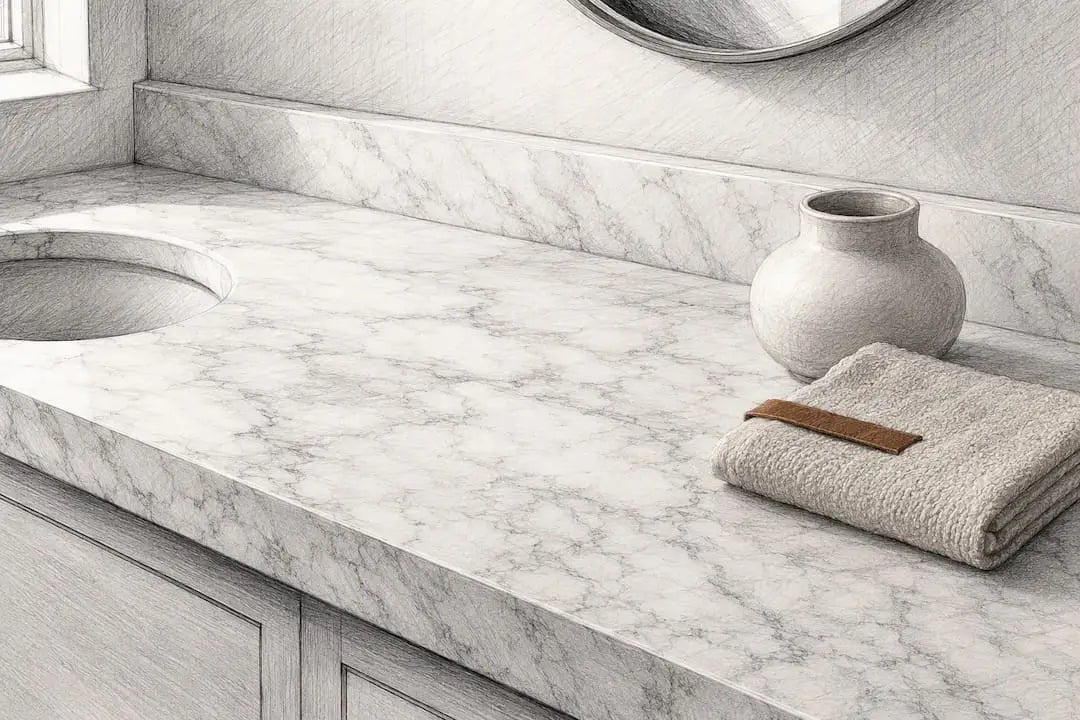
- Bathroom vanities: marble shines here since acidic splashes are rare and the visual payoff, especially in a low-traffic space, is significant.
- Flooring: both work, but granite tolerates grit and foot traffic in busy hallways better; marble flooring suits formal entryways or low-abrasion areas.
- Outdoor kitchens and patios: granite is the practical choice, since marble is more vulnerable to weathering and thermal shock outdoors.
A hybrid layout works well in practice: granite on the perimeter where knives and pots do the damage, marble on an island or backsplash where it’s mostly seen, not abused. Edge profile matters too. A bullnose or eased edge on marble reduces chipping risk at corners, and tight, well-matched seams keep both stones looking like a single slab rather than a patchwork.
Pro Tip: If you love marble but worry about upkeep, ask your fabricator about a honed (matte) finish instead of polished. Honed marble hides etch marks far better because it doesn’t rely on a glossy sheen that shows every dull spot.
How Do You Choose Between Granite and Marble?
Start with how you actually use your kitchen, not how a showroom slab looks under gallery lighting.
- Ask yourself how often you cook with citrus, wine, or vinegar-based marinades. Frequent acidic cooking pushes the decision toward granite.
- Set a realistic sealing budget. If resealing every six months isn’t happening, marble will show wear faster than it should.
- Decide whether the room is high-traffic (kitchen, mudroom) or low-traffic (powder room, formal dining).
- Weigh installed cost against the specific look you want. A rare marble vein can justify a premium; a standard granite pattern often can’t compete visually at any price.
When you meet with a fabricator, ask direct questions: How will slabs be matched for veining continuity? What sealing product do they recommend and how long does the warranty run? Which edge profile do they suggest for your traffic level? Watch for red flags too, like dry, poorly matched seams, evidence of heavy resin repairs on a “natural” slab, or vague, unitemized pricing that hides fabrication costs.
If low upkeep matters most, granite wins by default. If you’re set on marble’s look, plan for the sealing schedule from day one rather than treating it as optional.
Surfacesgalore’s Approach to Fabrication and Sealing
Surfacesgalore works as a direct importer of marble, limestone, and travertine, which means fewer markups between quarry and homeowner and more control over slab quality before it ever reaches a fabricator.
- Sealer performance depends heavily on dwell time. Applying sealant and wiping it off too quickly cuts protection significantly, a mistake even experienced installers rush through.
- Marble and limestone benefit from professional application on the first seal, since uneven coverage shows up fast on a light, veined surface.
- Fabrication and installation quality, especially seam matching and edge work, affects how well any stone tolerates daily wear.
- Sample requests and slab viewing are available before you commit, which matters more with marble since veining varies slab to slab.
Homeowners weighing marble versus granite for a full renovation can shop natural stone tiles today with a clearer sense of what each material actually demands over its lifetime.
A Practical Take on Matching Stone to Lifestyle
Most of the granite-versus-marble debate collapses once you’re honest about how you actually live in your kitchen. A family that cooks daily with citrus and cast iron will fight marble’s etching forever; that’s not a maintenance failure, it’s a mismatch. A homeowner who bakes often, entertains in a formal dining room, or simply wants the visual weight marble carries will find the sealing routine a fair trade for the look. Neither stone is objectively “better.” Browse Surfacesgalore’s marble collections or request samples before deciding. You’ll feel the weight and see the veining in person, which no photo captures accurately.
— cihan
Find the Right Natural Stone for Your Project
Surfacesgalore is the direct route to authentic marble, limestone, and travertine without the markup that comes from buying through multiple middlemen. As a direct importer based in Anaheim, California, shipping nationwide, Surfacesgalore gives homeowners, designers, and contractors access to the same slab quality and selection that trade professionals rely on, plus custom cuts, mosaics, and decorative trim for the details a standard countertop order won’t cover.

If the room-by-room advice above pointed you toward marble for an island or vanity, or granite for a hard-working kitchen perimeter, the next step is seeing the actual slab. Surfacesgalore offers sample options and bulk quotes for larger projects, so you can compare veining, color, and finish before committing. Explore the full natural stone selection and request samples or a custom quote for your next project.
Sources
- Granite vs Marble Countertops 2026 | SlabWise
- Marble | All About Geology
- Geology
- Marble vs Granite Countertops: Care & Restoration | Rose Restoration
FAQ
Is Granite or Marble Better for Kitchen Countertops?
Granite is the more practical choice for busy kitchens because it resists scratching and heat better, while marble suits kitchens where the look matters more than daily wear resistance.
What Is the Main Difference Between Granite and Marble?
Granite is igneous rock formed from cooled magma and rates 6 to 6.5 on the Mohs hardness scale; marble is metamorphic rock formed from recrystallized limestone and rates only 3 to 4, making it softer and more prone to etching.
Does Marble Stain More Than Granite?
Marble stains and etches more easily than granite because it’s softer and reacts to acids; sealing helps with staining but does not prevent etching from lemon juice, wine, or vinegar.
How Often Do Granite and Marble Need to Be Sealed?
Granite typically needs resealing every one to three years, while marble in kitchen use often needs resealing every six to twelve months.
Can You Use Marble Outdoors Like Granite?
Granite handles outdoor use well because of its heat and weather resistance, while marble is more vulnerable to thermal shock and weathering, making it a less reliable outdoor choice.

Leave a comment